Peru Acoustic Guitar Market Top 5 Importing Countries and Market Competition (HHI) Analysis
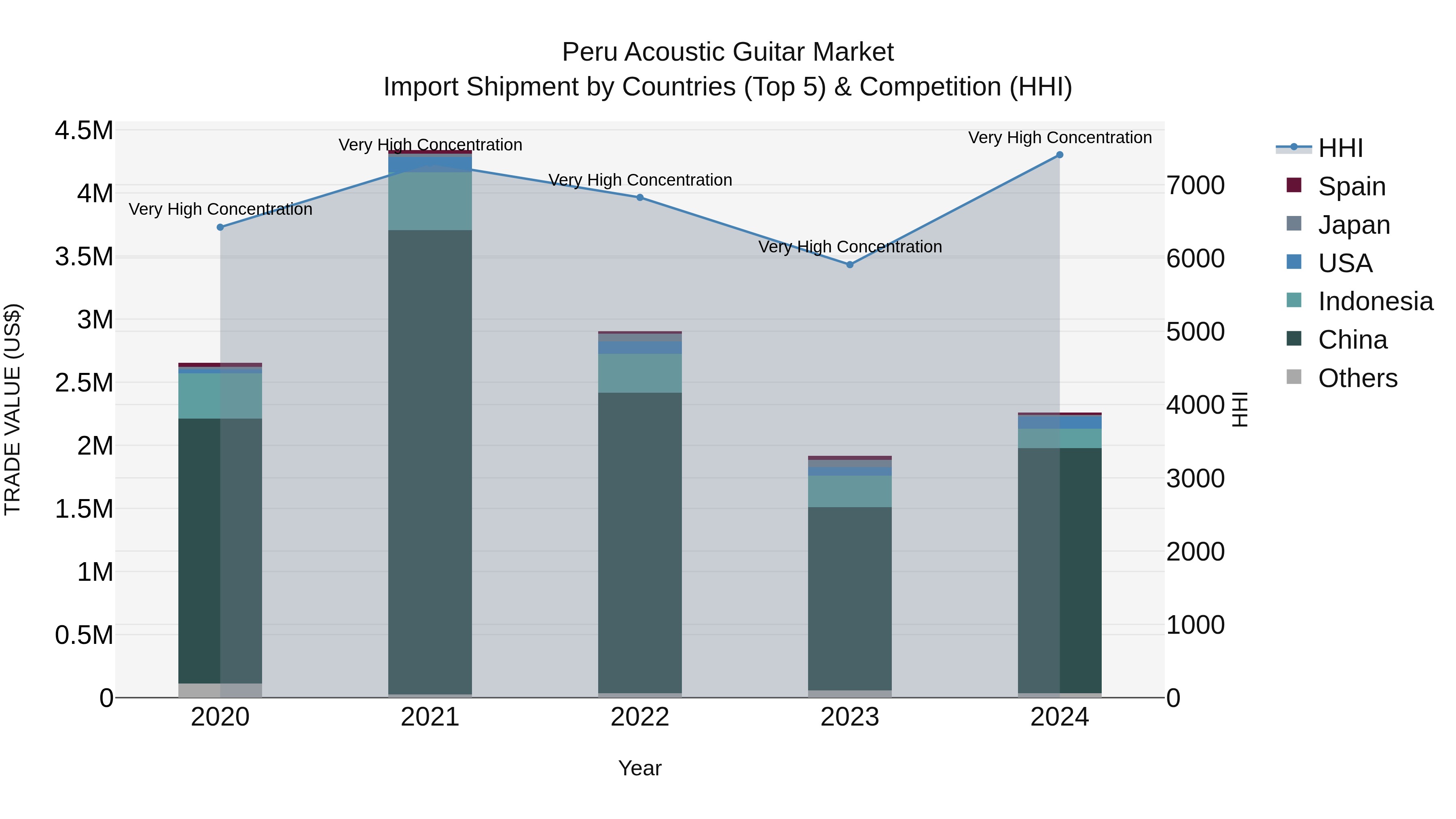
Peru continues to be a key destination for acoustic guitar imports, with top suppliers like China, Indonesia, and the USA dominating the market. Despite a challenging CAGR from 2020 to 2024, the industry saw a significant growth spurt in 2024, indicating a potential turnaround. The high concentration of market share among a few key players, as reflected by the high HHI, underscores the competitive landscape within the acoustic guitar import market in Peru. Monitoring these trends can provide valuable insights for stakeholders looking to navigate this dynamic industry.
Topics Covered in the Peru Acoustic Guitar Market
Peru Acoustic Guitar Market report thoroughly covers the market by product and by application. The market outlook report provides an unbiased and detailed analysis of the ongoing market trends, opportunities/high growth areas, and market drivers which would help the stakeholders to devise and align their market strategies according to the current and future market dynamics.
Peru Acoustic Guitar Market Synopsis
Peru acoustic guitar market is estimated to gain traction due to the demand for Peruvian guitars has risen sharply in recent years, as both renowned and burgeoning artists have begun incorporating the unique timbre and beauty of Peruvian guitars into their music. The challenges that come along with this industry are not to be ignored, but the country's artisans and manufacturers are slowly adapting innovative strategies to address these roadblocks.
According to 6Wresearch, the Peru Acoustic Guitar Market size is anticipated to reach at a CAGR of 3.9% during the forecast period 2025-2031. The historic and cultural significance of music in Peru, combined with its exceptional craftsmanship and timber resources, have helped to drive the growth of the market. Additionally, the government has helped carve out a space for the local guitar-making industry by providing support and subsidies for artisans and promoting the export of these unique instruments. Unlike these drivers, the Peru Acoustic Guitar industry is facing several challenges such as highly labour-intensive process, requiring skilled artisans and ample time—each guitar can take up to several weeks to complete. Additionally, the emergence of low-cost replicas of Peruvian guitars in the global market poses a challenge to the market's growth. Nevertheless, the rise of e-commerce has served as a boon to the Peru Acoustic Guitar Market, with online marketplaces providing a global platform for local artisans to showcase their products and attract an international customer base. Moreover, the emergence of sustainable and eco-friendly guitars is becoming increasingly popular in the global market, and this trend can be leveraged by Peruvian artisans who are already using local woods that are both sustainable and offer unique sound qualities.
Government Initiatives Introduced in the Peru Acoustic Guitar Market
The Peruvian government has been promoting the guitar-making industry by providing support, and representation in global trade markets. The Ministry of Culture has initiated several policies and programes to promote artistic and cultural expressions of Peru's eight regions, including support to emerging and established guitarists and guitar making workshops. Similarly, the Ministry of Foreign Trade and Tourism is promoting trade missions and importing delegations for Peruvian businesses, including musical instrument manufacturers, who can showcase their products on a global stage.
Key Players in the Peru Acoustic Guitar Market
Peru is home to several notable guitar manufacturers, known for producing quality instruments that are highly sought after in the market. Some of the well knowns include La Bella, Urquellas, Ayacucho, Nazca, Machu Picchu, and Cusco, among others. Their unique blend of traditional methods, craftsmanship skills, and innovation has made Peruvian guitars increasingly popular among musicians worldwide.
Market Analysis by Product
According to Dhaval, Research Manager, 6Wresearch, steel stringed guitars are taking lead over the Peru acoustic guitar market for several reasons. Due to they produce a brighter sound, are more durable, more affordable, versatile, and readily available.
Market Analysis by Application
Based on the application, teaching is the fastest-growing segment dominating the Peru's acoustic guitar market share. With more people interested in learning to play guitar, the demand for affordable and entry-level acoustic guitars is increasing.
Key attractiveness of the report
- 10 Years Market Numbers.
- Historical Data Starting from 2021 to 2024.
- Base Year: 2024.
- Forecast Data until 2031.
- Key Performance Indicators Impacting the Market.
- Major Upcoming Developments and Projects.
Key Highlights of the Report:
- Peru Acoustic Guitar Market Outlook
- Market Size of Peru Acoustic Guitar Market, 2024
- Forecast of Peru Acoustic Guitar Market, 2031
- Historical Data and Forecast of Peru Acoustic Guitar Revenues & Volume for the Period 2021 - 2031
- Peru Acoustic Guitar Market Trend Evolution
- Peru Acoustic Guitar Market Drivers and Challenges
- Peru Acoustic Guitar Price Trends
- Peru Acoustic Guitar Porter's Five Forces
- Peru Acoustic Guitar Industry Life Cycle
- Historical Data and Forecast of Peru Acoustic Guitar Market Revenues & Volume By Product for the Period 2021 - 2031
- Historical Data and Forecast of Peru Acoustic Guitar Market Revenues & Volume By Nylon/gut Stringed Guitars for the Period 2021 - 2031
- Historical Data and Forecast of Peru Acoustic Guitar Market Revenues & Volume By Steel Stringed Guitars for the Period 2021 - 2031
- Historical Data and Forecast of Peru Acoustic Guitar Market Revenues & Volume By Other for the Period 2021 - 2031
- Historical Data and Forecast of Peru Acoustic Guitar Market Revenues & Volume By Application for the Period 2021 - 2031
- Historical Data and Forecast of Peru Acoustic Guitar Market Revenues & Volume By Perform for the Period 2021 - 2031
- Historical Data and Forecast of Peru Acoustic Guitar Market Revenues & Volume By Teaching for the Period 2021 - 2031
- Historical Data and Forecast of Peru Acoustic Guitar Market Revenues & Volume By Other for the Period 2021 - 2031
- Peru Acoustic Guitar Import Export Trade Statistics
- Market Opportunity Assessment By Product
- Market Opportunity Assessment By Application
- Peru Acoustic Guitar Top Companies Market Share
- Peru Acoustic Guitar Competitive Benchmarking By Technical and Operational Parameters
- Peru Acoustic Guitar Company Profiles
- Peru Acoustic Guitar Key Strategic Recommendations
Market Covered
The report offers a comprehensive study of the subsequent market segments:
By Product
- Nylon/Gut Stringed Guitars
- Steel Stringed Guitars
- Other
By Application
- Perform
- Teaching
- Other






































