Peru Cement Market Growth Rate Analysis (2025 - 2031)
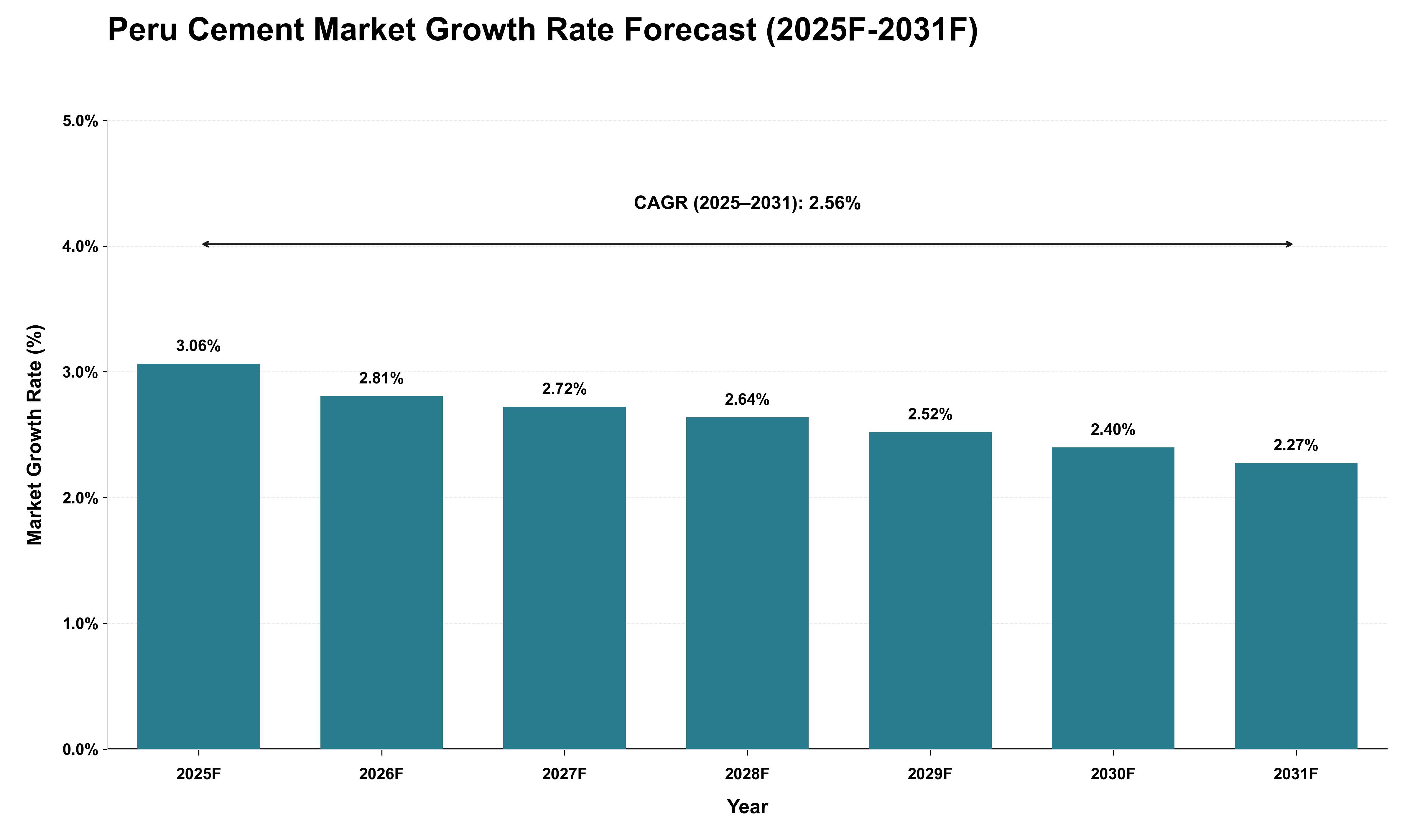
The forecast period for the Peru cement market will reflect a gradual deceleration in growth, driven by macroeconomic cycles and evolving demand dynamics. With a projected CAGR of 2.56%, the annual growth rates will exhibit a downward trend from 3.06% in 2025 to 2.27% by 2031, indicating a shift in consumption patterns influenced by infrastructure investments and housing developments. As urbanization continues, demand for cement will remain robust initially; however, external factors such as import dependencies on raw materials and fluctuations in global commodity prices may exert pressure on production costs and pricing strategies. Additionally, cyclical trends associated with economic recovery phases will likely impact construction activity, leading to variations in cement consumption rates. Overall, while the sector is poised for steady growth, it will navigate challenges that could temper expansion as the forecast horizon progresses.
Key Highlights of the Report:
- Peru Cement Market Outlook
- Market Size of Peru Cement Market, 2024
- Forecast of Peru Cement Market, 2031
- Historical Data and Forecast of Peru Cement Revenues & Volume for the Period 2021 - 2031
- Peru Cement Market Trend Evolution
- Peru Cement Market Drivers and Challenges
- Peru Cement Price Trends
- Peru Cement Porter's Five Forces
- Peru Cement Industry Life Cycle
- Historical Data and Forecast of Peru Cement Market Revenues & Volume By Product for the Period 2021 - 2031
- Historical Data and Forecast of Peru Cement Market Revenues & Volume By Portland for the Period 2021 - 2031
- Historical Data and Forecast of Peru Cement Market Revenues & Volume By Others for the Period 2021 - 2031
- Historical Data and Forecast of Peru Cement Market Revenues & Volume By Application for the Period 2021 - 2031
- Historical Data and Forecast of Peru Cement Market Revenues & Volume By Residential for the Period 2021 - 2031
- Historical Data and Forecast of Peru Cement Market Revenues & Volume By Non-residential/Infrastructure for the Period 2021 - 2031
- Peru Cement Import Export Trade Statistics
- Market Opportunity Assessment By Product
- Market Opportunity Assessment By Application
- Peru Cement Top Companies Market Share
- Peru Cement Competitive Benchmarking By Technical and Operational Parameters
- Peru Cement Company Profiles
- Peru Cement Key Strategic Recommendations






































