Peru Fruit and Vegetable Processing Market Size, Share & Growth Rate
The Peru Fruit and Vegetable Processing Market was estimated at USD 297 Million in 2025 and is projected to reach USD 407 Million by 2032, growing at a CAGR of 4.6% from 2026 to 2032. This upward trajectory is driven by the increasing domestic and international demand for processed foods, particularly as consumer preferences shift towards convenience and health-oriented options. Furthermore, technological advancements and heightened food safety standards are enhancing production capabilities, fostering the industry's growth.
Peru Fruit and Vegetable Processing Market Year-wise Growth Rate and Key Drivers
This graph highlights how the Peru Fruit and Vegetable Processing Market has steadily grown over the years, supported by major growth factors.
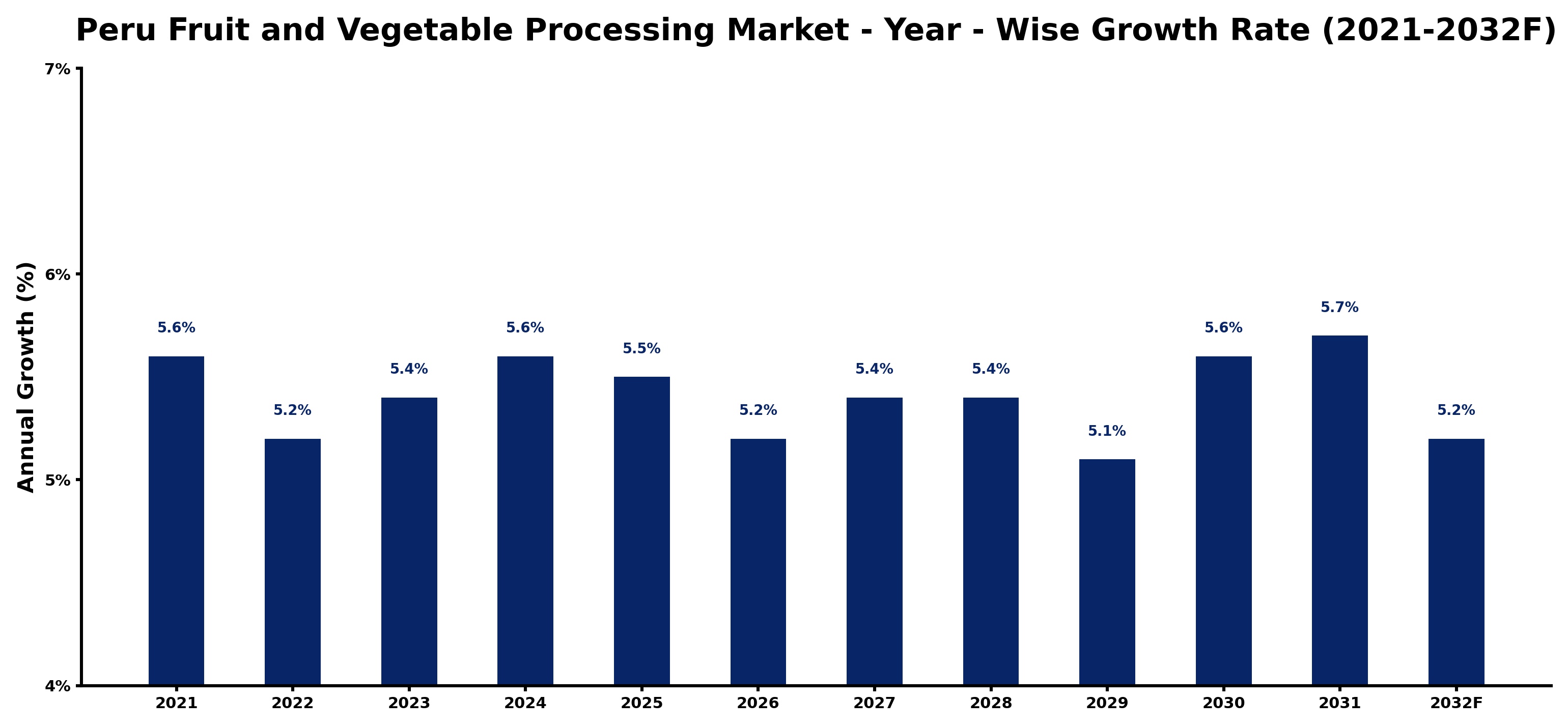
The table below presents the year‑wise growth rates along with the key drivers influencing the market
| Year | Growth Rate | Major Drivers |
| 2021 | 5.6% | Increased demand for organic produce |
| 2022 | 5.2% | Export opportunities expanded significantly |
| 2023 | 5.4% | Technological advancements improved efficiency |
| 2024 | 5.6% | Consumer preference shifted towards convenience |
| 2025 | 5.5% | Sustainable packaging adoption increased |
| 2026 | 5.2% | Local sourcing gained popularity rapidly |
| 2027 | 5.4% | Health awareness drove product innovation |
| 2028 | 5.4% | E-commerce platforms enhanced market reach |
| 2029 | 5.1% | Collaboration with local farmers strengthened |
| 2030 | 5.6% | Investment in processing facilities grew |
| 2031 | 5.7% | New product lines attracted consumers |
| 2032 | 5.2% | Nutritional awareness influenced purchasing decisions |
Note - Market size estimations and growth projections presented in this report are based on 6Wresearch's advanced forecasting approach, validated with industry datasets as of June 2026.
Peru Fruit and Vegetable Processing Market Synopsis
Peru's abundant agricultural output, including a wide variety of exotic fruits and vegetables, serves as a cornerstone for its processing industry. With products ranging from frozen items to purees and dried snacks, the market is uniquely positioned to leverage the country's diverse produce for both local consumption and export.
In recent years, the trend towards organic and natural food products has surged, prompting processors to innovate continuously. Companies are increasingly focusing on sustainability and environmentally friendly practices, reflecting changing consumer values and enhancing their market positions.
Peru Fruit and Vegetable Processing Market Key Takeaways
- The market is benefiting from a growing preference for healthy and convenient food options among consumers.
- Investments in technology and infrastructure are critical for enhancing efficiency and quality in processing operations.
- The government supports the sector with initiatives aimed at promoting agro-industrial development and increasing exports.
- Emerging trends include a rising interest in organic products and innovative processing techniques that maintain nutritional value.
- Challenges such as limited access to modern technology and fluctuations in raw material prices continue to pose hurdles for growth.
Evaluation of Restraints in Peru Fruit and Vegetable Processing Market
The Peru Fruit and Vegetable Processing Market encounters several restraints that hinder its potential. A significant challenge is the limited access to advanced technology and modern processing equipment, which restricts operational efficiency. Additionally, volatility in raw material prices can adversely affect production costs, impacting profitability. Logistics and infrastructure issues, particularly in rural areas, further complicate the timely delivery of perishable goods. Lastly, the necessity for compliance with stringent food safety and quality standards requires ongoing investment from processing companies, which can strain resources.
Peru Fruit and Vegetable Processing Market Trends
The landscape of the Peru Fruit and Vegetable Processing Market is shaped by various trends that reflect evolving consumer preferences. There is a marked shift towards organic and sustainably sourced products, with consumers seeking transparency in supply chains. Companies are also investing in innovative processing techniques that focus on retaining the natural flavor and nutrients of produce, catering to health-conscious buyers. Furthermore, product diversification is gaining traction, with processors launching unique fruit and vegetable-based offerings that resonate with contemporary consumer tastes.
Peru Fruit and Vegetable Processing Market Opportunities
The market presents significant investment opportunities, particularly in the establishment of modern processing facilities that can capitalize on Peru's high-quality agricultural output. Potential areas for growth include value-added products such as dried fruits and frozen vegetables, which are gaining popularity in both domestic and international markets. Collaborating with local farmers to ensure a reliable supply chain can further enhance investment success, allowing companies to maintain consistent quality while meeting burgeoning demand.
Government Initiatives in the Peru Fruit and Vegetable Processing Market
The Peruvian government has rolled out several supportive measures to bolster the fruit and vegetable processing industry. These initiatives include tax incentives for processing facility investments, subsidies for equipment acquisitions, and technical assistance programs aimed at enhancing processing efficiencies. Additionally, the establishment of rigorous quality standards ensures that both domestic and export products meet safety benchmarks, fostering a competitive environment that encourages innovation and growth within the sector.
Future Insights of the Peru Fruit and Vegetable Processing Market
Looking ahead to 2026-2032, the Peru Fruit and Vegetable Processing Market is set to thrive, propelled by a blend of rising health awareness and increased disposable incomes. Consumers are expected to demand more processed options that combine convenience with quality, thereby driving market expansion. Technological advancements in both processing and packaging will play a pivotal role in enhancing product longevity and quality, positioning Peru to solidify its status as a key player in the global fruit and vegetable processing arena.
Peru Fruit and Vegetable Processing Market Latest Developments (May 2025 - June 2026)
The industry has seen a focus on enhancing processing capabilities through investments in technology aimed at improving product quality and safety. Companies are also exploring new export markets, leveraging Peru's unique produce to meet diverse consumer tastes. Concurrently, there is a growing emphasis on sustainability practices among processors, as more businesses recognize the importance of environmental stewardship in their operations.
Peru Fruit and Vegetable Processing Market - Key Attractiveness of the Report
- 10 Years of Market Numbers
- Historical Data Starting from 2022 to 2025
- Base Year: 2025
- Forecast Data until 2032
- Key Performance Indicators Impacting the Market
- Major Upcoming Developments and Projects
The market was estimated at USD 297 Million in 2025 and is projected to reach USD 407 Million by 2032, growing at a CAGR of 4.6% from 2026 to 2032.
Consumer trends increasingly lean toward health and convenience, prompting processors to focus on organic offerings and innovative products that meet these evolving demands.
Processors must navigate stringent food safety regulations and invest in quality monitoring systems to comply with both domestic and international standards, which can present financial and operational challenges.
Government initiatives provide tax incentives and technical support, facilitating investments in processing facilities and promoting the overall growth of the industry.
Products such as frozen fruits, vegetable purees, and organic juices are at the forefront, appealing to health-conscious consumers both locally and internationally.
Key Highlights of the Report:
- Peru Fruit and Vegetable Processing Market Outlook
- Market Size of Peru Fruit and Vegetable Processing Market, 2025
- Forecast of Peru Fruit and Vegetable Processing Market, 2032
- Historical Data and Forecast of Peru Fruit and Vegetable Processing Revenues & Volume for the Period 2022-2032F
- Peru Fruit and Vegetable Processing Market Trend Evolution
- Peru Fruit and Vegetable Processing Market Drivers and Challenges
- Peru Fruit and Vegetable Processing Price Trends
- Peru Fruit and Vegetable Processing Porter's Five Forces
- Peru Fruit and Vegetable Processing Industry Life Cycle
- Historical Data and Forecast of Peru Fruit and Vegetable Processing Market Revenues & Volume By Type for the Period 2022-2032F
- Historical Data and Forecast of Peru Fruit and Vegetable Processing Market Revenues & Volume By Fruits for the Period 2022-2032F
- Historical Data and Forecast of Peru Fruit and Vegetable Processing Market Revenues & Volume By Vegetables for the Period 2022-2032F
- Historical Data and Forecast of Peru Fruit and Vegetable Processing Market Revenues & Volume By Product for the Period 2022-2032F
- Historical Data and Forecast of Peru Fruit and Vegetable Processing Market Revenues & Volume By Fresh for the Period 2022-2032F
- Historical Data and Forecast of Peru Fruit and Vegetable Processing Market Revenues & Volume By Fresh-cut for the Period 2022-2032F
- Historical Data and Forecast of Peru Fruit and Vegetable Processing Market Revenues & Volume By Canned for the Period 2022-2032F
- Historical Data and Forecast of Peru Fruit and Vegetable Processing Market Revenues & Volume By Frozen for the Period 2022-2032F
- Historical Data and Forecast of Peru Fruit and Vegetable Processing Market Revenues & Volume By Dried for the Period 2022-2032F
- Historical Data and Forecast of Peru Fruit and Vegetable Processing Market Revenues & Volume By Processing Equipment for the Period 2022-2032F
- Historical Data and Forecast of Peru Fruit and Vegetable Processing Market Revenues & Volume By Pre-processing for the Period 2022-2032F
- Historical Data and Forecast of Peru Fruit and Vegetable Processing Market Revenues & Volume By Processing for the Period 2022-2032F
- Historical Data and Forecast of Peru Fruit and Vegetable Processing Market Revenues & Volume By Washing for the Period 2022-2032F
- Historical Data and Forecast of Peru Fruit and Vegetable Processing Market Revenues & Volume By Filling for the Period 2022-2032F
- Historical Data and Forecast of Peru Fruit and Vegetable Processing Market Revenues & Volume By Seasoning for the Period 2022-2032F
- Historical Data and Forecast of Peru Fruit and Vegetable Processing Market Revenues & Volume By Packaging for the Period 2022-2032F
- Peru Fruit and Vegetable Processing Import Export Trade Statistics
- Market Opportunity Assessment By Type
- Market Opportunity Assessment By Product
- Market Opportunity Assessment By Processing Equipment
- Peru Fruit and Vegetable Processing Top Companies Market Share
- Peru Fruit and Vegetable Processing Competitive Benchmarking By Technical and Operational Parameters
- Peru Fruit and Vegetable Processing Company Profiles
- Peru Fruit and Vegetable Processing Key Strategic Recommendations






































