Peru Generator Market Top 5 Importing Countries and Market Competition (HHI) Analysis
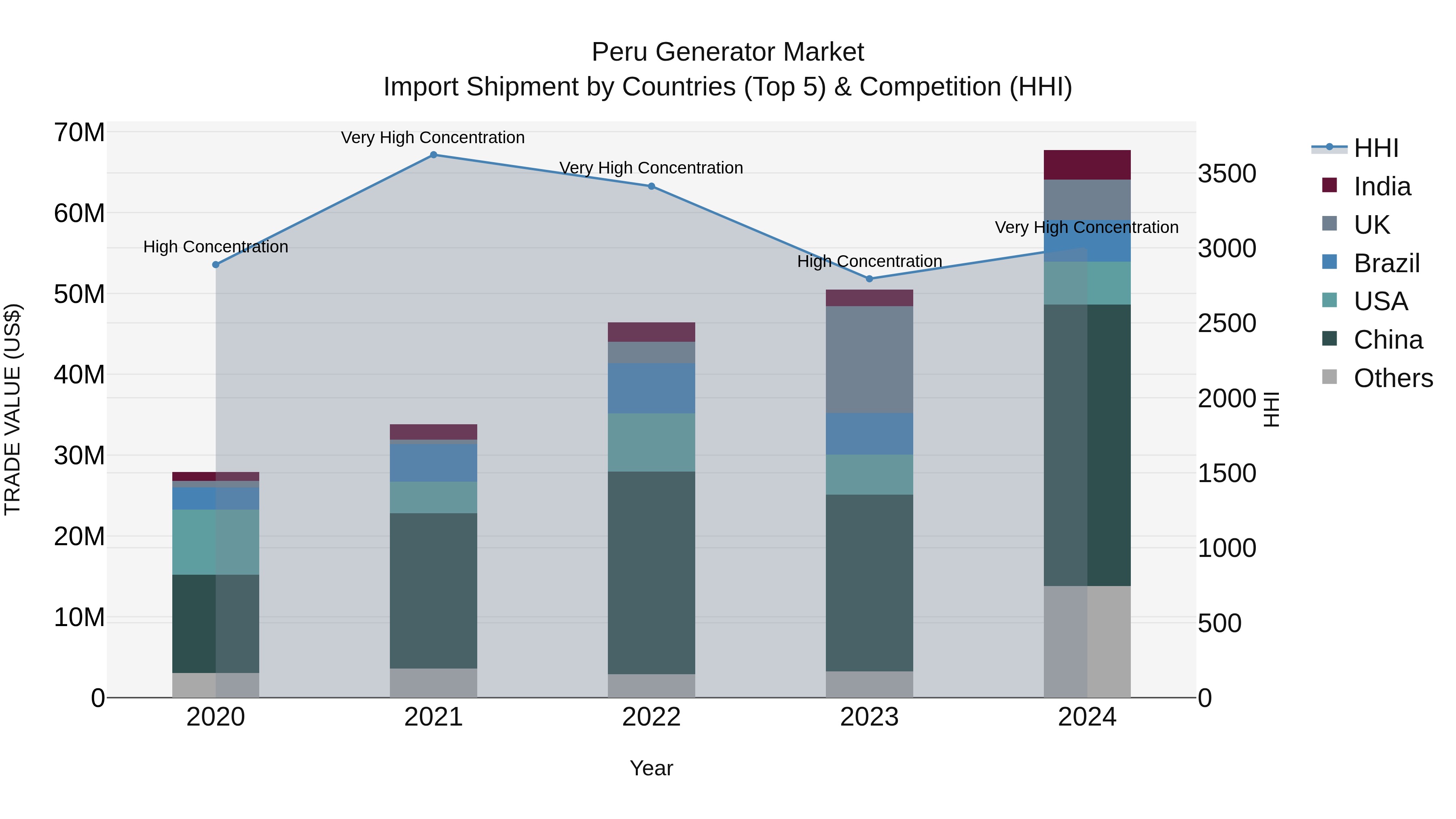
Peru`s generator import market continues to thrive, with top exporters China, Colombia, USA, Brazil, and UK dominating the scene in 2024. The market saw a significant increase in concentration levels, indicating strong competition among key players. With a impressive Compound Annual Growth Rate (CAGR) of 24.79% from 2020 to 2024, and a remarkable growth rate of 34.17% from 2023 to 2024, it is evident that the demand for generators in Peru remains robust, making it an attractive market for international suppliers.
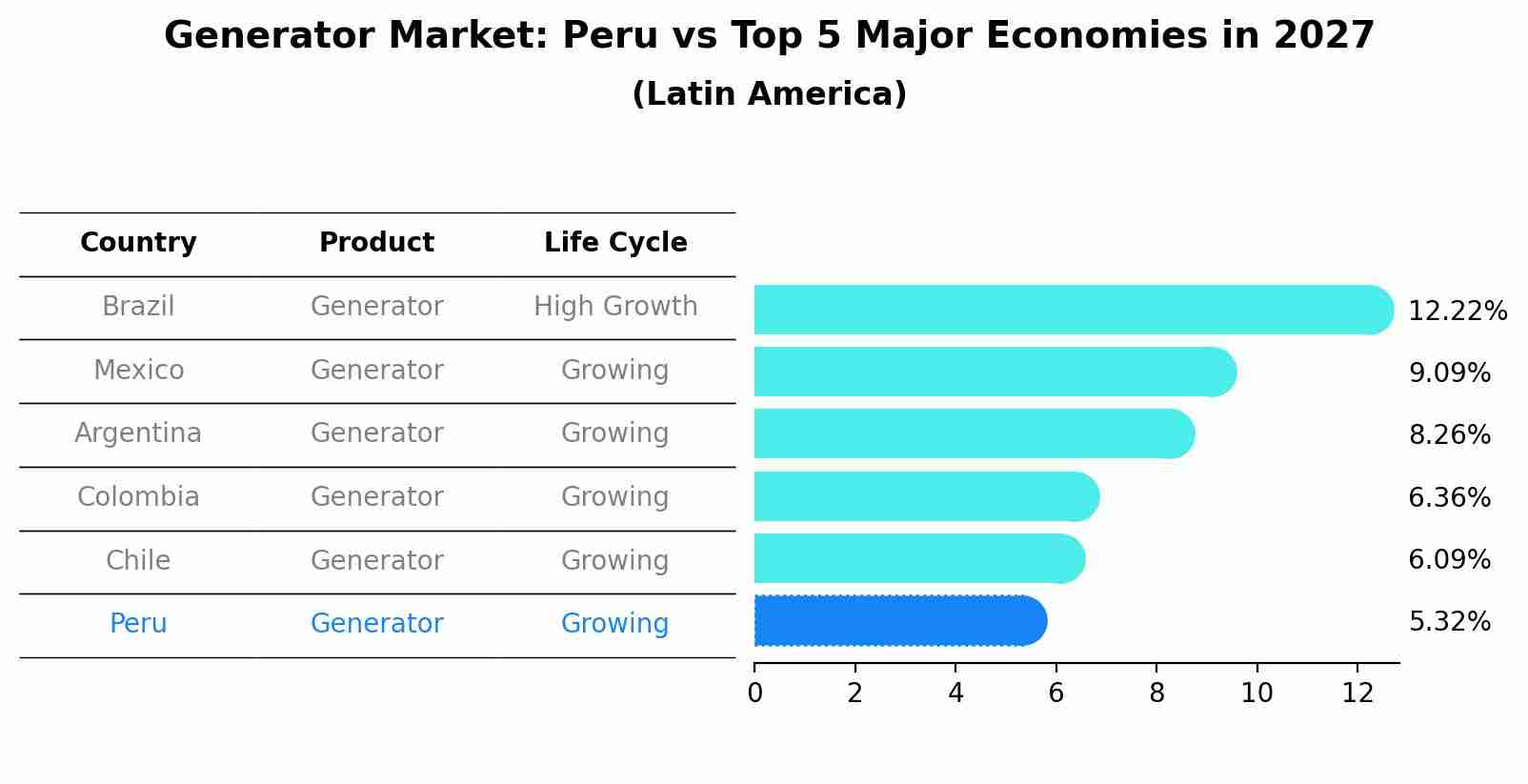
Generator Market: Peru vs Top 5 Major Economies in 2027 (Latin America)
Peru's Generator market is anticipated to experience a growing growth rate of 5.32% by 2027, reflecting trends observed in the largest economy Brazil, followed by Mexico, Argentina, Colombia and Chile.
Peru Generator Market Synopsis
The Peru Generator Market is experiencing steady growth driven by factors such as increasing industrialization, rapid urbanization, and a growing need for reliable backup power solutions in the country. The market is characterized by a mix of international and local players offering a wide range of generators powered by diesel, gas, and renewable energy sources. Key market segments include residential, commercial, and industrial applications, with a notable demand for standby and prime power generators. Government initiatives to improve electricity access in remote areas are also boosting market growth. Additionally, the market is witnessing a shift towards more fuel-efficient and environmentally friendly generator technologies. Overall, the Peru Generator Market presents opportunities for manufacturers to innovate and expand their product offerings to meet evolving customer needs and regulatory requirements.
Peru Generator Market Trends
The Peru Generator Market is witnessing a growing demand for clean energy solutions, leading to an increased adoption of renewable energy sources such as solar and wind generators. This shift is driven by environmental concerns, government incentives, and the need for energy diversification. Additionally, there is a rising trend towards the use of smart generators with advanced monitoring and control capabilities for improved efficiency and reliability. The market is also experiencing a surge in demand for portable generators, particularly in rural areas with unreliable grid power supply. Overall, the Peru Generator Market is evolving towards sustainable and technologically advanced solutions to meet the country`s growing energy needs while reducing environmental impact.
Peru Generator Market Challenges
In the Peru Generator Market, some of the key challenges faced include the impact of fluctuating fuel prices on operational costs, the need for continuous maintenance and servicing to ensure optimal performance, and competition from alternative power sources such as solar and wind energy. Additionally, regulatory hurdles and bureaucratic processes can pose obstacles for generator manufacturers and service providers looking to enter or expand in the market. Economic instability and political uncertainties in Peru can also affect investment decisions and overall market demand for generators. Overall, navigating these challenges requires companies in the Peru Generator Market to adapt quickly to changing conditions, innovate in terms of technology and service offerings, and build strong relationships with customers and stakeholders to maintain a competitive edge.
Peru Generator Market Investment Opportunities
The Peru Generator Market presents promising investment opportunities driven by increasing demand for reliable power supply in the country. With a growing economy and expanding industrial sector, the need for backup power solutions has been on the rise. Investors can explore opportunities in supplying diesel generators for commercial and industrial applications, as well as renewable energy solutions such as solar and wind generators to capitalize on the country`s focus on sustainability. Additionally, investing in advanced technology generators with features like remote monitoring and fuel efficiency can cater to the evolving needs of customers. Collaborating with local distribution partners and leveraging government incentives for renewable energy projects can further enhance investment prospects in the Peru Generator Market.
Jordan Agar Market Government Policies
The Peru Generator Market is subject to various government policies aimed at promoting renewable energy sources and reducing carbon emissions. The Peruvian government has implemented measures such as the Promotion of Renewable Energies for Electricity Generation Law, which provides incentives for the development and use of renewable energy sources, including generators powered by solar, wind, and hydroelectric sources. Additionally, there are regulations in place to ensure the environmental sustainability of generator projects, such as environmental impact assessments and compliance with emission standards. The government also offers tax incentives and subsidies for companies investing in clean energy technologies, further encouraging the growth of the generator market in Peru towards more sustainable and environmentally friendly practices.
Peru Generator Market Future Outlook
The Peru generator market is expected to witness steady growth in the coming years due to factors such as increasing demand for reliable power supply, rapid industrialization, and growing need for backup power solutions. The market is likely to be driven by investments in infrastructure development, particularly in remote areas where reliable grid power is limited. Additionally, the rising frequency of power outages and natural disasters in the region are expected to fuel the adoption of generators for both residential and commercial applications. Technological advancements in generator efficiency and sustainability, such as the shift towards cleaner fuel sources and smart grid integration, are also anticipated to shape the future landscape of the Peru generator market. Overall, the market is poised for expansion, presenting growth opportunities for key players in the industry.
Key Highlights of the Report:
- Peru Generator Market Outlook
- Market Size of Peru Generator Market, 2021
- Forecast of Peru Generator Market, 2031
- Historical Data and Forecast of Peru Generator Revenues & Volume for the Period 2018 - 2031
- Peru Generator Market Trend Evolution
- Peru Generator Market Drivers and Challenges
- Peru Generator Price Trends
- Peru Generator Porter's Five Forces
- Peru Generator Industry Life Cycle
- Historical Data and Forecast of Peru Generator Market Revenues & Volume By Application for the Period 2018 - 2031
- Historical Data and Forecast of Peru Generator Market Revenues & Volume By Stationary Generators for the Period 2018 - 2031
- Historical Data and Forecast of Peru Generator Market Revenues & Volume By Portable Generators for the Period 2018 - 2031
- Historical Data and Forecast of Peru Generator Market Revenues & Volume By Fuel for the Period 2018 - 2031
- Historical Data and Forecast of Peru Generator Market Revenues & Volume By Diesel Generators for the Period 2018 - 2031
- Historical Data and Forecast of Peru Generator Market Revenues & Volume By Gas Generators for the Period 2018 - 2031
- Historical Data and Forecast of Peru Generator Market Revenues & Volume By End Use for the Period 2018 - 2031
- Historical Data and Forecast of Peru Generator Market Revenues & Volume By Residential Generators for the Period 2018 - 2031
- Historical Data and Forecast of Peru Generator Market Revenues & Volume By Commercial Generators for the Period 2018 - 2031
- Historical Data and Forecast of Peru Generator Market Revenues & Volume By Industrial Generators for the Period 2018 - 2031
- Historical Data and Forecast of Peru Generator Market Revenues & Volume By Others for the Period 2018 - 2031
- Historical Data and Forecast of Peru Generator Market Revenues & Volume By Capacity for the Period 2018 - 2031
- Historical Data and Forecast of Peru Generator Market Revenues & Volume By 0-100 kVA for the Period 2018 - 2031
- Historical Data and Forecast of Peru Generator Market Revenues & Volume By 100-350 kVA for the Period 2018 - 2031
- Historical Data and Forecast of Peru Generator Market Revenues & Volume By 350-1000kVA for the Period 2018 - 2031
- Historical Data and Forecast of Peru Generator Market Revenues & Volume By Above 1000kVA for the Period 2018 - 2031
- Peru Generator Import Export Trade Statistics
- Market Opportunity Assessment By Application
- Market Opportunity Assessment By Fuel
- Market Opportunity Assessment By End Use
- Market Opportunity Assessment By Capacity
- Peru Generator Top Companies Market Share
- Peru Generator Competitive Benchmarking By Technical and Operational Parameters
- Peru Generator Company Profiles
- Peru Generator Key Strategic Recommendations






































