Peru Herbal Cosmetics Market Size, Share & Growth Rate
The Peru Herbal Cosmetics Market was estimated at USD 1157 Million in 2025 and is projected to reach USD 1671 Million by 2032, growing at a CAGR of 5.4% from 2026 to 2032. This growth trajectory is primarily fueled by an increasing consumer shift towards natural and organic beauty products, as well as heightened awareness regarding the benefits of plant-based ingredients. The infusion of traditional Peruvian botanicals into cosmetic formulations has further enhanced market appeal, solidifying consumer preference for these unique, culturally-relevant offerings.
Peru Herbal Cosmetics Market Year-wise Growth Rate and Key Drivers
This graph highlights how the Peru Herbal Cosmetics Market has steadily grown over the years, supported by major growth factors.
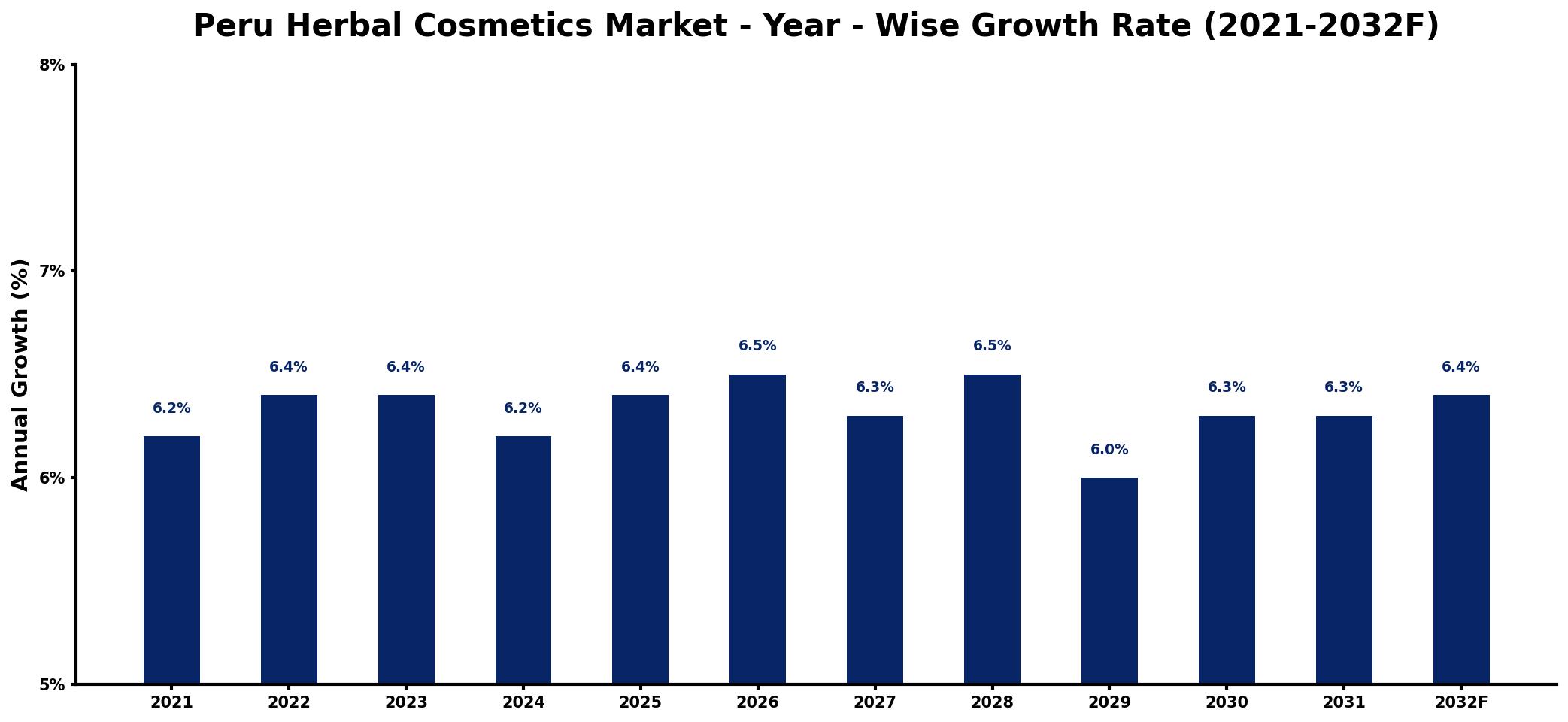
The table below presents the year‑wise growth rates along with the key drivers influencing the market
| Year | Growth Rate | Major Drivers |
| 2021 | 6.2% | Rising consumer health awareness |
| 2022 | 6.4% | Increased online shopping adoption |
| 2023 | 6.4% | Growing interest in sustainability |
| 2024 | 6.2% | Expansion of retail distribution |
| 2025 | 6.4% | Emergence of new brands |
| 2026 | 6.5% | Investments in eco-friendly packaging |
| 2027 | 6.3% | Enhanced product innovation efforts |
| 2028 | 6.5% | Strengthening of local supply chains |
| 2029 | 6.0% | Growing popularity of natural ingredients |
| 2030 | 6.3% | Increased collaboration with influencers |
| 2031 | 6.3% | Expansion into international markets |
| 2032 | 6.4% | Rising demand for ethical sourcing |
Note: Market size estimations and growth projections presented in this report are based on 6Wresearch's proprietary forecasting methodology, utilizing the latest available industry data, government publications, and primary research inputs.
Peru Herbal Cosmetics Market Synopsis
In Peru, the herbal cosmetics market is marked by a rich array of offerings that utilize indigenous botanical ingredients such as quinoa, maca, and coca leaf extracts. This reliance on local resources not only bolsters product authenticity but also resonates deeply with consumers who increasingly value sustainability and ethical sourcing. The market is becoming a vibrant space for innovative formulations that harness traditional knowledge while meeting contemporary beauty standards.
As awareness of the adverse effects of synthetic chemicals grows, consumers are gravitating towards herbal alternatives. This shift reflects a broader cultural movement towards wellness, where personal care routines are aligned with health-conscious choices. In response, brands are now prioritizing transparency in ingredient sourcing and production practices to cater to a more discerning audience.
Peru Herbal Cosmetics Market Key Takeaways
- The market is increasingly defined by consumer demand for natural and organic products infused with local botanical ingredients.
- Growth is supported by rising health and wellness trends, emphasizing the importance of ingredient transparency and sustainability.
- Local brands are gaining momentum, appealing to consumers interested in authentic and culturally significant beauty solutions.
- Innovation and eco-friendly practices are crucial for brands looking to differentiate themselves in a competitive landscape.
- Government regulations are shaping the market, ensuring safety and quality in herbal cosmetics.
Evaluation of Restraints in Peru Herbal Cosmetics Market
Despite its growth potential, the Peru Herbal Cosmetics Market faces several restraints. One significant hurdle is consumer education; many potential buyers remain unaware of the benefits of herbal cosmetics compared to conventional products. This knowledge gap can hinder demand. Furthermore, the market must contend with competition from established international brands that benefit from greater recognition and marketing resources. Additionally, sourcing high-quality herbal ingredients poses challenges, which can affect product pricing and availability. Regulatory compliance also creates obstacles for emerging brands, requiring careful navigation to succeed.
Peru Herbal Cosmetics Market Trends
Current trends within the Peru Herbal Cosmetics Market highlight a pronounced preference for clean formulations that avoid harmful chemicals. Consumers are increasingly enthusiastic about botanical ingredients, driven by a desire for healthier beauty solutions. Additionally, eco-friendly packaging is rising in importance, aligning with the values of conscientious consumers. The influence of social media in shaping beauty trends cannot be overlooked, as digital platforms amplify the appeal of locally-sourced and authentically crafted products.
Peru Herbal Cosmetics Market Opportunities
The Peru Herbal Cosmetics Market is ripe with investment opportunities as the appetite for organic products continues to expand. Brands that collaborate with indigenous communities for sustainable ingredient sourcing are likely to resonate well with consumers. There is also potential for innovation in packaging solutions that reduce environmental impact. Furthermore, as the market grows, there is an opportunity to explore niche segments, such as herbal products specifically formulated for men or children, capturing additional market share.
Government Initiatives in the Peru Herbal Cosmetics Market
The Peruvian government has enacted several initiatives to support the herbal cosmetics industry, ensuring consumer safety and promoting local production. Regulatory frameworks overseen by the General Directorate of Medicines, Supplies, and Drugs (DIGEMID) set forth guidelines for the registration and labeling of herbal products. Additionally, the National Institute of Quality (INACAL) establishes standards for manufacturing practices, fostering a competitive yet compliant market environment. These initiatives are crucial for enhancing consumer confidence and sustaining industry growth.
Future Insights of the Peru Herbal Cosmetics Market
Looking ahead to 2026-2032, the Peru Herbal Cosmetics Market is expected to flourish, fueled by a growing consumer base that prioritizes sustainability and wellness. As more brands enter the sector, competition will drive innovation and expansion of product offerings. The incorporation of traditional Peruvian ingredients will likely remain a focal point, creating differentiation and cultural value. Overall, the market outlook is bright, with considerable room for growth driven by evolving consumer preferences.
Peru Herbal Cosmetics Market Latest Developments (2025 - 2026)
In recent months, the Peru Herbal Cosmetics Market has seen a surge in product launches that highlight unique local ingredients, catering to the increasing demand for authenticity among consumers. Many brands are investing in sustainable practices, including eco-friendly packaging and ethical sourcing. Collaborations with local communities are becoming more common, ensuring that traditional knowledge is preserved while benefiting the local economy. Additionally, digital marketing efforts are being ramped up, leveraging social media to reach a wider audience and educate consumers about the benefits of herbal cosmetics.
Peru Herbal Cosmetics Market - Key Attractiveness of the Report
- 10 Years of Market Numbers
- Historical Data Starting from 2022 to 2025
- Base Year: 2025
- Forecast Data until 2032
- Key Performance Indicators Impacting the Market
- Major Upcoming Developments and Projects
Key Highlights of the Report:
- Peru Herbal Cosmetics Market Outlook
- Market Size of Peru Herbal Cosmetics Market, 2025
- Forecast of Peru Herbal Cosmetics Market, 2032
- Historical Data and Forecast of Peru Herbal Cosmetics Revenues & Volume for the Period 2022-2032F
- Peru Herbal Cosmetics Market Trend Evolution
- Peru Herbal Cosmetics Market Drivers and Challenges
- Peru Herbal Cosmetics Price Trends
- Peru Herbal Cosmetics Porter's Five Forces
- Peru Herbal Cosmetics Industry Life Cycle
- Historical Data and Forecast of Peru Herbal Cosmetics Market Revenues & Volume By Physical State for the Period 2022-2032F
- Historical Data and Forecast of Peru Herbal Cosmetics Market Revenues & Volume By Solid for the Period 2022-2032F
- Historical Data and Forecast of Peru Herbal Cosmetics Market Revenues & Volume By Semi-solid for the Period 2022-2032F
- Historical Data and Forecast of Peru Herbal Cosmetics Market Revenues & Volume By Liquid for the Period 2022-2032F
- Historical Data and Forecast of Peru Herbal Cosmetics Market Revenues & Volume By Product for the Period 2022-2032F
- Historical Data and Forecast of Peru Herbal Cosmetics Market Revenues & Volume By Skin Care Product for the Period 2022-2032F
- Historical Data and Forecast of Peru Herbal Cosmetics Market Revenues & Volume By Hair Care Product for the Period 2022-2032F
- Historical Data and Forecast of Peru Herbal Cosmetics Market Revenues & Volume By Baby Care Product for the Period 2022-2032F
- Historical Data and Forecast of Peru Herbal Cosmetics Market Revenues & Volume By Oral Care Product for the Period 2022-2032F
- Historical Data and Forecast of Peru Herbal Cosmetics Market Revenues & Volume By Make-up Product for the Period 2022-2032F
- Historical Data and Forecast of Peru Herbal Cosmetics Market Revenues & Volume By Distribution Channel for the Period 2022-2032F
- Historical Data and Forecast of Peru Herbal Cosmetics Market Revenues & Volume By Supermarket for the Period 2022-2032F
- Historical Data and Forecast of Peru Herbal Cosmetics Market Revenues & Volume By Pharmacy for the Period 2022-2032F
- Historical Data and Forecast of Peru Herbal Cosmetics Market Revenues & Volume By Departmental Store for the Period 2022-2032F
- Historical Data and Forecast of Peru Herbal Cosmetics Market Revenues & Volume By Beauty Spa/Salon for the Period 2022-2032F
- Historical Data and Forecast of Peru Herbal Cosmetics Market Revenues & Volume By Internet Retailing for the Period 2022-2032F
- Historical Data and Forecast of Peru Herbal Cosmetics Market Revenues & Volume By Specialty Store for the Period 2022-2032F
- Peru Herbal Cosmetics Import Export Trade Statistics
- Market Opportunity Assessment By Physical State
- Market Opportunity Assessment By Product
- Market Opportunity Assessment By Distribution Channel
- Peru Herbal Cosmetics Top Companies Market Share
- Peru Herbal Cosmetics Competitive Benchmarking By Technical and Operational Parameters
- Peru Herbal Cosmetics Company Profiles
- Peru Herbal Cosmetics Key Strategic Recommendations






































