Peru Network as a Service Market Size & Growth Rate (2026-2032)
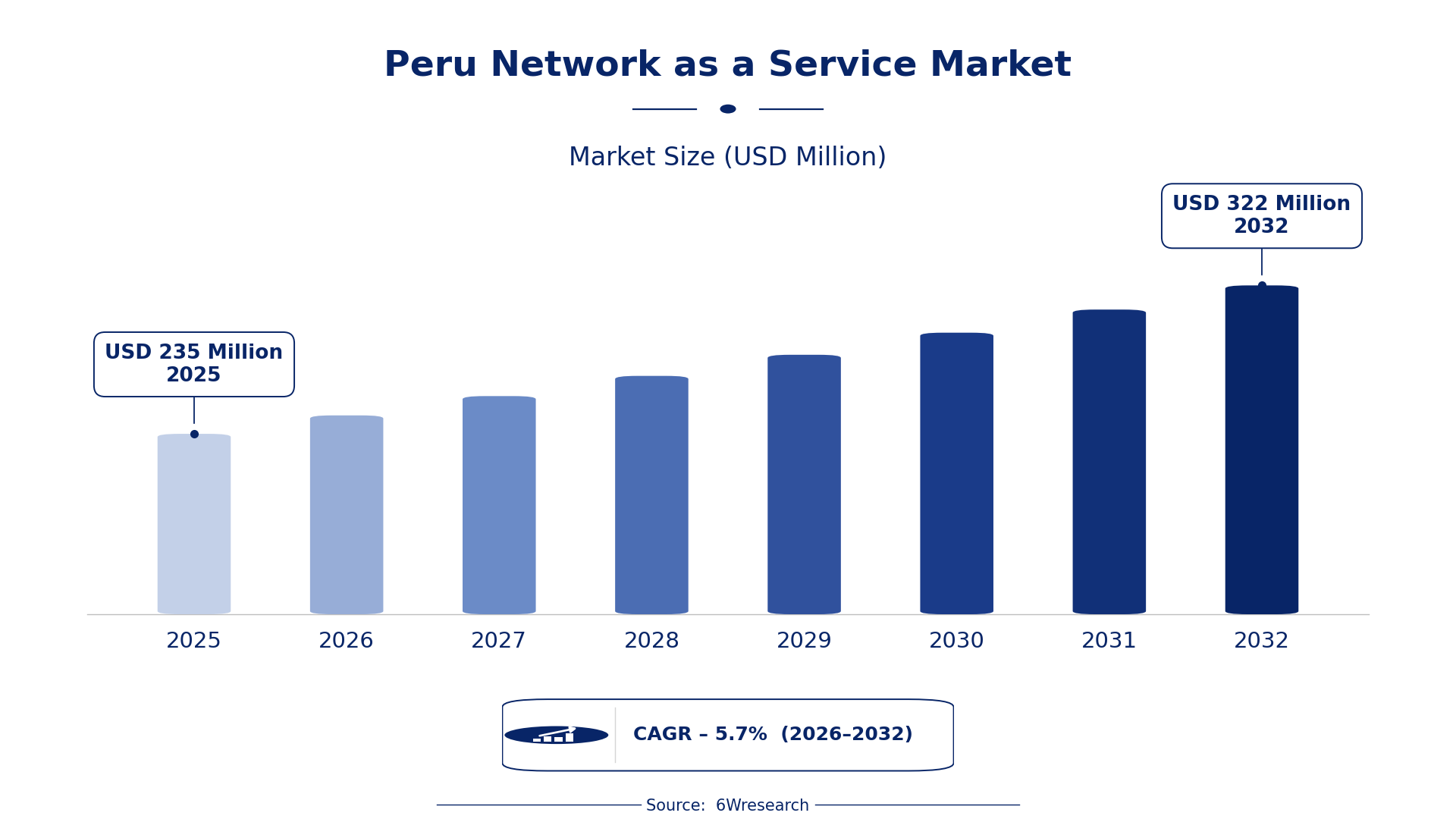
The Peru Network as a Service Market was estimated at USD 235 Million in 2025 and is projected to reach USD 322 Million by 2032, growing at a CAGR of 5.7% from 2026 to 2032.
Peru Network as a Service Market Synopsis
The Peru Network as a Service market is on a promising trajectory, driven by the increasing shift of enterprises towards cloud-based solutions. Businesses are increasingly recognizing the advantages of NaaS, including cost savings and enhanced flexibility, which are vital in the current fast-paced digital environment.
With a growing emphasis on digital transformation, the demand for scalable networking solutions is becoming critical for organizations across various sectors. This trend is not only reshaping the operational frameworks of businesses but also fostering a competitive environment for NaaS providers looking to innovate and deliver tailored services.
Peru Network as a Service Market Year-wise Growth Rate and Key Drivers
This graph illustrates the annual growth rates of the Peru Network as a Service Market from 2021 to 2032, highlighting a steady upward trajectory and projected expansion over the forecast period.
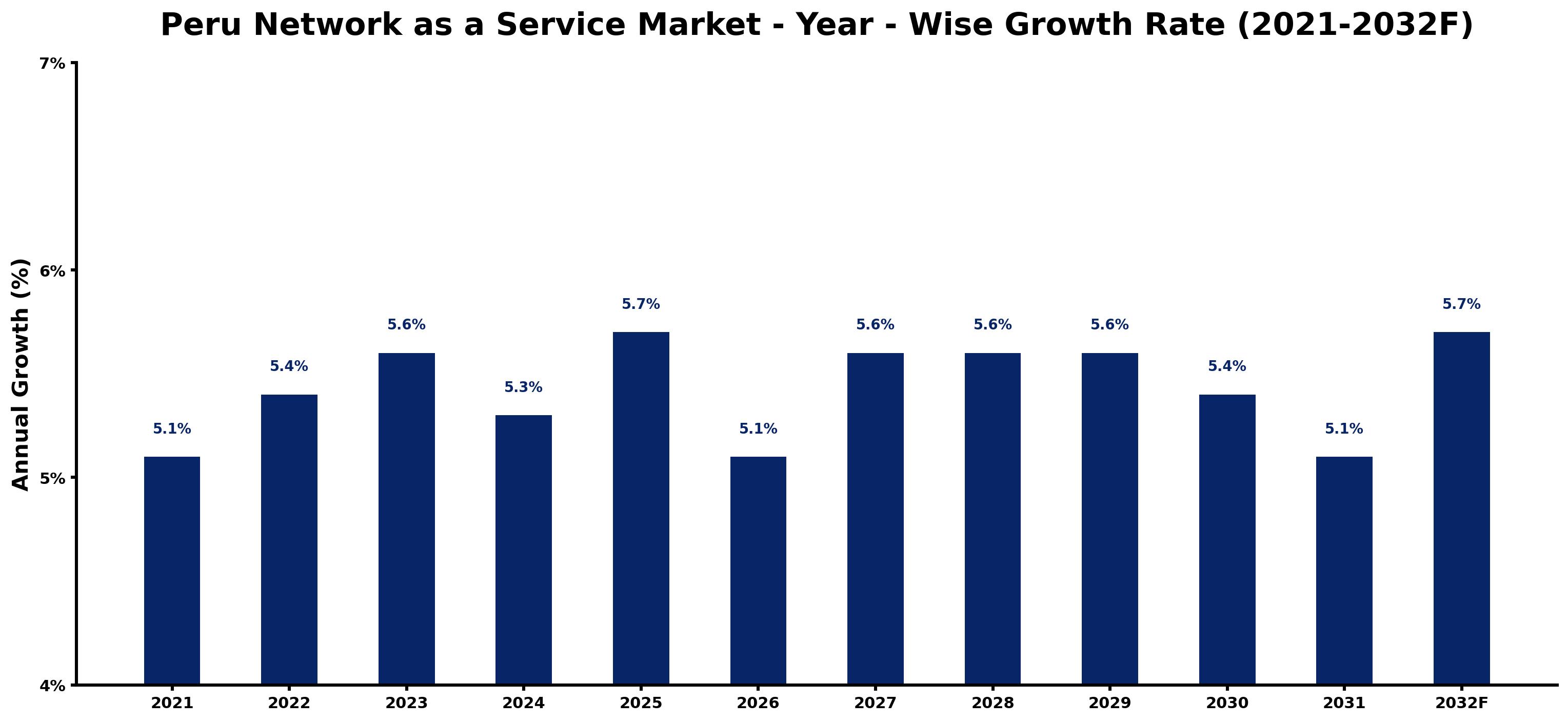
The table below presents the year‑wise growth rates along with the key drivers influencing the market
| Year | Growth Rate | Major Drivers |
| 2021 | 5.1% | Government's Digital Peru initiative promotes internet accessibility. |
| 2022 | 5.4% | Increase in mobile users demands enhanced network services. |
| 2023 | 5.6% | Telecom regulatory reforms enable competitive pricing for services. |
| 2024 | 5.3% | Rising e-commerce activity increases demand for network reliability. |
| 2025 | 5.7% | Local startups drive need for flexible networking solutions. |
| 2026 | 5.1% | Investments in fintech require robust network infrastructures. |
| 2027 | 5.6% | Growth in telehealth services demands secure network provisions. |
| 2028 | 5.6% | Increased foreign investment enhances network service deployment. |
| 2029 | 5.6% | Rising cloud adoption requires adaptive network management. |
| 2030 | 5.4% | Substantial urbanization boosts demand for enhanced connectivity. |
| 2031 | 5.1% | National broadband plan accelerates rural network expansions. |
| 2032 | 5.7% | Emerging tech hubs increase network capacity requirements. |
Note: Market size estimations and growth projections presented in this report are based on 6Wresearch's proprietary forecasting methodology, utilizing the latest available industry data, government publications, and primary research inputs.
Peru Network as a Service Market Key Takeaways
Below are some of the specific key takeaways from the market, including:
- The increasing adoption of software-defined networking (SDN) is reshaping traditional networking models.
- Remote work trends are pushing businesses to seek more flexible networking solutions.
- Concerns over data security are prompting companies to prioritize NaaS providers with enhanced security features.
- Managed NaaS services are gaining traction as businesses look to simplify network management.
- The government's support for digital infrastructure is creating a favorable environment for NaaS growth.
Evaluation of Restraints in Peru Network as a Service Market
Despite the promising growth, the Peru Network as a Service market is not without its challenges. Limited infrastructure, particularly in remote regions, hinders the widespread adoption of NaaS solutions. High initial investment costs also pose a barrier for many companies, especially small and medium-sized enterprises.
The ongoing shortage of skilled IT professionals further complicates the situation, making it difficult for businesses to effectively implement and manage NaaS solutions. These factors create a complex environment that requires strategic planning and partnerships for successful navigation.
Peru Network as a Service Market Trends
Several trends are currently shaping the Peru Network as a Service market. The shift towards software-defined networking (SDN) continues to gain momentum, offering businesses greater control over their networks. Additionally, edge computing is becoming increasingly relevant, driven by the need for real-time data processing.
on top of that, the integration of artificial intelligence and machine learning into network management is emerging as a key trend, optimizing network performance and enhancing security measures. These trends are not just altering how companies view their networking needs; they are also influencing the strategies of NaaS providers in Peru.
Peru Network as a Service Market Opportunities
The landscape presents significant opportunities for growth and innovation. Industries such as healthcare, finance, and manufacturing are particularly ripe for tailored NaaS solutions that cater to their unique requirements. As businesses increasingly prioritize digital transformation, NaaS providers can capitalize on this demand by offering specialized services.
Enhanced security offerings will also be crucial as concerns over data protection and privacy continue to rise. By focusing on these areas, NaaS providers can differentiate themselves and tap into new revenue streams, driving the market's evolution in Peru.
Government Initiatives in the Peru Network as a Service Market
Government policies in Peru are actively shaping the Network as a Service market through strategic initiatives. The emphasis on improving digital infrastructure is creating a favorable regulatory environment for NaaS providers. With recent efforts aimed at enhancing cybersecurity and expanding broadband access, the government is fostering an ecosystem conducive to growth in the NaaS sector.
- A national digital infrastructure upgrade programme, recently launched, aims to improve broadband access across underserved regions.
- Current efforts are underway to streamline regulations, encouraging innovation in telecommunications and related sectors.
- A regulatory framework focused on enhancing data protection and cybersecurity measures is being implemented to ensure a secure environment for NaaS users.
- Planned investments in 5G technology infrastructure are expected to support the expansion of NaaS capabilities by 2028.
- An initiative to promote digital literacy among IT professionals is currently being rolled out to address the skills gap in the industry.
Future Insights of the Peru Network as a Service Market
Looking ahead, the Peru Network as a Service market is set for steady growth driven by continued cloud adoption and the rise of remote work. The demand for flexible networking solutions will remain a central theme, as businesses seek cost-effective options to support their operations.
The anticipated rollout of 5G networks and the increasing proliferation of IoT devices will open new avenues for NaaS providers, allowing them to offer innovative solutions tailored to emerging needs. However, navigating the challenges of data security and regulatory compliance will be critical for success.
Peru Network as a Service Market Latest Developments
Recent months have seen a flurry of activity in the Peru Network as a Service market, reflecting the industry's dynamic nature. Providers are increasingly focusing on enhancing their service offerings to meet the growing demand for efficient and secure networking solutions.
- A major technology vendor launched a new SDN platform in early 2025, designed to improve network performance for enterprises.
- An ongoing partnership between local telecom companies aims to expand managed NaaS services to small businesses throughout the country.
- By mid-2026, a new initiative is expected to introduce AI-driven analytics tools for network optimization to help businesses manage their infrastructure more effectively.
- A regulatory body completed a review of data protection laws in late 2025, enhancing compliance frameworks for NaaS providers.
- Planned service upgrades for existing NaaS offerings are expected to be rolled out by the second half of 2026, focusing on improved security features.
Peru Network as a Service Market - Key Attractiveness of the Report
- 10 Years of Market Numbers
- Historical Data Starting from 2022 to 2025
- Base Year: 2025
- Forecast Data until 2032
- Key Performance Indicators Impacting the Market
- Major Upcoming Developments and Projects
Key Highlights of the Report:
- Peru Network as a Service Market Outlook
- Market Size of Peru Network as a Service Market, 2025
- Forecast of Peru Network as a Service Market, 2032
- Historical Data and Forecast of Peru Network as a Service Revenues & Volume for the Period 2022-2032F
- Peru Network as a Service Market Trend Evolution
- Peru Network as a Service Market Drivers and Challenges
- Peru Network as a Service Price Trends
- Peru Network as a Service Porter's Five Forces
- Peru Network as a Service Industry Life Cycle
- Historical Data and Forecast of Peru Network as a Service Market Revenues & Volume By Type for the Period 2022-2032F
- Historical Data and Forecast of Peru Network as a Service Market Revenues & Volume By Local Area Network and Wireless Local Area Network for the Period 2022-2032F
- Historical Data and Forecast of Peru Network as a Service Market Revenues & Volume By Wire Area Network for the Period 2022-2032F
- Historical Data and Forecast of Peru Network as a Service Market Revenues & Volume By Communication and Collaboration for the Period 2022-2032F
- Historical Data and Forecast of Peru Network as a Service Market Revenues & Volume By Network Security for the Period 2022-2032F
- Historical Data and Forecast of Peru Network as a Service Market Revenues & Volume By End User for the Period 2022-2032F
- Historical Data and Forecast of Peru Network as a Service Market Revenues & Volume By Banking, Financial, Services, and Insurance for the Period 2022-2032F
- Historical Data and Forecast of Peru Network as a Service Market Revenues & Volume By Manufacturing for the Period 2022-2032F
- Historical Data and Forecast of Peru Network as a Service Market Revenues & Volume By Retail and eCommerce for the Period 2022-2032F
- Historical Data and Forecast of Peru Network as a Service Market Revenues & Volume By Software and Technology for the Period 2022-2032F
- Historical Data and Forecast of Peru Network as a Service Market Revenues & Volume By Media and Entertainment for the Period 2022-2032F
- Historical Data and Forecast of Peru Network as a Service Market Revenues & Volume By Healthcare for the Period 2022-2032F
- Historical Data and Forecast of Peru Network as a Service Market Revenues & Volume By Education for the Period 2022-2032F
- Historical Data and Forecast of Peru Network as a Service Market Revenues & Volume By Government for the Period 2022-2032F
- Historical Data and Forecast of Peru Network as a Service Market Revenues & Volume By Organization Size for the Period 2022-2032F
- Historical Data and Forecast of Peru Network as a Service Market Revenues & Volume By Large Enterprises for the Period 2022-2032F
- Historical Data and Forecast of Peru Network as a Service Market Revenues & Volume By SMEs for the Period 2022-2032F
- Historical Data and Forecast of Peru Network as a Service Market Revenues & Volume By Application for the Period 2022-2032F
- Historical Data and Forecast of Peru Network as a Service Market Revenues & Volume By UCaaS/Video Conferencing for the Period 2022-2032F
- Historical Data and Forecast of Peru Network as a Service Market Revenues & Volume By Virtual Private Network for the Period 2022-2032F
- Historical Data and Forecast of Peru Network as a Service Market Revenues & Volume By Cloud and SaaS Connectivity for the Period 2022-2032F
- Historical Data and Forecast of Peru Network as a Service Market Revenues & Volume By Bandwidth on Demand for the Period 2022-2032F
- Historical Data and Forecast of Peru Network as a Service Market Revenues & Volume By Multi-Branch Connectivity for the Period 2022-2032F
- Historical Data and Forecast of Peru Network as a Service Market Revenues & Volume By WAN Optimization for the Period 2022-2032F
- Historical Data and Forecast of Peru Network as a Service Market Revenues & Volume By Secure Web Gateway for the Period 2022-2032F
- Peru Network as a Service Import Export Trade Statistics
- Market Opportunity Assessment By Type
- Market Opportunity Assessment By End User
- Market Opportunity Assessment By Organization Size
- Market Opportunity Assessment By Application
- Peru Network as a Service Top Companies Market Share
- Peru Network as a Service Competitive Benchmarking By Technical and Operational Parameters
- Peru Network as a Service Company Profiles
- Peru Network as a Service Key Strategic Recommendations






































