Peru Penicillin Market Size Growth Rate
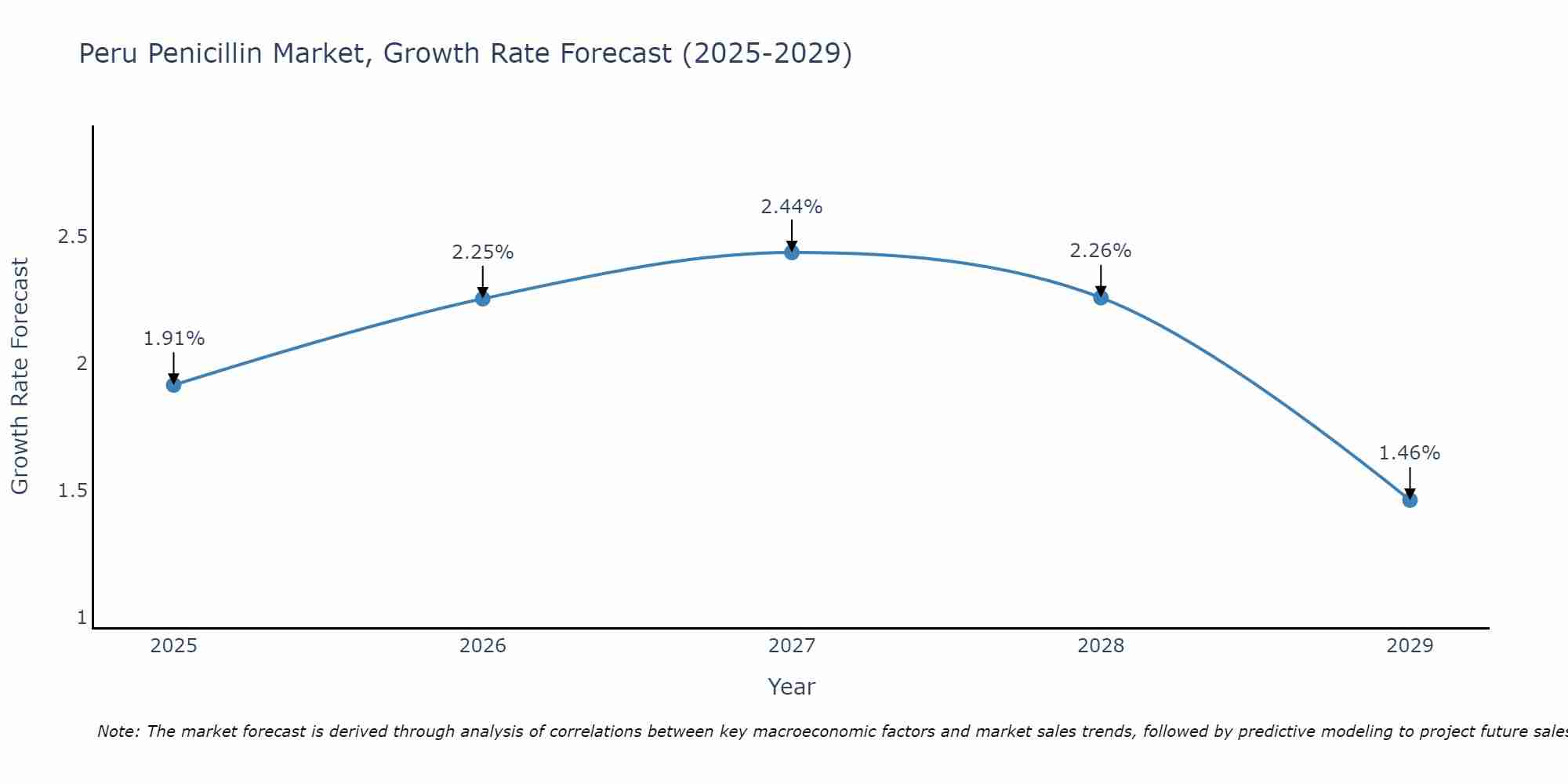
The Peru Penicillin Market is projected to witness mixed growth rate patterns during 2025 to 2029. The growth rate begins at 1.91% in 2025, climbs to a high of 2.44% in 2027, and moderates to 1.46% by 2029.
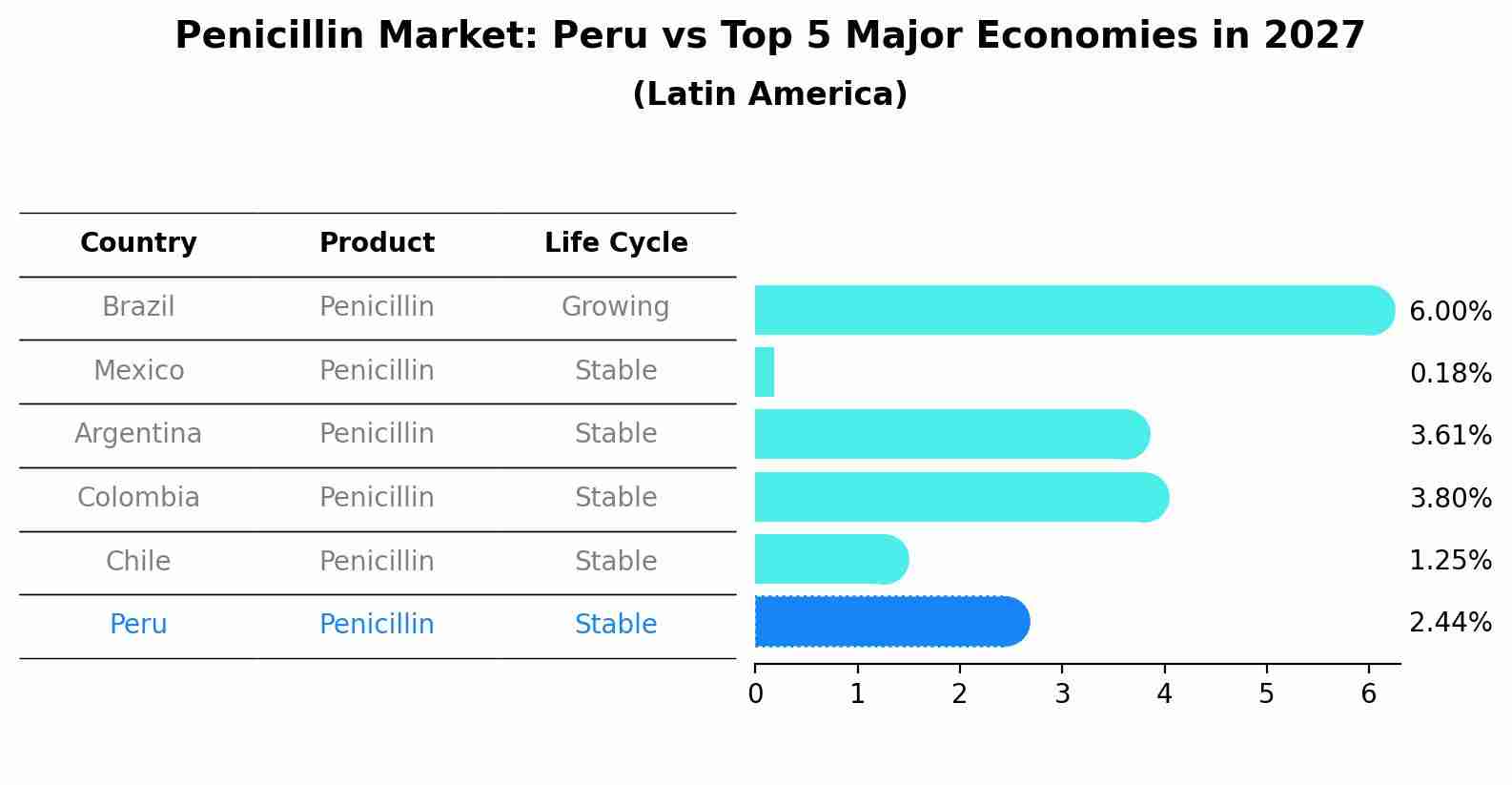
Penicillin Market: Peru vs Top 5 Major Economies in 2027 (Latin America)
The Penicillin market in Peru is projected to grow at a stable growth rate of 2.44% by 2027, highlighting the country's increasing focus on advanced technologies within the Latin America region, where Brazil holds the dominant position, followed closely by Mexico, Argentina, Colombia and Chile, shaping overall regional demand.
Peru Penicillin Market Overview
The Peru Penicillin market is experiencing steady growth driven by factors such as increasing prevalence of bacterial infections, growing demand for antibiotics, and improving healthcare infrastructure. The market is characterized by the presence of key players offering a wide range of penicillin products for various medical applications. Government initiatives to promote access to essential medicines and rising awareness about the importance of antibiotic treatment are also contributing to market expansion. Additionally, advancements in pharmaceutical research and development are leading to the introduction of innovative penicillin formulations with enhanced efficacy and safety profiles. Overall, the Peru Penicillin market is poised for continued growth in the foreseeable future, presenting opportunities for market players to capitalize on the growing demand for antibiotics in the country.
Peru Penicillin Market Trends
The Peru Penicillin market is currently experiencing steady growth driven by increasing demand for antibiotics in the healthcare sector. The market is witnessing a shift towards the use of more advanced and effective penicillin formulations to combat a wide range of bacterial infections. Factors such as rising prevalence of infectious diseases, growing awareness about the importance of antibiotic treatment, and improving healthcare infrastructure are contributing to the market growth. Additionally, government initiatives to promote the responsible use of antibiotics and the presence of key market players offering a diverse range of penicillin products are further fueling market expansion. With ongoing research and development activities focused on enhancing the efficacy and safety of penicillin drugs, the market is expected to continue on its growth trajectory in the coming years.
Peru Penicillin Market Challenges
In the Peru Penicillin Market, challenges arise from factors such as price competition among manufacturers, counterfeit products, regulatory hurdles, and limited access to healthcare in remote regions. Price competition can lead to lower profit margins for companies, while the presence of counterfeit penicillin products poses risks to patient safety and undermines trust in the market. Regulatory hurdles, such as lengthy approval processes and changing standards, can hinder market growth and innovation. Additionally, the limited access to healthcare in remote regions of Peru can restrict the distribution and availability of penicillin products, impacting the overall market reach and patient outcomes. Overcoming these challenges requires collaboration between stakeholders, investment in infrastructure, and stringent regulatory enforcement to ensure the quality and accessibility of penicillin in the Peruvian market.
Peru Penicillin Market Investment Opportunities
The Peru Penicillin Market offers promising investment opportunities due to the growing demand for antibiotics in the country`s healthcare sector. With an increasing focus on healthcare infrastructure and access to quality medications, there is a rising need for penicillin products to treat various bacterial infections. Investing in local pharmaceutical companies that manufacture and distribute penicillin drugs could be a lucrative option, especially if they have a strong presence in the Peruvian market. Additionally, there is potential for partnerships or collaborations with healthcare providers to ensure the efficient delivery and utilization of penicillin medications. Monitoring regulatory changes and market trends will be essential for investors to capitalize on the opportunities presented by the Peru Penicillin Market.
Peru Penicillin Market Government Policy
In Peru, the government has implemented regulations and policies to ensure the quality, safety, and efficacy of penicillin products in the market. The country`s regulatory authority, the General Directorate of Medicines, Supplies, and Drugs (DIGEMID), oversees the registration, importation, and distribution of penicillin to guarantee compliance with international standards and Good Manufacturing Practices (GMP). Additionally, the government promotes the rational use of antibiotics, including penicillin, through education and awareness campaigns to combat antimicrobial resistance. Penicillin products are subject to price controls to make them accessible to the population, with subsidies available for low-income individuals. Overall, the government`s policies aim to protect public health, ensure product quality, and promote responsible use of penicillin in Peru.
Peru Penicillin Market Future Outlook
The Peru Penicillin market is projected to experience steady growth in the coming years due to increasing healthcare expenditures, rising prevalence of infectious diseases, and growing awareness about the benefits of penicillin in combating bacterial infections. Additionally, the government`s efforts to improve healthcare infrastructure and expand access to essential medicines are expected to further drive market growth. With a focus on research and development to introduce innovative penicillin-based products, pharmaceutical companies are likely to capitalize on the growing demand in Peru. However, challenges such as the emergence of antibiotic resistance and stringent regulatory requirements may impact market dynamics. Overall, the Peru Penicillin market is anticipated to witness favorable growth opportunities in the foreseeable future.
Key Highlights of the Report:
- Peru Penicillin Market Outlook
- Market Size of Peru Penicillin Market, 2021
- Forecast of Peru Penicillin Market, 2027
- Historical Data and Forecast of Peru Penicillin Revenues & Volume for the Period 2018 - 2027
- Peru Penicillin Market Trend Evolution
- Peru Penicillin Market Drivers and Challenges
- Peru Penicillin Price Trends
- Peru Penicillin Porter's Five Forces
- Peru Penicillin Industry Life Cycle
- Historical Data and Forecast of Peru Penicillin Market Revenues & Volume By Product for the Period 2018 - 2027
- Historical Data and Forecast of Peru Penicillin Market Revenues & Volume By Bulk for the Period 2018 - 2027
- Historical Data and Forecast of Peru Penicillin Market Revenues & Volume By Dosage for the Period 2018 - 2027
- Historical Data and Forecast of Peru Penicillin Market Revenues & Volume By Type for the Period 2018 - 2027
- Historical Data and Forecast of Peru Penicillin Market Revenues & Volume By Aminopenicillin for the Period 2018 - 2027
- Historical Data and Forecast of Peru Penicillin Market Revenues & Volume By Antipseudomonal Penicillin for the Period 2018 - 2027
- Historical Data and Forecast of Peru Penicillin Market Revenues & Volume By Beta-lactamase Inhibitor for the Period 2018 - 2027
- Historical Data and Forecast of Peru Penicillin Market Revenues & Volume By Natural Penicillin for the Period 2018 - 2027
- Historical Data and Forecast of Peru Penicillin Market Revenues & Volume By Penicillinase-resistant Penicillin for the Period 2018 - 2027
- Historical Data and Forecast of Peru Penicillin Market Revenues & Volume By Manufacturing Process for the Period 2018 - 2027
- Historical Data and Forecast of Peru Penicillin Market Revenues & Volume By Synthetic Process for the Period 2018 - 2027
- Historical Data and Forecast of Peru Penicillin Market Revenues & Volume By Natural Process for the Period 2018 - 2027
- Historical Data and Forecast of Peru Penicillin Market Revenues & Volume By Semisynthetic Process for the Period 2018 - 2027
- Historical Data and Forecast of Peru Penicillin Market Revenues & Volume By Mode of Delivery for the Period 2018 - 2027
- Historical Data and Forecast of Peru Penicillin Market Revenues & Volume By Oral for the Period 2018 - 2027
- Historical Data and Forecast of Peru Penicillin Market Revenues & Volume By Intramuscular for the Period 2018 - 2027
- Historical Data and Forecast of Peru Penicillin Market Revenues & Volume By Intravenous for the Period 2018 - 2027
- Historical Data and Forecast of Peru Penicillin Market Revenues & Volume By End User for the Period 2018 - 2027
- Historical Data and Forecast of Peru Penicillin Market Revenues & Volume By Hospitals for the Period 2018 - 2027
- Historical Data and Forecast of Peru Penicillin Market Revenues & Volume By Clinics for the Period 2018 - 2027
- Historical Data and Forecast of Peru Penicillin Market Revenues & Volume By Research Institutes for the Period 2018 - 2027
- Historical Data and Forecast of Peru Penicillin Market Revenues & Volume By Others for the Period 2018 - 2027
- Peru Penicillin Import Export Trade Statistics
- Market Opportunity Assessment By Product
- Market Opportunity Assessment By Type
- Market Opportunity Assessment By Manufacturing Process
- Market Opportunity Assessment By Mode of Delivery
- Market Opportunity Assessment By End User
- Peru Penicillin Top Companies Market Share
- Peru Penicillin Competitive Benchmarking By Technical and Operational Parameters
- Peru Penicillin Company Profiles
- Peru Penicillin Key Strategic Recommendations






































