Peru Process Analytics Market Size & Growth Rate (2026-2032)
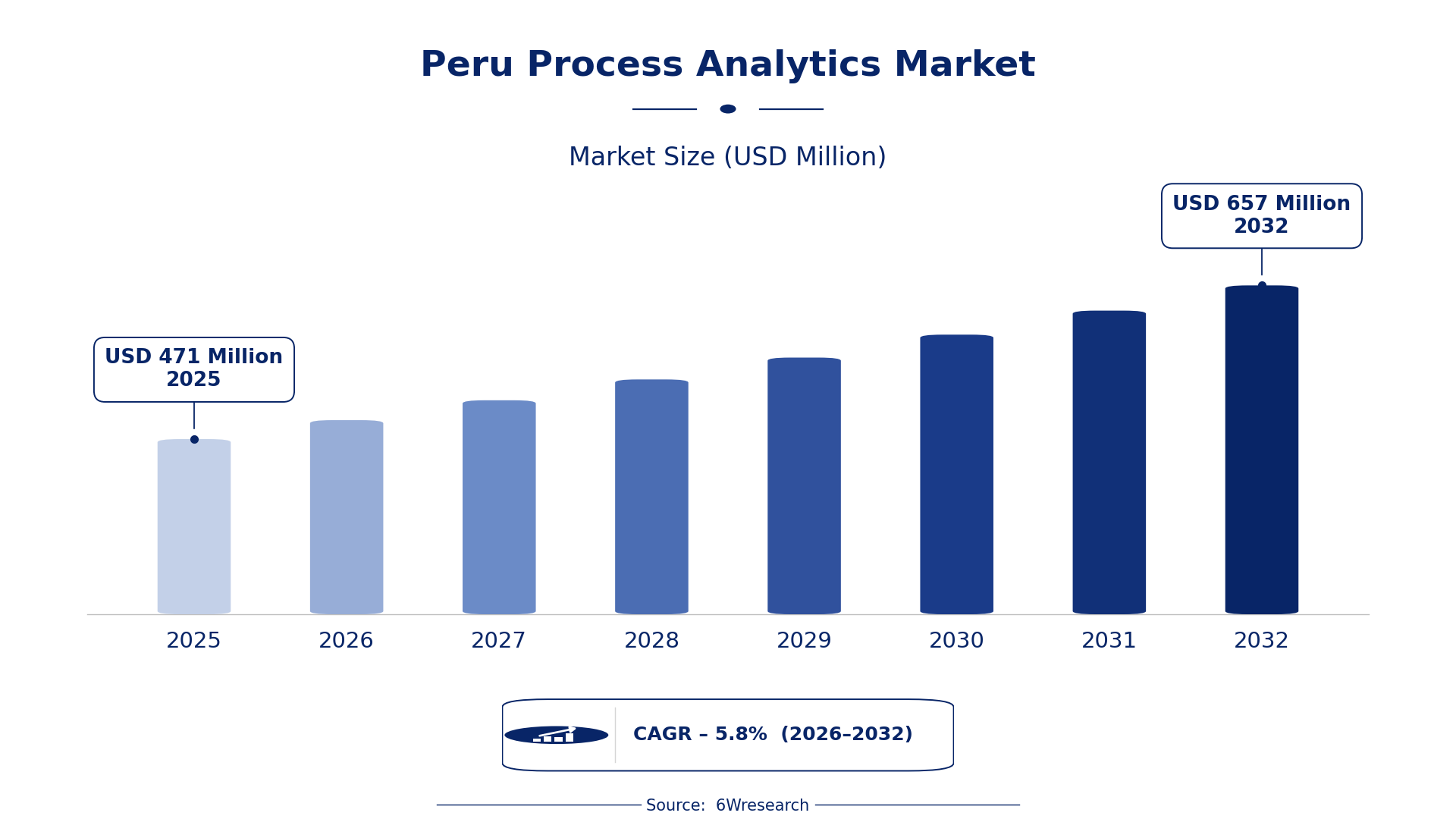
The Peru Process Analytics Market was estimated at USD 471 Million in 2025 and is projected to reach USD 657 Million by 2032, growing at a CAGR of 5.8% from 2026 to 2032.
Peru Process Analytics Market Synopsis
Recent growth in the Peru Process Analytics Market reflects a broader global shift towards data-driven decision-making. As industries increasingly adopt advanced analytics technologies, the local market is set to capitalize on this trend, particularly in sectors like manufacturing, healthcare, and mining.
Looking ahead, the market is expected to maintain its upward trajectory, fueled by an increasing emphasis on operational efficiency and compliance. Organizations are prioritizing process optimization, and as such, the demand for tailored analytics solutions is anticipated to grow significantly.
Peru Process Analytics Market Year-wise Growth Rate and Key Drivers
This graph illustrates the annual growth rates of the Peru Process Analytics Market from 2021 to 2032, highlighting a steady upward trajectory and projected expansion over the forecast period.
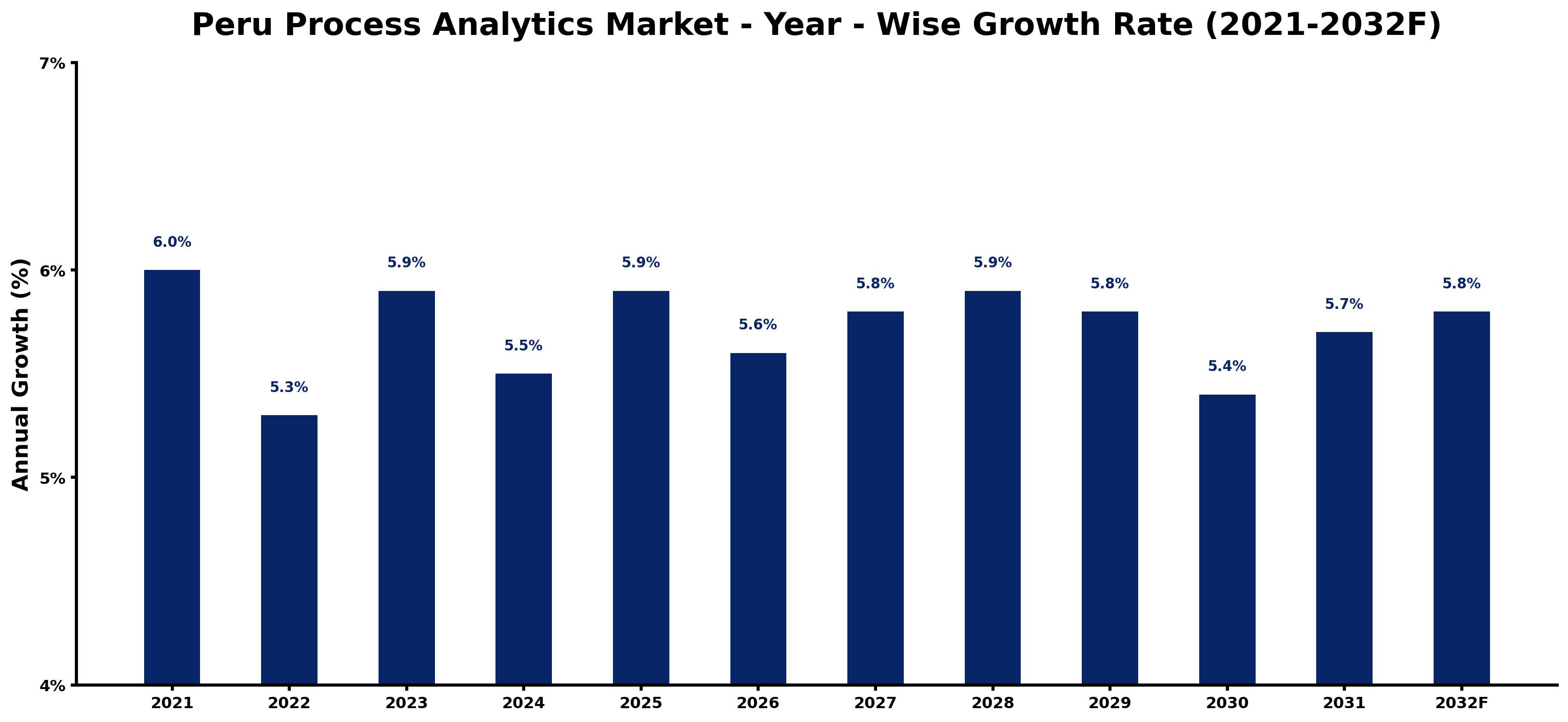
The table below presents the year‑wise growth rates along with the key drivers influencing the market
| Year | Growth Rate | Major Drivers |
| 2021 | 6.0% | Government's digital transformation initiatives boost process analytics demand. |
| 2022 | 5.3% | Increased investment in mining sector enhances operational efficiency tracking. |
| 2023 | 5.9% | Rising need for compliance with data protection regulations. |
| 2024 | 5.5% | Surge in local startups leveraging analytics for business intelligence. |
| 2025 | 5.9% | Adoption of cloud services accelerates process optimization efforts. |
| 2026 | 5.6% | Growing interest in operational efficiency among manufacturing firms. |
| 2027 | 5.8% | Enhanced training programs improve analytics skills in workforce. |
| 2028 | 5.9% | Collaborations between tech firms and universities advance analytics innovation. |
| 2029 | 5.8% | Emergence of fintech companies drives demand for process analytics. |
| 2030 | 5.4% | Focus on sustainable practices influences analytics in agriculture. |
| 2031 | 5.7% | Increased competitiveness in retail sector spurs analytics investment. |
| 2032 | 5.8% | Government incentives support tech adoption across various industries. |
Note: Market size estimations and growth projections presented in this report are based on 6Wresearch's proprietary forecasting methodology, utilizing the latest available industry data, government publications, and primary research inputs.
Peru Process Analytics Market Key Takeaways
Below are some of the specific key takeaways from the market, including:
- Strong growth is anticipated, with an expected increase from USD 471 Million in 2025 to USD 657 Million by 2032.
- Industries are increasingly integrating AI and machine learning into their analytics processes to enhance performance.
- Cloud-based analytics solutions are gaining traction, reflecting a shift in how organizations approach data management.
- There is a pressing need for skilled professionals in process analytics, which poses a challenge for market expansion.
- Government initiatives are actively supporting the adoption of process analytics, fostering industry growth.
Evaluation of Restraints in Peru Process Analytics Market
Despite its promising trajectory, the Peru Process Analytics Market faces several limitations. A significant barrier is the lack of awareness among small and medium enterprises regarding the benefits that process analytics can offer. Many businesses remain unconvinced about the ROI associated with implementing these solutions. on top of that, the shortage of skilled professionals in this specialized field further hampers adoption rates, creating a skills gap that companies struggle to fill. Concerns surrounding data privacy and security also loom large, as organizations must navigate complex regulations while adopting new technologies.
Peru Process Analytics Market Trends
A shift towards cloud-based analytics platforms is evident as companies prioritize flexibility and scalability in their operations. Additionally, the integration of real-time data analysis tools is becoming increasingly common, allowing businesses to make informed decisions quickly. Companies are also exploring the synergies between process analytics and AI technologies, enhancing predictive capabilities and operational insights. This evolving landscape is characterized by a growing emphasis on customized analytics solutions tailored to specific industry needs.
Peru Process Analytics Market Opportunities
The market is ripe for growth, particularly in the development of industry-specific analytics solutions. As organizations recognize the advantages of data-driven decision-making, there is substantial potential for vendors to offer tailored tools that address unique operational challenges. on top of that, the increasing digitalization of small and medium enterprises presents an opportunity for analytics service providers to expand their reach. The rising demand for predictive analytics tools offers another avenue for growth, as companies seek to enhance their decision-making processes and operational efficiencies.
Government Initiatives in the Peru Process Analytics Market
Government policy plays a crucial role in shaping the Peru Process Analytics Market, focusing on the promotion of advanced analytics technologies across various sectors. Public-sector priorities include fostering innovation and ensuring that businesses adhere to regulatory standards, which is vital for maintaining competitiveness. Recent initiatives aim to create an environment conducive to the adoption of process analytics, ultimately driving economic growth.
- A national program launched in early 2025 provides financial incentives for companies investing in process analytics technologies.
- Current initiatives include a workforce development program aimed at upskilling professionals in data analytics, which is underway and expected to yield results by mid-2026.
- Upcoming plans involve a public-private partnership expected to focus on enhancing data privacy regulations to support analytics adoption by 2028.
- A regulatory framework established in 2025 mandates transparency in data handling, reinforcing compliance in the analytics sector.
Future Insights of the Peru Process Analytics Market
The outlook for the Peru Process Analytics Market remains positive as industries increasingly turn to data-driven solutions to enhance operational efficiency. With the anticipated acceleration of digital transformation initiatives, demand for analytics tools is set to rise. Companies are expected to focus on integrating advanced analytics capabilities into their operations to maintain competitiveness. As organizations continue to adapt to regulatory requirements, the adoption of process analytics will likely become a necessity rather than an option, solidifying the market's growth trajectory through 2032.
Peru Process Analytics Market Latest Developments
Recent developments in the Peru Process Analytics Market indicate a dynamic shift toward advanced technologies and increased investment in analytics solutions. Over the past year, various initiatives have emerged, reflecting the industry's commitment to enhancing operational efficiencies and data-driven decision-making.
- A leading regional operator launched a new cloud-based analytics platform in early 2025, aimed at improving real-time data processing capabilities for manufacturing clients.
- A major technology vendor is currently piloting an AI-driven predictive analytics solution within healthcare organizations, with results expected by late 2025.
- An initiative that began in mid-2025 focuses on partnering with educational institutions to develop specialized training programs for analytics professionals, addressing the skills gap in the market.
- By mid-2026, a planned rollout of a national analytics framework is expected to standardize processes across various sectors, enhancing compliance and operational efficiency.
Peru Process Analytics Market - Key Attractiveness of the Report
- 10 Years of Market Numbers
- Historical Data Starting from 2022 to 2025
- Base Year: 2025
- Forecast Data until 2032
- Key Performance Indicators Impacting the Market
- Major Upcoming Developments and Projects
Key Highlights of the Report:
- Peru Process Analytics Market Outlook
- Market Size of Peru Process Analytics Market, 2025
- Forecast of Peru Process Analytics Market, 2032
- Historical Data and Forecast of Peru Process Analytics Revenues & Volume for the Period 2022-2032F
- Peru Process Analytics Market Trend Evolution
- Peru Process Analytics Market Drivers and Challenges
- Peru Process Analytics Price Trends
- Peru Process Analytics Porter's Five Forces
- Peru Process Analytics Industry Life Cycle
- Historical Data and Forecast of Peru Process Analytics Market Revenues & Volume By Process Mining Type for the Period 2022-2032F
- Historical Data and Forecast of Peru Process Analytics Market Revenues & Volume By Process discovery for the Period 2022-2032F
- Historical Data and Forecast of Peru Process Analytics Market Revenues & Volume By Process conformance for the Period 2022-2032F
- Historical Data and Forecast of Peru Process Analytics Market Revenues & Volume By Process enhancement for the Period 2022-2032F
- Historical Data and Forecast of Peru Process Analytics Market Revenues & Volume By Deployment Type for the Period 2022-2032F
- Historical Data and Forecast of Peru Process Analytics Market Revenues & Volume By On-premises for the Period 2022-2032F
- Historical Data and Forecast of Peru Process Analytics Market Revenues & Volume By Cloud for the Period 2022-2032F
- Historical Data and Forecast of Peru Process Analytics Market Revenues & Volume By Organization Size for the Period 2022-2032F
- Historical Data and Forecast of Peru Process Analytics Market Revenues & Volume By SMEs for the Period 2022-2032F
- Historical Data and Forecast of Peru Process Analytics Market Revenues & Volume By Large enterprises for the Period 2022-2032F
- Historical Data and Forecast of Peru Process Analytics Market Revenues & Volume By Application for the Period 2022-2032F
- Historical Data and Forecast of Peru Process Analytics Market Revenues & Volume By Business process for the Period 2022-2032F
- Historical Data and Forecast of Peru Process Analytics Market Revenues & Volume By Information technology process for the Period 2022-2032F
- Historical Data and Forecast of Peru Process Analytics Market Revenues & Volume By Customer interaction for the Period 2022-2032F
- Peru Process Analytics Import Export Trade Statistics
- Market Opportunity Assessment By Process Mining Type
- Market Opportunity Assessment By Deployment Type
- Market Opportunity Assessment By Organization Size
- Market Opportunity Assessment By Application
- Peru Process Analytics Top Companies Market Share
- Peru Process Analytics Competitive Benchmarking By Technical and Operational Parameters
- Peru Process Analytics Company Profiles
- Peru Process Analytics Key Strategic Recommendations






































