Peru Propane Market Top 5 Importing Countries and Market Competition (HHI) Analysis
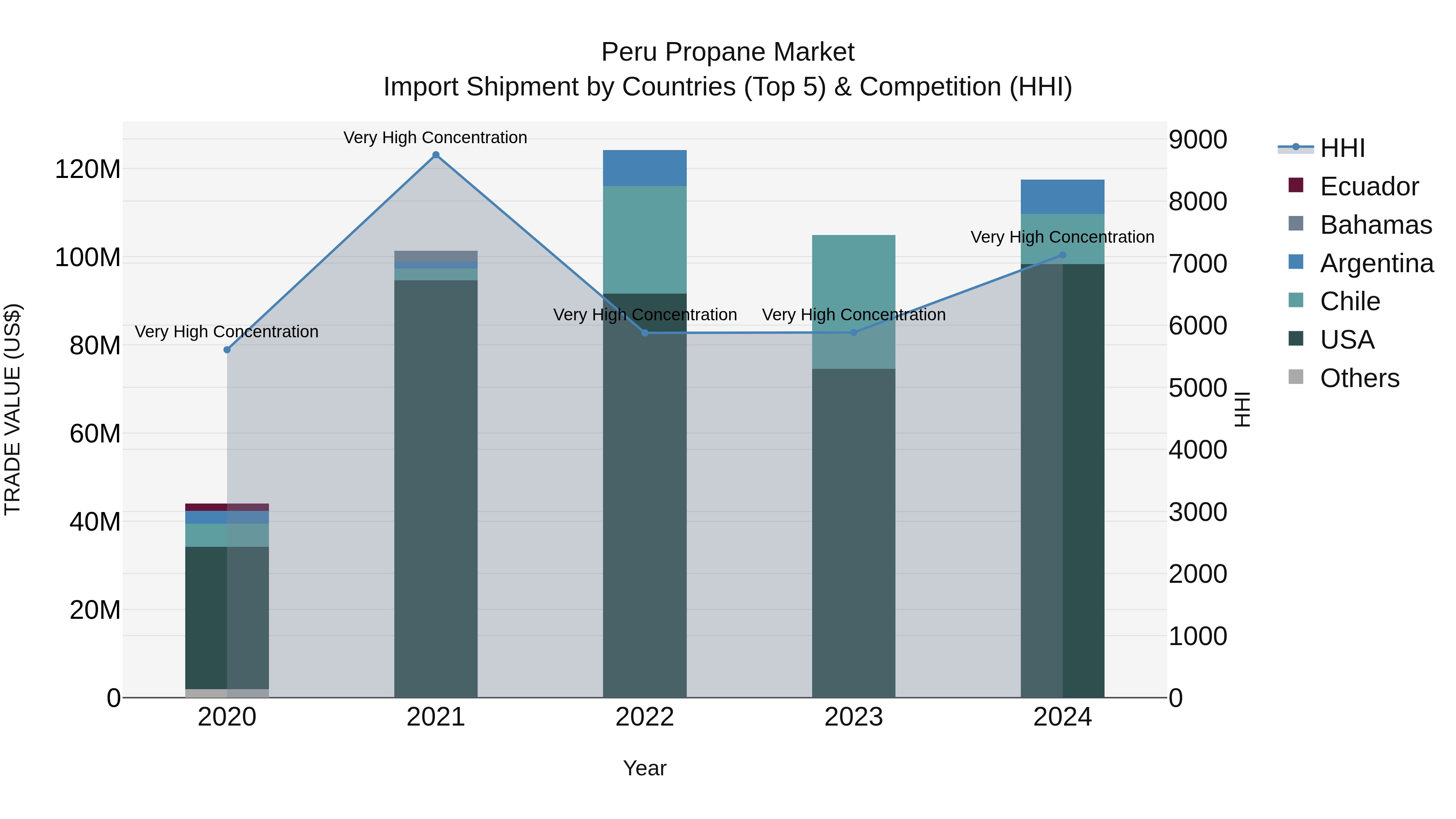
Peru`s propane import market in 2024 continued to be dominated by key suppliers including the USA, Chile, Argentina, Colombia, and South Korea. The high Herfindahl-Hirschman Index (HHI) indicates a concentrated market, with limited competition among importers. The strong compound annual growth rate (CAGR) of 27.84% from 2020 to 2024 reflects robust demand for propane in Peru. Additionally, the growth rate of 12.01% in 2024 highlights the resilience and expansion of the market despite challenges. Overall, Peru`s propane import sector is experiencing steady growth and maintaining strong relationships with key exporting countries.
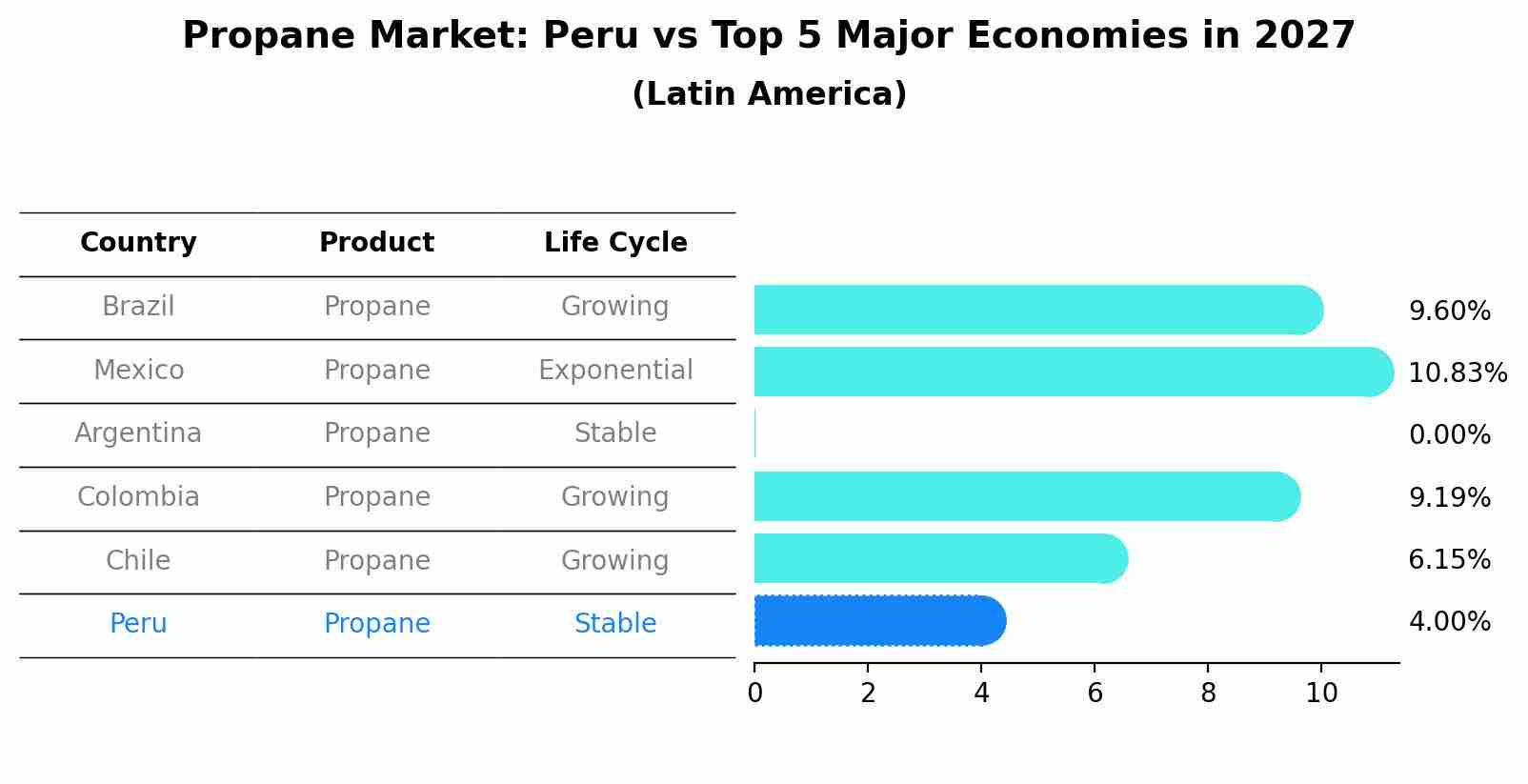
Propane Market: Peru vs Top 5 Major Economies in 2027 (Latin America)
The Propane market in Peru is projected to grow at a stable growth rate of 4.00% by 2027, within the Latin America region led by Brazil, along with other countries like Mexico, Argentina, Colombia and Chile, collectively shaping a dynamic and evolving market environment driven by innovation and increasing adoption of emerging technologies.
Peru Propane Market Overview
The Peru propane market is experiencing steady growth driven by the increasing adoption of propane as a clean and efficient energy source for residential, commercial, and industrial applications. The market is primarily driven by the demand for propane as a cooking fuel, particularly in rural areas where access to natural gas is limited. Additionally, the use of propane for transportation, agriculture, and power generation is also contributing to market growth. Key market players in Peru include propane distributors, retailers, and equipment manufacturers. Government initiatives promoting the use of clean fuels and the development of infrastructure for propane distribution are further supporting market expansion. Overall, the Peru propane market is poised for continued growth as awareness of the benefits of propane as a versatile and sustainable energy source continues to increase.
Peru Propane Market Trends
The Peru Propane Market is experiencing steady growth due to increasing demand from various industries, including commercial, residential, and industrial sectors. One of the prominent trends in the market is the growing popularity of propane as a clean and efficient alternative to traditional fuels, driven by environmental concerns and government initiatives to reduce emissions. The market is also seeing a rise in the adoption of propane-powered vehicles and equipment, further contributing to the demand for propane in the country. Additionally, the expansion of distribution networks and the availability of cost-effective propane solutions are attracting more consumers to switch to propane for their energy needs. Overall, the Peru Propane Market is poised for continued expansion and innovation in the coming years.
Peru Propane Market Challenges
In the Peru Propane Market, several challenges are faced, including regulatory hurdles and safety concerns. Regulations surrounding the storage, transportation, and usage of propane can be stringent and complex, requiring companies to navigate a potentially challenging regulatory landscape. Safety is another significant concern, as mishandling of propane can lead to accidents, fires, and environmental damage. Additionally, the market may face supply chain disruptions that can impact the availability and pricing of propane. Competition from alternative fuel sources and the need for ongoing infrastructure development to support the distribution of propane further add to the challenges faced by players in the Peru Propane Market. Addressing these challenges will require proactive measures, strategic planning, and collaboration among industry stakeholders.
Peru Propane Market Investment Opportunities
The Peru Propane Market presents promising investment opportunities due to the country`s increasing demand for propane as a clean and versatile energy source. With Peru`s growing urbanization and infrastructure development, the use of propane for residential, commercial, and industrial purposes is on the rise. Investors can explore opportunities in propane distribution, storage facilities, transportation infrastructure, and equipment manufacturing to cater to the expanding market. Additionally, the government`s initiatives to promote propane as a sustainable fuel option further enhance the investment potential in this sector. Investing in the Peru Propane Market could provide long-term growth prospects and a chance to capitalize on the country`s transitioning energy landscape towards more environmentally friendly alternatives.
Peru Propane Market Government Policy
The government policies related to the Peru Propane Market primarily focus on promoting the use of propane as a cleaner and more efficient alternative to traditional fuels, particularly in rural areas. The government has implemented subsidies and incentives to encourage the adoption of propane for cooking, heating, and transportation purposes. Additionally, there are regulations in place to ensure the safe handling and distribution of propane, as well as to monitor pricing and prevent monopolistic practices in the market. Overall, the government aims to increase access to propane, reduce reliance on more polluting fuels, and promote sustainable energy practices in Peru.
Peru Propane Market Future Outlook
The future outlook for the Peru Propane Market appears to be positive, with steady growth expected in the coming years. Factors such as increasing industrialization, expanding residential and commercial construction activities, and a growing demand for clean energy sources are likely to drive the market forward. Additionally, the government`s initiatives to promote the use of cleaner fuels and reduce carbon emissions are expected to further boost the demand for propane in the country. The market is also witnessing investments in infrastructure development and distribution networks, which will enhance accessibility and availability of propane across Peru. Overall, the Peru Propane Market is poised for expansion, offering opportunities for market players to capitalize on the increasing demand for this versatile and sustainable energy source.
Key Highlights of the Report:
- Peru Propane Market Outlook
- Market Size of Peru Propane Market, 2021
- Forecast of Peru Propane Market, 2027
- Historical Data and Forecast of Peru Propane Revenues & Volume for the Period 2018 - 2027
- Peru Propane Market Trend Evolution
- Peru Propane Market Drivers and Challenges
- Peru Propane Price Trends
- Peru Propane Porter's Five Forces
- Peru Propane Industry Life Cycle
- Historical Data and Forecast of Peru Propane Market Revenues & Volume By Applications for the Period 2018 - 2027
- Historical Data and Forecast of Peru Propane Market Revenues & Volume By Industrial for the Period 2018 - 2027
- Historical Data and Forecast of Peru Propane Market Revenues & Volume By Commercial for the Period 2018 - 2027
- Historical Data and Forecast of Peru Propane Market Revenues & Volume By Residential for the Period 2018 - 2027
- Historical Data and Forecast of Peru Propane Market Revenues & Volume By Transportation for the Period 2018 - 2027
- Historical Data and Forecast of Peru Propane Market Revenues & Volume By Agriculture for the Period 2018 - 2027
- Historical Data and Forecast of Peru Propane Market Revenues & Volume By Chemicals and Refineries for the Period 2018 - 2027
- Peru Propane Import Export Trade Statistics
- Market Opportunity Assessment By Applications
- Peru Propane Top Companies Market Share
- Peru Propane Competitive Benchmarking By Technical and Operational Parameters
- Peru Propane Company Profiles
- Peru Propane Key Strategic Recommendations






































