Peru Shaving Foam Market Top 5 Importing Countries and Market Competition (HHI) Analysis
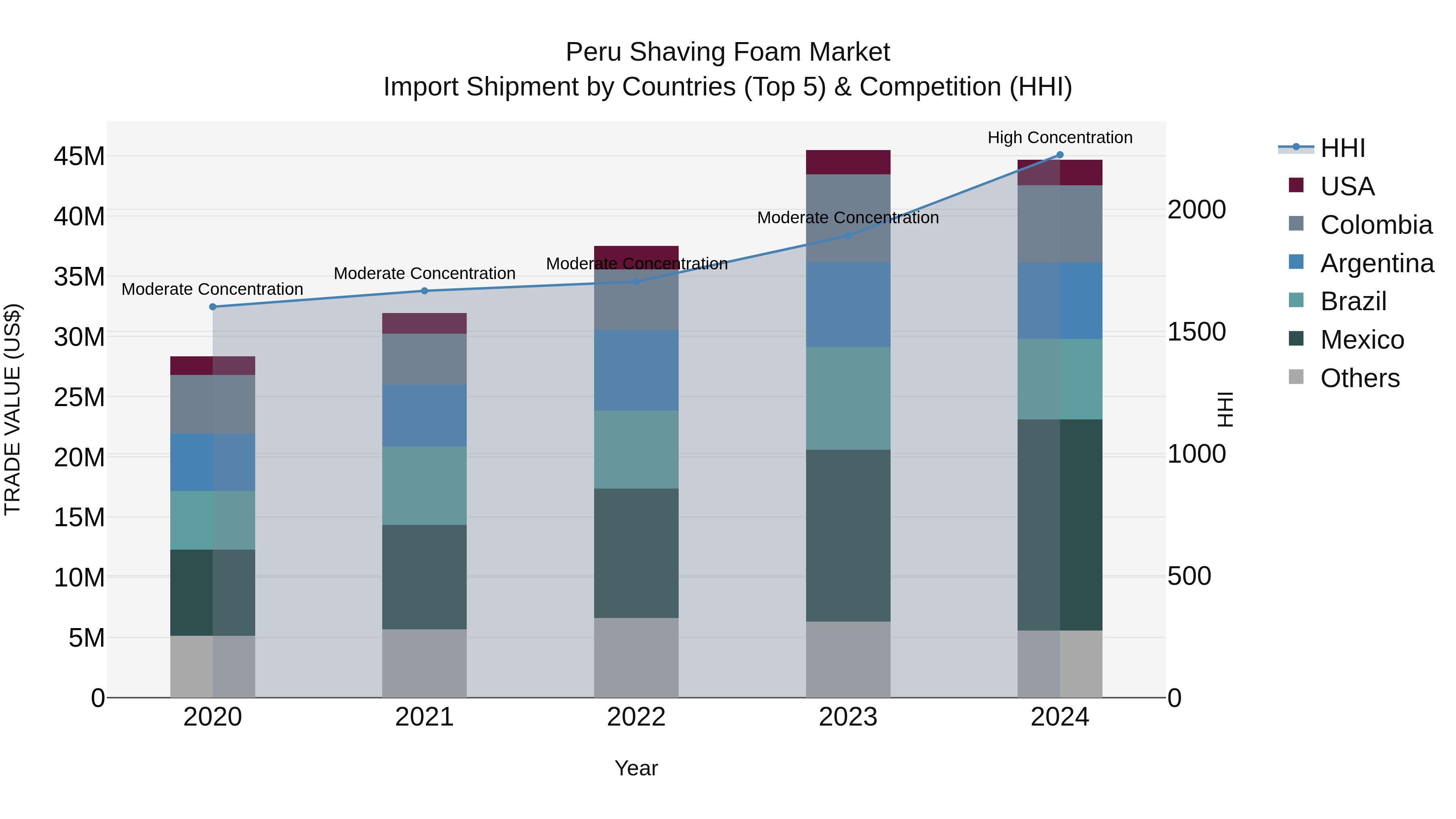
Peru`s shaving foam import market saw significant growth with a CAGR of 12.05% from 2020 to 2024, attracting shipments primarily from Mexico, Brazil, Colombia, Argentina, and the USA. However, the market experienced a slight decline in growth rate from 2023 to 2024 (-1.74%). The market concentration, as measured by the HHI, shifted from moderate in 2023 to high in 2024, indicating increased dominance by key exporting countries. This trend suggests a competitive landscape shaping up in Peru`s shaving foam import sector, potentially leading to strategic shifts and market dynamics in the coming years.
Peru Shaving Foam Market Synopsis
The Peru Shaving Foam Market is experiencing steady growth driven by increasing grooming habits among men, growing influence of social media in promoting personal care products, and rising disposable incomes. Consumers in Peru are becoming more conscious about personal grooming, leading to a surge in demand for shaving foam products. Key market players are focusing on product innovation, such as introducing natural and organic ingredients, to cater to the changing preferences of consumers. The market is highly competitive with both domestic and international brands vying for market share. Retail channels such as supermarkets, hypermarkets, and online platforms are crucial for the distribution of shaving foam products in Peru. Overall, the market is poised for further expansion as consumer awareness about grooming products continues to rise.
Peru Shaving Foam Market Trends
The Peru shaving foam market is experiencing a shift towards natural and organic products, driven by the increasing consumer preference for clean and sustainable grooming solutions. Manufacturers are focusing on launching products with natural ingredients like aloe vera and essential oils to cater to this demand. Another trend in the market is the rising popularity of multi-functional shaving foams that offer additional benefits such as moisturizing and anti-aging properties. Opportunities lie in targeting the male grooming segment with innovative packaging designs and personalized marketing strategies to attract male consumers who are increasingly investing in grooming products. Additionally, expanding distribution channels through e-commerce platforms and collaborations with local retailers can further drive growth in the Peru shaving foam market.
Peru Shaving Foam Market Challenges
In the Peru shaving foam market, one of the key challenges faced is increasing competition from both domestic and international brands. This competition has led to price wars and aggressive marketing strategies, making it difficult for smaller or newer companies to establish a foothold in the market. Additionally, changing consumer preferences and the rise of alternative grooming products, such as shaving gels and creams, pose a threat to the traditional shaving foam segment. Another challenge is the impact of economic fluctuations and currency devaluation on production costs and pricing strategies. To stay competitive, companies in the Peru shaving foam market need to innovate, differentiate their products, and invest in effective marketing campaigns to attract and retain customers in a crowded and dynamic market landscape.
Peru Shaving Foam Market Investment Opportunities
The Peru Shaving Foam Market is primarily driven by the increasing focus on personal grooming and hygiene among men in the country. With a growing awareness of grooming trends and the desire to maintain a well-groomed appearance, the demand for shaving foam has been steadily rising. Additionally, the availability of a wide range of shaving foam products catering to different skin types and preferences, along with aggressive marketing strategies by key players in the market, has further fueled the growth. Moreover, the rising disposable income levels among the urban population in Peru have also contributed to the growing demand for premium shaving foam products. Overall, the combination of changing consumer preferences, product innovation, and marketing efforts are key drivers propelling the Peru Shaving Foam Market forward.
Peru Shaving Foam Market Government Polices
In Peru, the shaving foam market is regulated by various government policies aimed at ensuring product safety and consumer protection. The General Directorate of Medicines, Supplies and Drugs (DIGEMID) oversees the registration and approval of shaving foam products to ensure they meet quality and safety standards. Additionally, the Ministry of Production may implement trade policies to regulate imports and exports of shaving foam products. The Peruvian government also enforces labeling requirements, including ingredient transparency and proper usage instructions, to inform consumers about the products they are using. Overall, the government`s policies in Peru aim to safeguard consumer health, promote fair competition among manufacturers, and maintain a reliable market for shaving foam products.
Peru Shaving Foam Market Future Outlook
The Peru Shaving Foam Market is expected to exhibit steady growth in the coming years due to increasing grooming habits among the male population, coupled with a rising trend of personal care and grooming products among both men and women. The market is likely to be driven by factors such as urbanization, a growing middle-class population, and a higher disposable income leading to increased spending on personal care products. Additionally, the influence of social media and advertising campaigns promoting grooming products is expected to further fuel the demand for shaving foam in Peru. Companies in the market are likely to focus on product innovation, packaging, and marketing strategies to cater to changing consumer preferences and stay competitive in this evolving market landscape.
Key Highlights of the Report:
- Peru Shaving Foam Market Outlook
- Market Size of Peru Shaving Foam Market, 2024
- Forecast of Peru Shaving Foam Market, 2031
- Historical Data and Forecast of Peru Shaving Foam Revenues & Volume for the Period 2021- 2031
- Peru Shaving Foam Market Trend Evolution
- Peru Shaving Foam Market Drivers and Challenges
- Peru Shaving Foam Price Trends
- Peru Shaving Foam Porter's Five Forces
- Peru Shaving Foam Industry Life Cycle
- Historical Data and Forecast of Peru Shaving Foam Market Revenues & Volume By Product for the Period 2021- 2031
- Historical Data and Forecast of Peru Shaving Foam Market Revenues & Volume By Organic for the Period 2021- 2031
- Historical Data and Forecast of Peru Shaving Foam Market Revenues & Volume By Conventional for the Period 2021- 2031
- Historical Data and Forecast of Peru Shaving Foam Market Revenues & Volume By Distribution Channel for the Period 2021- 2031
- Historical Data and Forecast of Peru Shaving Foam Market Revenues & Volume By Hypermarkets/Supermarkets for the Period 2021- 2031
- Historical Data and Forecast of Peru Shaving Foam Market Revenues & Volume By Departmental Stores for the Period 2021- 2031
- Historical Data and Forecast of Peru Shaving Foam Market Revenues & Volume By Speciality Stores for the Period 2021- 2031
- Historical Data and Forecast of Peru Shaving Foam Market Revenues & Volume By Online for the Period 2021- 2031
- Peru Shaving Foam Import Export Trade Statistics
- Market Opportunity Assessment By Product
- Market Opportunity Assessment By Distribution Channel
- Peru Shaving Foam Top Companies Market Share
- Peru Shaving Foam Competitive Benchmarking By Technical and Operational Parameters
- Peru Shaving Foam Company Profiles
- Peru Shaving Foam Key Strategic Recommendations






































