Peru Submarine Market Size, Share & Growth Rate
The Peru Submarine Market was estimated at USD 239 Million in 2025 and is projected to reach USD 333 Million by 2032, growing at a CAGR of 4.9% from 2026 to 2032. This growth trajectory is driven by increasing governmental investments in naval capabilities, aimed at bolstering maritime security. As geopolitical concerns rise, the Peruvian Navy is prioritizing the modernization of its fleet to effectively safeguard its extensive maritime borders.
Peru Submarine Market Year-wise Growth Rate and Key Drivers
This graph highlights how the Peru Submarine Market has steadily grown over the years, supported by major growth factors.
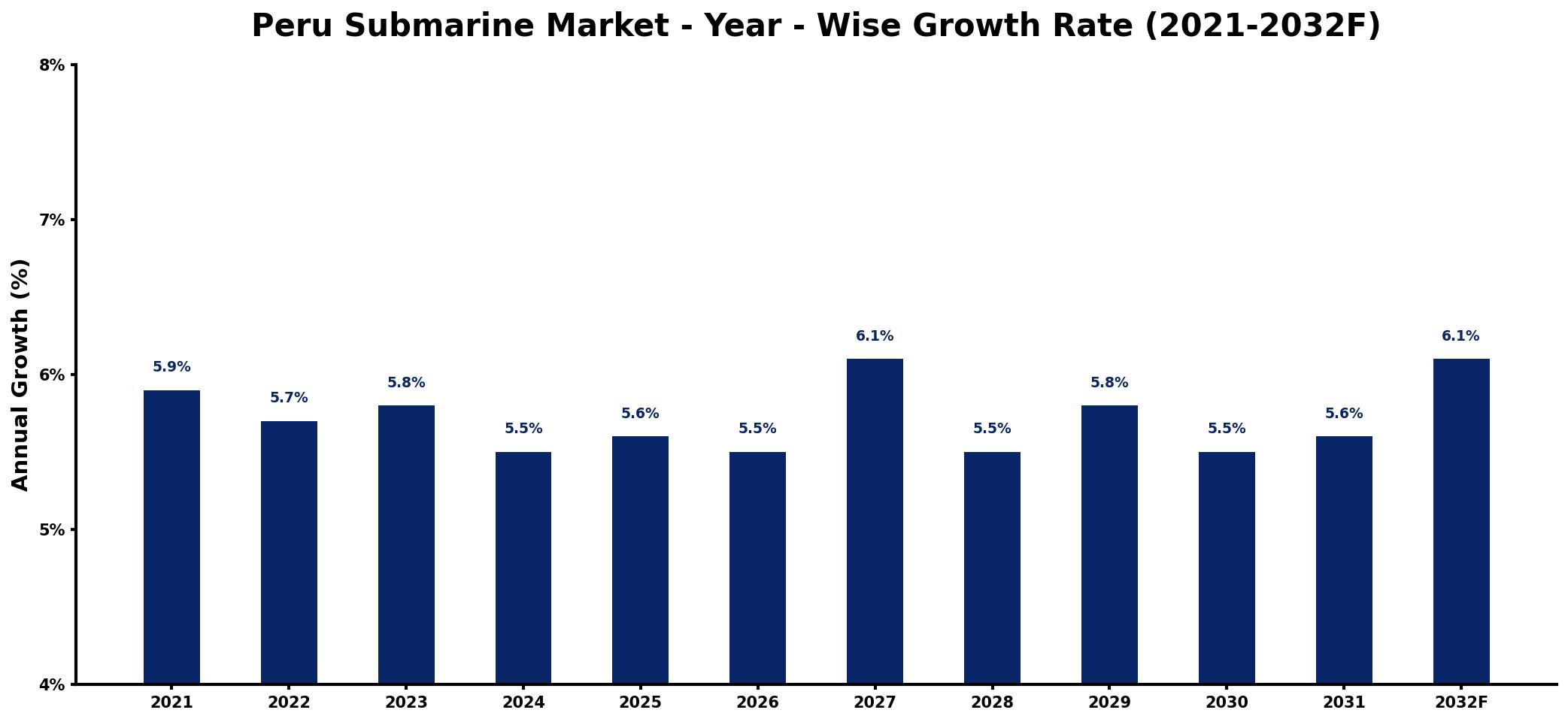
The table below presents the year‑wise growth rates along with the key drivers influencing the market
| Year | Growth Rate | Major Drivers |
| 2021 | 5.9% | Rising defense spending initiatives |
| 2022 | 5.7% | Increased maritime security concerns |
| 2023 | 5.8% | Growth in underwater research projects |
| 2024 | 5.5% | Expansion of naval capabilities |
| 2025 | 5.6% | Investment in advanced technologies |
| 2026 | 5.5% | Surge in strategic partnerships |
| 2027 | 6.1% | Development of new naval bases |
| 2028 | 5.5% | Enhanced regional cooperation agreements |
| 2029 | 5.8% | Focus on environmental monitoring efforts |
| 2030 | 5.5% | Growing interest in exploration missions |
| 2031 | 5.6% | Strengthening of supply chain networks |
| 2032 | 6.1% | Emergence of private sector investments |
Note: Market size estimations and growth projections presented in this report are based on 6Wresearch's proprietary forecasting methodology, utilizing the latest available industry data, government publications, and primary research inputs.
Peru Submarine Market Synopsis
Recent momentum in the Peru submarine market reflects a strategic pivot towards enhancing maritime defense capabilities. The governments commitment to upgrading its fleet is evident, with a blend of both domestic and international submarine procurement efforts underway. This initiative is a response to evolving threats and a proactive approach to securing maritime interests.
As the country navigates the complexities of regional security dynamics, the focus remains on integrating advanced technologies and enhancing operational readiness. Collaboration with international partners is becoming increasingly critical to ensure that Peru's submarine capabilities remain modern and effective, positioning the nation favorably in defense preparedness.
Peru Submarine Market Key Takeaways
- The market is characterized by strategic investments in submarine modernization and procurement.
- Geopolitical tensions are driving demand for advanced submarine technology.
- Partnerships with international defense contractors are essential for capability enhancement.
- Environmental sustainability is gaining prominence in submarine design and operation.
- Challenges such as budget constraints necessitate strategic planning in defense investments.
Evaluation of Restraints in Peru Submarine Market
The Peru submarine market faces several real restraints that may hinder its potential. A critical concern is the limited budget for defense spending, which can restrict the acquisition of new submarine technologies and the necessary upgrades to existing assets. Additionally, reliance on foreign suppliers for technological advancements and maintenance poses risks, as it may complicate logistics and increase operational costs. The fluctuating political landscape also introduces uncertainties, impacting long-term investments and stability in planning. Thus, a comprehensive approach that addresses budget allocations and fosters domestic capabilities is vital for enhancing Peru's submarine readiness.
Peru Submarine Market Trends
A notable trend in the Peru submarine market is the increasing demand for submarines equipped with advanced stealth features and sophisticated weapon systems. This focus aims to bolster the country's ability to monitor and protect its maritime borders. Furthermore, there is a shift towards incorporating sustainable technologies in submarine operations, reflecting a broader global emphasis on environmental responsibility. As Peru seeks to modernize its naval fleet, the interest in cutting-edge communication systems also rises, ensuring that submarines can operate effectively within joint military frameworks and coordinate seamlessly with allied forces.
Peru Submarine Market Opportunities
The Peru submarine market offers several investment opportunities for companies engaged in defense technology and maritime security. Key areas of interest include the supply of advanced submarines and critical components, as well as maintenance services that support operational readiness. Training programs for submarine operators present additional opportunities, enhancing the skill set required to operate sophisticated naval assets. Collaborating with local defense contractors or government agencies through joint ventures can facilitate entry into this market, providing strategic advantages and aligning with national defense goals.
Government Initiatives in the Peru Submarine Market
Government policies regarding the Peru submarine market emphasize strengthening naval capabilities through strategic funding and international collaboration. By allocating resources to modernize its submarine fleet, the Peruvian government aims to enhance maritime security and operational effectiveness. The government also promotes partnerships with international defense manufacturers, facilitating access to advanced technology and expertise. Additionally, regulations fostering domestic production support local industries, ensuring that Peru can maintain and innovate its submarine capabilities over the long term.
Future Insights of the Peru Submarine Market
Looking ahead to 2026-2032, the Peru submarine market is set for steady growth fueled by increasing defense budgets and a sustained commitment to fleet modernization. The strategic acquisition of new submarines and the emphasis on maintaining existing assets will be pivotal in driving market expansion. Geopolitical dynamics and the imperative to protect maritime resources will continue to drive demand for advanced submarine technologies. Anticipated collaborations with international defense suppliers are expected to enhance operational capabilities, ensuring that Peru is well-equipped to navigate evolving security challenges in the region.
Peru Submarine Market Latest Developments (2025 - 2026)
Recent developments in the Peru submarine market highlight a strategic push towards modernization and technological innovation. The Peruvian government has initiated several projects aimed at upgrading its existing fleet, with particular emphasis on stealth capabilities and advanced weaponry. Additionally, partnerships with international manufacturers are being explored to facilitate knowledge transfer and bolster local production capabilities. Ongoing training programs for personnel are also being prioritized to ensure operational readiness and technical proficiency.
Peru Submarine Market - Key Attractiveness of the Report
- 10 Years of Market Numbers
- Historical Data Starting from 2022 to 2025
- Base Year: 2025
- Forecast Data until 2032
- Key Performance Indicators Impacting the Market
- Major Upcoming Developments and Projects
Key Highlights of the Report:
- Peru Submarine Market Outlook
- Market Size of Peru Submarine Market, 2025
- Forecast of Peru Submarine Market, 2032
- Historical Data and Forecast of Peru Submarine Revenues & Volume for the Period 2022-2032F
- Peru Submarine Market Trend Evolution
- Peru Submarine Market Drivers and Challenges
- Peru Submarine Price Trends
- Peru Submarine Porter's Five Forces
- Peru Submarine Industry Life Cycle
- Historical Data and Forecast of Peru Submarine Market Revenues & Volume By Type for the Period 2022-2032F
- Historical Data and Forecast of Peru Submarine Market Revenues & Volume By Nuclear Powered Submarine for the Period 2022-2032F
- Historical Data and Forecast of Peru Submarine Market Revenues & Volume By Diesel Electric Submarine & Ballistic Missile Submarine for the Period 2022-2032F
- Historical Data and Forecast of Peru Submarine Market Revenues & Volume By Application for the Period 2022-2032F
- Historical Data and Forecast of Peru Submarine Market Revenues & Volume By Surveillance for the Period 2022-2032F
- Historical Data and Forecast of Peru Submarine Market Revenues & Volume By Combat for the Period 2022-2032F
- Historical Data and Forecast of Peru Submarine Market Revenues & Volume By Marine Environmental Monitoring for the Period 2022-2032F
- Historical Data and Forecast of Peru Submarine Market Revenues & Volume By Detection Of Oil Resources for the Period 2022-2032F
- Historical Data and Forecast of Peru Submarine Market Revenues & Volume By Scientific Research for the Period 2022-2032F
- Historical Data and Forecast of Peru Submarine Market Revenues & Volume By Others for the Period 2022-2032F
- Historical Data and Forecast of Peru Submarine Market Revenues & Volume By Platform for the Period 2022-2032F
- Historical Data and Forecast of Peru Submarine Market Revenues & Volume By Commercial for the Period 2022-2032F
- Historical Data and Forecast of Peru Submarine Market Revenues & Volume By Military for the Period 2022-2032F
- Peru Submarine Import Export Trade Statistics
- Market Opportunity Assessment By Type
- Market Opportunity Assessment By Application
- Market Opportunity Assessment By Platform
- Peru Submarine Top Companies Market Share
- Peru Submarine Competitive Benchmarking By Technical and Operational Parameters
- Peru Submarine Company Profiles
- Peru Submarine Key Strategic Recommendations






































