Peru Veterinary Vaccines Market Size, Share & Growth Rate
The Peru Veterinary Vaccines Market was estimated at USD 428 Million in 2025 and is projected to reach USD 600 Million by 2032, growing at a CAGR of 4.9% from 2026 to 2032. This growth trajectory is fueled by a rising consciousness about animal health among pet owners and livestock farmers, alongside robust government initiatives aimed at disease control. The increasing consumption of animal protein products further amplifies the demand for effective veterinary vaccines, positioning this market for sustained expansion.
Peru Veterinary Vaccines Market Growth Rate Analysis (2021-2032)
The Peru veterinary vaccines market displays a stable growth pattern, with annual increases averaging around 6.1% in 2021, gradually adjusting to 5.6% in 2023 before recovering to 6.0% in 2024 and 6.1% in 2025. This growth can be attributed to rising investments in livestock health and agricultural policies aimed at enhancing food security. Additionally, increased consumer demand for quality animal products fuels the need for effective vaccination strategies, particularly as the industry adapts to challenges posed by infectious diseases. Despite minor fluctuations, the overall trend remains robust, supported by ongoing advancements in veterinary technologies and a focus on sustainable practices across Peru’s agricultural landscape.
Peru Veterinary Vaccines Market Year-wise Growth Rate and Key Drivers
This graph highlights how the Peru Veterinary Vaccines Market has steadily grown over the past five years, supported by major growth factors.
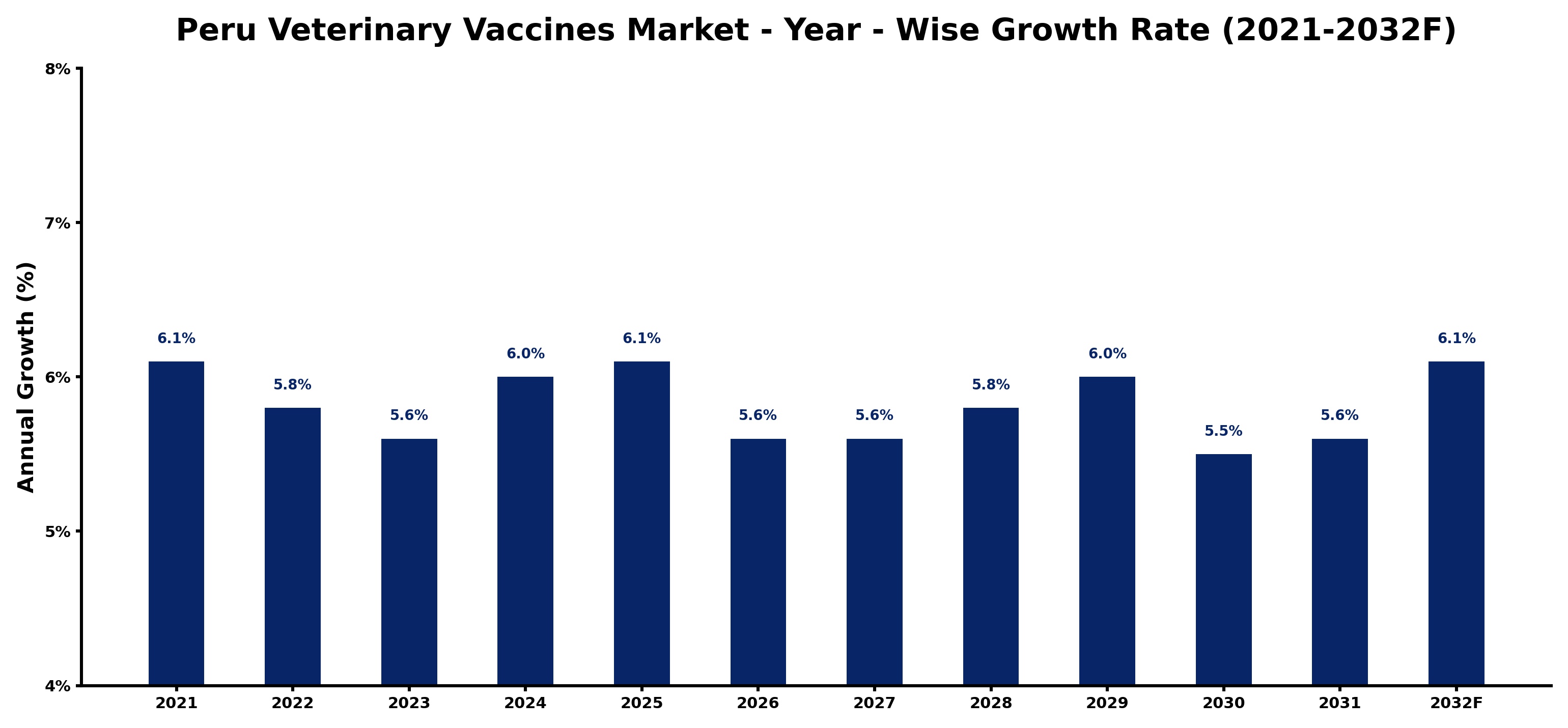
The table below presents the year‑wise growth rates along with the key drivers influencing the market
| Year | Growth Rate | Major Drivers |
| 2021 | 6.1% | Increasing adoption of advanced technologies |
| 2022 | 5.8% | Rising electricity demand across industries |
| 2023 | 5.6% | Increasing adoption of advanced technologies |
| 2024 | 6.0% | Government infrastructure modernization initiatives |
| 2025 | 6.1% | Increasing industrial infrastructure investments |
| 2026 | 5.6% | Expansion of manufacturing activities |
| 2027 | 5.6% | Government infrastructure modernization initiatives |
| 2028 | 5.8% | Expansion of manufacturing activities |
| 2029 | 6.0% | Increasing industrial infrastructure investments |
| 2030 | 5.5% | Expansion of commercial construction activities |
| 2031 | 5.6% | Increasing industrial automation investments |
| 2032 | 6.1% | Growing urbanization and commercial development |
Note - Market size estimations and growth projections presented in this report are based on 6Wresearch’s advanced forecasting approach, validated with industry datasets as of June 2026.
Peru Veterinary Vaccines Market Synopsis
The most significant force shaping the Peru Veterinary Vaccines Market is the escalating need for effective disease prevention among both pets and livestock. With a surge in pet ownership and heightened awareness regarding zoonotic diseases, there is a clear shift towards prioritizing animal health. This awareness translates into an increased willingness to invest in veterinary vaccines, reflecting an evolving mindset among consumers and industry stakeholders alike.
Simultaneously, advancements in biotechnology are enabling the development of innovative vaccines that promise enhanced efficacy and safety. Government support further strengthens this market landscape, promoting the adoption of vaccination programs to mitigate disease prevalence, thereby ensuring both animal welfare and public health.
Peru Veterinary Vaccines Market Key Takeaways
- The Peru Veterinary Vaccines Market is on a steady growth path, driven by rising animal healthcare awareness.
- Technological advancements are leading to more effective and safer vaccines with fewer side effects.
- Government initiatives are critical in promoting vaccination for disease prevention.
- The demand for animal protein products is pushing the need for enhanced livestock health management.
- Challenges related to vaccine accessibility in rural regions are being addressed through targeted educational campaigns.
Evaluation of Restraints in Peru Veterinary Vaccines Market
Despite its promising outlook, the Peru Veterinary Vaccines Market faces notable restraints. A significant challenge is the limited awareness among smaller livestock farmers regarding the critical importance of vaccinations, which can lead to suboptimal vaccination rates in rural areas. Additionally, the high costs associated with vaccines often restrict accessibility for farmers with tight budgets. Coupled with complex regulatory processes that hinder the swift entry of new vaccines, these factors pose considerable obstacles that require strategic interventions to improve overall market dynamics.
Peru Veterinary Vaccines Market Trends
Current trends in the Peru Veterinary Vaccines Market reveal a notable shift towards advanced vaccines designed to combat not only conventional diseases but also zoonotic infections. There is an increasing focus on developing vaccines that minimize side effects while maximizing efficacy. Additionally, the uptick in pet ownership is driving demand for companion animal vaccines, with both pet owners and farmers becoming increasingly proactive in recognizing the significance of regular vaccinations to ensure health and productivity.
Peru Veterinary Vaccines Market Opportunities
The Peru Veterinary Vaccines Market presents compelling investment opportunities, particularly in the realms of research and development for innovative vaccines. As awareness regarding animal healthcare continues to grow, stakeholders can capitalize on this trend by developing targeted vaccines addressing specific regional health challenges. Establishing collaborations with local veterinary clinics and enhancing distribution networks to reach underserved rural markets also represent significant avenues for growth. Moreover, tapping into the expanding livestock sector will further bolster opportunities for market players.
Government Initiatives in the Peru Veterinary Vaccines Market
The Peruvian government plays a pivotal role in regulating the veterinary vaccines market, primarily through the National Agricultural Health Service (SENASA), which oversees the registration and approval of vaccines. Policies are designed to ensure safety and efficacy, while also promoting the usage of vaccines among livestock and companion animals. Government initiatives aimed at enhancing animal health standards align with global trends towards sustainable agriculture, demonstrating a commitment to improving public health and animal welfare through improved vaccination practices.
Future Insights of the Peru Veterinary Vaccines Market
Looking ahead, the Peru Veterinary Vaccines Market is poised for significant evolution from 2026 to 2032, driven by increasing demand for animal healthcare products. The dual rise in pet ownership and concern over zoonotic diseases will continue to bolster market growth. Moreover, the integration of advanced technologies in vaccine development is expected to yield more efficient products, while the government's focus on promoting animal welfare through vaccination will catalyze further expansion. Consequently, key industry players will find ample opportunities to innovate and thrive in this rapidly evolving landscape.
Peru Veterinary Vaccines Market Latest Developments (May 2025 - June 2026)
In recent months, there have been significant movements within the Peru Veterinary Vaccines Market, with a notable increase in public awareness campaigns aimed at educating both pet owners and livestock farmers on the importance of vaccinations. Additionally, there is an ongoing push for collaboration between private companies and government entities to facilitate research initiatives that focus on disease prevention in animals. These developments reflect a growing commitment to strengthening the framework of veterinary health care in Peru.
Peru Veterinary Vaccines Market - Key Attractiveness of the Report
- 10 Years of Market Numbers
- Historical Data Starting from 2022 to 2025
- Base Year: 2025
- Forecast Data until 2032
- Key Performance Indicators Impacting the Market
- Major Upcoming Developments and Projects
Key Highlights of the Report:
- Peru Veterinary Vaccines Market Outlook
- Market Size of Peru Veterinary Vaccines Market, 2025
- Forecast of Peru Veterinary Vaccines Market, 2032F
- Historical Data and Forecast of Peru Veterinary Vaccines Revenues & Volume for the Period 2022-2032F
- Peru Veterinary Vaccines Market Trend Evolution
- Peru Veterinary Vaccines Market Drivers and Challenges
- Peru Veterinary Vaccines Price Trends
- Peru Veterinary Vaccines Porter's Five Forces
- Peru Veterinary Vaccines Industry Life Cycle
- Historical Data and Forecast of Peru Veterinary Vaccines Market Revenues & Volume By Type for the Period 2022-2032F
- Historical Data and Forecast of Peru Veterinary Vaccines Market Revenues & Volume By Porcine Vaccines for the Period 2022-2032F
- Historical Data and Forecast of Peru Veterinary Vaccines Market Revenues & Volume By Poultry Vaccine for the Period 2022-2032F
- Historical Data and Forecast of Peru Veterinary Vaccines Market Revenues & Volume By Livestock Vaccine for the Period 2022-2032F
- Historical Data and Forecast of Peru Veterinary Vaccines Market Revenues & Volume By Companion Animal Vaccine for the Period 2022-2032F
- Historical Data and Forecast of Peru Veterinary Vaccines Market Revenues & Volume By Aquaculture Vaccines for the Period 2022-2032F
- Historical Data and Forecast of Peru Veterinary Vaccines Market Revenues & Volume By Other Animal Vaccines for the Period 2022-2032F
- Historical Data and Forecast of Peru Veterinary Vaccines Market Revenues & Volume By Disease for the Period 2022-2032F
- Historical Data and Forecast of Peru Veterinary Vaccines Market Revenues & Volume By Porcine for the Period 2022-2032F
- Historical Data and Forecast of Peru Veterinary Vaccines Market Revenues & Volume By Poultry for the Period 2022-2032F
- Historical Data and Forecast of Peru Veterinary Vaccines Market Revenues & Volume By Livestock for the Period 2022-2032F
- Historical Data and Forecast of Peru Veterinary Vaccines Market Revenues & Volume By Companion Animal for the Period 2022-2032F
- Historical Data and Forecast of Peru Veterinary Vaccines Market Revenues & Volume By Aquaculture for the Period 2022-2032F
- Historical Data and Forecast of Peru Veterinary Vaccines Market Revenues & Volume By Technology for the Period 2022-2032F
- Historical Data and Forecast of Peru Veterinary Vaccines Market Revenues & Volume By Live Attenuated Vaccines for the Period 2022-2032F
- Historical Data and Forecast of Peru Veterinary Vaccines Market Revenues & Volume By Inactivated Vaccines for the Period 2022-2032F
- Historical Data and Forecast of Peru Veterinary Vaccines Market Revenues & Volume By Toxoid Vaccines for the Period 2022-2032F
- Historical Data and Forecast of Peru Veterinary Vaccines Market Revenues & Volume By Recombinant Vaccines for the Period 2022-2032F
- Historical Data and Forecast of Peru Veterinary Vaccines Market Revenues & Volume By Other Vaccines for the Period 2022-2032F
- Peru Veterinary Vaccines Import Export Trade Statistics
- Market Opportunity Assessment By Type
- Market Opportunity Assessment By Disease
- Market Opportunity Assessment By Technology
- Peru Veterinary Vaccines Top Companies Market Share
- Peru Veterinary Vaccines Competitive Benchmarking By Technical and Operational Parameters
- Peru Veterinary Vaccines Company Profiles
- Peru Veterinary Vaccines Key Strategic Recommendations






































