Philippines 300cc Motorcycle Market (2026-2032) | Competitive, Pricing Analysis, Growth, Industry, Segmentation, Restraints, Strategic Insights, Competition, Strategy, Trends, Challenges, Revenue, Drivers, Share, Consumer Insights, Demand, Size, Outlook, Investment Trends, Analysis, Opportunities, Supply, Value, Segments, Companies, Forecast
Market Forecast By Engine Type (Single-Cylinder, Multi- Cylinder), By Application (Sports, Commuting, Touring), By Fuel Type (Petrol, Diesel), By Distribution Channel (Online, Offline) And Competitive Landscape
| Product Code: ETC11434657 | Publication Date: Apr 2025 | Updated Date: May 2026 | Product Type: Market Research Report | |
| Publisher: 6Wresearch | Author: Bhawna Singh | No. of Pages: 65 | No. of Figures: 34 | No. of Tables: 19 |
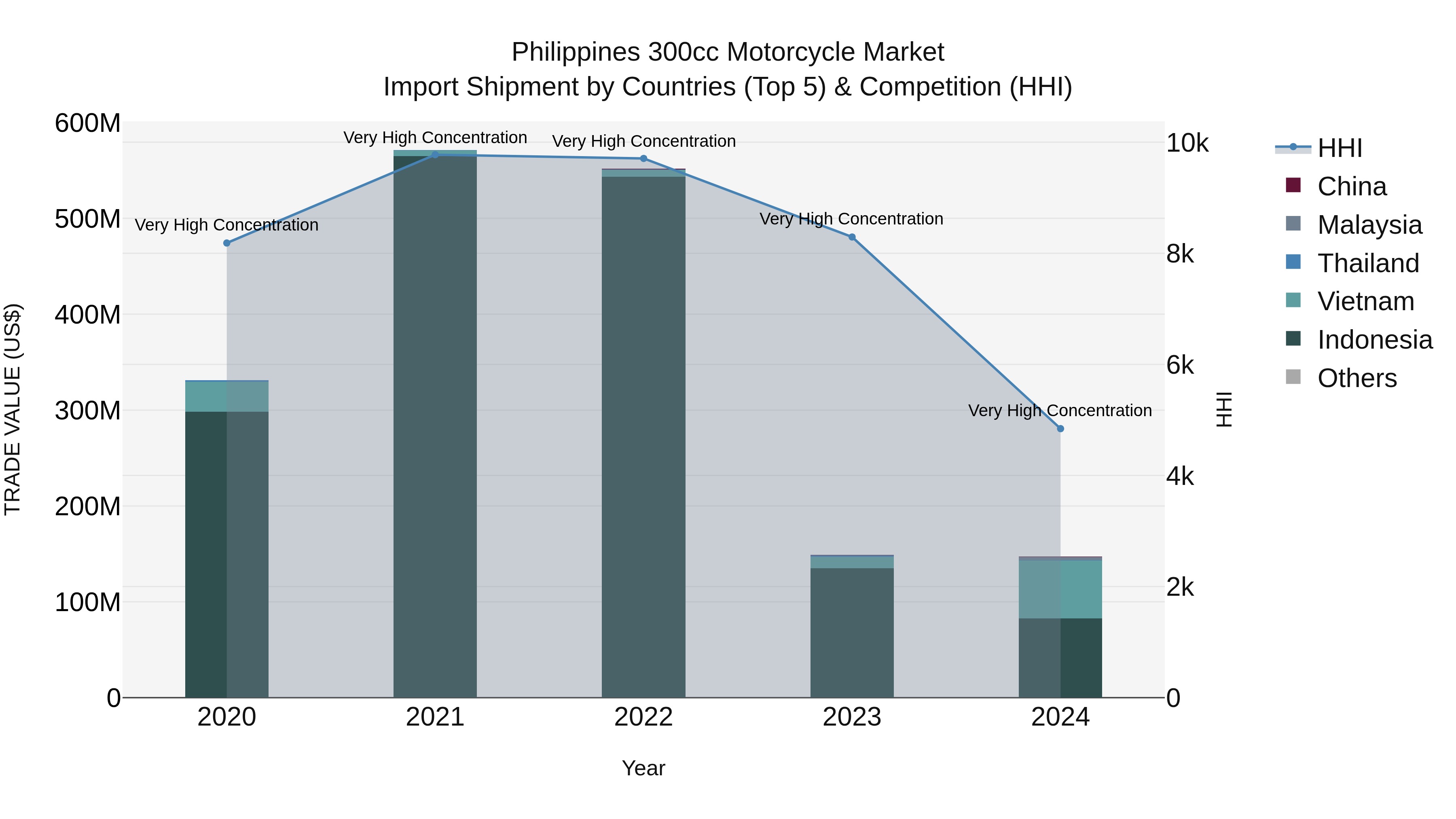
Philippines 300Cc Motorcycle Market Top 5 Importing Countries and Market Competition (HHI) Analysis
Despite a decline in the growth rate of 300cc motorcycle imports to the Philippines in 2024, the market remains highly concentrated, with top exporters being Indonesia, Vietnam, Malaysia, Thailand, and China. The negative compound annual growth rate (CAGR) from 2020 to 2024 indicates challenges in this segment. However, the slight improvement in the growth rate from 2023 to 2024 may suggest a potential stabilization or recovery in the market. Monitoring how market dynamics evolve in the coming years will be crucial for industry players to adapt their strategies accordingly.
Philippines 300cc Motorcycle Market Growth Rate
According to 6Wresearch internal database and industry insights, the Philippines 300cc Motorcycle Market is projected to grow at a compound annual growth rate (CAGR) of 7.1% during the forecast period from 2026 to 2032.
Topics Covered in the Philippines 300cc Motorcycle Market Report
The Philippines 300cc Motorcycle Market report thoroughly covers the market by engine type, application, fuel type, and distribution channel, providing an unbiased and detailed analysis of ongoing market trends, opportunities, challenges, and market drivers, helping stakeholders align their strategies with current and future market dynamics.
Philippines 300cc Motorcycle Market Highlights
| Report Name |
Philippines 300cc Motorcycle Market |
| Forecast period | 2026-2032 |
| CAGR | 7.1% |
| Market Size |
300cc Motorcycles |
Philippines 300cc Motorcycle Market Synopsis
The Philippines 300cc Motorcycle Market is experiencing strong growth, driven by rising demand for high-performance motorcycles for commuting, sports, and touring, while increasing urban congestion, along with growing disposable incomes, is encouraging adoption and technological innovations in engine design, fuel efficiency, and digital instrument clusters are further supporting market development. The versatility of 300cc motorcycles, serving both daily commuting and recreational riding needs, continues to reinforce market expansion and these factors collectively position the market for sustained growth and long-term opportunities in the Philippines.
Evaluation of Growth Drivers in the Philippines 300cc Motorcycle Market (2026- 2032)
Below mentioned are some prominent drivers and their impact on the market dynamics:
| Drivers | Primary Segments Affected | Why It Matters (Evidence) |
| Increasing Urban Commuting Needs | Single-Cylinder, Petrol | Motorcycles provide a cost-effective and faster alternative to cars in congested urban areas. |
| Growing Popularity of Sports Bikes | Multi-Cylinder, Sports | Young consumers prefer high-performance motorcycles for leisure and recreational use. |
| Technological Advancements | Single-Cylinder, Multi-Cylinder | Improved engine performance and better fuel efficiency lead to better experiences for riders which results in higher adoption rates. |
| Government Incentives | Petrol, Diesel | Tax incentives and fuel-efficient motorcycle subsidy programs create economic growth in the market. |
| Rise of Delivery Services | Commuting, Touring | Growing e-commerce has increased demand for motorcycles in logistics and delivery applications. |
The Philippines 300cc Motorcycle Market Size is projected to grow at a CAGR of 7.1% from 2026 to 2032. The Philippines 300cc Motorcycle Market continues expanding, fueled by increasing urban commuting needs, sports and recreational usage, and the adoption of technologically advanced engines, while, the rise of fuel-efficient and eco-friendly motorcycles is creating broader market opportunities thus consumer trends emphasizing convenience, performance, and style are further driving adoption together, these factors are accelerating market growth by meeting rising demand for reliable, high-quality, and versatile motorcycles as continued innovation, combined with shifting preferences and sustainable practices, positions the market for long-term development and increased consumer engagement across segments.
Evaluation of Restraints in the Philippines 300cc Motorcycle Market
Below mentioned are some major restraints and their influence on the market dynamics:
| Restraints | Primary Segments Affected | What This Means (Evidence) |
| High Ownership Costs | Multi-Cylinder, Sports | Premium motorcycles may limit access for budget-conscious consumers. |
| Road Safety Concerns | Single-Cylinder, Touring | People will not adopt the new technology as traffic accidents and protective gear knowledge shortages prevent them from doing so. |
| Regulatory Compliance | All Engine Types | The new emissions and safety regulations will result in higher expenses for companies. |
| Competing Public Transport | Commuting | The extensive presence of buses and jeepneys throughout the area will decrease the number of people who use motorcycles. |
| Fuel Price Volatility | Petrol | Fluctuating fuel prices could affect affordability and adoption. |
Philippines 300cc Motorcycle Market Challenges
The Philippines 300cc Motorcycle Industry faces multiple ongoing difficulties which include expensive premium motorcycles, safety issues and public transportation as their main competitor. The industry needs to educate riders about safe riding techniques while they work to make motorcycles more affordable and develop technologies which improve fuel efficiency and motorcycle performance. The three parties need to work together since they require manufacturing and dealership operations along with government agencies and also, they need to work together to develop successful strategies which will help them meet regulations while building consumer trust.
Philippines 300cc Motorcycle Market Trends
Here are some major trends changing the Philippines 300cc Motorcycle Market Growth dynamics:
- Advanced Engine Technologies – Introduction of fuel-injection and ABS systems is improving fuel efficiency and safety, encouraging adoption.
- Customization and Personalization – Consumers increasingly demand custom paint, decals, and aftermarket accessories for aesthetic appeal and performance enhancement.
- Electric Motorcycle Market Expansion – Environmental protection demands and demand for sustainable electric motorcycles create a new market trend which drives their market growth.
Investment Opportunities in the Philippines 300cc Motorcycle Market
The Philippines 300cc Motorcycle Market presents several investment opportunities, including:
- Advanced Engine Development – Manufacturers need to invest their research and development resources into fuel-efficient and high-performance engine technology as consumer demands are changing.
- E-Commerce Platform Expansion - E-commerce platforms will grow their business potential by creating better systems for online sales and delivery operations.
- Consumer Awareness Programs – consumer awareness programs will improve market penetration as they teach riders about safety procedures, bike maintenance and fuel-efficient riding methods.
Top 5 Leading Players in the Philippines 300cc Motorcycle Market
Below is the list of prominent companies leading the Philippines 300cc Motorcycle Market Share:
1. Honda Philippines, Inc.
| Company Name | Honda Philippines, Inc. |
|---|---|
| Established Year | 1990 |
| Headquarters | Manila, Philippines |
| Official Website | Click Here |
Honda Philippines is a leading motorcycle manufacturer offering a range of 300cc models, focusing on fuel efficiency, reliability, and innovative engine technology.
2. Yamaha Motor
| Company Name | Yamaha Motor |
|---|---|
| Established Year | 1960 |
| Headquarters | Makati, Philippines |
| Official Website | Click Here |
Yamaha specializes in sports and commuter motorcycles, providing high-performance engines and modern designs tailored for urban and recreational riders.
3. KTM Philippines
| Company Name | KTM Philippines |
|---|---|
| Established Year | 2010 |
| Headquarters | Quezon City, Philippines |
| Official Website | - |
KTM offers premium sports motorcycles with advanced engine technologies and customization options, catering to performance enthusiasts.
4. Suzuki Philippines
| Company Name | Suzuki Philippines |
|---|---|
| Established Year | 1950 |
| Headquarters | Manila, Philippines |
| Official Website | Click Here |
Suzuki provides a balanced portfolio of commuter and sports motorcycles, emphasizing affordability, fuel efficiency, and ease of use.
5. Kawasaki Motors Philippines
| Company Name | Kawasaki Motors Philippines |
|---|---|
| Established Year | 1970 |
| Headquarters | Pasig City, Philippines |
| Official Website | - |
Kawasaki is known for high-performance multi-cylinder motorcycles for sports and touring, combining speed, comfort, and advanced technology.
Government Regulations Introduced in the Philippines 300cc Motorcycle Market
According to Filipino government data, the Department of Transportation (DOTr) and Land Transportation Office (LTO) have implemented regulations ensuring motorcycles comply with safety and emission standards and initiatives like the Motorcycle Riding Safety Program and incentives for fuel-efficient motorcycles protect consumers, encourage responsible riding, and stimulate market growth and enhanced collaboration between government agencies and manufacturers strengthens compliance, innovation, and industry support. These programs collaborate together to ensure market stability, improve rider safety, and promote sustainable growth, positioning the Philippine motorcycle industry on a path for long-term development while addressing environmental and consumer needs.
Future Insights of the Philippines 300cc Motorcycle Market
The Future outlook for the Philippines 300cc Motorcycle Market is positive, driven by technological advancements, rising interest in sports and touring motorcycles, and greater adoption of eco-friendly engines and the growing consumer awareness of performance, safety, and comfort features, combined with increasing disposable incomes, is expected to boost demand as supportive government policies, improved infrastructure, and expanding distribution channels enhance accessibility, together, these factors suggest a stable, sustainable, and long-term growth trajectory for the industry, making it an attractive segment for manufacturers, dealers, and investors alike.
Market Segmentation Analysis
The report offers a comprehensive study of the following market segments and their leading categories:
By Engine Type – Single-Cylinder to Dominate the Market
According to Ritika Kalra, Senior Research Analyst, 6Wresearch, single-cylinder motorcycles are expected to dominate due to their affordability, fuel efficiency, and suitability for city commuting. These motorcycles are ideal for daily use and small-distance touring, appealing to cost-conscious urban riders.
By Application – Commuting to Dominate the Market
The growing urban traffic problems and need for budget-friendly travel options will make commuting motorcycles the primary choice for transportation and the recreational riding and long-distance travel needs of enthusiasts drive the rising popularity of sports and touring motorcycles.
By Fuel Type – Petrol to Dominate the Market
Petrol motorcycles will become the market leader as people can find them everywhere, their fueling stations exist and they have lower starting prices. The diesel motorcycle market exists as a specialized segment which caters to long-distance travel needs and heavy-duty motorcycle requirements.
By Distribution Channel – Offline to Dominate the Market
The market will be controlled by offline distribution channels which include dealerships and showrooms as customers need to test products and access after-sales support.
Key Attractiveness of the Report
- 10 Years of Market Numbers
- Historical Data Starting from 2022 to 2025
- Base Year: 2025
- Forecast Data until 2032
- Key Performance Indicators Impacting the Market
- Major Upcoming Developments and Projects
Key Highlights of the Report:
- Philippines 300cc Motorcycle Market Outlook
- Market Size of Philippines 300cc Motorcycle Market, 2025
- Forecast of Philippines 300cc Motorcycle Market, 2032
- Historical Data and Forecast of Philippines 300cc Motorcycle Revenues & Volume for the Period 2022 - 2032F
- Philippines 300cc Motorcycle Market Trend Evolution
- Philippines 300cc Motorcycle Market Drivers and Challenges
- Philippines 300cc Motorcycle Price Trends
- Philippines 300cc Motorcycle Porter's Five Forces
- Philippines 300cc Motorcycle Industry Life Cycle
- Historical Data and Forecast of Philippines 300cc Motorcycle Market Revenues & Volume By Engine Type for the Period 2022 - 2032F
- Historical Data and Forecast of Philippines 300cc Motorcycle Market Revenues & Volume By Single-Cylinder for the Period 2022 - 2032F
- Historical Data and Forecast of Philippines 300cc Motorcycle Market Revenues & Volume By Multi- Cylinder for the Period 2022 - 2032F
- Historical Data and Forecast of Philippines 300cc Motorcycle Market Revenues & Volume By Application for the Period 2022 - 2032F
- Historical Data and Forecast of Philippines 300cc Motorcycle Market Revenues & Volume By Sports for the Period 2022 - 2032F
- Historical Data and Forecast of Philippines 300cc Motorcycle Market Revenues & Volume By Commuting for the Period 2022 - 2032F
- Historical Data and Forecast of Philippines 300cc Motorcycle Market Revenues & Volume By Touring for the Period 2022 - 2032F
- Historical Data and Forecast of Philippines 300cc Motorcycle Market Revenues & Volume By Fuel Type for the Period 2022 - 2032F
- Historical Data and Forecast of Philippines 300cc Motorcycle Market Revenues & Volume By Petrol for the Period 2022 - 2032F
- Historical Data and Forecast of Philippines 300cc Motorcycle Market Revenues & Volume By Diesel for the Period 2022 - 2032F
- Historical Data and Forecast of Philippines 300cc Motorcycle Market Revenues & Volume By Distribution Channel for the Period 2022 - 2032F
- Historical Data and Forecast of Philippines 300cc Motorcycle Market Revenues & Volume By Online for the Period 2022 - 2032F
- Historical Data and Forecast of Philippines 300cc Motorcycle Market Revenues & Volume By Offline for the Period 2022 - 2032F
- Philippines 300cc Motorcycle Import Export Trade Statistics
- Market Opportunity Assessment By Engine Type
- Market Opportunity Assessment By Application
- Market Opportunity Assessment By Fuel Type
- Market Opportunity Assessment By Distribution Channel
- Philippines 300cc Motorcycle Top Companies Market Share
- Philippines 300cc Motorcycle Competitive Benchmarking By Technical and Operational Parameters
- Philippines 300cc Motorcycle Company Profiles
- Philippines 300cc Motorcycle Key Strategic Recommendations
Market Covered
The report offers a comprehensive study of the subsequent market segments:
By Engine Type
- Single-Cylinder
- Multi-Cylinder
By Application
- Sports
- Commuting
- Touring
By Fuel Type
- Petrol
- Diesel
By Distribution Channel
- Online
- Offline
Philippines 300cc Motorcycle Market (2026-2032): FAQs
The market is projected to grow at a CAGR of 7.1% between 2026–2032.
Single-cylinder motorcycles are expected to dominate due to affordability and fuel efficiency.
The main areas of growth for the company include electric and hybrid motorcycles, advanced engine research and development, e-commerce expansion, and the production of customized motorcycles.
Programs like Motorcycle Riding Safety Initiative and incentives for fuel-efficient motorcycles support market expansion.
6Wresearch actively monitors the Philippines 300cc Motorcycle Market and publishes its comprehensive annual report, highlighting emerging trends, growth drivers, revenue analysis, and forecast outlook. Our insights help businesses to make data-backed strategic decisions with ongoing market dynamics. Our analysts track relevent industries related to the Philippines 300cc Motorcycle Market, allowing our clients with actionable intelligence and reliable forecasts tailored to emerging regional needs.
Yes, we provide customisation as per your requirements. To learn more, feel free to contact us on sales@6wresearch.com
| 1 Executive Summary |
| 2 Introduction |
| 2.1 Key Highlights of the Report |
| 2.2 Report Description |
| 2.3 Market Scope & Segmentation |
| 2.4 Research Methodology |
| 2.5 Assumptions |
| 3 Philippines 300cc Motorcycle Market Overview |
| 3.1 Philippines Country Macro Economic Indicators |
| 3.2 Philippines 300cc Motorcycle Market Revenues & Volume, 2022 & 2032F |
| 3.3 Philippines 300cc Motorcycle Market - Industry Life Cycle |
| 3.4 Philippines 300cc Motorcycle Market - Porter's Five Forces |
| 3.5 Philippines 300cc Motorcycle Market Revenues & Volume Share, By Engine Type, 2022 & 2032F |
| 3.6 Philippines 300cc Motorcycle Market Revenues & Volume Share, By Application, 2022 & 2032F |
| 3.7 Philippines 300cc Motorcycle Market Revenues & Volume Share, By Fuel Type, 2022 & 2032F |
| 3.8 Philippines 300cc Motorcycle Market Revenues & Volume Share, By Distribution Channel, 2022 & 2032F |
| 4 Philippines 300cc Motorcycle Market Dynamics |
| 4.1 Impact Analysis |
| 4.2 Market Drivers |
| 4.2.1 Increasing demand for affordable transportation solutions in urban areas of the Philippines |
| 4.2.2 Growth in disposable income and purchasing power of the middle-class population |
| 4.2.3 Rising popularity of motorcycling as a recreational activity and means of commuting |
| 4.3 Market Restraints |
| 4.3.1 Stringent government regulations and policies related to motorcycle safety and emissions standards |
| 4.3.2 Competition from other modes of transportation such as public buses and ride-sharing services |
| 5 Philippines 300cc Motorcycle Market Trends |
| 6 Philippines 300cc Motorcycle Market, By Types |
| 6.1 Philippines 300cc Motorcycle Market, By Engine Type |
| 6.1.1 Overview and Analysis |
| 6.1.2 Philippines 300cc Motorcycle Market Revenues & Volume, By Engine Type, 2022 - 2032F |
| 6.1.3 Philippines 300cc Motorcycle Market Revenues & Volume, By Single-Cylinder, 2022 - 2032F |
| 6.1.4 Philippines 300cc Motorcycle Market Revenues & Volume, By Multi- Cylinder, 2022 - 2032F |
| 6.2 Philippines 300cc Motorcycle Market, By Application |
| 6.2.1 Overview and Analysis |
| 6.2.2 Philippines 300cc Motorcycle Market Revenues & Volume, By Sports, 2022 - 2032F |
| 6.2.3 Philippines 300cc Motorcycle Market Revenues & Volume, By Commuting, 2022 - 2032F |
| 6.2.4 Philippines 300cc Motorcycle Market Revenues & Volume, By Touring, 2022 - 2032F |
| 6.3 Philippines 300cc Motorcycle Market, By Fuel Type |
| 6.3.1 Overview and Analysis |
| 6.3.2 Philippines 300cc Motorcycle Market Revenues & Volume, By Petrol, 2022 - 2032F |
| 6.3.3 Philippines 300cc Motorcycle Market Revenues & Volume, By Diesel, 2022 - 2032F |
| 6.4 Philippines 300cc Motorcycle Market, By Distribution Channel |
| 6.4.1 Overview and Analysis |
| 6.4.2 Philippines 300cc Motorcycle Market Revenues & Volume, By Online, 2022 - 2032F |
| 6.4.3 Philippines 300cc Motorcycle Market Revenues & Volume, By Offline, 2022 - 2032F |
| 7 Philippines 300cc Motorcycle Market Import-Export Trade Statistics |
| 7.1 Philippines 300cc Motorcycle Market Export to Major Countries |
| 7.2 Philippines 300cc Motorcycle Market Imports from Major Countries |
| 8 Philippines 300cc Motorcycle Market Key Performance Indicators |
| 8.1 Average age of motorcycles in operation in the Philippines |
| 8.2 Number of new motorcycle registrations in the 300cc category |
| 8.3 Frequency of motorcycle events and rallies in the Philippines |
| 9 Philippines 300cc Motorcycle Market - Opportunity Assessment |
| 9.1 Philippines 300cc Motorcycle Market Opportunity Assessment, By Engine Type, 2022 & 2032F |
| 9.2 Philippines 300cc Motorcycle Market Opportunity Assessment, By Application, 2022 & 2032F |
| 9.3 Philippines 300cc Motorcycle Market Opportunity Assessment, By Fuel Type, 2022 & 2032F |
| 9.4 Philippines 300cc Motorcycle Market Opportunity Assessment, By Distribution Channel, 2022 & 2032F |
| 10 Philippines 300cc Motorcycle Market - Competitive Landscape |
| 10.1 Philippines 300cc Motorcycle Market Revenue Share, By Companies, 2025 |
| 10.2 Philippines 300cc Motorcycle Market Competitive Benchmarking, By Operating and Technical Parameters |
| 11 Company Profiles |
| 12 Recommendations |
| 13 Disclaimer |
Global Go To Market Strategy - 2030
Export potential enables firms to identify high-growth global markets with greater confidence by combining advanced trade intelligence with a structured quantitative methodology. The framework analyzes emerging demand trends and country-level import patterns while integrating macroeconomic and trade datasets such as GDP and population forecasts, bilateral import–export flows, tariff structures, elasticity differentials between developed and developing economies, geographic distance, and import demand projections. Using weighted trade values from 2020–2024 as the base period to project country-to-country export potential for 2030, these inputs are operationalized through calculated drivers such as gravity model parameters, tariff impact factors, and projected GDP per-capita growth. Through an analysis of hidden potentials, demand hotspots, and market conditions that are most favorable to success, this method enables firms to focus on target countries, maximize returns, and global expansion with data, backed by accuracy.
By factoring in the projected importer demand gap that is currently unmet and could be potential opportunity, it identifies the potential for the Exporter (Country) among 190 countries, against the general trade analysis, which identifies the biggest importer or exporter.
To discover high-growth global markets and optimize your business strategy:
Click Here
Pricing
- Single User License$ 1,995
- Department License$ 2,400
- Site License$ 3,120
- Global License$ 3,795

Leadership Perspectives from Industry Events
Search
Thought Leadership and Analyst Meet





Our Clients








6WResearch In News
- Doha a strategic location for EV manufacturing hub: IPA Qatar
- Demand for luxury TVs surging in the GCC, says Samsung
- Empowering Growth: The Thriving Journey of Bangladesh’s Cable Industry
- Demand for luxury TVs surging in the GCC, says Samsung
- Video call with a traditional healer? Once unthinkable, it’s now common in South Africa
- Intelligent Buildings To Smooth GCC’s Path To Net Zero
Latest Reports
- Cape Verde Portable Hand-Thrown Extinguisher Market (2026-2032)
- Canada Portable Hand-Thrown Extinguisher Market (2026-2032)
- Cameroon Portable Hand-Thrown Extinguisher Market (2026-2032)
- Burundi Portable Hand-Thrown Extinguisher Market (2026-2032)
- Burkina Faso Portable Hand-Thrown Extinguisher Market (2026-2032)
- Bulgaria Portable Hand-Thrown Extinguisher Market (2026-2032)
- Brunei Portable Hand-Thrown Extinguisher Market (2026-2032)
- Botswana Portable Hand-Thrown Extinguisher Market (2026-2032)
- Bosnia and Herzegovina Portable Hand-Thrown Extinguisher Market (2026-2032)
- Bolivia Portable Hand-Thrown Extinguisher Market (2026-2032)
Industry Events and Analyst Meet

HIMTEX 2026

India Refining Summit 2026

India EV Show 2026

EV tech India Expo 2026

Auto Tech Asia 2026
Whitepaper
- Middle East & Africa Commercial Security Market Click here to view more.
- Middle East & Africa Fire Safety Systems & Equipment Market Click here to view more.
- GCC Drone Market Click here to view more.
- Middle East Lighting Fixture Market Click here to view more.
- GCC Physical & Perimeter Security Market Click here to view more.


