Philippines 3D Printed Drones Market (2026-2032) | Investment Trends, Share, Size, Challenges, Strategy, Growth, Consumer Insights, Demand, Competitive, Companies, Revenue, Drivers, Competition, Opportunities, Outlook, Pricing Analysis, Forecast, Industry, Segments, Value, Strategic Insights, Supply, Segmentation, Analysis, Restraints, Trends
Market Forecast By Type (Fixed-Wing, Rotary-Wing, Hybrid), By Component (Airframe, Payload, Propulsion, Others), By Application (Military & Defense, Commercial, Consumer, Others) And Competitive Landscape
| Product Code: ETC11536609 | Publication Date: Apr 2025 | Updated Date: Jun 2026 | Product Type: Market Research Report | |
| Publisher: 6Wresearch | Author: Bhawna Singh | No. of Pages: 65 | No. of Figures: 34 | No. of Tables: 19 |
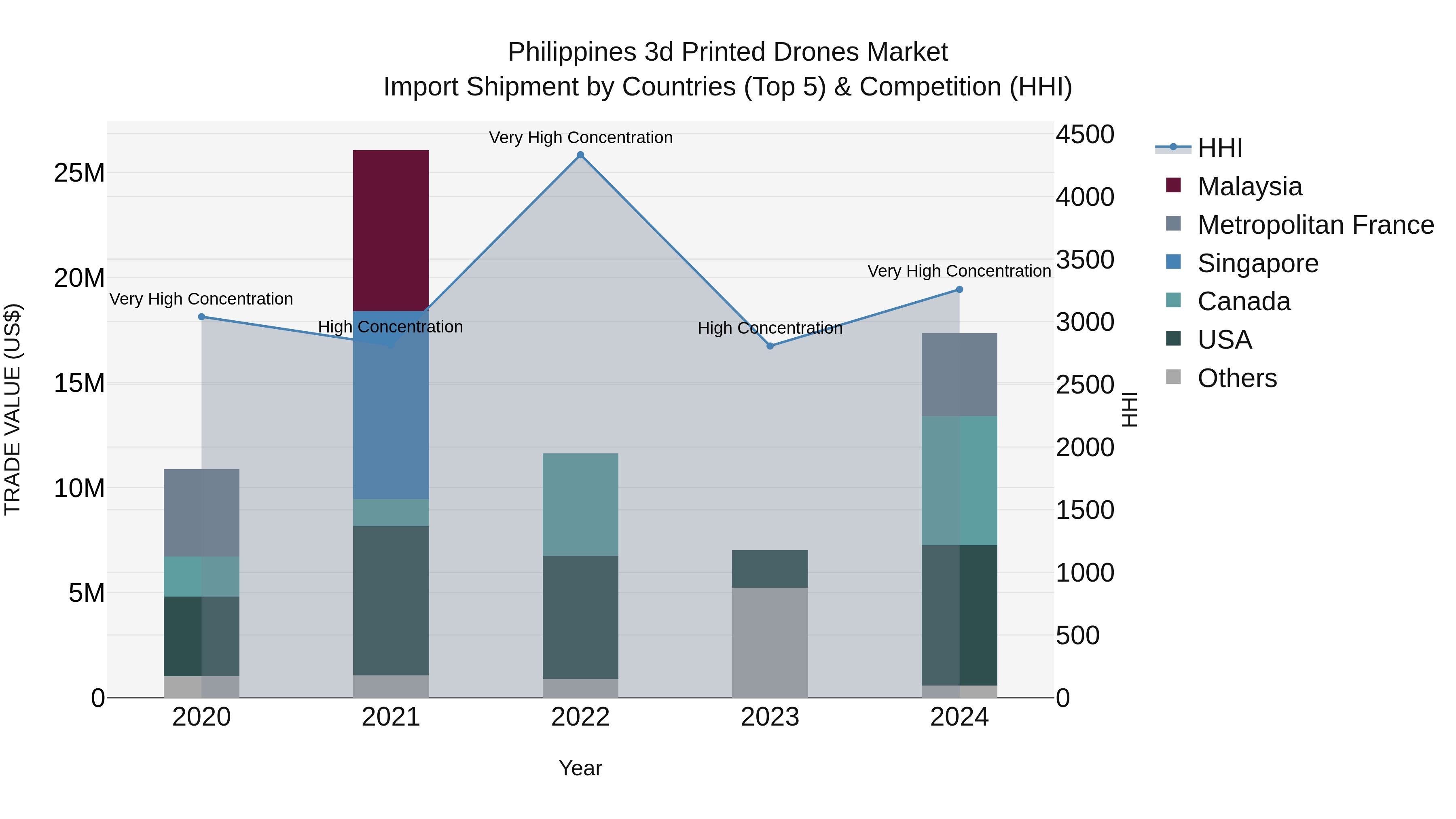
Philippines 3D Printed Drones Market Top 5 Importing Countries and Market Competition (HHI) Analysis
The Philippines saw a significant increase in import shipments of 3D printed drones in 2024, with top exporting countries being the USA, Canada, Metropolitan France, UK, and Marshall Islands. The market concentration, as measured by HHI, reached very high levels in 2024, indicating a competitive landscape dominated by a few key players. The impressive Compound Annual Growth Rate (CAGR) of 12.36% from 2020 to 2024 highlights the growing demand for this innovative technology. Moreover, the exceptional growth rate of 146.82% from 2023 to 2024 underscores the rapid expansion and adoption of 3D printed drones in the Philippines.
Philippines 3D Printed Drones Market Growth Rate
According to 6Wresearch internal database and industry insights, the Philippines 3D Printed Drones Market is projected to grow at a compound annual growth rate (CAGR) of 14.8% during the forecast period from 2026 to 2032.
Topics Covered in the Philippines 3D Printed Drones Market Report
The Philippines 3D Printed Drones Market report thoroughly covers the market by type, component, and application providing an unbiased and detailed analysis of ongoing market trends, opportunities, challenges, and market drivers, helping stakeholders align their strategies with current and future market dynamics.
Philippines 3D Printed Drones Market Highlights
| Report Name |
Philippines 3D Printed Drones Market |
| Forecast period | 2026-2032 |
| CAGR | 14.8% |
| Market Size |
3D Printed Drone Manufacturing |
Philippines 3D Printed Drones Market Synopsis
The Philippines 3D Printed Drones Market is witnessing rapid growth driven by increasing demand for cost-effective and lightweight unmanned aerial vehicles, rising adoption in defense surveillance and commercial applications, and advancements in additive manufacturing technologies, while the integration of AI-based flight control systems and real-time data analytics is enhancing drone performance and operational efficiency, and growing investments in local drone manufacturing along with government initiatives supporting indigenous production are further accelerating market expansion across various sectors in the Philippines today.
Evaluation of Growth Drivers in the Philippines 3D Printed Drones Market (2026-2032)
Below mentioned are some prominent drivers and their impact on the market dynamics:
| Drivers | Primary Segments Affected | Why It Matters (Evidence) |
| Rising Defense and Surveillance Needs | Military & Defense | Increasing maritime security and border surveillance require advanced drone systems. |
| Advancements in 3D Printing Technology | Airframe, Payload | 3D printing enables the development of lighter structures, and facilitates faster prototyping processes. |
| Growth in Commercial Drone Applications | Agriculture, Logistics | Drones are widely used in crop monitoring, delivery, and inspection tasks. |
| Government Support for Local Manufacturing | All Segments | Policies are pushing for homegrown drone production so that countries don’t rely as much on imports. |
| Integration of AI and Automation | All Applications | AI improves navigation, object detection, and mission efficiency. |
The Philippines 3D Printed Drones Market Size is projected to grow at a CAGR of 14.8% from 2026 to 2032. The Philippines 3D Printed Drones Market is expanding due to increasing use of drones in agriculture, defense, and infrastructure monitoring, while demand for customized drone designs and rapid prototyping through 3D printing is encouraging innovation, and integration of IoT and AI technologies is enhancing real-time data capabilities and operational efficiency, further strengthening the market’s growth trajectory and enabling advanced aerial solutions across industries nationwide. This trend is also supported by growing investments in smart surveillance systems, disaster management solutions, and logistics automation initiatives across the country.
Evaluation of Restraints in the Philippines 3D Printed Drones Market
Below mentioned are some major restraints and their influence on the market dynamics:
| Restraints | Primary Segments Affected | What This Means (Evidence) |
| High Initial Investment Costs | Airframe, Propulsion | Advanced 3D printing systems and drone components are expensive. |
| Regulatory Restrictions | Commercial, Consumer | Strict drone operation regulations limit widespread adoption. |
| Limited Skilled Workforce | All Segments | Growth is affected by shortage in expertise about drone design , and additive manufacturing. |
| Battery Limitations | Propulsion | Limited flight time impacts operational efficiency. |
| Data Security Concerns | Military & Commercial | Surveillance data management risks limit adoption |
Philippines 3D Printed Drones Market Challenges
Some of the challenges faced by the Philippines 3D Printed Drones Industry include regulatory compliance complexities, high development costs, and limited infrastructure for advanced manufacturing. Issues related to airspace management, and cybersecurity risks also impact adoption and to overcome these challenges, stronger regulatory frameworks, investment in training programs, and advancements in battery technology are required to enhance performance and scalability while ensuring safe and efficient drone operations across industries . This will promote innovation , collaboration , and sustainable growth within the evolving drone ecosystem globally .
Philippines 3D Printed Drones Market Trends
Here are some major trends changing the Philippines 3D Printed Drones Market Growth dynamics:
- Adoption of AI-Enabled Autonomous Drones – AI integration allows drones to operate with minimal human intervention, improving efficiency and enabling advanced applications such as surveillance and delivery.
- Lightweight 3D Printed Parts- Additive manufacturing is increasingly being adopted by manufacturers to produce lightweight and durable drone parts, improving flight performance and reducing costs.
- Agricultural Application Increase - Drones are used extensively for crop spraying, crop monitoring, crop yield analysis etc., leading to increased agricultural productivity.
- IoT and Cloud Platform Integration - Integrating drones with IoT platforms enables real-time data collection and on-the-fly processing, while also supporting more informed and practical decision-making.
Investment Opportunities in the Philippines 3D Printed Drones Market
The Philippines 3D Printed Drones Market offers multiple investment opportunities, such as
- Custom Drone Manufacturing: Businesses can manufacture custom drones (for example) for defence, agriculture or logistics.
- Expansion of the Drone-as-a-Service (DaaS) Model: Businesses will be able to offer drone-related services, such as aerial mapping, surveillance, and inspections.
- Investment in Advanced Battery Technology: Longer-lasting batteries are expected to increase drone output and operational use.
- Creation of Smart Agriculture Solutions: Developing smart agriculture solutions help investors build drone based tools and systems for crop monitoring , so farmers can improve farm management overall.
Top 5 Leading Players in the Philippines 3D Printed Drones Market
Below is the list of prominent companies leading the Philippines 3D Printed Drones Market Share:
1. DJI
| Company Name | DJI |
|---|---|
| Established Year | 2006 |
| Headquarters | Shenzhen, China |
| Official Website | Click Here |
DJI is a global leader in drone technology, offering advanced UAV systems with high-performance imaging and AI capabilities, widely used in commercial and defense applications.
2. Parrot SA
| Company Name | Parrot SA |
|---|---|
| Established Year | 1994 |
| Headquarters | Paris, France |
| Official Website | Click Here |
Parrot specializes in professional drones for mapping, agriculture, and defense, focusing on lightweight drone designs and open-source software integration.
3. AeroVironment Inc.
| Company Name | AeroVironment Inc. |
|---|---|
| Established Year | 1971 |
| Headquarters | Virginia, USA |
| Official Website | Click Here |
AeroVironment develops advanced unmanned aircraft systems for defense and commercial markets, emphasizing autonomous drone solutions and high-end surveillance capabilities.
4. Lockheed Martin
| Company Name | Lockheed Martin |
|---|---|
| Established Year | 1995 |
| Headquarters | Maryland, USA |
| Official Website | Click Here |
Lockheed Martin provides military-grade drone systems and advanced aerospace technologies, focusing on precision surveillance and defense applications.
5. 3D Robotics
| Company Name | 3D Robotics |
|---|---|
| Established Year | 2009 |
| Headquarters | California, USA |
| Official Website | Click Here |
3D Robotics focuses on drone software and mapping solutions, leveraging 3D printing and automation technologies for commercial drone applications.
Government Regulations Introduced in the Philippines 3D Printed Drones Market
According to Filipino government data, the drone ecosystem is being supported through various initiatives by the Civil Aviation Authority of the Philippines (CAAP) and the Department of Trade and Industry in terms of regulatory frameworks and innovation programs such as the Drone Technology Roadmap and the Innovation and Industrial Strategy (i3S) that promote local manufacturing and R&D activities moreover, programs like the Balik Scientist Program encourage expertise development in aerospace technologies, and tax incentives for technology firms and infrastructure support in special economic zones promote domestic drone production and innovation, ensuring compliance with aviation safety standards and encouraging investment in advanced drone technologies.
Civil Aviation Authority of the Philippines (CAAP)
Department of Trade and Industry (DTI)
Department of Science and Technology (DOST)
Philippine Economic Zone Authority (PEZA)
Philippine Government Portal (GOVPH)
Future Insights of the Philippines 3D Printed Drones Market
The Philippines 3D Printed Drones Market is expected to witness strong growth driven by increasing adoption of autonomous drones, advancements in additive manufacturing technologies, and expanding applications across defense, agriculture, and logistics sectors, while continuous innovation in AI and battery systems will enhance drone capabilities, and strong government support for local manufacturing and smart technologies will position the Philippines as an emerging hub for drone innovation in Southeast Asia, improving operational efficiency and expanding industrial applications across key industries globally.
Market Segmentation Analysis
The report offers a comprehensive study of the following market segments and their leading categories:
By Type - Hybrid to Dominate the Market
According to Ritika Kalra, Senior Research Analyst, 6Wresearch, hybrid drones are expected to dominate the market due to their ability to combine the long endurance of fixed-wing drones with the vertical take-off and landing capability of rotary-wing drones, making them highly efficient for surveillance, mapping, and logistics operations, while their versatility and operational flexibility make them suitable for diverse applications including defense and commercial sectors, further driving their adoption across the Philippines.
By Component - Airframe to Dominate the Market
The airframe segment is anticipated to dominate the market due to the ability of 3D printing to construct lightweight and durable structures, thus improving flight efficiency and reducing manufacturing costs further, developments in material science and additive manufacturing techniques are improving structural performance and allowing for rapid prototyping of customized drone designs.
By Application - Military & Defense to Dominate the Market
Military and defense applications are expected to dominate the market due to increasing investments in surveillance, reconnaissance, and border security, while drones equipped with advanced imaging and AI capabilities provide real-time intelligence and operational efficiency, driving their adoption in defense operations.
Key Attractiveness of the Report
- 10 Years of Market Numbers
- Historical Data Starting from 2022 to 2025
- Base Year: 2025
- Forecast Data until 2032
- Key Performance Indicators Impacting the Market
- Major Upcoming Developments and Projects
Key Highlights of the Report:
- Philippines 3D Printed Drones Market Outlook
- Market Size of Philippines 3D Printed Drones Market, 2025
- Forecast of Philippines 3D Printed Drones Market, 2032
- Historical Data and Forecast of Philippines 3D Printed Drones Revenues & Volume for the Period 2022 - 2032F
- Philippines 3D Printed Drones Market Trend Evolution
- Philippines 3D Printed Drones Market Drivers and Challenges
- Philippines 3D Printed Drones Price Trends
- Philippines 3D Printed Drones Porter's Five Forces
- Philippines 3D Printed Drones Industry Life Cycle
- Historical Data and Forecast of Philippines 3D Printed Drones Market Revenues & Volume By Type for the Period 2022 - 2032F
- Historical Data and Forecast of Philippines 3D Printed Drones Market Revenues & Volume By Fixed-Wing for the Period 2022 - 2032F
- Historical Data and Forecast of Philippines 3D Printed Drones Market Revenues & Volume By Rotary-Wing for the Period 2022 - 2032F
- Historical Data and Forecast of Philippines 3D Printed Drones Market Revenues & Volume By Hybrid for the Period 2022 - 2032F
- Historical Data and Forecast of Philippines 3D Printed Drones Market Revenues & Volume By Component for the Period 2022 - 2032F
- Historical Data and Forecast of Philippines 3D Printed Drones Market Revenues & Volume By Airframe for the Period 2022 - 2032F
- Historical Data and Forecast of Philippines 3D Printed Drones Market Revenues & Volume By Payload for the Period 2022 - 2032F
- Historical Data and Forecast of Philippines 3D Printed Drones Market Revenues & Volume By Propulsion for the Period 2022 - 2032F
- Historical Data and Forecast of Philippines 3D Printed Drones Market Revenues & Volume By Others for the Period 2022 - 2032F
- Historical Data and Forecast of Philippines 3D Printed Drones Market Revenues & Volume By Application for the Period 2022 - 2032F
- Historical Data and Forecast of Philippines 3D Printed Drones Market Revenues & Volume By Military & Defense for the Period 2022 - 2032F
- Historical Data and Forecast of Philippines 3D Printed Drones Market Revenues & Volume By Commercial for the Period 2022 - 2032F
- Historical Data and Forecast of Philippines 3D Printed Drones Market Revenues & Volume By Consumer for the Period 2022 - 2032F
- Historical Data and Forecast of Philippines 3D Printed Drones Market Revenues & Volume By Others for the Period 2022 - 2032F
- Philippines 3D Printed Drones Import Export Trade Statistics
- Market Opportunity Assessment By Type
- Market Opportunity Assessment By Component
- Market Opportunity Assessment By Application
- Philippines 3D Printed Drones Top Companies Market Share
- Philippines 3D Printed Drones Competitive Benchmarking By Technical and Operational Parameters
- Philippines 3D Printed Drones Company Profiles
- Philippines 3D Printed Drones Key Strategic Recommendations
Market Covered
The report offers a comprehensive study of the subsequent market segments:
By Type
- Fixed-Wing
- Rotary-Wing
- Hybrid
By Component
- Airframe
- Payload
- Propulsion
- Others
By Application
- Military & Defense
- Commercial
- Consumer
- Others
Philippines 3D Printed Drones Market (2026-2032): FAQs
The Philippines 3D Printed Drones Market is projected to grow at a CAGR of 14.8% between 2026-2032.
Hybrid drones are expected to dominate due to their flexibility, longer flight endurance, and multi-functional capabilities.
Airframe dominates due to increasing use of 3D printing for lightweight and durable drone structures.
Military & defense leads due to increased demand for surveillance, reconnaissance and security operations.
6Wresearch actively monitors the Philippines 3D Printed Drones Market and publishes its comprehensive annual report, highlighting emerging trends, growth drivers, revenue analysis, and forecast outlook. Our insights help businesses to make data-backed strategic decisions with ongoing market dynamics. Our analysts track relevent industries related to the Philippines 3D Printed Drones Market, allowing our clients with actionable intelligence and reliable forecasts tailored to emerging regional needs.
Yes, we provide customisation as per your requirements. To learn more, feel free to contact us on sales@6wresearch.com
Global Go To Market Strategy - 2030
Export potential enables firms to identify high-growth global markets with greater confidence by combining advanced trade intelligence with a structured quantitative methodology. The framework analyzes emerging demand trends and country-level import patterns while integrating macroeconomic and trade datasets such as GDP and population forecasts, bilateral import–export flows, tariff structures, elasticity differentials between developed and developing economies, geographic distance, and import demand projections. Using weighted trade values from 2020–2024 as the base period to project country-to-country export potential for 2030, these inputs are operationalized through calculated drivers such as gravity model parameters, tariff impact factors, and projected GDP per-capita growth. Through an analysis of hidden potentials, demand hotspots, and market conditions that are most favorable to success, this method enables firms to focus on target countries, maximize returns, and global expansion with data, backed by accuracy.
By factoring in the projected importer demand gap that is currently unmet and could be potential opportunity, it identifies the potential for the Exporter (Country) among 190 countries, against the general trade analysis, which identifies the biggest importer or exporter.
To discover high-growth global markets and optimize your business strategy:
Click Here
Pricing
- Single User License$ 1,995
- Department License$ 2,400
- Site License$ 3,120
- Global License$ 3,795

Leadership Perspectives from Industry Events
Search
Thought Leadership and Analyst Meet





Our Clients








6WResearch In News
- Doha a strategic location for EV manufacturing hub: IPA Qatar
- Demand for luxury TVs surging in the GCC, says Samsung
- Empowering Growth: The Thriving Journey of Bangladesh’s Cable Industry
- Demand for luxury TVs surging in the GCC, says Samsung
- Video call with a traditional healer? Once unthinkable, it’s now common in South Africa
- Intelligent Buildings To Smooth GCC’s Path To Net Zero
Latest Reports
- Taiwan Airport Wireless Infrastructure Market (2026-2032)
- Vietnam Airport Wireless Infrastructure Market (2026-2032)
- Thailand Airport Wireless Infrastructure Market (2026-2032)
- South Korea Airport Wireless Infrastructure Market (2026-2032)
- Romania Airport Wireless Infrastructure Market (2026-2032)
- Qatar Airport Wireless Infrastructure Market (2026-2032)
- Philippines Airport Wireless Infrastructure Market (2026-2032)
- Japan Airport Wireless Infrastructure Market (2026-2032)
- Taiwan Airport Winter Services Market (2026-2032)
- Vietnam Airport Winter Services Market (2026-2032)
Industry Events and Analyst Meet

HIMTEX 2026

India Refining Summit 2026

India EV Show 2026

EV tech India Expo 2026

Auto Tech Asia 2026
Whitepaper
- Middle East & Africa Commercial Security Market Click here to view more.
- Middle East & Africa Fire Safety Systems & Equipment Market Click here to view more.
- GCC Drone Market Click here to view more.
- Middle East Lighting Fixture Market Click here to view more.
- GCC Physical & Perimeter Security Market Click here to view more.


