Philippines 3D Rendering Software Market Growth Rate
According to 6Wresearch internal database and industry insights, the Philippines 3D Rendering Software Market is projected to grow at a compound annual growth rate (CAGR) of 7.44% during the forecast period (2026-2032).
Philippines 3D Rendering Software Market Year-wise Growth Rate and Key Drivers
This graph illustrates the annual growth rates of the Philippines 3D Rendering Software Market from 2021 to 2032, highlighting a steady upward trajectory and projected market expansion over the forecast period.
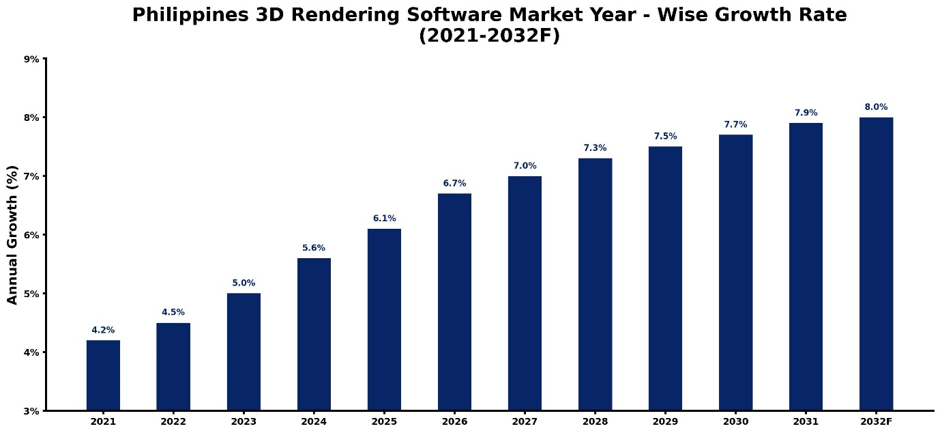
The table below represents the historical and projected growth rates for the Philippines 3D Rendering Software Market and the rationale behind each year’s performance.
| Year | Est. Annual Growth (%) | Reason / Factor |
| 2021 | 4.2% | More and more people are adopting 3D visualization, in architectural and construction projects. |
| 2022 | 4.5% | Growth of cloud-based rendering platforms for small studios and freelance designers. |
| 2023 | 5% | VR and gaming content keeps expanding, so high quality rendering tools become important. |
| 2024 | 5.6% | AI-assisted rendering engines are getting rolled out, they’re speeding things up and also sharpening accuracy. |
| 2025 | 6.1% | There are government digital design incentives, and some local tech grants that nudge adoption of the software. |
| 2026 | 6.7% | There is rising demand inside architectural visualization, and also in product design industries. |
| 2027 | 7% | Increased integration of cloud-based collaborative platforms in design workflows. |
| 2028 | 7.3% | Expansion of AR/VR applications, and immersive media projects alongside. |
| 2029 | 7.5% | Adoption is growing in manufacturing and automotive design projects. |
| 2030 | 7.7% | High-performance AI rendering tools are cutting down the manual work, and reducing turnaround time too. |
| 2031 | 7.9% | Growth in creative studios and media production houses seeking real-time rendering. |
| 2032 | 8% | Government programs supporting digital content and software adoption. |
Topics Covered in the Philippines 3D Rendering Software Market Report
The Philippines 3D Rendering Software Market report thoroughly covers the market by type, deployment, application, and end user. The market report provides an unbiased and detailed analysis of ongoing market trends, opportunities/high growth areas, and market drivers, which would help stakeholders devise and align their market strategies according to the current and future market dynamics.
Philippines 3D Rendering Software Market Highlights
| Report Name | Philippines 3D Rendering Software Market |
| Forecast period | 2026-2032 |
| CAGR | 7.44% |
| Growing Sector | Architectural Visualization & Gaming |
Philippines 3D Rendering Software Market Synopsis
The Philippines 3D Rendering Software Market is expected to experience strong growth driven by the growing adoption of cloud-based platforms, AI-assisted rendering engines, and real-time visualization solutions which are driving the demand. Local innovation subsidies and government programs like the Department of Trade and Industry's Digital Design Grant encourage studios and firms to spend money on advanced rendering software. Increasing demand in areas such as architectural visualization, gaming, product design and virtual reality is also supporting market growth.
Evaluation of Growth Drivers in the Philippines 3D Rendering Software Market (2026-2032)
Below are some of the mentioned growth drivers and their impact on market dynamics:
| Drivers | Primary Segments Affected | Why It Matters |
| Government Support & Grants (e.g., DTI Digital Design Grant) | All Segments | Promotes adoption of advanced rendering tools, supports creative projects, and strengthens the Philippines’ digital content ecosystem. |
| Rise in Cloud & Collaborative Platforms | Technology Segment | Helps remote groups stay in sync, it boosts workflow efficiency and reduces the need for hardware. |
| AI-Assisted Rendering Tools | Software & Services | Increases speed and quality, reduces manual work and enables cost-effective content production. |
| Expansion of Architectural & Gaming Projects | End Users | A higher appetite for top-tier rendering options improves the standing of local studios overseas. |
| Digital Transformation Initiatives | All Segments | Encourages companies to use updated software, cloud services and real-time visualization features. |
The Philippines 3D Rendering Software Market Size is expected to grow significantly, with a CAGR of 7.44% during 2026-2032. The key factors which are driving the Philippines 3D rendering software market are the quick uptake of cloud-based platforms which gives studios access to powerful tools without the need for large hardware investments, AI-powered render engines increase efficiency and reduce production time, and real-time visualization solutions enhance creative workflows while investment in sophisticated software is encouraged by government support, such as the Digital Design Grant from the Department of Trade and Industry and local innovation grants.
Evaluation of Restraints in the Philippines 3D Rendering Software Market
Below mentioned are some major restraints and their influence on market dynamics:
| Restraints | Primary Segments Affected | What This Means |
| High Software Costs | All Segments | Limits adoption by small firms and freelancers; reduces flexibility for experimental workflows. |
| Skilled Workforce Shortage | End Users | It lowers the ability to really make use of advanced rendering tools, and delays project timelines. |
| Regulatory & IP Compliance | All Segments | Increases legal and operational costs for software deployment and content use. |
| Integration Complexity | Technology & Application | Makes adoption of AI and cloud solutions slower, requiring training and infrastructure upgrades. |
| Hardware Dependency | Software & Services | High-end systems required for rendering limit small studio scalability and increase costs. |
Philippines 3D Rendering Software Market Challenges
There are several challenges faced by the Philippines 3D Rendering Software Industry such as high software costs, limited technical expertise, integration complexity, and hardware dependency greatly affect adoption. These challenges pose considerable obstacles to scaling creative production, restricting studios’ ability to innovate and experiment. It slows project timelines, reduces operational efficiency and drives up overall costs. Emerging and mid-sized studios are especially at risk as they can’t compete with larger companies that can withstand these obstacles.
Philippines 3D Rendering Software Market Trends
Some major trends contributing to the Philippines 3D Rendering Software Market Growth are:
- AI-assisted rendering: Artificial intelligence simplifies rendering, modelling and visualization workflows, shortening production time and improving output quality.
- Cloud-Based Rendering Platforms: Cloud solutions facilitate collaboration between multiple locations, file management, and scalable computing resources for rendering projects.
- Real-Time Visualization Tools: Real time engines help push efficiency forward in gaming, VR, architecture, and product design and also providing instant feedback so production cycles get faster.
Investment Opportunities in the Philippines 3D Rendering Software Market
Below mentioned are some investment opportunities in the Philippines 3D Rendering Software Market:
- Cloud & SaaS Solutions: Affordable scalable setups for studios plus freelancers, supporting teams and joint rendering.
- Educational & Training Programs: Hands on workshops so people can build skills, and boost workforce readiness while increasing adoption of advanced 3D rendering software.
- Customized Rendering Tools: Industry specific AI assisted software designed to improve creative efficiency and opening up of niche market opportunities.
Top 5 Leading Players in the Philippines 3D Rendering Software Market
Here are some top companies contributing to Philippines 3D Rendering Software Market Share:
1. Autodesk Philippines, Inc.
| Company Name | Autodesk Philippines, Inc. |
| Established Year | 2006 (Local office presence) |
| Headquarters | Makati City, Philippines |
| Official Website | Click Here |
Provides localized sales, support, and consulting for 3ds Max, Maya, and Revit, serving the Philippine architectural, engineering, and construction (AEC) sectors.
2. CIM Technologies, Inc.
| Company Name | CIM Technologies, Inc. |
| Established Year | 1987 |
| Headquarters | Pasig City, Philippines |
| Official Website | Click Here |
A leading local solutions provider and systems integrator that specializes in CAD, BIM, and 3D visualization software, acting as a primary partner for Autodesk and other engineering software brands in the country.
3. Toei Animation Phils., Inc.
| Company Name | Toei Animation Phils., Inc. |
| Established Year | 1986 |
| Headquarters | Pasig City, Philippines |
| Official Website | Click Here |
A major animation studio subsidiary that applies high-end 3D rendering and digital production techniques to international animated media.
4. VSTECS Philippines, Inc.
| Company Name | VSTECS Philippines, Inc. |
| Established Year | 1998 |
| Headquarters | Pasig City, Philippines |
| Official Website | Click Here |
One of the largest ICT distributors in the Philippines, facilitating the supply chain for various global software vendors (including rendering and design software partners) to local resellers and enterprise clients.
5. Digiscript Philippines Inc.
| Company Name | Digiscript Philippines Inc. |
| Established Year | 2006 |
| Headquarters | Quezon City, Philippines |
| Official Website | Click Here |
A prominent local production house specializing in high-end 3D animation, architectural visualization, and digital modeling, serving both the local construction industry and international media clients.
Government Regulations in the Philippines 3D Rendering Software Market
According to Filipino Government data, the Philippine government has implemented programs like the DTI Digital Design Grant, Technology Innovation Support Fund, and local tech incubators to increase the use of cloud-based, AI-assisted, and real-time rendering tools. Such efforts provide funding, technical advice and training opportunities, and promote collaboration between designers and developers. These efforts are improving creative capabilities, supporting sustainable practices and promoting international competitiveness resulting in broader market penetration and encouraging domestic and global growth in the 3D rendering software industry.
Future Insights of the Philippines 3D Rendering Software Market
The Philippines 3D Rendering Software Market is anticipated to grow rapidly over the forecast period. Demand for architectural visualization, gaming and product design will continue to drive growth. The government initiatives to promote innovation, education and skill development are expected to augment the usage of software, streamline the production workflows and strengthen the country’s competitive position in global 3D rendering. Furthermore, these factors together show sustained market momentum through 2032.
Market Segmentation Analysis
The report offers a comprehensive study of the subsequent market segments and their leading categories.
By Type – Software Dominates, Services Set for Steady Growth
According to Ritika Kalra, Senior Research Analyst, 6Wresearch, software solutions captured a commanding 66.5% of the Philippines 3D rendering software market value in 2025, fueled by strong demand for high-performance modeling and rendering tools across architecture, gaming, and media sectors. Conversely, professional services are anticipated to witness a robust CAGR of 8.7% during the forecast period of 2026 to 2032, as a result of increasing software complexity, integration requirements, and demand for expert deployment and customization.
By Deployment – Cloud-Based Platforms Lead
The cloud-based 3D rendering platforms accounted for the largest market share of 61.3% in 2025, owing to scalable computing resources and the ability to facilitate remote collaboration and the wider adoption of cloud workflows and on-demand rendering services are expected to drive the solutions to register a CAGR of 9.1% between 2026 and 2032.
By Application – Architectural Visualization Dominates
In 2025, architectural visualization accounted for 48.2% of the market share of 3D rendering software applications in the Philippines, driven by the demand for virtual walkthroughs, real estate marketing, and design prototyping while the segment is anticipated to grow at a CAGR of 7.8% through 2032 owing to the advent of AI assisted rendering and real time visualization tools.
By End User – Architects & Designers Lead
The architects & designers segment held a market share of 44.7% in 2025 on account of the growth of construction, design services and demand for high-quality visualization. This segment is expected to expand at a CAGR of 8.3% during the forecast period of 2026 to 2032, owing to the adoption of AI and cloud in rendering that improves efficiency and output quality.
Note: Market size estimations and growth projections are based on 6Wresearch’s advanced forecasting approach, validated with industry datasets as of June 2026.
Key Attractiveness of the Report
- 10 Years Market Numbers
- Historical Data Starting from 2022 to 2025
- Base Year: 2025
- Forecast Data until 2032
- Key Performance Indicators Impacting the Market
- Major Upcoming Developments and Projects
Key Highlights of the Report:
- Philippines 3D Rendering Software Market Outlook
- Market Size of Philippines 3D Rendering Software Market,2025
- Forecast of Philippines 3D Rendering Software Market, 2032
- Historical Data and Forecast of Philippines 3D Rendering Software Revenues & Volume for the Period 2022 - 2032
- Philippines 3D Rendering Software Market Trend Evolution
- Philippines 3D Rendering Software Market Drivers and Challenges
- Philippines 3D Rendering Software Price Trends
- Philippines 3D Rendering Software Porter's Five Forces
- Philippines 3D Rendering Software Industry Life Cycle
- Historical Data and Forecast of Philippines 3D Rendering Software Market Revenues & Volume By Type for the Period 2022 - 2032
- Historical Data and Forecast of Philippines 3D Rendering Software Market Revenues & Volume By Software for the Period 2022 - 2032
- Historical Data and Forecast of Philippines 3D Rendering Software Market Revenues & Volume By Services for the Period 2022 - 2032
- Historical Data and Forecast of Philippines 3D Rendering Software Market Revenues & Volume By Deployment for the Period 2022 - 2032
- Historical Data and Forecast of Philippines 3D Rendering Software Market Revenues & Volume By Cloud-Based for the Period 2022 - 2032
- Historical Data and Forecast of Philippines 3D Rendering Software Market Revenues & Volume By On-Premise for the Period 2022 - 2032
- Historical Data and Forecast of Philippines 3D Rendering Software Market Revenues & Volume By Standalone for the Period 2022 - 2032
- Historical Data and Forecast of Philippines 3D Rendering Software Market Revenues & Volume By Offline Rendering for the Period 2022 - 2032
- Historical Data and Forecast of Philippines 3D Rendering Software Market Revenues & Volume By Application for the Period 2022 - 2032
- Historical Data and Forecast of Philippines 3D Rendering Software Market Revenues & Volume By Architectural Visualization for the Period 2022 - 2032
- Historical Data and Forecast of Philippines 3D Rendering Software Market Revenues & Volume By Gaming & Animation for the Period 2022 - 2032
- Historical Data and Forecast of Philippines 3D Rendering Software Market Revenues & Volume By Product Design for the Period 2022 - 2032
- Historical Data and Forecast of Philippines 3D Rendering Software Market Revenues & Volume By Virtual Reality for the Period 2022 - 2032
- Historical Data and Forecast of Philippines 3D Rendering Software Market Revenues & Volume By End User for the Period 2022 - 2032
- Historical Data and Forecast of Philippines 3D Rendering Software Market Revenues & Volume By Architects & Designers for the Period 2022 - 2032
- Historical Data and Forecast of Philippines 3D Rendering Software Market Revenues & Volume By Media & Entertainment for the Period 2022 - 2032
- Historical Data and Forecast of Philippines 3D Rendering Software Market Revenues & Volume By Manufacturers for the Period 2022 - 2032
- Historical Data and Forecast of Philippines 3D Rendering Software Market Revenues & Volume By Healthcare for the Period 2022 - 2032
- Philippines 3D Rendering Software Import Export Trade Statistics
- Market Opportunity Assessment By Type
- Market Opportunity Assessment By Deployment
- Market Opportunity Assessment By Application
- Market Opportunity Assessment By End User
- Philippines 3D Rendering Software Top Companies Market Share
- Philippines 3D Rendering Software Competitive Benchmarking By Technical and Operational Parameters
- Philippines 3D Rendering Software Company Profiles
- Philippines 3D Rendering Software Key Strategic Recommendations
Market Covered
The report subsequently covers the market by following segments and subsegments.
By Type
- Software
- Services
By Deployment
- Cloud-Based
- On-Premise
- Standalone
- Offline Rendering
By Application
- Architectural Visualization
- Gaming & Animation
- Product Design
- Virtual Reality
By End User
- Architects & Designers
- Media & Entertainment
- Manufacturers
- Healthcare






































