Philippines Active Pharmaceutical Ingredient CDMO Market Growth Rate
According to 6Wresearch internal database and industry insights, the Philippines Active Pharmaceutical Ingredient CDMO Market is projected to grow at a compound annual growth rate (CAGR) of around 7.5% during the forecast period of 2026–2032.
Philippines Active Pharmaceutical Ingredient CDMO Market Year-wise Growth Rate and Key Drivers (2022-2032)
This graph illustrates the annual growth rates of the Philippines Active Pharmaceutical Ingredient CDMO Market from 2022 to 2032, highlighting a steady upward trajectory and projected market expansion over the forecast period.
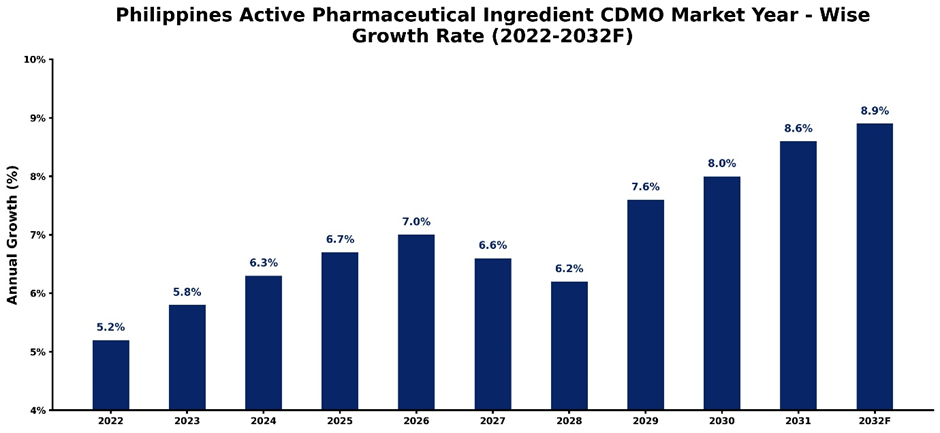
The following table summarizes the historical and forecasted growth rates of the Philippines Active Pharmaceutical Ingredient CDMO Market, along with the rationale behind each year’s performance.
| Year | Estimated Growth (%) | Market Rationale |
| 2022 | 5.2% | Growing domestic healthcare requirements and increasing reliance on contract manufacturing partnerships. |
| 2023 | 5.8% | Expansion of generic drug production and increasing pharmaceutical investment activities in the Philippines. |
| 2024 | 6.3% | Rising demand for cost-efficient API sourcing and improved local pharmaceutical manufacturing capabilities. |
| 2025 | 6.7% | Growing adoption of CDMO partnerships among pharmaceutical companies seeking scalable production solutions. |
| 2026 | 7% | Start of forecast period; increasing demand for advanced API manufacturing and quality-compliant production facilities. |
| 2027 | 6.6% | Expansion of generic medicines and increasing outsourcing activities by regional pharmaceutical companies. |
| 2028 | 6.2% | Rising adoption of biologic API development and pharmaceutical research collaborations. |
| 2029 | 7.6% | Increasing investments in advanced manufacturing technologies and regulatory-compliant production facilities. |
| 2030 | 8% | Growth in specialty medicines and increasing demand for customized API development services. |
| 2031 | 8.6% | Higher adoption of integrated CDMO services covering development, testing, and commercial-scale production. |
| 2032 | 8.9% | Mature growth phase supported by pharmaceutical innovation, healthcare expansion, and outsourcing trends. |
Topics Covered in the Philippines Active Pharmaceutical Ingredient CDMO Market Report
The Philippines Active Pharmaceutical Ingredient CDMO Market report covers the market by Type and Application. The report provides a detailed analysis of ongoing trends in pharmaceutical outsourcing, generic medicine production and advanced drug manufacturing capabilities, along with key growth drivers and opportunities that will help stakeholders align strategies with current and future market dynamics.
Philippines Active Pharmaceutical Ingredient CDMO Market Highlights
| Report Name | Philippines Active Pharmaceutical Ingredient CDMO Market |
| Forecast period | 2026-2032 |
| CAGR | 7.5% |
| Growing Sector | Pharmaceutical Manufacturing & Healthcare Outsourcing |
Philippines Active Pharmaceutical Ingredient CDMO Market Synopsis
The Philippines Active Pharmaceutical Ingredient CDMO Market is expected to grow at a steady pace with rising demand from the pharmaceutical industry, increasing healthcare expenditure and growing acceptance of outsourced manufacturing solutions. The developing healthcare ecosystem and emphasis on medicine availability are creating the demand for trusted partners in API production. CDMOs are helping pharma companies with API development, process optimization, regulatory compliance and commercial manufacturing services. Increasing demand for generics, specialty drugs and advanced manufacturing capabilities are driving investments in pharmaceutical infrastructure and quality systems.
Evaluation of Growth Drivers in Philippines Active Pharmaceutical Ingredient CDMO Market (2026–2032)
Below mentioned are some major drivers and their influence on the market dynamics:
| Drivers | Primary Segment | What This Means |
| Growing Generic Drug Demand | Pharmaceutical Manufacturing | Increasing demand for affordable medicines is encouraging pharmaceutical companies to collaborate with CDMOs for efficient API production. |
| Pharmaceutical Outsourcing Growth | API Manufacturing | Companies are increasingly outsourcing API development and manufacturing to reduce operational costs and improve production flexibility. |
| Healthcare Infrastructure Expansion | Healthcare Sector | The demand for dependable pharmaceutical supply chains is being driven by the growth of healthcare facilities and the increasing use of medicines. |
| Biologic Drug Development | Biopharmaceuticals | Increasing interest in advanced therapies is creating demand for specific biologic API manufacturing capabilities. |
| Regulatory Compliance Requirements | Pharmaceutical Industry | Strict quality standards are encouraging companies to partner with experienced CDMOs having advanced manufacturing and validation capabilities. |
The Philippines Active Pharmaceutical Ingredient CDMO Market growth is projected to reach a CAGR of 7.5% strongly during 2026–2032. The development profile is supported by increasing healthcare awareness, expanding pharmaceutical manufacturing activities, and rising demand for cost-effective medicines. With a population of over 110 million and rising healthcare needs, the Philippines offers a good base for API CDMO growth. This is driving new opportunities with higher investments in pharmaceutical facilities, rising healthcare spending and higher adoption of outsourcing models by drug manufacturers. In addition, government initiatives to increase local medicine production and supply chain resilience are enhancing the long-term outlook for API CDMO providers.
Evaluation of Restraints in Philippines Active Pharmaceutical Ingredient CDMO Market
Below are some major restraints and their influence on the market dynamics:
| Restraints | Primary Segment | What This Means |
| High Manufacturing Investment | API Production Facilities | Establishing advanced API manufacturing facilities requires significant capital investment, specialized equipment, and quality systems. |
| Regulatory Compliance Complexity | Pharmaceutical Manufacturing | Meeting international regulatory standards increases operational requirements and validation costs for CDMO providers. |
| Dependence on Imported Raw Materials | Pharmaceutical Supply Chain | Reliance on imported pharmaceutical ingredients and intermediates can cause supply chain uncertainties |
| Limited Advanced Manufacturing Capabilities | Biologic APIs | Advanced biologic API production, specialized technology, and also skilled professionals end up slowing down local adoption. |
| Skilled Workforce Shortage | Pharmaceutical Industry | Limited availability of professionals with expertise in advanced pharmaceutical manufacturing can affect expansion plans. |
Philippines Active Pharmaceutical Ingredient CDMO Market Challenges
Philippines Active Pharmaceutical Ingredient CDMO Industry has considerable growth potential but faces infrastructure, compliance and supply chain dependency challenges. More than 70% of pharmaceutical products are imported, indicating dependence on external manufacturing networks. Setting up GMP compliant facilities requires an investment in state-of-the-art equipment, validation and skilled manpower but the processes of regulatory approval can be extended by the timelines. Cost pressures due to limited access to local API expertise and reliance on imported raw materials. To build resilience, companies must develop technology partnerships, workforce training and domestic manufacturing capabilities.
Trends in the Philippines Active Pharmaceutical Ingredient CDMO Market
Below mentioned are some of the trends shaping the Philippines Active Pharmaceutical Ingredient CDMO Market Growth:
- Increasing Outsourcing of Pharmaceutical Manufacturing: Pharmaceutical companies are increasingly outsourcing API development and manufacturing activities to CDMOs to reduce operational costs, improve production flexibility, and access specialized manufacturing capabilities without establishing additional facilities.
- Growth of Biologic API Development: Increasing demand for advanced therapies, including biologics and complex molecules, is encouraging CDMO providers to develop capabilities in biologic API production, cell culture technologies, and advanced purification processes.
- Adoption of Advanced Manufacturing Technologies: Pharmaceutical manufacturers are increasingly adopting automation, digital quality monitoring, and advanced analytical technologies to improve production accuracy, reduce processing time, and maintain regulatory compliance.
Investment Opportunities in Philippines Active Pharmaceutical Ingredient CDMO Market
The following are some of the investment opportunities driving in Philippines Active Pharmaceutical Ingredient CDMO Market:
- Advanced API Manufacturing Facilities: The growing demand for dependable pharmaceutical supply chains presents investment opportunities in state-of-the-art API manufacturing facilities with advanced synthesis, purification, and quality testing capabilities.
- Biologic API and Specialty Manufacturing: Growing interest in biologics, oncology drugs, and specialty pharmaceuticals provides opportunities for companies investing in biotechnology-based API manufacturing capabilities.
- Integrated Pharmaceutical Development Services: CDMOs offering end-to-end services, including formulation support, analytical testing, process development, and regulatory assistance, can capture increasing demand from pharmaceutical companies seeking integrated solutions.
Top Leading Players in Philippines Active Pharmaceutical Ingredient CDMO Market
Stated below are some of the leading companies and organizations boosting the Philippines Active Pharmaceutical Ingredient CDMO Market Share:
1. WuXi AppTec Co., Ltd.
| Company Name | WuXi AppTec Co., Ltd. |
|---|---|
| Established Year | 2000 |
| Headquarters | Shanghai, China |
| Official Website | Click Here |
WuXi AppTec Co., Ltd. operates a global open-access CRDMO platform providing end-to-end small-molecule discovery, bulk active substance manufacturing, and testing services for global and regional pharma brands.
2. Lonza Group Ltd.
| Company Name | Lonza Group Ltd. |
|---|---|
| Established Year | 1897 |
| Headquarters | Basel, Switzerland |
| Official Website | Click Here |
Lonza Group Ltd. stands out as a world-leading CDMO providing highly integrated process development and massive commercial-scale synthesis for both traditional small-molecule APIs and complex biologics.
3. Dr. Reddy's Laboratories Ltd. (Custom Pharma Services)
| Company Name | Dr. Reddy's Laboratories Ltd. (Custom Pharma Services) |
|---|---|
| Established Year | 1984 |
| Headquarters | Hyderabad, Telangana, India |
| Official Website | Click Here |
Dr. Reddy's Laboratories Ltd. utilizes its Custom Pharma Services (CPS) arm to offer contract development and manufacturing, specializing in exporting complex generic APIs and custom chemistry solutions to global markets.
Government Initiatives in the Philippines Active Pharmaceutical Ingredient CDMO Market
According to Filipino government data, there are several Programs supporting pharmaceutical manufacturing, healthcare innovation and technology adoption which are boosting the active pharmaceutical ingredient CDMO market and the DTI is the champion of industrial competitiveness. The BOI offers incentives to bring in pharmaceutical investments through tax breaks and investment support. DOST programs boost capabilities in pharmaceutical research, biotechnology and innovation. FDA strengthens quality compliance for drugs and manufacturing sites. These efforts coupled with the strengthening of healthcare infrastructure and local medicine production initiatives are opening doors for API CDMO providers.
Future Insights of the Philippines Active Pharmaceutical Ingredient CDMO Market
The Philippines Active Pharmaceutical Ingredient CDMO Market is expected to witness strong growth with the continuous growth of pharmaceutical outsourcing. The growth is supported by the increasing healthcare sector and the growing demand for locally produced medicines. As the population exceeds 110 million and costs of healthcare continue to climb, a reliable API supplier is becoming more necessary. The Philippines consumes more than 70% imported medicines, so there is opportunity for localised manufacturing. Companies that invest in GMP facilities, automation and digital quality systems will be more competitive.
Market Segmentation Analysis
The report offers a comprehensive study of the following market segments and their leading categories in the Philippines Active Pharmaceutical Ingredient CDMO Market:
By Type – Market Dominated by Synthetic APIs, Expected to Witness Increasing Adoption of Biologic APIs
According to Bhawna Singh, Senior Research Analyst, 6Wresearch, till 2025, Synthetic APIs dominated the Philippines Active Pharmaceutical Ingredient CDMO Market with an estimated 68% market share, driven by established manufacturing capabilities, cost-effective production processes, and strong demand from generic drug manufacturers. From 2026–2032, Synthetic APIs are expected to continue leading the segment, growing at a CAGR of 7.2%, supported by increasing outsourcing activities, rising pharmaceutical production, and demand for scalable API manufacturing solutions.
By Application – Market Dominated by Generic Pharmaceuticals, Expected to Maintain Leadership Through 2032
Till 2025, Generic Pharmaceuticals dominated the Philippines Active Pharmaceutical Ingredient CDMO Market with an estimated 55% share, driven by increasing demand for affordable medicines, expanding healthcare access, and growing requirements for cost-efficient pharmaceutical manufacturing. With a CAGR of 7.5%, generic pharmaceuticals are expected to remain the leading application segment from 2026–2032 due to increasing pharmaceutical outsourcing, domestic medicine production, and rising demand for essential drugs.
Note: Market size estimations and growth projections presented in this report are based on 6Wresearch's proprietary forecasting methodology, utilizing the latest available industry data, government publications, and primary research inputs.
Key Attractiveness of the Report:
- 10 Years of Market Numbers
- Historical Data Starting from 2022 to 2025
- Base Year: 2025
- Forecast Data until 2032
- Key Performance Indicators Impacting the Market
- Major Upcoming Developments and Projects
Key Highlights of the Report:
- Philippines Active Pharmaceutical Ingredient CDMO Market Outlook
- Market Size of Philippines Active Pharmaceutical Ingredient CDMO Market, 2025
- Forecast of Philippines Active Pharmaceutical Ingredient CDMO Market, 2032
- Historical Data and Forecast of Philippines Active Pharmaceutical Ingredient CDMO Revenues & Volume for the Period 2022-2032
- Philippines Active Pharmaceutical Ingredient CDMO Market Trend Evolution
- Philippines Active Pharmaceutical Ingredient CDMO Market Drivers and Challenges
- Philippines Active Pharmaceutical Ingredient CDMO Price Trends
- Philippines Active Pharmaceutical Ingredient CDMO Porter's Five Forces
- Philippines Active Pharmaceutical Ingredient CDMO Industry Life Cycle
- Historical Data and Forecast of Philippines Active Pharmaceutical Ingredient CDMO Market Revenues & Volume By Type for the Period 2022-2032
- Historical Data and Forecast of Philippines Active Pharmaceutical Ingredient CDMO Market Revenues & Volume By Synthetic APIs for the Period 2022-2032
- Historical Data and Forecast of Philippines Active Pharmaceutical Ingredient CDMO Market Revenues & Volume By Biologic APIs for the Period 2022-2032
- Historical Data and Forecast of Philippines Active Pharmaceutical Ingredient CDMO Market Revenues & Volume By Application for the Period 2022-2032
- Historical Data and Forecast of Philippines Active Pharmaceutical Ingredient CDMO Market Revenues & Volume By Generic Pharmaceuticals for the Period 2022-2032
- Historical Data and Forecast of Philippines Active Pharmaceutical Ingredient CDMO Market Revenues & Volume By Branded Pharmaceuticals for the Period 2022-2032
- Historical Data and Forecast of Philippines Active Pharmaceutical Ingredient CDMO Market Revenues & Volume By Over-the-Counter (OTC) Medications for the Period 2022-2032
- Philippines Active Pharmaceutical Ingredient CDMO Import Export Trade Statistics
- Market Opportunity Assessment By Type
- Market Opportunity Assessment By Application
- Philippines Active Pharmaceutical Ingredient CDMO Top Companies Market Share
- Philippines Active Pharmaceutical Ingredient CDMO Competitive Benchmarking By Technical and Operational Parameters
- Philippines Active Pharmaceutical Ingredient CDMO Company Profiles
- Philippines Active Pharmaceutical Ingredient CDMO Key Strategic Recommendations
Market Covered
The report offers an extensive study of the following market segments:
By Type
- Synthetic APIs
- Biologic APIs
By Application
- Generic Pharmaceuticals
- Branded Pharmaceuticals
- Over-the-Counter (OTC) Medications






































