Philippines Aerospace & Defense C-class Parts Market Size, Share & Growth Rate
The Philippines Aerospace & Defense C-class Parts Market was estimated at USD 310 Million in 2025 and is projected to reach USD 404 Million by 2032, growing at a CAGR of 3.9% from 2026 to 2032. This growth is bolstered by rising defense expenditures aligned with the country's commitment to modernizing its defense capabilities. The strategic geographical position of the Philippines, along with increasing partnerships in aerospace manufacturing, is providing a solid foundation for this sector's expansion.
Philippines Aerospace & Defense C-class Parts Market Year-wise Growth Rate and Key Drivers
This graph highlights how the Philippines Aerospace & Defense C-class Parts Market has steadily grown over the years, supported by major growth factors.
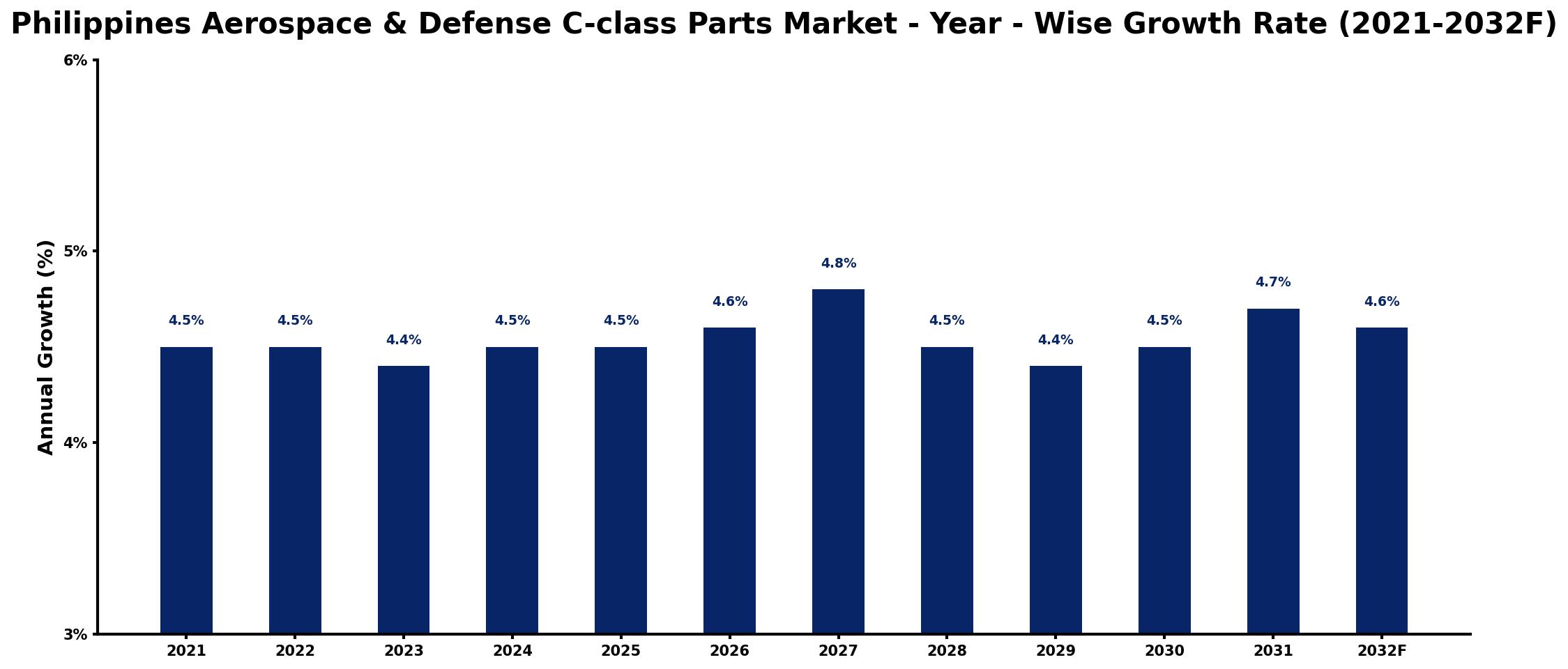
The table below presents the year‑wise growth rates along with the key drivers influencing the market
| Year | Growth Rate | Major Drivers |
| 2021 | 4.5% | improved processing technologies adoption |
| 2022 | 4.5% | Rising demand for military modernization |
| 2023 | 4.4% | Expanding commercial air travel market |
| 2024 | 4.5% | Growing investments in manufacturing technologies |
| 2025 | 4.5% | Strengthening regional security partnerships |
| 2026 | 4.6% | Surge in domestic production capabilities |
| 2027 | 4.8% | Increased focus on sustainability efforts |
| 2028 | 4.5% | Enhanced research and development funding |
| 2029 | 4.4% | Growing utilization of unmanned systems |
| 2030 | 4.5% | Strengthening supply chain resilience strategies |
| 2031 | 4.7% | Expansion of international collaborations |
| 2032 | 4.6% | increased production capacity utilization |
Note: Market size estimations and growth projections presented in this report are based on 6Wresearch's proprietary forecasting methodology, utilizing the latest available industry data, government publications, and primary research inputs.
Philippines Aerospace & Defense C-class Parts Market Synopsis
The Philippines Aerospace & Defense C-class Parts Market is experiencing robust growth as the nation prioritizes enhanced defense readiness and local manufacturing capabilities. Recent trends indicate that local firms are increasingly supplying essential components for both military and commercial aerospace applications, highlighting a shift towards domestic production.
With the government's focus on strategic partnerships and regional collaborations, the market dynamics are evolving rapidly. This expansion aligns with broader industrial diversification goals, fostering an environment ripe for investment and innovation in the aerospace sector.
- The market is projected to experience steady growth, driven by increased defense spending and technological advancements.
- Local manufacturing capabilities are being enhanced, providing greater self-sufficiency in critical defense components.
- Strategic partnerships with international firms are vital for elevating the technological landscape of the aerospace sector.
- Government initiatives are focused on bolstering the local defense industry to ensure national security and economic resilience.
- Emerging trends in aerospace technology and production techniques are shaping the future of the market.
Despite promising growth, the Philippines Aerospace & Defense C-class Parts Market faces notable restraints that could hinder progress. Significant investment is needed in research, development, and technology to keep pace with global advancements in aerospace. Moreover, reliance on imported defense technologies limits the country's capability to achieve self-sufficiency, potentially affecting strategic responses to security threats. Budget constraints exacerbated by the COVID-19 pandemic have also challenged defense funding, necessitating adaptive strategies as the market navigates recovery.
A number of emerging trends are shaping the demand within the Philippines Aerospace & Defense C-class Parts Market. The focus on advanced manufacturing processes, such as additive manufacturing and automation, is reshaping how components are produced. Additionally, there is a marked shift toward adopting environmentally sustainable practices in aerospace manufacturing, driven by global environmental standards. Furthermore, increased collaboration with international firms is anticipated to facilitate knowledge transfer and improve local manufacturing capabilities.
Opportunities abound in the Philippines Aerospace & Defense C-class Parts Market as the country continues to modernize its defense capabilities. Investment in local defense production presents a viable path to foster independence in critical components. The demand for specialized parts due to ongoing geopolitical tensions provides a favorable environment for growth. Additionally, participating in international defense collaborations can enhance technological advancements and facilitate the export of locally manufactured products.
The Philippine government is actively pursuing policies to enhance its defense capabilities through various initiatives aimed at local industry support. Increased public spending on defense and security has been prioritized, alongside programs to stimulate research and development in aerospace technology. The government is also keen on fostering partnerships with both local and international players to create a more self-reliant defense sector. These initiatives are set to create a favorable climate for investment and innovation within the aerospace and defense market.
Looking ahead to 2026-2032, the Philippines Aerospace & Defense C-class Parts Market is poised for significant transformation. Continued investment in modernization efforts and local manufacturing will play a crucial role in shaping the landscape. Moreover, as the government reinforces its commitment to national security, opportunities for local companies to innovate and enhance their competitive edge will proliferate. The emphasis on collaboration and technological advancement will be central themes driving the market's future growth.
In recent months, the Philippines Aerospace & Defense C-class Parts Market has witnessed an uptick in strategic partnerships aimed at bolstering domestic production capabilities. These collaborations have focused on integrating advanced technologies into the manufacturing process, enabling local companies to enhance their product offerings. Additionally, public sentiment towards national defense has shifted positively, leading to increased government investments and a renewed focus on strengthening the local aerospace sector.
- 10 Years of Market Numbers
- Historical Data Starting from 2022 to 2025
- Base Year: 2025
- Forecast Data until 2032
- Key Performance Indicators Impacting the Market
- Major Upcoming Developments and Projects
Key Highlights of the Report:
- Philippines Aerospace & Defense C-class Parts Market Outlook
- Market Size of Philippines Aerospace & Defense C-class Parts Market, 2025
- Forecast of Philippines Aerospace & Defense C-class Parts Market, 2032
- Historical Data and Forecast of Philippines Aerospace & Defense C-class Parts Revenues & Volume for the Period 2022-2032F
- Philippines Aerospace & Defense C-class Parts Market Trend Evolution
- Philippines Aerospace & Defense C-class Parts Market Drivers and Challenges
- Philippines Aerospace & Defense C-class Parts Price Trends
- Philippines Aerospace & Defense C-class Parts Porter's Five Forces
- Philippines Aerospace & Defense C-class Parts Industry Life Cycle
- Historical Data and Forecast of Philippines Aerospace & Defense C-class Parts Market Revenues & Volume By Product for the Period 2022-2032F
- Historical Data and Forecast of Philippines Aerospace & Defense C-class Parts Market Revenues & Volume By Fasteners for the Period 2022-2032F
- Historical Data and Forecast of Philippines Aerospace & Defense C-class Parts Market Revenues & Volume By Bearings for the Period 2022-2032F
- Historical Data and Forecast of Philippines Aerospace & Defense C-class Parts Market Revenues & Volume By Electrical Parts for the Period 2022-2032F
- Historical Data and Forecast of Philippines Aerospace & Defense C-class Parts Market Revenues & Volume By Machined Parts for the Period 2022-2032F
- Historical Data and Forecast of Philippines Aerospace & Defense C-class Parts Market Revenues & Volume By Application for the Period 2022-2032F
- Historical Data and Forecast of Philippines Aerospace & Defense C-class Parts Market Revenues & Volume By Engine for the Period 2022-2032F
- Historical Data and Forecast of Philippines Aerospace & Defense C-class Parts Market Revenues & Volume By Aerostructure for the Period 2022-2032F
- Historical Data and Forecast of Philippines Aerospace & Defense C-class Parts Market Revenues & Volume By Interiors for the Period 2022-2032F
- Historical Data and Forecast of Philippines Aerospace & Defense C-class Parts Market Revenues & Volume By Equipment for the Period 2022-2032F
- Historical Data and Forecast of Philippines Aerospace & Defense C-class Parts Market Revenues & Volume By Safety for the Period 2022-2032F
- Historical Data and Forecast of Philippines Aerospace & Defense C-class Parts Market Revenues & Volume By Support for the Period 2022-2032F
- Historical Data and Forecast of Philippines Aerospace & Defense C-class Parts Market Revenues & Volume By Avionics for the Period 2022-2032F
- Historical Data and Forecast of Philippines Aerospace & Defense C-class Parts Market Revenues & Volume By End-use for the Period 2022-2032F
- Historical Data and Forecast of Philippines Aerospace & Defense C-class Parts Market Revenues & Volume By Commercial for the Period 2022-2032F
- Historical Data and Forecast of Philippines Aerospace & Defense C-class Parts Market Revenues & Volume By Military for the Period 2022-2032F
- Historical Data and Forecast of Philippines Aerospace & Defense C-class Parts Market Revenues & Volume By Business & General Aviation for the Period 2022-2032F
- Historical Data and Forecast of Philippines Aerospace & Defense C-class Parts Market Revenues & Volume By Others for the Period 2022-2032F
- Philippines Aerospace & Defense C-class Parts Import Export Trade Statistics
- Market Opportunity Assessment By Product
- Market Opportunity Assessment By Application
- Market Opportunity Assessment By End-use
- Philippines Aerospace & Defense C-class Parts Top Companies Market Share
- Philippines Aerospace & Defense C-class Parts Competitive Benchmarking By Technical and Operational Parameters
- Philippines Aerospace & Defense C-class Parts Company Profiles
- Philippines Aerospace & Defense C-class Parts Key Strategic Recommendations






































