Philippines Aircraft Cabin Interior Market Size, Share & Growth Rate
The Philippines Aircraft Cabin Interior Market was estimated at USD 1318 Million in 2025 and is projected to reach USD 2296 Million by 2032, growing at a CAGR of 8.3% from 2026 to 2032. This growth is primarily driven by an increase in air travel as the country sees a recovery in tourism and business travel following the pandemic. Airlines are consequently investing heavily in modernizing cabin interiors to enhance passenger comfort and experiences, positioning the Philippines as a competitive player in the aerospace industry.
Philippines Aircraft Cabin Interior Market Year-wise Growth Rate and Key Drivers
This graph highlights how the Philippines Aircraft Cabin Interior Market has steadily grown over the years, supported by major growth factors.
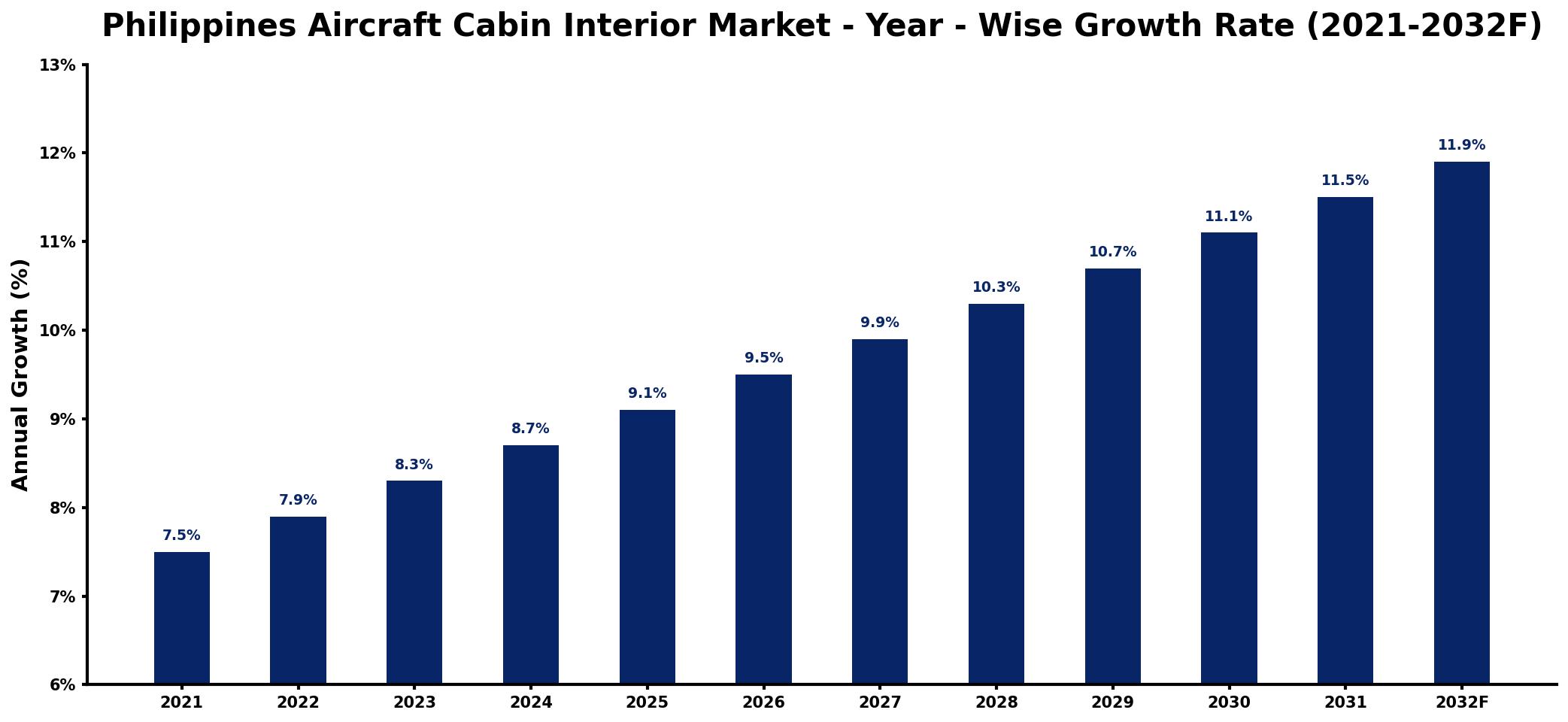
The table below presents the year‑wise growth rates along with the key drivers influencing the market
| Year | Growth Rate | Major Drivers |
| 2021 | 7.5% | Rising passenger travel demand |
| 2022 | 7.9% | Increased airline fleet orders |
| 2023 | 8.3% | Technological advancements in design |
| 2024 | 8.7% | Growing focus on sustainability |
| 2025 | 9.1% | Expansion of regional airlines |
| 2026 | 9.5% | Investment in premium services |
| 2027 | 9.9% | Emergence of new aviation markets |
| 2028 | 10.3% | Enhancements in passenger comfort |
| 2029 | 10.7% | Growth in maintenance services |
| 2030 | 11.1% | Increase in charter flight popularity |
| 2031 | 11.5% | Strengthening of safety regulations |
| 2032 | 11.9% | Rising demand for customization |
Note: Market size estimations and growth projections presented in this report are based on 6Wresearch's proprietary forecasting methodology, utilizing the latest available industry data, government publications, and primary research inputs.
Philippines Aircraft Cabin Interior Market Synopsis
The Philippines Aircraft Cabin Interior Market has recently gained momentum, driven by the rising demand for improved passenger experiences and innovations in aircraft technology. Airlines are increasingly focused on upgrading their cabin interiors, embracing modern designs and technologies that align with consumer preferences.
Looking ahead, the market is anticipated to evolve significantly as local airlines compete with international carriers. This dynamic landscape will foster increased investment and collaboration with global suppliers, propelling the development of sophisticated and customized cabin interior solutions to meet diverse passenger expectations.
Philippines Aircraft Cabin Interior Market Key Takeaways
- The market is witnessing robust growth due to increasing air travel demand.
- Investment in cabin modernization is crucial for enhancing passenger experience.
- Philippine airlines are focusing on innovative and cost-effective interior solutions.
- Strategic partnerships with international firms are likely to shape market development.
- Regulatory support and favorable government policies are expected to drive growth.
Evaluation of Restraints in Philippines Aircraft Cabin Interior Market
While the Philippines Aircraft Cabin Interior Market exhibits promising growth potential, it is not without its challenges. One significant restraint is the high capital investment required for the design and installation of advanced cabin interior systems. Furthermore, ongoing economic uncertainties can affect airlines' budgets, potentially leading to delayed modernization projects. Additionally, stringent regulatory standards for safety and environmental impact may hinder rapid technological adoption, requiring thorough compliance efforts from both manufacturers and airlines.
Philippines Aircraft Cabin Interior Market Trends
Several trends are currently shaping the Philippines Aircraft Cabin Interior Market. Firstly, there is a noticeable shift toward sustainable and eco-friendly materials, driven by increased environmental awareness among consumers and regulatory mandates. Additionally, technological advancements in in-flight entertainment and connectivity systems are enhancing passenger engagement and satisfaction. Customization has also become a key focus, with airlines seeking to differentiate their offerings through unique cabin designs that cater to specific passenger demographics.
Philippines Aircraft Cabin Interior Market Opportunities
Opportunities for growth within the Philippines Aircraft Cabin Interior Market are substantial. As the country reopens its borders and tourism rebounds, there will be increased demand for modern aircraft that can provide enhanced passenger comfort. Moreover, local airlines are expected to explore partnerships with global suppliers for state-of-the-art cabin innovations. This collaborative approach can lead to the development of tailored solutions that elevate the travel experience while positioning the Philippines as a formidable competitor in the regional aviation landscape.
Government Initiatives in the Philippines Aircraft Cabin Interior Market
The Philippine government is actively promoting initiatives aimed at strengthening the aerospace and aviation sector. Through policies that encourage investments in infrastructure and technological advancements, the government aims to foster a supportive environment for local airlines. Various public spending programs have been allocated for airport modernization and upgrades, ultimately benefiting the overall cabin interior market as airlines look to enhance passenger experiences.
Future Insights of the Philippines Aircraft Cabin Interior Market
Between 2026 and 2032, the Philippines Aircraft Cabin Interior Market is poised for significant transformation. As airlines continue to enhance their service offerings, the focus on cabin interiors will intensify. The introduction of next-generation materials and smart technologies will further redefine passenger experiences. With rising competition and evolving consumer expectations, the market landscape will likely shift toward a more innovative and customer-centric approach, ensuring sustained growth in the coming years.
Philippines Aircraft Cabin Interior Market Latest Developments (2025 - 2026)
Recent developments in the Philippines Aircraft Cabin Interior Market indicate a strategic emphasis on upgrading passenger services as airlines respond to increasing travel demand. Various initiatives focused on enhancing cabin aesthetics and comfort have emerged, aligning with global trends. Furthermore, airlines are exploring partnerships with technology firms to integrate advanced in-flight entertainment systems, signaling a shift towards a more immersive travel experience.
Philippines Aircraft Cabin Interior Market - Key Attractiveness of the Report
- 10 Years of Market Numbers
- Historical Data Starting from 2022 to 2025
- Base Year: 2025
- Forecast Data until 2032
- Key Performance Indicators Impacting the Market
- Major Upcoming Developments and Projects
Key Highlights of the Report:
- Philippines Aircraft Cabin Interior Market Outlook
- Market Size of Philippines Aircraft Cabin Interior Market, 2025
- Forecast of Philippines Aircraft Cabin Interior Market, 2032
- Historical Data and Forecast of Philippines Aircraft Cabin Interior Revenues & Volume for the Period 2022-2032F
- Philippines Aircraft Cabin Interior Market Trend Evolution
- Philippines Aircraft Cabin Interior Market Drivers and Challenges
- Philippines Aircraft Cabin Interior Price Trends
- Philippines Aircraft Cabin Interior Porter's Five Forces
- Philippines Aircraft Cabin Interior Industry Life Cycle
- Historical Data and Forecast of Philippines Aircraft Cabin Interior Market Revenues & Volume By Type for the Period 2022-2032F
- Historical Data and Forecast of Philippines Aircraft Cabin Interior Market Revenues & Volume By Seats for the Period 2022-2032F
- Historical Data and Forecast of Philippines Aircraft Cabin Interior Market Revenues & Volume By Cabin Lightening for the Period 2022-2032F
- Historical Data and Forecast of Philippines Aircraft Cabin Interior Market Revenues & Volume By Windows and Windshields for the Period 2022-2032F
- Historical Data and Forecast of Philippines Aircraft Cabin Interior Market Revenues & Volume By Galley and Lavatory for the Period 2022-2032F
- Historical Data and Forecast of Philippines Aircraft Cabin Interior Market Revenues & Volume By In-Flight Entertainment & Connectivity for the Period 2022-2032F
- Historical Data and Forecast of Philippines Aircraft Cabin Interior Market Revenues & Volume By Others for the Period 2022-2032F
- Historical Data and Forecast of Philippines Aircraft Cabin Interior Market Revenues & Volume By Class for the Period 2022-2032F
- Historical Data and Forecast of Philippines Aircraft Cabin Interior Market Revenues & Volume By First Class for the Period 2022-2032F
- Historical Data and Forecast of Philippines Aircraft Cabin Interior Market Revenues & Volume By Business Class for the Period 2022-2032F
- Historical Data and Forecast of Philippines Aircraft Cabin Interior Market Revenues & Volume By Premium Economy Class for the Period 2022-2032F
- Historical Data and Forecast of Philippines Aircraft Cabin Interior Market Revenues & Volume By Economy Class for the Period 2022-2032F
- Historical Data and Forecast of Philippines Aircraft Cabin Interior Market Revenues & Volume By Aircraft Type for the Period 2022-2032F
- Historical Data and Forecast of Philippines Aircraft Cabin Interior Market Revenues & Volume By Narrow Body Aircraft for the Period 2022-2032F
- Historical Data and Forecast of Philippines Aircraft Cabin Interior Market Revenues & Volume By Wide-Body Aircraft for the Period 2022-2032F
- Historical Data and Forecast of Philippines Aircraft Cabin Interior Market Revenues & Volume By Business Jets for the Period 2022-2032F
- Historical Data and Forecast of Philippines Aircraft Cabin Interior Market Revenues & Volume By Regional Transport Aircraft for the Period 2022-2032F
- Historical Data and Forecast of Philippines Aircraft Cabin Interior Market Revenues & Volume By End User for the Period 2022-2032F
- Historical Data and Forecast of Philippines Aircraft Cabin Interior Market Revenues & Volume By OEM for the Period 2022-2032F
- Historical Data and Forecast of Philippines Aircraft Cabin Interior Market Revenues & Volume By Aftermarket for the Period 2022-2032F
- Philippines Aircraft Cabin Interior Import Export Trade Statistics
- Market Opportunity Assessment By Type
- Market Opportunity Assessment By Class
- Market Opportunity Assessment By Aircraft Type
- Market Opportunity Assessment By End User
- Philippines Aircraft Cabin Interior Top Companies Market Share
- Philippines Aircraft Cabin Interior Competitive Benchmarking By Technical and Operational Parameters
- Philippines Aircraft Cabin Interior Company Profiles
- Philippines Aircraft Cabin Interior Key Strategic Recommendations






































