Philippines Antimony Ore Market Size, Share & Growth Rate
The Philippines Antimony Ore Market was estimated at USD 464 Million in 2025 and is projected to reach USD 677 Million by 2032, growing at a CAGR of 5.5% from 2026 to 2032. This growth trajectory is primarily fueled by the increasing demand for antimony in flame retardants, lead-acid batteries, and various industrial applications. As sectors such as electronics and construction expand in the region, the reliance on antimony compounds is expected to rise significantly.
Philippines Antimony Ore Market Year-wise Growth Rate and Key Drivers
This graph highlights how the Philippines Antimony Ore Market has steadily grown over the years, supported by major growth factors.
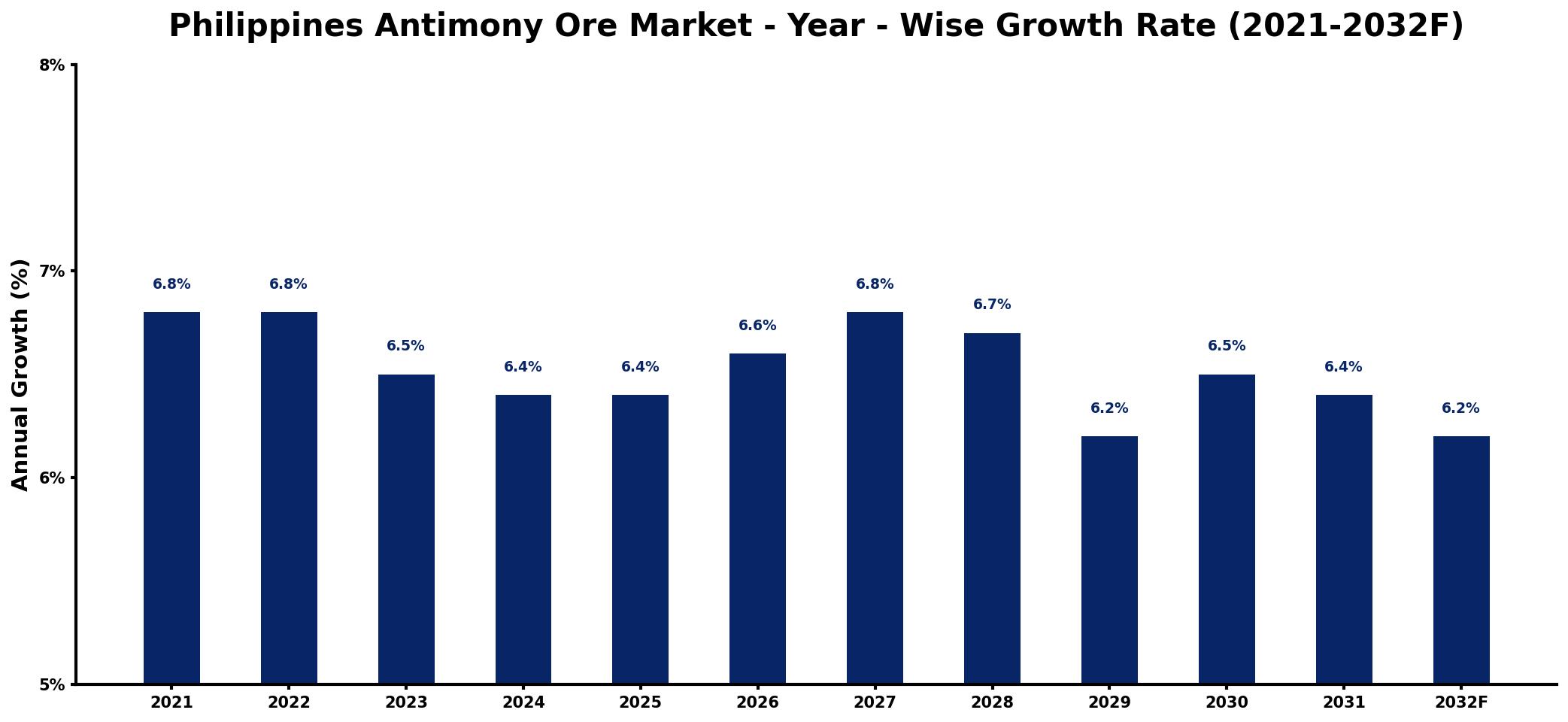
The table below presents the year‑wise growth rates along with the key drivers influencing the market
| Year | Growth Rate | Major Drivers |
| 2021 | 6.8% | Rising electronics manufacturing demand |
| 2022 | 6.8% | Increased construction sector activities |
| 2023 | 6.5% | Growing renewable energy investments |
| 2024 | 6.4% | Expanding automotive industry requirements |
| 2025 | 6.4% | Boost in aerospace applications demand |
| 2026 | 6.6% | Heightened demand for alloys |
| 2027 | 6.8% | Surge in battery production needs |
| 2028 | 6.7% | Growth in chemical production sectors |
| 2029 | 6.2% | strengthening underlying market demand |
| 2030 | 6.5% | Increase in recycling initiatives adoption |
| 2031 | 6.4% | Expansion of industrial applications usage |
| 2032 | 6.2% | Rising demand for technological innovations |
Note: Market size estimations and growth projections presented in this report are based on 6Wresearch's proprietary forecasting methodology, utilizing the latest available industry data, government publications, and primary research inputs.
Philippines Antimony Ore Market Synopsis
The strongest force currently shaping the Philippines Antimony Ore Market is the surge in demand for antimony-based products, particularly in flame retardants used in electronics and construction. This growing focus on safety standards and environmental regulations is driving manufacturers to seek high-quality antimony ore to meet compliance requirements.
Moreover, the burgeoning battery manufacturing sector, especially with the rise of electric vehicles and renewable energy storage systems, is creating a robust market for antimony. As the Philippines continues to position itself as a significant player in the global antimony supply chain, its production capabilities will be crucial in addressing both domestic and international demands.
Philippines Antimony Ore Market Key Takeaways
- The market is poised for steady growth, driven by rising industrial applications of antimony.
- Key demand sources include the electronics and construction sectors, particularly for flame retardants.
- The Philippines is enhancing its role as a vital supplier in the global antimony landscape.
- Government initiatives are aimed at bolstering sustainable mining practices in the region.
- Technological advancements are improving extraction and processing efficiency, impacting market dynamics.
Evaluation of Restraints in Philippines Antimony Ore Market
Despite its promising outlook, the Philippines Antimony Ore Market faces several restraints that may impede growth. One major concern is the environmental impact associated with antimony mining and processing, which has attracted scrutiny from both regulatory bodies and environmental activists. Strict compliance with regulations can elevate operational costs and potentially limit mining activities. Additionally, fluctuations in global antimony prices can create uncertainty for local producers, affecting investment decisions and market stability. Political and economic factors in the region also play a critical role in shaping market sentiment and potential growth trajectories.
Philippines Antimony Ore Market Trends
Current trends in the Philippines Antimony Ore Market reflect a shift towards sustainable practices, with increasing emphasis on environmentally friendly mining methods. The advancement of technology in ore processing is enhancing yield while reducing waste. Furthermore, the growing acceptance of antimony in newer applications, such as in renewable energy storage, is expanding its market reach. Collaborative initiatives between government and private sectors are also fostering innovation and investment in sustainable mining projects, aligning with global efforts to promote sustainability.
Philippines Antimony Ore Market Opportunities
The Philippines presents numerous growth and investment opportunities within the Antimony Ore Market. As global demand for high-quality antimony compounds escalates, local producers can capitalize on this trend by enhancing their production capabilities and export potential. The rise of electric vehicles and battery technologies highlights a lucrative avenue for antimony applications. Furthermore, investments in mining infrastructure and sustainable practices can position the Philippines as a competitive supplier in the international market.
Government Initiatives in the Philippines Antimony Ore Market
The Philippine government is implementing various initiatives to bolster the antimony mining sector, focusing on sustainable extraction and processing methods. Policies aimed at improving regulatory frameworks and promoting environmentally responsible mining are being prioritized. These initiatives not only encourage local investments but also aim to enhance the countrys competitiveness in the global antimony supply chain. Collaboration with international organizations and adherence to global best practices are part of the governments strategy to elevate the sector while ensuring environmental protection.
Future Insights of the Philippines Antimony Ore Market
Looking ahead to 2026-2032, the Philippines Antimony Ore Market is expected to witness robust growth. The increasing demand for antimony in various industries, combined with government support for sustainable mining, will be pivotal in shaping the market landscape. Additionally, as technological advancements continue to evolve, they will likely drive efficiency in extraction and processing, enhancing overall profitability. With a strategic approach to environmental concerns and a focus on innovation, the Philippines is set to reinforce its position as a leading player in the global antimony market.
Philippines Antimony Ore Market Latest Developments (2025 - 2026)
Recent developments in the Philippines Antimony Ore Market include increased investment in research and development to improve mining and processing techniques. Initiatives aimed at community engagement and environmental stewardship are gaining traction, reflecting a commitment to sustainable practices. Additionally, local companies are exploring partnerships with international firms to enhance their technological capabilities and expand market reach. As the global push for greener solutions continues, the Filipino antimony sector is adapting to meet emerging market needs and consumer preferences.
Philippines Antimony Ore Market - Key Attractiveness of the Report
- 10 Years of Market Numbers
- Historical Data Starting from 2022 to 2025
- Base Year: 2025
- Forecast Data until 2032
- Key Performance Indicators Impacting the Market
- Major Upcoming Developments and Projects
Key Highlights of the Report:
- Philippines Antimony Ore Market Outlook
- Market Size of Philippines Antimony Ore Market, 2025
- Forecast of Philippines Antimony Ore Market, 2032
- Historical Data and Forecast of Philippines Antimony Ore Revenues & Volume for the Period 2022-2032F
- Philippines Antimony Ore Market Trend Evolution
- Philippines Antimony Ore Market Drivers and Challenges
- Philippines Antimony Ore Price Trends
- Philippines Antimony Ore Porter's Five Forces
- Philippines Antimony Ore Industry Life Cycle
- Historical Data and Forecast of Philippines Antimony Ore Market Revenues & Volume By Type for the Period 2022-2032F
- Historical Data and Forecast of Philippines Antimony Ore Market Revenues & Volume By Stibnite for the Period 2022-2032F
- Historical Data and Forecast of Philippines Antimony Ore Market Revenues & Volume By Senarmontite for the Period 2022-2032F
- Historical Data and Forecast of Philippines Antimony Ore Market Revenues & Volume By Other for the Period 2022-2032F
- Historical Data and Forecast of Philippines Antimony Ore Market Revenues & Volume By Application for the Period 2022-2032F
- Historical Data and Forecast of Philippines Antimony Ore Market Revenues & Volume By Battery Material for the Period 2022-2032F
- Historical Data and Forecast of Philippines Antimony Ore Market Revenues & Volume By Fire Retardant for the Period 2022-2032F
- Historical Data and Forecast of Philippines Antimony Ore Market Revenues & Volume By Chemicals for the Period 2022-2032F
- Historical Data and Forecast of Philippines Antimony Ore Market Revenues & Volume By Ceramics and Glass for the Period 2022-2032F
- Historical Data and Forecast of Philippines Antimony Ore Market Revenues & Volume By Other for the Period 2022-2032F
- Philippines Antimony Ore Import Export Trade Statistics
- Market Opportunity Assessment By Type
- Market Opportunity Assessment By Application
- Philippines Antimony Ore Top Companies Market Share
- Philippines Antimony Ore Competitive Benchmarking By Technical and Operational Parameters
- Philippines Antimony Ore Company Profiles
- Philippines Antimony Ore Key Strategic Recommendations






































