Philippines Antiparasitics Drugs Market Size, Share & Growth Rate
The Philippines Antiparasitics Drugs Market was estimated at USD 313 Million in 2025 and is projected to reach USD 420 Million by 2032, growing at a CAGR of 4.3% from 2026 to 2032. This robust growth trajectory is fueled by the rising incidence of parasitic infections in the region, compounded by the country's tropical climate that supports parasite proliferation. Public health initiatives aimed at raising awareness about these infections, along with advancements in medical research, are further driving the demand for effective antiparasitic therapies.
Philippines Antiparasitics Drugs Market Year-wise Growth Rate and Key Drivers
This graph highlights how the Philippines Antiparasitics Drugs Market has steadily grown over the years, supported by major growth factors.
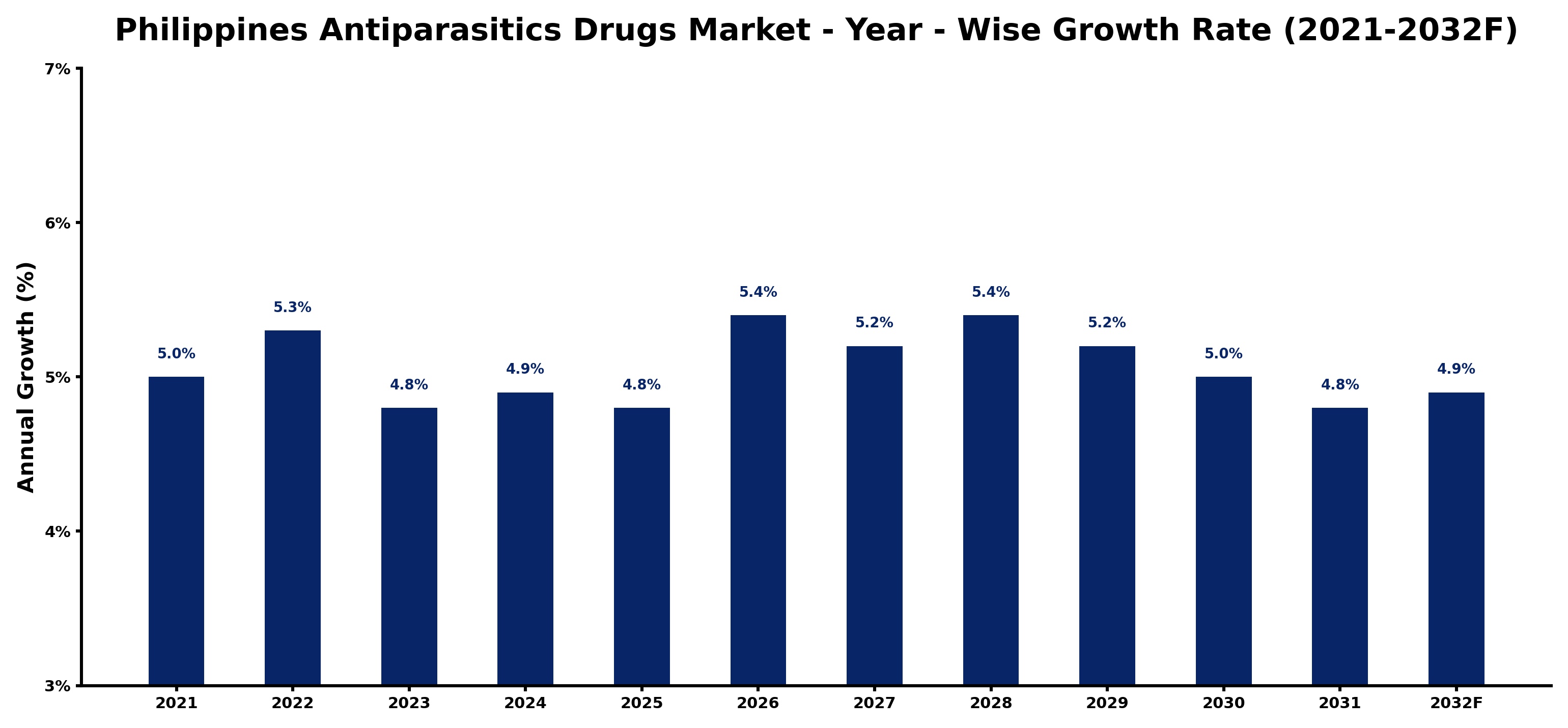
The table below presents the year‑wise growth rates along with the key drivers influencing the market
| Year | Growth Rate | Major Drivers |
| 2021 | 5.0% | Pharmaceutical manufacturers optimize production lines for antiparasitics supply |
| 2022 | 5.3% | Innovative drug formulation technologies enhanced antiparasitic production efficiency |
| 2023 | 4.8% | Manufacturing investments in local antiparasitic production enhance supply chain resilience |
| 2024 | 4.9% | Production facility upgrades enhance antiparasitic drug manufacturing capabilities |
| 2025 | 4.8% | Surge in livestock farming boosts antiparasitic drug production needs |
| 2026 | 5.4% | Improved local formulations drive increased antiparasitic production capacity |
| 2027 | 5.2% | Domestic production scaling up due to renewed veterinary drug demand |
| 2028 | 5.4% | Local manufacturers adopt digital tools to streamline antiparasitic production processes |
| 2029 | 5.2% | Increased production capacity for antiparasitics bolstered local supply chains |
| 2030 | 5.0% | Local pharmaceutical companies optimize production capacity for antiparasitics |
| 2031 | 4.8% | Local production of antiparasitics drives investment in pharmaceutical manufacturing infrastructure |
| 2032 | 4.9% | Local pharmaceutical companies boost antiparasitics production capacity investments |
Note - Market size estimations and growth projections presented in this report are based on 6Wresearch's advanced forecasting approach, validated with industry datasets as of June 2026.
Philippines Antiparasitics Drugs Market Synopsis
In recent years, the Philippines antiparasitics drugs market has experienced significant momentum, reflecting a growing recognition of parasitic diseases as a critical public health issue. As the country aims to enhance its healthcare framework, the market is set to evolve further, driven by ongoing government support and increasing healthcare access.
Looking ahead, the market is poised for continual growth, bolstered by a collaborative environment among pharmaceutical companies and healthcare organizations. Such partnerships are essential for ensuring that advanced antiparasitic treatments become accessible to underserved populations across the nation.
Philippines Antiparasitics Drugs Market Key Takeaways
- The market is on a growth trajectory with an estimated valuation of USD 313 Million in 2025.
- Public health campaigns are pivotal in increasing awareness and access to antiparasitic medications.
- Pharmaceutical innovations are leading to the development of more targeted antiparasitic drugs.
- Government initiatives are crucial for enhancing the affordability and accessibility of treatments.
- Collaboration between the private sector and local health organizations is expected to expand treatment reach.
Evaluation of Restraints in Philippines Antiparasitics Drugs Market
Despite the positive outlook, the Philippines antiparasitics drugs market is confronted with significant restraints. The persistent prevalence of parasitic infections necessitates a reliable supply of effective medications, which is often challenged by drug resistance and diagnostic limitations. Access to quality healthcare remains uneven, especially in rural areas, complicating the timely treatment of parasitic diseases. These factors underline the importance of establishing comprehensive healthcare strategies to enhance treatment efficacy and patient education in the region.
Philippines Antiparasitics Drugs Market Trends
The current landscape of the Philippines antiparasitics drugs market is shaped by several emerging trends. There is a noticeable shift towards research and development of novel, targeted therapies that promise improved efficacy against resistant strains of parasites. Digital health initiatives are also gaining traction, with mobile applications and telemedicine services helping to streamline patient education and treatment adherence. Additionally, a greater focus on preventive care and hygiene education is being integrated into public health strategies, which is expected to reduce the overall burden of parasitic diseases.
Philippines Antiparasitics Drugs Market Opportunities
The Philippines presents a fertile ground for growth and investment in the antiparasitic drugs market. Opportunities lie in the development of affordable generics that can cater to lower-income populations, which face higher rates of infection. Furthermore, there is potential for collaboration with international organizations to bolster research and development efforts. Expanding distribution networks, particularly in underserved areas, will also be vital in addressing existing healthcare gaps. The increasing demand for preventative medications presents additional avenues for market players to explore.
Government Initiatives in the Philippines Antiparasitics Drugs Market
The Philippine government has been proactive in addressing public health challenges, including parasitic infections. Through various public spending programs and health initiatives, the government aims to provide free access to essential medications for affected populations. Additionally, national campaigns focused on hygiene education and preventive care are vital in combating the spread of these diseases. Collaborative efforts with local healthcare providers and international organizations further enhance the framework for effective health interventions.
Future Insights of the Philippines Antiparasitics Drugs Market
Looking forward to the period between 2026 and 2032, the Philippines antiparasitics drugs market is expected to evolve significantly. Continued investments in medical research and infrastructure improvements will likely enhance the availability of novel treatments. There will be a growing emphasis on combating drug resistance, driving innovation in drug development. Additionally, the focus on strengthening public health systems will improve access to treatments across the nation, ultimately aiming to reduce the incidence of parasitic diseases and enhance overall health outcomes.
Philippines Antiparasitics Drugs Market Latest Developments (May 2025 - June 2026)
Recent developments within the antiparasitics drugs market in the Philippines reflect a dynamic response to evolving healthcare needs. Pharmaceutical companies are increasingly focusing on research collaborations aimed at discovering more effective treatments. Moreover, local health organizations have begun implementing community outreach programs to raise awareness about the significance of early diagnosis and treatment of parasitic infections. The renewed emphasis on public health infrastructure following the COVID-19 pandemic has invigorated discussions around accessibility and affordability of antiparasitic medications.
Philippines Antiparasitics Drugs Market - Key Attractiveness of the Report
- 10 Years of Market Numbers
- Historical Data Starting from 2022 to 2025
- Base Year: 2025
- Forecast Data until 2032
- Key Performance Indicators Impacting the Market
- Major Upcoming Developments and Projects
Key Highlights of the Report:
- Philippines Antiparasitics Drugs Market Outlook
- Market Size of Philippines Antiparasitics Drugs Market, 2025
- Forecast of Philippines Antiparasitics Drugs Market, 2032
- Historical Data and Forecast of Philippines Antiparasitics Drugs Revenues & Volume for the Period 2022-2032F
- Philippines Antiparasitics Drugs Market Trend Evolution
- Philippines Antiparasitics Drugs Market Drivers and Challenges
- Philippines Antiparasitics Drugs Price Trends
- Philippines Antiparasitics Drugs Porter's Five Forces
- Philippines Antiparasitics Drugs Industry Life Cycle
- Historical Data and Forecast of Philippines Antiparasitics Drugs Market Revenues & Volume By Route of Administration for the Period 2022-2032F
- Historical Data and Forecast of Philippines Antiparasitics Drugs Market Revenues & Volume By Oral for the Period 2022-2032F
- Historical Data and Forecast of Philippines Antiparasitics Drugs Market Revenues & Volume By Injectable for the Period 2022-2032F
- Historical Data and Forecast of Philippines Antiparasitics Drugs Market Revenues & Volume By Topical for the Period 2022-2032F
- Historical Data and Forecast of Philippines Antiparasitics Drugs Market Revenues & Volume By Drug class for the Period 2022-2032F
- Historical Data and Forecast of Philippines Antiparasitics Drugs Market Revenues & Volume By Anthelmintics for the Period 2022-2032F
- Historical Data and Forecast of Philippines Antiparasitics Drugs Market Revenues & Volume By Antiprotozoals for the Period 2022-2032F
- Historical Data and Forecast of Philippines Antiparasitics Drugs Market Revenues & Volume By Others for the Period 2022-2032F
- Historical Data and Forecast of Philippines Antiparasitics Drugs Market Revenues & Volume By Distribution Channel for the Period 2022-2032F
- Historical Data and Forecast of Philippines Antiparasitics Drugs Market Revenues & Volume By Hospital Pharmacies for the Period 2022-2032F
- Historical Data and Forecast of Philippines Antiparasitics Drugs Market Revenues & Volume By Retail Pharmacies for the Period 2022-2032F
- Historical Data and Forecast of Philippines Antiparasitics Drugs Market Revenues & Volume By Online Pharmacies for the Period 2022-2032F
- Philippines Antiparasitics Drugs Import Export Trade Statistics
- Market Opportunity Assessment By Route of Administration
- Market Opportunity Assessment By Drug class
- Market Opportunity Assessment By Distribution Channel
- Philippines Antiparasitics Drugs Top Companies Market Share
- Philippines Antiparasitics Drugs Competitive Benchmarking By Technical and Operational Parameters
- Philippines Antiparasitics Drugs Company Profiles
- Philippines Antiparasitics Drugs Key Strategic Recommendations






































