Philippines Application Security Market Size & Growth Rate (2026-2032)
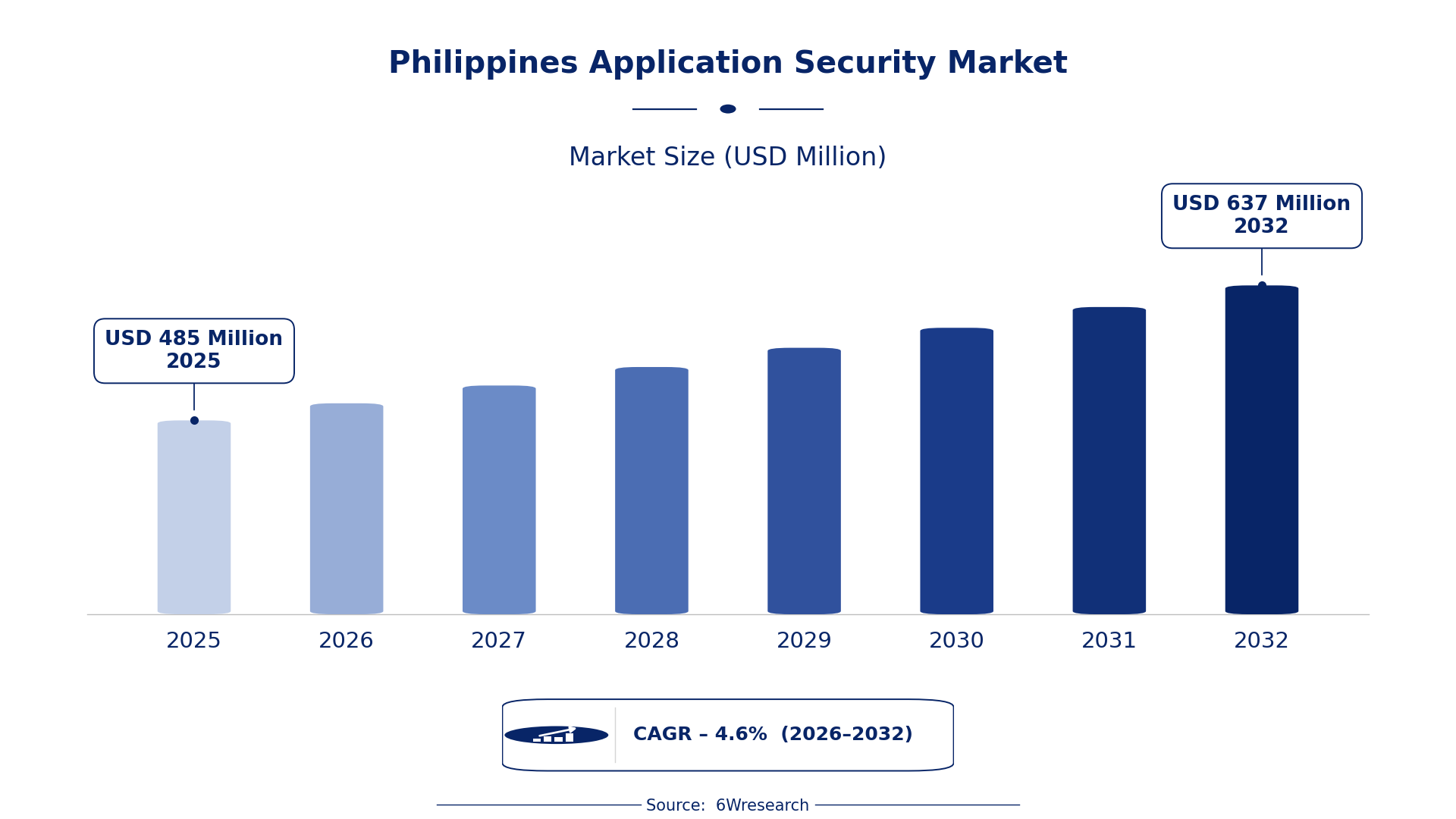
The Philippines Application Security Market was estimated at USD 485 Million in 2025 and is projected to reach USD 637 Million by 2032, growing at a CAGR of 4.6% from 2026 to 2032.
Philippines Application Security Market Synopsis
The surge in digital transformation across various sectors is the most influential factor driving the Philippines Application Security Market today. As organizations pivot to embrace software solutions, the potential for cyber threats looms large, necessitating robust security measures.
In this environment, businesses are increasingly prioritizing the security of their applications to mitigate risks associated with data breaches. With a rapidly evolving software development landscape, the demand for sophisticated application security solutions is set to rise, presenting both challenges and opportunities in equal measure.
Philippines Application Security Market Year-wise Growth Rate and Key Drivers
This graph illustrates the annual growth rates of the Philippines Application Security Market from 2021 to 2032, highlighting a steady upward trajectory and projected expansion over the forecast period.
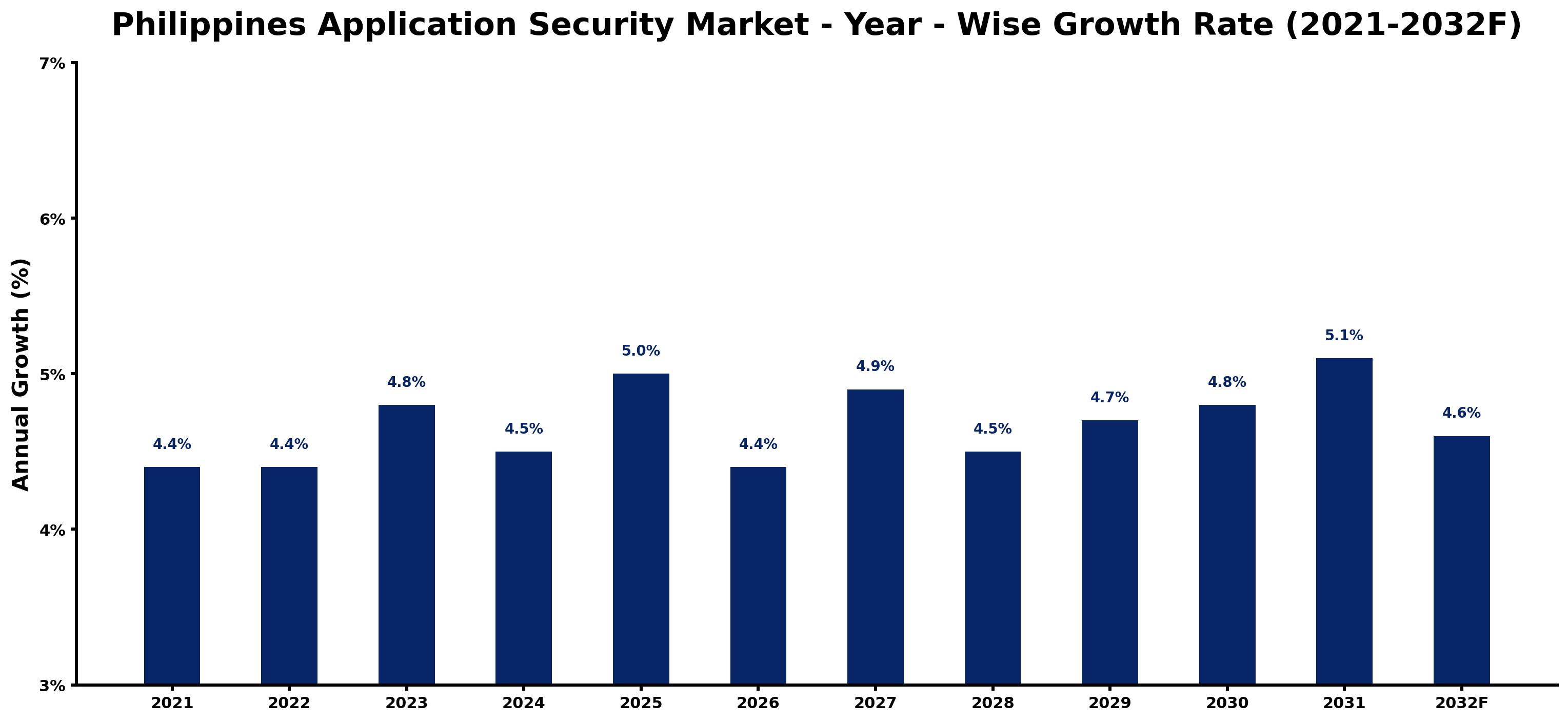
The table below presents the year‑wise growth rates along with the key drivers influencing the market
| Year | Growth Rate | Major Drivers |
| 2021 | 4.4% | Cybersecurity Awareness Act boosting demand for application security |
| 2022 | 4.4% | Growing mobile banking usage requires enhanced security measures |
| 2023 | 4.8% | Increased cyber threats motivating businesses to secure applications |
| 2024 | 4.5% | National government prioritizing digital transformation initiatives |
| 2025 | 5.0% | Rise in e-commerce stimulating application security needs |
| 2026 | 4.4% | Local startups pushing for stringent security protocols |
| 2027 | 4.9% | Major industries adopting cloud services demand application robustness |
| 2028 | 4.5% | Regulatory push for data privacy improving app security investments |
| 2029 | 4.7% | Telecommunications expansion increasing app vulnerability focus |
| 2030 | 4.8% | SMEs digitalization trends fueling application security adoption |
| 2031 | 5.1% | Government-led cybersecurity training programs enhancing sector capabilities |
| 2032 | 4.6% | Public sector modernization increases specialized security requirements |
Note: Market size estimations and growth projections presented in this report are based on 6Wresearch's proprietary forecasting methodology, utilizing the latest available industry data, government publications, and primary research inputs.
Philippines Application Security Market Key Takeaways
Below are some of the specific key takeaways from the market, including:
- Growing recognition among enterprises about the importance of securing applications.
- Increased investment in application security tools driven by regulatory requirements.
- Expansion of remote work leading to a rise in cyber threats and a focus on application security.
- Complex application architectures demanding advanced security solutions.
- Strategic partnerships emerging to enhance application security capabilities.
Evaluation of Restraints in Philippines Application Security Market
Despite the growth potential, the market faces considerable restraints primarily due to the increasing complexity of software applications. Organizations often struggle with integrating security measures into their development processes, which can lead to overlooked vulnerabilities. on top of that, a shortage of skilled security professionals hampers efforts to implement comprehensive application security programs effectively. The challenge of balancing security with agility in software development remains a critical hurdle for many businesses.
Philippines Application Security Market Trends
A shift towards automated security solutions is currently shaping the Philippines Application Security Market. Companies are investing in tools that utilize machine learning and artificial intelligence to detect vulnerabilities and manage security threats more efficiently. Additionally, the adoption of DevSecOps practices is gaining momentum, allowing for the integration of security directly into the software development lifecycle. This trend is indicative of a growing recognition that security should not be an afterthought but a fundamental part of application development.
Philippines Application Security Market Opportunities
The rising digitalization across various industries opens up numerous growth opportunities in the application security sector. Companies looking to implement secure DevOps practices will find significant demand for specialized tools and services. on top of that, the increasing emphasis on compliance with data protection regulations presents a lucrative avenue for security solution providers. As organizations enhance their cybersecurity infrastructure, partnerships between technology firms and enterprises can lead to the development of innovative security solutions tailored to local needs.
Government Initiatives in the Philippines Application Security Market
The Philippine government has recognized the critical need to bolster cybersecurity, particularly within application security. In response, a series of initiatives have been launched to create a more secure digital environment. These actions not only set the stage for improved compliance but also emphasize the importance of safeguarding sensitive information in an increasingly digital world.
- A national cybersecurity framework established in 2023 aimed at enhancing public and private sector collaboration on security protocols.
- Ongoing training programs for government officials and IT personnel to strengthen skills in application security.
- Recent legislation mandating stricter compliance with security standards for software applications utilized by government agencies.
- Upcoming initiatives include a multi-agency cybersecurity awareness campaign expected to launch in late 2025.
- Planned establishment of a Cybersecurity Competence Center to promote innovation in application security technologies and practices.
Future Insights of the Philippines Application Security Market
Looking ahead to 2026-2032, the Philippines Application Security Market is expected to witness accelerated growth driven by a combination of regulatory pressures and evolving cyber threats. Organizations will increasingly adopt a proactive security posture, prioritizing the identification and mitigation of potential vulnerabilities before they can be exploited. The convergence of emerging technologies such as blockchain and the Internet of Things (IoT) with traditional application security measures will also redefine market dynamics, urging businesses to innovate continually.
Philippines Application Security Market Latest Developments
In the past year, the Philippines Application Security Market has experienced notable activity as organizations react to the evolving threat landscape. Many companies are investing in advanced security technologies to counteract increasing cyber risks, with a focus on enhancing their application security strategies.
- A leading software vendor launched a new suite of application security tools in early 2023, designed to integrate seamlessly with popular development environments.
- In Q2 2023, a collaborative project between major tech firms focused on creating a shared security intelligence platform was initiated, aiming to improve threat detection capabilities across industries.
- A cybersecurity awareness initiative targeting small and medium-sized enterprises (SMEs) is currently underway, scheduled to continue through 2024.
- An upcoming product upgrade expected to be unveiled in late 2024 promises to enhance real-time application security monitoring functionalities for enterprise users.
- A technology firm announced a partnership with a local university in early 2023 to develop a new curriculum aimed at training students in application security best practices.
Philippines Application Security Market - Key Attractiveness of the Report
- 10 Years of Market Numbers
- Historical Data Starting from 2022 to 2025
- Base Year: 2025
- Forecast Data until 2032
- Key Performance Indicators Impacting the Market
- Major Upcoming Developments and Projects
Key Highlights of the Report:
- Philippines Application Security Market Outlook
- Market Size of Philippines Application Security Market, 2025
- Forecast of Philippines Application Security Market, 2032
- Historical Data and Forecast of Philippines Application Security Revenues & Volume for the Period 2022-2032F
- Philippines Application Security Market Trend Evolution
- Philippines Application Security Market Drivers and Challenges
- Philippines Application Security Price Trends
- Philippines Application Security Porter's Five Forces
- Philippines Application Security Industry Life Cycle
- Historical Data and Forecast of Philippines Application Security Market Revenues & Volume By Component for the Period 2022-2032F
- Historical Data and Forecast of Philippines Application Security Market Revenues & Volume By Software Tools (SAST and DAST) for the Period 2022-2032F
- Historical Data and Forecast of Philippines Application Security Market Revenues & Volume By Services for the Period 2022-2032F
- Historical Data and Forecast of Philippines Application Security Market Revenues & Volume By Type for the Period 2022-2032F
- Historical Data and Forecast of Philippines Application Security Market Revenues & Volume By Web Application Security for the Period 2022-2032F
- Historical Data and Forecast of Philippines Application Security Market Revenues & Volume By Mobile Application Security for the Period 2022-2032F
- Historical Data and Forecast of Philippines Application Security Market Revenues & Volume By Deployment Mode for the Period 2022-2032F
- Historical Data and Forecast of Philippines Application Security Market Revenues & Volume By On-premises for the Period 2022-2032F
- Historical Data and Forecast of Philippines Application Security Market Revenues & Volume By Cloud for the Period 2022-2032F
- Historical Data and Forecast of Philippines Application Security Market Revenues & Volume By Organization Size for the Period 2022-2032F
- Historical Data and Forecast of Philippines Application Security Market Revenues & Volume By Large Enterprises for the Period 2022-2032F
- Historical Data and Forecast of Philippines Application Security Market Revenues & Volume By SMEs for the Period 2022-2032F
- Historical Data and Forecast of Philippines Application Security Market Revenues & Volume By Vertical Healthcare for the Period 2022-2032F
- Historical Data and Forecast of Philippines Application Security Market Revenues & Volume By Healthcare for the Period 2022-2032F
- Historical Data and Forecast of Philippines Application Security Market Revenues & Volume By BFSI for the Period 2022-2032F
- Philippines Application Security Import Export Trade Statistics
- Market Opportunity Assessment By Component
- Market Opportunity Assessment By Type
- Market Opportunity Assessment By Deployment Mode
- Market Opportunity Assessment By Organization Size
- Market Opportunity Assessment By Vertical Healthcare
- Philippines Application Security Top Companies Market Share
- Philippines Application Security Competitive Benchmarking By Technical and Operational Parameters
- Philippines Application Security Company Profiles
- Philippines Application Security Key Strategic Recommendations






































