Philippines Artificial Flowers Market Top 5 Importing Countries and Market Competition (HHI) Analysis
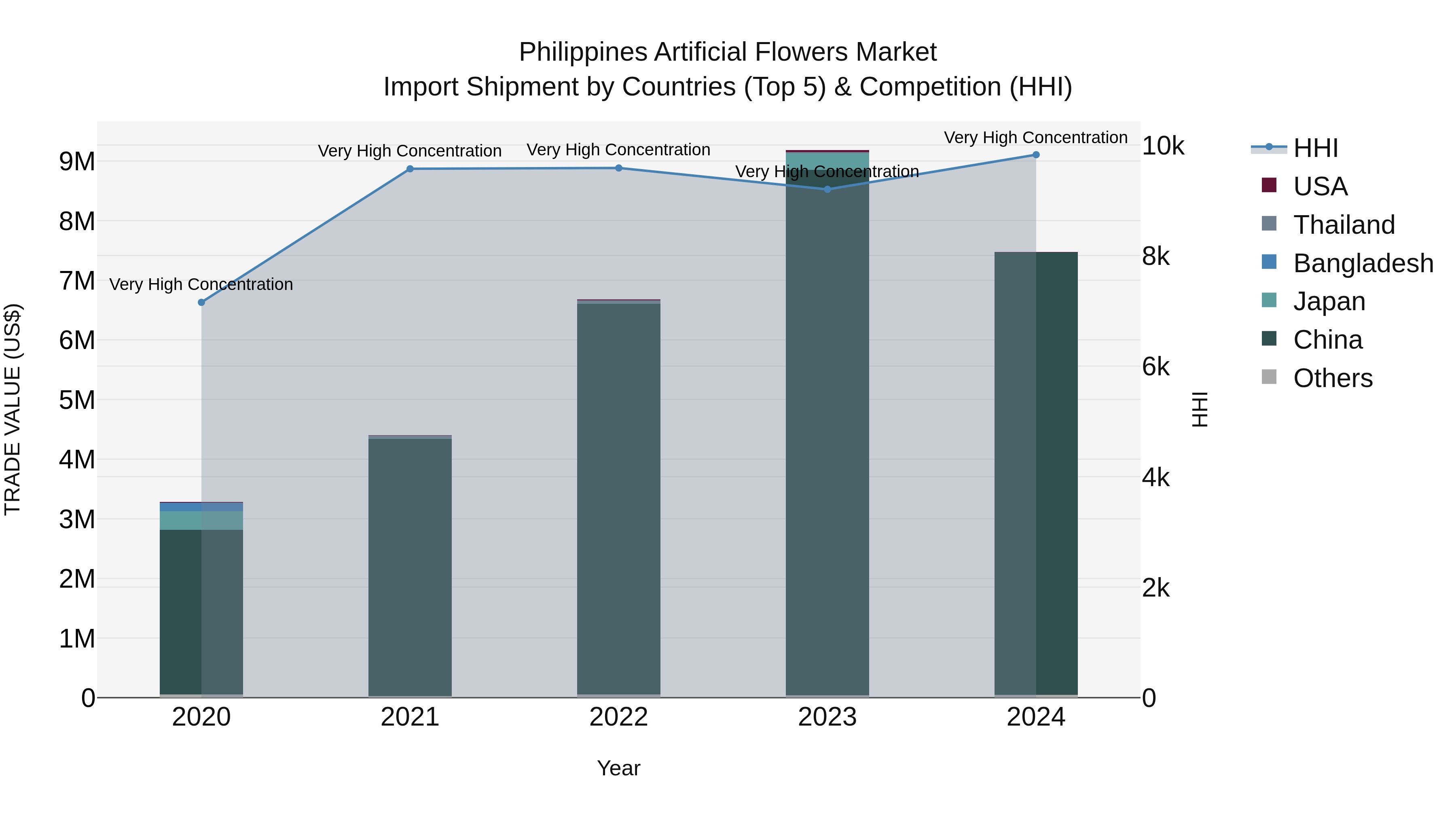
The Philippines artificial flowers import market in 2024 continues to be dominated by top exporting countries such as China, Malaysia, Mexico, Spain, and South Korea. Despite high concentration with a high Herfindahl-Hirschman Index (HHI), the market has shown a strong Compound Annual Growth Rate (CAGR) of 22.85% from 2020 to 2024. However, there was a slight decline in the growth rate from 2023 to 2024 by -18.62%, indicating a potential shift or adjustment in the market dynamics. It will be interesting to monitor how these trends evolve in the coming years.
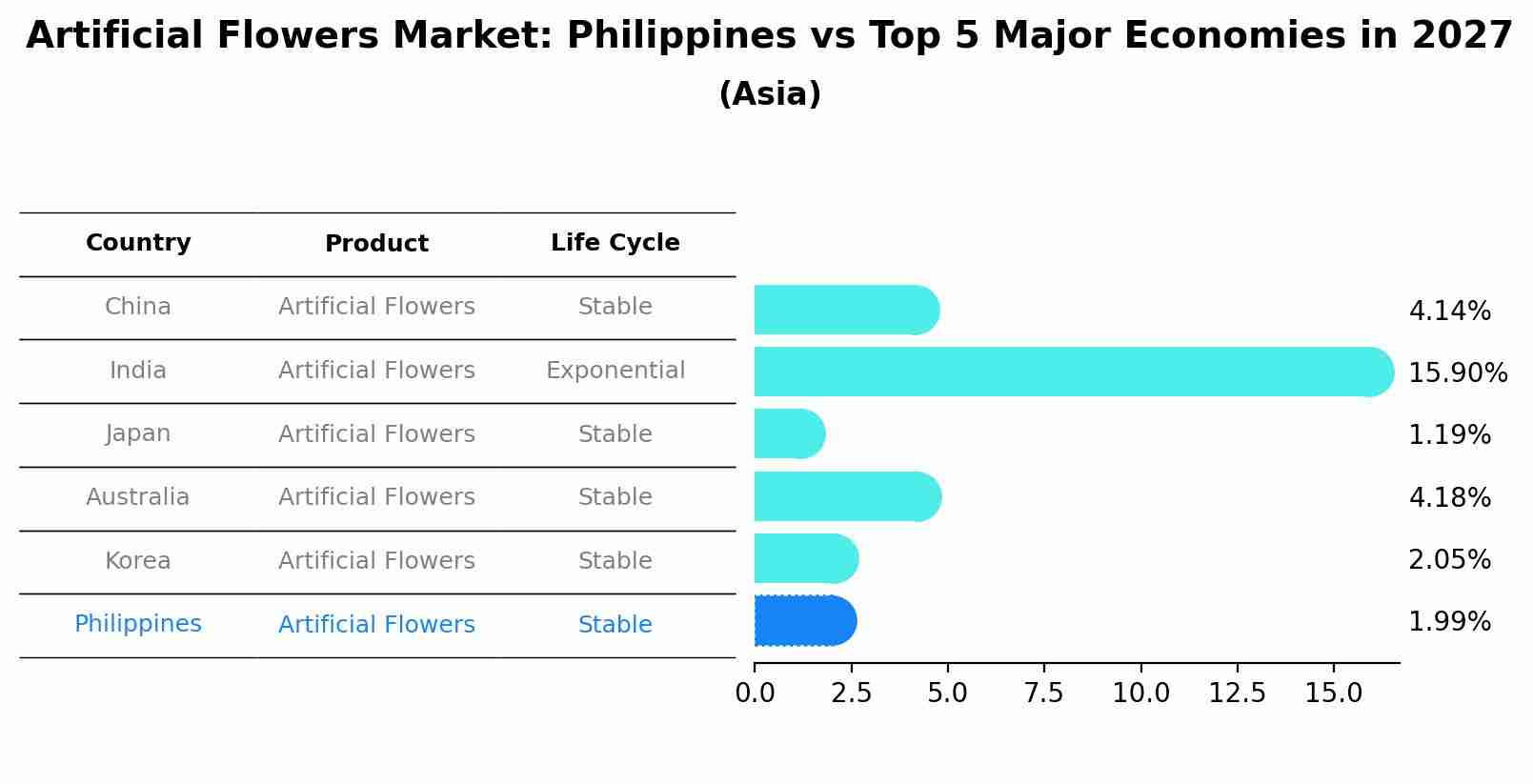
Artificial Flowers Market: Philippines vs Top 5 Major Economies in 2027 (Asia)
The Artificial Flowers market in Philippines is projected to grow at a stable growth rate of 1.99% by 2027, within the Asia region led by China, along with other countries like India, Japan, Australia and South Korea, collectively shaping a dynamic and evolving market environment driven by innovation and increasing adoption of emerging technologies.
philippines artificial flowers market Synopsis
The Philippines artificial flowers market was valued at US$ 33 million in 2025 and is expected to register a CAGR of 4. 2% during the forecast period. Floral arrangements made from artificial material find wide application in events such as wedding ceremonies, exhibition decoration and special occasions like birthdays or anniversaries among others increasing its demand over the years globally. Growing preference for low maintenance home decor items has further augmented growth prospects for this sector within the country over recent past years.
Drivers of the Market
The Philippines artificial flowers market is primarily driven by changing consumer preferences for durable and low-maintenance decorative products. Artificial flowers offer the advantage of long-lasting beauty without the need for continuous care. The market is influenced by factors such as urbanization, smaller living spaces, and a desire for aesthetically pleasing home d?cor. Additionally, events and celebrations that require decorative elements also contribute to the demand for artificial flowers.
Challenges of the Market
The artificial flowers market in the Philippines faces a unique set of challenges. While these products offer longevity and aesthetic appeal, they compete with real flowers in a culture with a strong tradition of using fresh blooms for various occasions. Convincing consumers of the value and quality of artificial flowers can be an uphill battle. Maintaining a diverse and appealing product range, along with effective distribution, requires continuous effort. Moreover, ensuring environmentally friendly materials and production processes is becoming increasingly important.
COVID-19 Impact on the Market
The Philippines artificial flowers market experienced a notable impact from the pandemic. With restrictions on gatherings and events, demand for artificial flowers used in decorations and arrangements decreased significantly. The wedding, hospitality, and event sectors, which are key consumers, were among the most affected. However, as restrictions ease and social events return, the market is anticipated to witness a gradual recovery, supported by pent-up demand for decorative items.
Key Players in the Market
In the Philippines, the artificial flowers market serves both decorative and commercial purposes. Local manufacturers such as Philippine Handicrafts Development Corporation create artificial flower products for domestic and international markets. These artificial flowers find applications in events, home decor, and religious practices, contributing to the vibrant cultural and aesthetic landscape of the country.
Key Highlights of the Report:
- Philippines Artificial Flowers Market Outlook
- Market Size of Philippines Artificial Flowers Market, 2024
- Forecast of Philippines Artificial Flowers Market, 2031
- Historical Data and Forecast of Philippines Artificial Flowers Revenues & Volume for the Period 2021-2031
- Philippines Artificial Flowers Market Trend Evolution
- Philippines Artificial Flowers Market Drivers and Challenges
- Philippines Artificial Flowers Price Trends
- Philippines Artificial Flowers Porter's Five Forces
- Philippines Artificial Flowers Industry Life Cycle
- Historical Data and Forecast of Philippines Artificial Flowers Market Revenues & Volume By Material Type for the Period 2021-2031
- Historical Data and Forecast of Philippines Artificial Flowers Market Revenues & Volume By Clay & Porcelain for the Period 2021-2031
- Historical Data and Forecast of Philippines Artificial Flowers Market Revenues & Volume By Cotton & Silk for the Period 2021-2031
- Historical Data and Forecast of Philippines Artificial Flowers Market Revenues & Volume By Leather & Nylon for the Period 2021-2031
- Historical Data and Forecast of Philippines Artificial Flowers Market Revenues & Volume By Paper & Wax for the Period 2021-2031
- Historical Data and Forecast of Philippines Artificial Flowers Market Revenues & Volume By Plastic & Polyester for the Period 2021-2031
- Historical Data and Forecast of Philippines Artificial Flowers Market Revenues & Volume By Application for the Period 2021-2031
- Historical Data and Forecast of Philippines Artificial Flowers Market Revenues & Volume By Commercial for the Period 2021-2031
- Historical Data and Forecast of Philippines Artificial Flowers Market Revenues & Volume By Residential for the Period 2021-2031
- Philippines Artificial Flowers Import Export Trade Statistics
- Market Opportunity Assessment By Material Type
- Market Opportunity Assessment By Application
- Philippines Artificial Flowers Top Companies Market Share
- Philippines Artificial Flowers Competitive Benchmarking By Technical and Operational Parameters
- Philippines Artificial Flowers Company Profiles
- Philippines Artificial Flowers Key Strategic Recommendations






































