Philippines Artificial Plants And Flowers Market Top 5 Importing Countries and Market Competition (HHI) Analysis
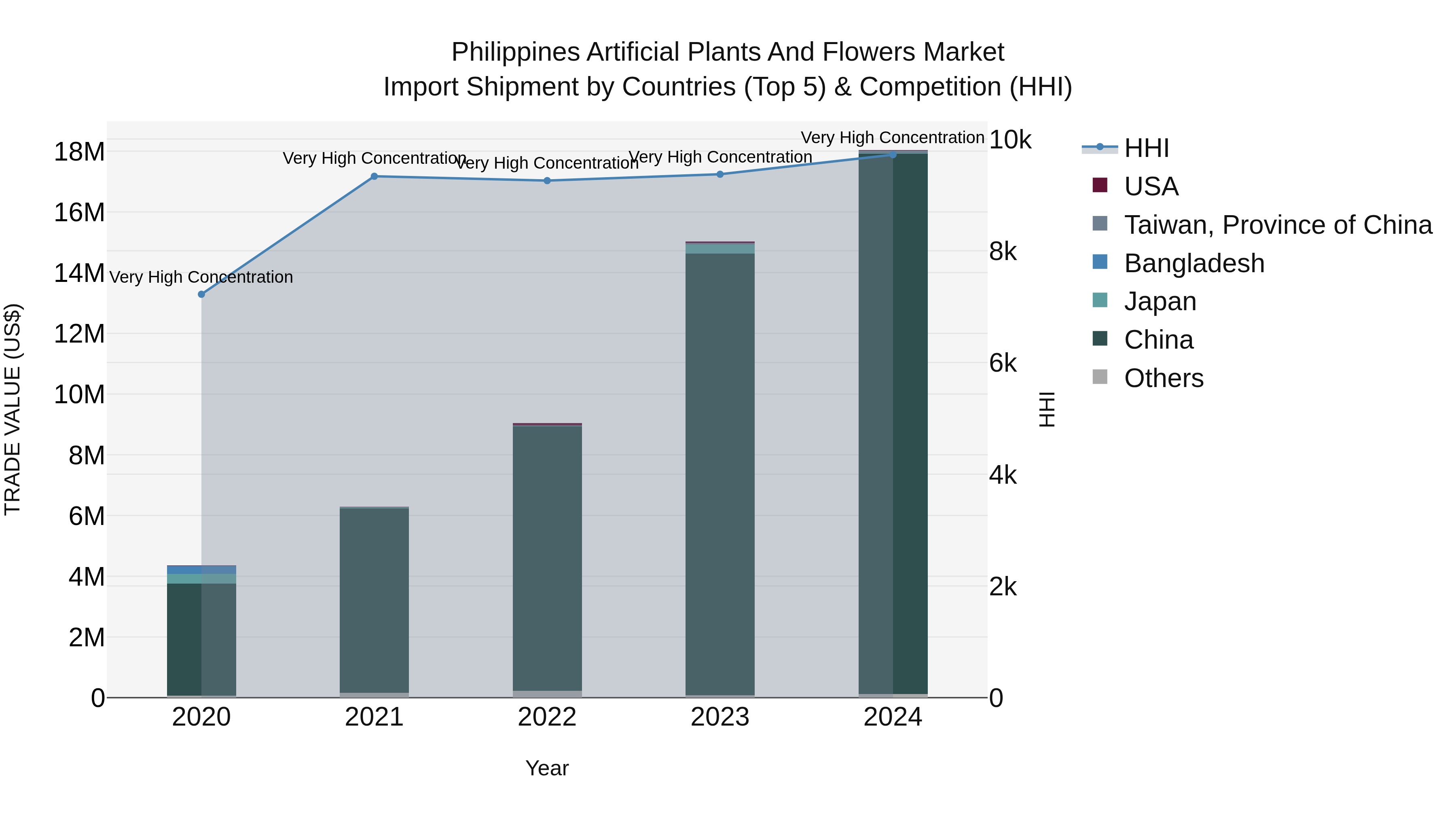
The Philippines continues to rely heavily on imports of artificial plants and flowers, with China, Taiwan, Malaysia, Netherlands, and Japan leading the way in 2024. The high Herfindahl-Hirschman Index (HHI) indicates a concentrated market, showcasing the dominance of these top exporting countries. The impressive compound annual growth rate (CAGR) of 42.6% from 2020 to 2024 highlights the increasing demand for artificial plants and flowers in the Philippines. Moreover, the growth rate of 20.0% from 2023 to 2024 suggests a continued upward trend in import shipments, demonstrating a flourishing market for these products.
philippines artificial plants and flowers market Synopsis
The Philippines artificial plants & flowers market was valued at USD 17 Million in 2025 and is anticipated to grow at a CAGR of 2. 2% during the forecast period owing to increased use as decorative elements across households along with commercial spaces such as malls, offices etc. Factors such as growing trend of using indoor greenery coupled with rising disposable income have also contributed towards driving up sales through retail outlets while ecommerce portals offer ease convenience regarding purchase decisions amongst consumers thereby fuelling overall growth outlook for this segment within this region over recent past years.
Drivers of the Market
The Philippines artificial plants and flowers market is driven by urban living trends and the need for convenient yet appealing home decoration options. Artificial plants and flowers provide the benefits of greenery without the need for watering or sunlight. The market is influenced by factors such as interior design trends, a desire for eco-friendly alternatives, and the busy lifestyles of consumers who seek low-maintenance d?cor solutions.
Challenges of the Market
The artificial plants and flowers market encounters challenges in overcoming the preference for real plants among Filipino consumers. The market`s success relies on replicating the beauty and freshness of natural plants while providing the benefits of low maintenance. Addressing concerns about the environmental impact of synthetic materials used in these products is crucial. Moreover, establishing effective marketing strategies to position artificial plants as viable d?cor options is a continuous challenge.
COVID-19 Impact on the Market
The Philippines artificial plants and flowers market experienced a notable shift due to the COVID-19 pandemic. With restrictions on movement and gatherings, the demand for indoor decoration surged, leading to increased interest in artificial plants and flowers as a way to beautify homes and spaces. Consumers sought low-maintenance alternatives to live plants, driving the market`s growth. The e-commerce sector played a pivotal role as online shopping gained momentum during lockdowns. This market demonstrated resilience in the face of the crisis, adapting to changing consumer preferences and leveraging digital platforms for sales.
Key Players in the Market
The Philippines` artificial plants and flowers market caters to the growing demand for low-maintenance decor solutions. Major players include companies like HomeMall Philippines and SM Home, which offer a wide range of artificial plants and flowers for indoor and outdoor embellishment. These products appeal to urban consumers seeking aesthetic enhancements without the need for extensive care.
Key Highlights of the Report:
- Philippines Artificial Plants And Flowers Market Outlook
- Market Size of Philippines Artificial Plants And Flowers Market, 2024
- Forecast of Philippines Artificial Plants And Flowers Market, 2031
- Historical Data and Forecast of Philippines Artificial Plants And Flowers Revenues & Volume for the Period 2021-2031
- Philippines Artificial Plants And Flowers Market Trend Evolution
- Philippines Artificial Plants And Flowers Market Drivers and Challenges
- Philippines Artificial Plants And Flowers Price Trends
- Philippines Artificial Plants And Flowers Porter's Five Forces
- Philippines Artificial Plants And Flowers Industry Life Cycle
- Historical Data and Forecast of Philippines Artificial Plants And Flowers Market Revenues & Volume By Material for the Period 2021-2031
- Historical Data and Forecast of Philippines Artificial Plants And Flowers Market Revenues & Volume By Plastic for the Period 2021-2031
- Historical Data and Forecast of Philippines Artificial Plants And Flowers Market Revenues & Volume By Polyester for the Period 2021-2031
- Historical Data and Forecast of Philippines Artificial Plants And Flowers Market Revenues & Volume By Clay for the Period 2021-2031
- Historical Data and Forecast of Philippines Artificial Plants And Flowers Market Revenues & Volume By Cotton for the Period 2021-2031
- Historical Data and Forecast of Philippines Artificial Plants And Flowers Market Revenues & Volume By Glass for the Period 2021-2031
- Historical Data and Forecast of Philippines Artificial Plants And Flowers Market Revenues & Volume By Nylon for the Period 2021-2031
- Historical Data and Forecast of Philippines Artificial Plants And Flowers Market Revenues & Volume By Porcelain for the Period 2021-2031
- Historical Data and Forecast of Philippines Plastic Artificial Plants And Flowers Market Revenues & Volume By Silk And Others for the Period 2021-2031
- Historical Data and Forecast of Philippines Artificial Plants And Flowers Market Revenues & Volume By Price Range for the Period 2021-2031
- Historical Data and Forecast of Philippines Artificial Plants And Flowers Market Revenues & Volume By Mass for the Period 2021-2031
- Historical Data and Forecast of Philippines Artificial Plants And Flowers Market Revenues & Volume By Premium for the Period 2021-2031
- Historical Data and Forecast of Philippines Artificial Plants And Flowers Market Revenues & Volume By On The Basis Of Application for the Period 2021-2031
- Historical Data and Forecast of Philippines Artificial Plants And Flowers Market Revenues & Volume By Commercial for the Period 2021-2031
- Historical Data and Forecast of Philippines Artificial Plants And Flowers Market Revenues & Volume By Residential for the Period 2021-2031
- Historical Data and Forecast of Philippines Artificial Plants And Flowers Market Revenues & Volume By Commercial Application for the Period 2021-2031
- Historical Data and Forecast of Philippines Artificial Plants And Flowers Market Revenues & Volume By Hotels for the Period 2021-2031
- Historical Data and Forecast of Philippines Artificial Plants And Flowers Market Revenues & Volume By Offices for the Period 2021-2031
- Historical Data and Forecast of Philippines Artificial Plants And Flowers Market Revenues & Volume By Schools for the Period 2021-2031
- Historical Data and Forecast of Philippines Artificial Plants And Flowers Market Revenues & Volume By Hospitals for the Period 2021-2031
- Historical Data and Forecast of Philippines Artificial Plants And Flowers Market Revenues & Volume By Theme Parks for the Period 2021-2031
- Historical Data and Forecast of Philippines Artificial Plants And Flowers Market Revenues & Volume By Airports for the Period 2021-2031
- Historical Data and Forecast of Philippines Artificial Plants And Flowers Market Revenues & Volume By Cruise Ships And Others for the Period 2021-2031
- Historical Data and Forecast of Philippines Artificial Plants And Flowers Market Revenues & Volume By Sales Channel for the Period 2021-2031
- Historical Data and Forecast of Philippines Artificial Plants And Flowers Market Revenues & Volume By Wholesalers/distributors for the Period 2021-2031
- Historical Data and Forecast of Philippines Artificial Plants And Flowers Market Revenues & Volume By Direct Sales for the Period 2021-2031
- Historical Data and Forecast of Philippines Artificial Plants And Flowers Market Revenues & Volume By Online Retailers for the Period 2021-2031
- Historical Data and Forecast of Philippines Artificial Plants And Flowers Market Revenues & Volume By Independent Stores for the Period 2021-2031
- Historical Data and Forecast of Philippines Artificial Plants And Flowers Market Revenues & Volume By Specialty Stores for the Period 2021-2031
- Historical Data and Forecast of Philippines Artificial Plants And Flowers Market Revenues & Volume By Other Sales Channel for the Period 2021-2031
- Philippines Artificial Plants And Flowers Import Export Trade Statistics
- Market Opportunity Assessment By Material
- Market Opportunity Assessment By Price Range
- Market Opportunity Assessment By Commercial Application
- Market Opportunity Assessment By Sales Channel
- Philippines Artificial Plants And Flowers Top Companies Market Share
- Philippines Artificial Plants And Flowers Competitive Benchmarking By Technical and Operational Parameters
- Philippines Artificial Plants And Flowers Company Profiles
- Philippines Artificial Plants And Flowers Key Strategic Recommendations






































