Philippines Asbestos Mining Market Size, Share & Growth Rate
The Philippines Asbestos Mining Market was estimated at USD 157 Million in 2025 and is projected to reach USD 212 Million by 2032, growing at a CAGR of 4.4% from 2026 to 2032. This growth is primarily driven by the ongoing infrastructure and construction boom, fueled by rapid urbanization and industrialization in the region. However, the market is also navigating the challenging waters of stringent regulations and health concerns linked to asbestos usage.
Philippines Asbestos Mining Market Year-wise Growth Rate and Key Drivers
This graph highlights how the Philippines Asbestos Mining Market has steadily grown over the years, supported by major growth factors.
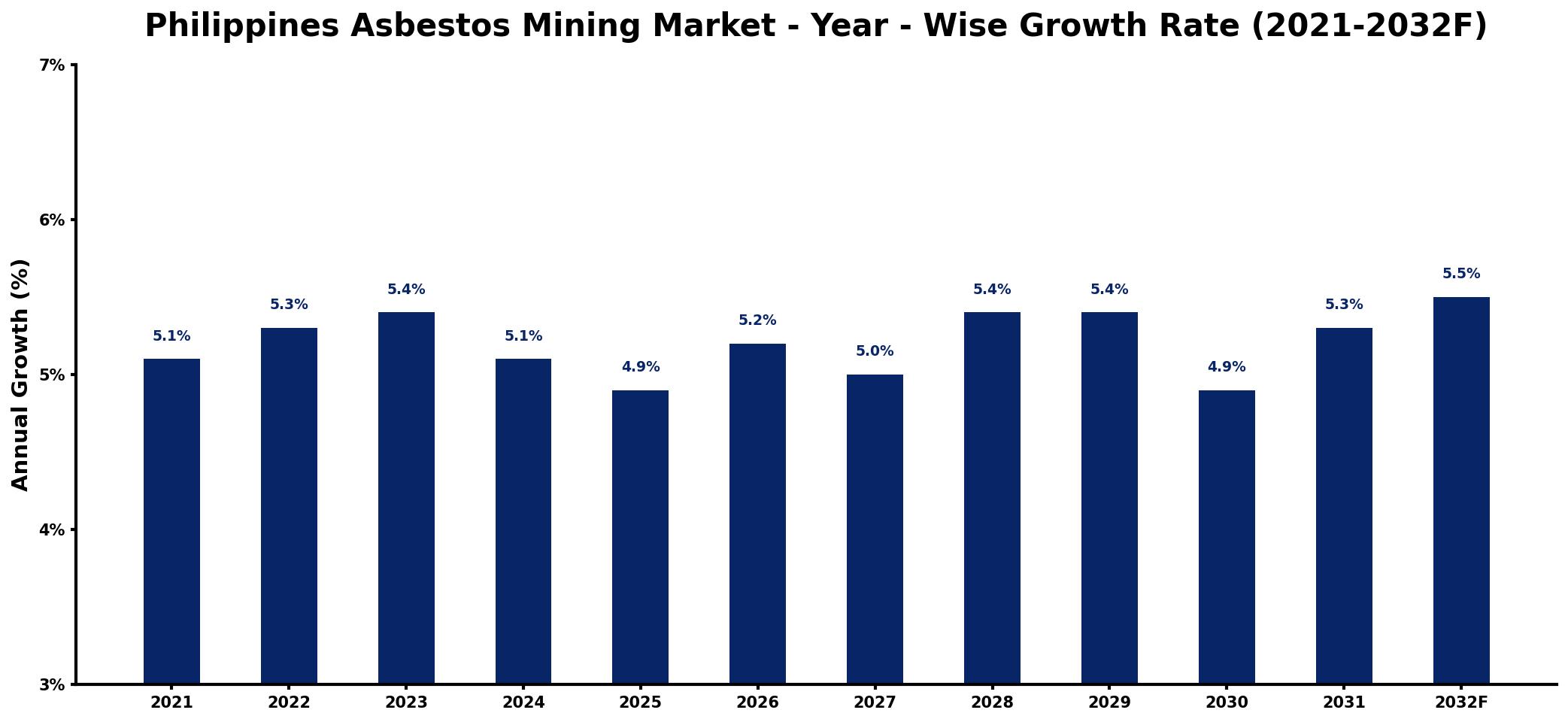
The table below presents the year‑wise growth rates along with the key drivers influencing the market
| Year | Growth Rate | Major Drivers |
| 2021 | 5.1% | increased construction sector activities |
| 2022 | 5.3% | rising demand for insulation materials |
| 2023 | 5.4% | growing industrial manufacturing investments |
| 2024 | 5.1% | expansion in infrastructure projects |
| 2025 | 4.9% | increased housing market investments |
| 2026 | 5.2% | growth in automotive sector demand |
| 2027 | 5.0% | surge in energy sector projects |
| 2028 | 5.4% | rising need for fireproof materials |
| 2029 | 5.4% | increased focus on sustainable practices |
| 2030 | 4.9% | growing demand for renovation projects |
| 2031 | 5.3% | expansion of commercial real estate |
| 2032 | 5.5% | increased research and development funding |
Note: Market size estimations and growth projections presented in this report are based on 6Wresearch's proprietary forecasting methodology, utilizing the latest available industry data, government publications, and primary research inputs.
Philippines Asbestos Mining Market Synopsis
The demand for asbestos in the Philippines is currently facing a significant decline due to escalating health and environmental concerns. As regulatory bodies intensify their scrutiny, the total production volume has plummeted by nearly 95%, highlighting the urgent need for sustainable practices in the industry.
Despite these challenges, certain sectors, including construction and automotive, still present a residual demand for asbestos-containing products. The market is adapting to these shifts by exploring innovative uses for asbestos while prioritizing responsible mining practices.
Philippines Asbestos Mining Market Key Takeaways
- The asbestos mining market in the Philippines is experiencing a transitional phase influenced by stringent health regulations.
- Market growth is projected at a CAGR of 4.4%, revealing resilience amidst substantial challenges.
- Infrastructure development remains a significant driver of demand, specifically in urbanized areas.
- Key players are actively seeking sustainable alternatives to asbestos to address health risks.
- Exploration of innovative mining practices is critical for future market viability.
Evaluation of Restraints in Philippines Asbestos Mining Market
The Philippines asbestos mining market faces formidable restraints primarily stemming from escalating health concerns associated with asbestos exposure. Legislative measures aimed at banning or heavily regulating asbestos use in construction and other industries significantly limit growth potential. Moreover, the global shift towards safer, non-asbestos alternatives continues to pose competitive challenges, forcing the industry to reevaluate its operational strategies and adopt safer mining practices. This evolving landscape necessitates a careful balance between economic imperatives and health considerations.
Philippines Asbestos Mining Market Trends
Current trends indicate a growing demand for alternatives to asbestos, influenced by increasing public awareness of health risks. Additionally, technological advancements in mining practices and material science are emerging as key factors driving market transformation. As stakeholders actively pursue sustainable solutions, the development of safer materials is likely to reshape the construction and industrial sectors, aligning with global health standards. Such innovations will not only mitigate health risks but will also create new business opportunities within the market.
Philippines Asbestos Mining Market Opportunities
Despite the challenges, opportunities for investment and growth exist, particularly in sectors that require innovative materials. As regulatory frameworks evolve, there is potential for companies to innovate with safer, environmentally friendly substitutes for asbestos in construction and manufacturing. Additionally, public infrastructure projects driven by government initiatives provide a fertile ground for sustainable mining and responsible use of asbestos-related materials, paving the way for new business models and practices.
Government Initiatives in the Philippines Asbestos Mining Market
The Philippine government is actively engaged in promoting safer mining practices through various initiatives aimed at regulating asbestos use. Legislative efforts focus on increasing awareness of health risks while encouraging the transition to alternative materials. Public spending on infrastructure projects also supports sustainable development practices, aligning with global health standards and enhancing community safety. The ongoing evaluation of existing mining regulations seeks to balance economic growth with environmental protection, reflecting a commitment to public health and safety.
Future Insights of the Philippines Asbestos Mining Market
Looking ahead to 2026-2032, the Philippines asbestos mining market is expected to undergo significant evolution. The emphasis on sustainable practices and alternative materials will become increasingly pronounced, necessitating adaptability from industry players. As awareness of health risks continues to grow, demand for asbestos is likely to diminish, leading to a market that prioritizes safety and sustainability over traditional mining practices. Companies that can pivot effectively in response to these trends will likely emerge as leaders in a transformed market landscape.
Philippines Asbestos Mining Market Latest Developments (2025 - 2026)
Recent developments in the Philippines asbestos mining market indicate a shift towards stricter compliance with health regulations and a growing focus on sustainable practices. Industry stakeholders are increasingly collaborating with governmental bodies to ensure that mining operations align with new health and safety standards. Additionally, research into alternative materials is gaining momentum, signaling a broader industry transformation towards responsible practices aimed at mitigating health risks associated with asbestos.
Philippines Asbestos Mining Market - Key Attractiveness of the Report
- 10 Years of Market Numbers
- Historical Data Starting from 2022 to 2025
- Base Year: 2025
- Forecast Data until 2032
- Key Performance Indicators Impacting the Market
- Major Upcoming Developments and Projects
Key Highlights of the Report:
- Philippines Asbestos Mining Market Outlook
- Market Size of Philippines Asbestos Mining Market, 2025
- Forecast of Philippines Asbestos Mining Market, 2032
- Historical Data and Forecast of Philippines Asbestos Mining Revenues & Volume for the Period 2022-2032F
- Philippines Asbestos Mining Market Trend Evolution
- Philippines Asbestos Mining Market Drivers and Challenges
- Philippines Asbestos Mining Price Trends
- Philippines Asbestos Mining Porter's Five Forces
- Philippines Asbestos Mining Industry Life Cycle
- Historical Data and Forecast of Philippines Asbestos Mining Market Revenues & Volume By End-use for the Period 2022-2032F
- Historical Data and Forecast of Philippines Asbestos Mining Market Revenues & Volume By Automobile for the Period 2022-2032F
- Historical Data and Forecast of Philippines Asbestos Mining Market Revenues & Volume By Pharmaceutical for the Period 2022-2032F
- Historical Data and Forecast of Philippines Asbestos Mining Market Revenues & Volume By Refinery for the Period 2022-2032F
- Philippines Asbestos Mining Import Export Trade Statistics
- Market Opportunity Assessment By End-use
- Philippines Asbestos Mining Top Companies Market Share
- Philippines Asbestos Mining Competitive Benchmarking By Technical and Operational Parameters
- Philippines Asbestos Mining Company Profiles
- Philippines Asbestos Mining Key Strategic Recommendations






































