Philippines Automotive Aluminum Alloy Market (2025-2031) | Growth, Outlook, Share, Value, Competitive Landscape, Analysis, Size & Revenue, Companies, Forecast, Trends, Segmentation, Industry
Market Forecast By Application (Engine Components, Wheels, Driveline, Heat Exchangers, Body Parts, Others), By Electric Vehicle Application (Engine Components, Wheels, Driveline, Heat Exchangers, Body Parts, Others), By Vehicle Type (Passenger Vehicle, Light Commercial Vehicle, Heavy Commercial Vehicle) And Competitive Landscape
| Product Code: ETC8835184 | Publication Date: Sep 2024 | Updated Date: Nov 2025 | Product Type: Market Research Report | |
| Publisher: 6Wresearch | Author: Shubham Deep | No. of Pages: 75 | No. of Figures: 35 | No. of Tables: 20 |
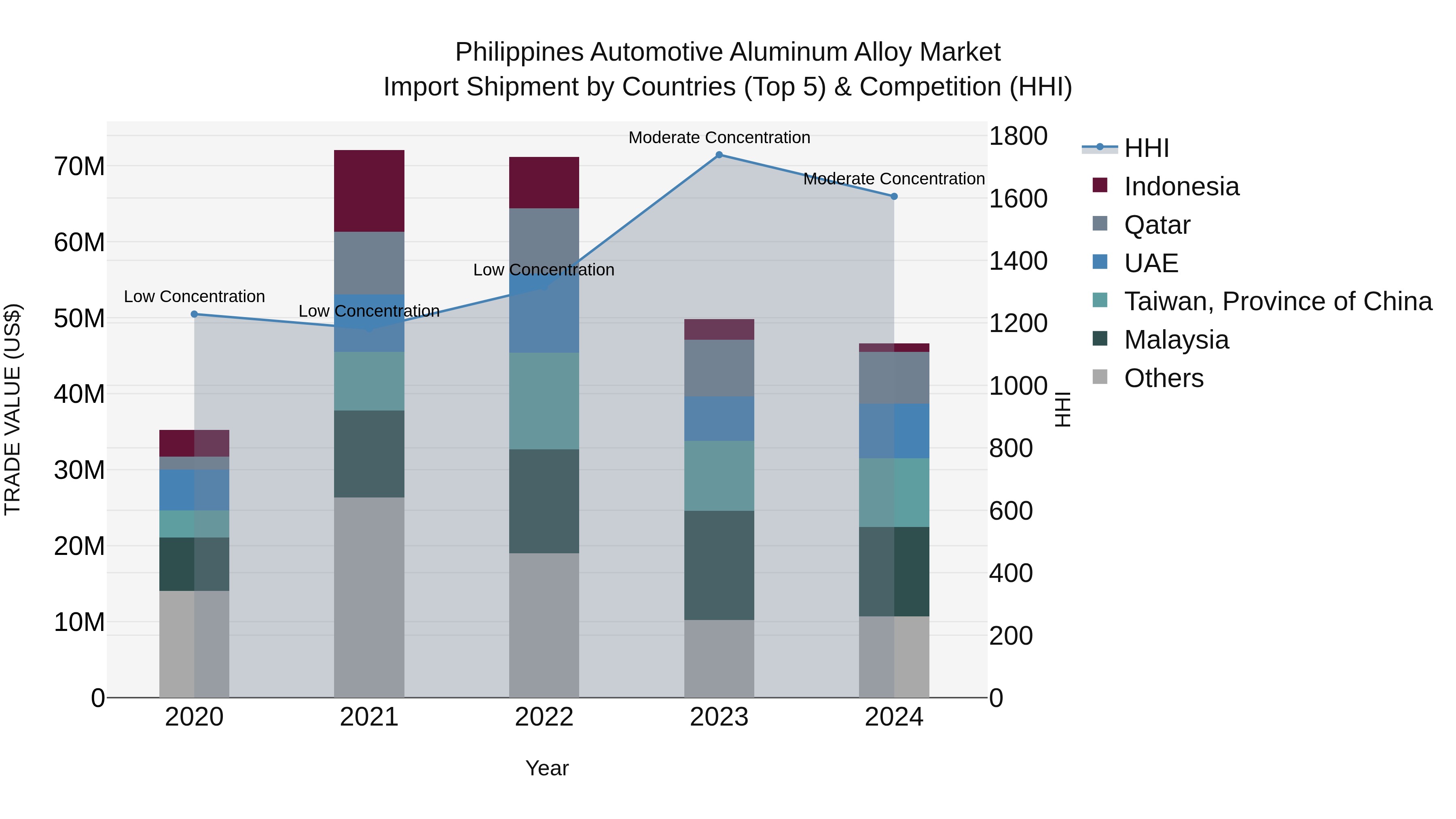
Philippines Automotive Aluminum Alloy Market Top 5 Importing Countries and Market Competition (HHI) Analysis
In 2024, the Philippines saw a steady increase in automotive aluminum alloy import shipments, with Malaysia, Taiwan, UAE, Qatar, and South Korea emerging as the top exporters. Despite moderate concentration, the Compound Annual Growth Rate (CAGR) from 2020 to 2024 stood at a healthy 7.26%. However, there was a slight decline in growth rate from 2023 to 2024 at -6.45%, indicating a potential slowdown in the market. Staying abreast of these trends and understanding the dynamics of these key exporting countries will be crucial for stakeholders in the automotive aluminum alloy industry in the Philippines.
Philippines Automotive Aluminum Alloy Market Overview
The automotive aluminum alloy market in the Philippines is expanding as manufacturers seek stronger and lighter materials to enhance vehicle performance and reduce emissions. Aluminum alloys are increasingly being used in the construction of engine parts, wheels, and other vehicle components due to their strength-to-weight ratio. The ongoing push for lighter, more efficient vehicles is expected to drive demand for high-quality aluminum alloys in the automotive industry.
Trends of the market
The Philippines automotive aluminum alloy market is expanding due to the increasing adoption of aluminum alloys in vehicle manufacturing. Aluminum alloys are preferred for their strength, durability, and ability to withstand various environmental conditions. These alloys are used in the production of lightweight automotive components, which help reduce fuel consumption and CO2 emissions. As the automotive industry in the Philippines continues to embrace sustainability and regulatory pressures around emissions tighten, the demand for aluminum alloys in vehicles is expected to grow.
Challenges of the market
The Automotive Aluminum Alloy market in the Philippines faces challenges primarily related to supply chain and cost efficiency. Although aluminum alloys are increasingly used in vehicles to reduce weight and improve fuel efficiency, the cost of aluminum alloys remains high due to their complex production processes and the dependence on imported materials. There is also a lack of local manufacturing capacity for high-performance alloys, leading to reliance on global suppliers. Furthermore, market adoption is slowed by limited awareness among local manufacturers about the advantages of aluminum alloys, as well as the technical challenges involved in processing them effectively.
Investment opportunities in the Market
Aluminum alloy use in powertrains, heat exchangers, and wheels is expanding across the Philippine automotive sector. Investments in alloy innovation, recycling capabilities, and metallurgical R&D can meet rising demand for corrosion-resistant, durable materials. Import substitution and supply agreements with OEMs offer a route to market penetration.
Government Policy of the market
The automotive aluminum alloy market in the Philippines is experiencing growth due to the increasing demand for lightweight, high-strength materials in vehicle manufacturing. The Philippine government supports the use of aluminum alloys in the automotive industry through policies that encourage the development of more fuel-efficient and environmentally friendly vehicles. As part of its sustainability initiatives, the government also promotes the recycling of aluminum, further boosting the demand for high-quality aluminum alloys in the automotive sector. The push for local manufacturing and industrial development aligns with this trend, making aluminum alloys a vital part of the Philippine automotive supply chain.
Key Highlights of the Report:
- Philippines Automotive Aluminum Alloy Market Outlook
- Market Size of Philippines Automotive Aluminum Alloy Market, 2024
- Forecast of Philippines Automotive Aluminum Alloy Market, 2031
- Historical Data and Forecast of Philippines Automotive Aluminum Alloy Revenues & Volume for the Period 2021- 2031
- Philippines Automotive Aluminum Alloy Market Trend Evolution
- Philippines Automotive Aluminum Alloy Market Drivers and Challenges
- Philippines Automotive Aluminum Alloy Price Trends
- Philippines Automotive Aluminum Alloy Porter's Five Forces
- Philippines Automotive Aluminum Alloy Industry Life Cycle
- Historical Data and Forecast of Philippines Automotive Aluminum Alloy Market Revenues & Volume By Application for the Period 2021- 2031
- Historical Data and Forecast of Philippines Automotive Aluminum Alloy Market Revenues & Volume By Engine Components for the Period 2021- 2031
- Historical Data and Forecast of Philippines Automotive Aluminum Alloy Market Revenues & Volume By Wheels for the Period 2021- 2031
- Historical Data and Forecast of Philippines Automotive Aluminum Alloy Market Revenues & Volume By Driveline for the Period 2021- 2031
- Historical Data and Forecast of Philippines Automotive Aluminum Alloy Market Revenues & Volume By Heat Exchangers for the Period 2021- 2031
- Historical Data and Forecast of Philippines Automotive Aluminum Alloy Market Revenues & Volume By Body Parts for the Period 2021- 2031
- Historical Data and Forecast of Philippines Automotive Aluminum Alloy Market Revenues & Volume By Others for the Period 2021- 2031
- Historical Data and Forecast of Philippines Automotive Aluminum Alloy Market Revenues & Volume By Electric Vehicle Application for the Period 2021- 2031
- Historical Data and Forecast of Philippines Automotive Aluminum Alloy Market Revenues & Volume By Engine Components for the Period 2021- 2031
- Historical Data and Forecast of Philippines Automotive Aluminum Alloy Market Revenues & Volume By Wheels for the Period 2021- 2031
- Historical Data and Forecast of Philippines Automotive Aluminum Alloy Market Revenues & Volume By Driveline for the Period 2021- 2031
- Historical Data and Forecast of Philippines Automotive Aluminum Alloy Market Revenues & Volume By Heat Exchangers for the Period 2021- 2031
- Historical Data and Forecast of Philippines Automotive Aluminum Alloy Market Revenues & Volume By Body Parts for the Period 2021- 2031
- Historical Data and Forecast of Philippines Automotive Aluminum Alloy Market Revenues & Volume By Others for the Period 2021- 2031
- Historical Data and Forecast of Philippines Automotive Aluminum Alloy Market Revenues & Volume By Vehicle Type for the Period 2021- 2031
- Historical Data and Forecast of Philippines Automotive Aluminum Alloy Market Revenues & Volume By Passenger Vehicle for the Period 2021- 2031
- Historical Data and Forecast of Philippines Automotive Aluminum Alloy Market Revenues & Volume By Light Commercial Vehicle for the Period 2021- 2031
- Historical Data and Forecast of Philippines Automotive Aluminum Alloy Market Revenues & Volume By Heavy Commercial Vehicle for the Period 2021- 2031
- Philippines Automotive Aluminum Alloy Import Export Trade Statistics
- Market Opportunity Assessment By Application
- Market Opportunity Assessment By Electric Vehicle Application
- Market Opportunity Assessment By Vehicle Type
- Philippines Automotive Aluminum Alloy Top Companies Market Share
- Philippines Automotive Aluminum Alloy Competitive Benchmarking By Technical and Operational Parameters
- Philippines Automotive Aluminum Alloy Company Profiles
- Philippines Automotive Aluminum Alloy Key Strategic Recommendations
Frequently Asked Questions About the Market Study (FAQs):
6Wresearch actively monitors the Philippines Automotive Aluminum Alloy Market and publishes its comprehensive annual report, highlighting emerging trends, growth drivers, revenue analysis, and forecast outlook. Our insights help businesses to make data-backed strategic decisions with ongoing market dynamics. Our analysts track relevent industries related to the Philippines Automotive Aluminum Alloy Market, allowing our clients with actionable intelligence and reliable forecasts tailored to emerging regional needs.
Yes, we provide customisation as per your requirements. To learn more, feel free to contact us on sales@6wresearch.com
1 Executive Summary |
2 Introduction |
2.1 Key Highlights of the Report |
2.2 Report Description |
2.3 Market Scope & Segmentation |
2.4 Research Methodology |
2.5 Assumptions |
3 Philippines Automotive Aluminum Alloy Market Overview |
3.1 Philippines Country Macro Economic Indicators |
3.2 Philippines Automotive Aluminum Alloy Market Revenues & Volume, 2021 & 2031F |
3.3 Philippines Automotive Aluminum Alloy Market - Industry Life Cycle |
3.4 Philippines Automotive Aluminum Alloy Market - Porter's Five Forces |
3.5 Philippines Automotive Aluminum Alloy Market Revenues & Volume Share, By Application, 2021 & 2031F |
3.6 Philippines Automotive Aluminum Alloy Market Revenues & Volume Share, By Electric Vehicle Application, 2021 & 2031F |
3.7 Philippines Automotive Aluminum Alloy Market Revenues & Volume Share, By Vehicle Type, 2021 & 2031F |
4 Philippines Automotive Aluminum Alloy Market Dynamics |
4.1 Impact Analysis |
4.2 Market Drivers |
4.2.1 Growing demand for lightweight vehicles to improve fuel efficiency and reduce emissions |
4.2.2 Increasing focus on sustainability and recyclability in the automotive industry |
4.2.3 Advancements in automotive manufacturing technologies leading to higher adoption of aluminum alloys |
4.3 Market Restraints |
4.3.1 High initial cost of aluminum alloys compared to traditional materials like steel |
4.3.2 Limited availability and higher lead times for specialized aluminum alloy grades |
4.3.3 Challenges related to recycling and waste management of aluminum alloys in the automotive sector |
5 Philippines Automotive Aluminum Alloy Market Trends |
6 Philippines Automotive Aluminum Alloy Market, By Types |
6.1 Philippines Automotive Aluminum Alloy Market, By Application |
6.1.1 Overview and Analysis |
6.1.2 Philippines Automotive Aluminum Alloy Market Revenues & Volume, By Application, 2021- 2031F |
6.1.3 Philippines Automotive Aluminum Alloy Market Revenues & Volume, By Engine Components, 2021- 2031F |
6.1.4 Philippines Automotive Aluminum Alloy Market Revenues & Volume, By Wheels, 2021- 2031F |
6.1.5 Philippines Automotive Aluminum Alloy Market Revenues & Volume, By Driveline, 2021- 2031F |
6.1.6 Philippines Automotive Aluminum Alloy Market Revenues & Volume, By Heat Exchangers, 2021- 2031F |
6.1.7 Philippines Automotive Aluminum Alloy Market Revenues & Volume, By Body Parts, 2021- 2031F |
6.1.8 Philippines Automotive Aluminum Alloy Market Revenues & Volume, By Others, 2021- 2031F |
6.2 Philippines Automotive Aluminum Alloy Market, By Electric Vehicle Application |
6.2.1 Overview and Analysis |
6.2.2 Philippines Automotive Aluminum Alloy Market Revenues & Volume, By Engine Components, 2021- 2031F |
6.2.3 Philippines Automotive Aluminum Alloy Market Revenues & Volume, By Wheels, 2021- 2031F |
6.2.4 Philippines Automotive Aluminum Alloy Market Revenues & Volume, By Driveline, 2021- 2031F |
6.2.5 Philippines Automotive Aluminum Alloy Market Revenues & Volume, By Heat Exchangers, 2021- 2031F |
6.2.6 Philippines Automotive Aluminum Alloy Market Revenues & Volume, By Body Parts, 2021- 2031F |
6.2.7 Philippines Automotive Aluminum Alloy Market Revenues & Volume, By Others, 2021- 2031F |
6.3 Philippines Automotive Aluminum Alloy Market, By Vehicle Type |
6.3.1 Overview and Analysis |
6.3.2 Philippines Automotive Aluminum Alloy Market Revenues & Volume, By Passenger Vehicle, 2021- 2031F |
6.3.3 Philippines Automotive Aluminum Alloy Market Revenues & Volume, By Light Commercial Vehicle, 2021- 2031F |
6.3.4 Philippines Automotive Aluminum Alloy Market Revenues & Volume, By Heavy Commercial Vehicle, 2021- 2031F |
7 Philippines Automotive Aluminum Alloy Market Import-Export Trade Statistics |
7.1 Philippines Automotive Aluminum Alloy Market Export to Major Countries |
7.2 Philippines Automotive Aluminum Alloy Market Imports from Major Countries |
8 Philippines Automotive Aluminum Alloy Market Key Performance Indicators |
8.1 Adoption rate of aluminum alloys in new vehicle models |
8.2 Percentage of vehicles using lightweight materials like aluminum alloys |
8.3 Investment in research and development for aluminum alloy applications in automotive industry |
9 Philippines Automotive Aluminum Alloy Market - Opportunity Assessment |
9.1 Philippines Automotive Aluminum Alloy Market Opportunity Assessment, By Application, 2021 & 2031F |
9.2 Philippines Automotive Aluminum Alloy Market Opportunity Assessment, By Electric Vehicle Application, 2021 & 2031F |
9.3 Philippines Automotive Aluminum Alloy Market Opportunity Assessment, By Vehicle Type, 2021 & 2031F |
10 Philippines Automotive Aluminum Alloy Market - Competitive Landscape |
10.1 Philippines Automotive Aluminum Alloy Market Revenue Share, By Companies, 2024 |
10.2 Philippines Automotive Aluminum Alloy Market Competitive Benchmarking, By Operating and Technical Parameters |
11 Company Profiles |
12 Recommendations |
13 Disclaimer |
Pricing
- Single User License$ 1,995
- Department License$ 2,400
- Site License$ 3,120
- Global License$ 3,795

Search
Thought Leadership and Analyst Meet





Our Clients








Related Reports
- Germany Breakfast Food Market (2026-2032) | Industry, Share, Growth, Size, Companies, Value, Analysis, Revenue, Trends, Forecast & Outlook
- Australia Briquette Market (2025-2031) | Growth, Size, Revenue, Forecast, Analysis, Trends, Value, Share, Industry & Companies
- Vietnam System Integrator Market (2025-2031) | Size, Companies, Analysis, Industry, Value, Forecast, Growth, Trends, Revenue & Share
- ASEAN and Thailand Brain Health Supplements Market (2025-2031) | Strategy, Consumer Insights, Analysis, Investment Trends, Opportunities, Growth, Size, Share, Industry, Revenue, Segments, Value, Segmentation, Supply, Forecast, Restraints, Outlook, Competition, Drivers, Trends, Demand, Pricing Analysis, Competitive, Strategic Insights, Companies, Challenges
- ASEAN Bearings Market (2025-2031) | Strategy, Consumer Insights, Analysis, Investment Trends, Opportunities, Growth, Size, Share, Industry, Revenue, Segments, Value, Segmentation, Supply, Forecast, Restraints, Outlook, Competition, Drivers, Trends, Demand, Pricing Analysis, Competitive, Strategic Insights, Companies, Challenges
- Europe Flooring Market (2025-2031) | Outlook, Share, Industry, Trends, Forecast, Companies, Revenue, Size, Analysis, Growth & Value
- Saudi Arabia Manlift Market (2025-2031) | Outlook, Size, Growth, Trends, Companies, Industry, Revenue, Value, Share, Forecast & Analysis
- Uganda Excavator, Crane, and Wheel Loaders Market (2025-2031) | Strategy, Consumer Insights, Analysis, Investment Trends, Opportunities, Growth, Size, Share, Industry, Revenue, Segments, Value, Segmentation, Supply, Forecast, Restraints, Outlook, Competition, Drivers, Trends, Demand, Pricing Analysis, Competitive, Strategic Insights, Companies, Challenges
- Rwanda Excavator, Crane, and Wheel Loaders Market (2025-2031) | Strategy, Consumer Insights, Analysis, Investment Trends, Opportunities, Growth, Size, Share, Industry, Revenue, Segments, Value, Segmentation, Supply, Forecast, Restraints, Outlook, Competition, Drivers, Trends, Demand, Pricing Analysis, Competitive, Strategic Insights, Companies, Challenges
- Kenya Excavator, Crane, and Wheel Loaders Market (2025-2031) | Strategy, Consumer Insights, Analysis, Investment Trends, Opportunities, Growth, Size, Share, Industry, Revenue, Segments, Value, Segmentation, Supply, Forecast, Restraints, Outlook, Competition, Drivers, Trends, Demand, Pricing Analysis, Competitive, Strategic Insights, Companies, Challenges
Industry Events and Analyst Meet

Stationery & Paper Expo Saudi Arabia 2026

Kids & Toys Expo Saudi Arabia 2026

Gifts & Homeware Expo Saudi Arabia 2026

Smart Home Expo 2026

Industrial Facilities Management Expo 2025
Whitepaper
- Middle East & Africa Commercial Security Market Click here to view more.
- Middle East & Africa Fire Safety Systems & Equipment Market Click here to view more.
- GCC Drone Market Click here to view more.
- Middle East Lighting Fixture Market Click here to view more.
- GCC Physical & Perimeter Security Market Click here to view more.
6WResearch In News
- Doha a strategic location for EV manufacturing hub: IPA Qatar
- Demand for luxury TVs surging in the GCC, says Samsung
- Empowering Growth: The Thriving Journey of Bangladesh’s Cable Industry
- Demand for luxury TVs surging in the GCC, says Samsung
- Video call with a traditional healer? Once unthinkable, it’s now common in South Africa
- Intelligent Buildings To Smooth GCC’s Path To Net Zero


