Philippines Automotive Bumpers Market (2025-2031) | Value, Analysis, Forecast, Share, Outlook, Industry, Trends, Companies, Revenue, Size & Growth
Market Forecast By Product Type (Regular/Standard, Deep Drop Bumpers, Roll Pan Bumpers, Step Bumper, Tube Bumper), By Raw Material (Plastic, Aluminium, Others), By Vehicle Type (Compact, Mid-Sized, Premium, Luxury, Commercial, Heavy Commercial), By Sales Channel (OEM, Aftermarket) And Competitive Landscape
| Product Code: ETC063108 | Publication Date: Jul 2023 | Updated Date: Nov 2025 | Product Type: Report | |
| Publisher: 6Wresearch | Author: Ravi Bhandari | No. of Pages: 70 | No. of Figures: 35 | No. of Tables: 5 |
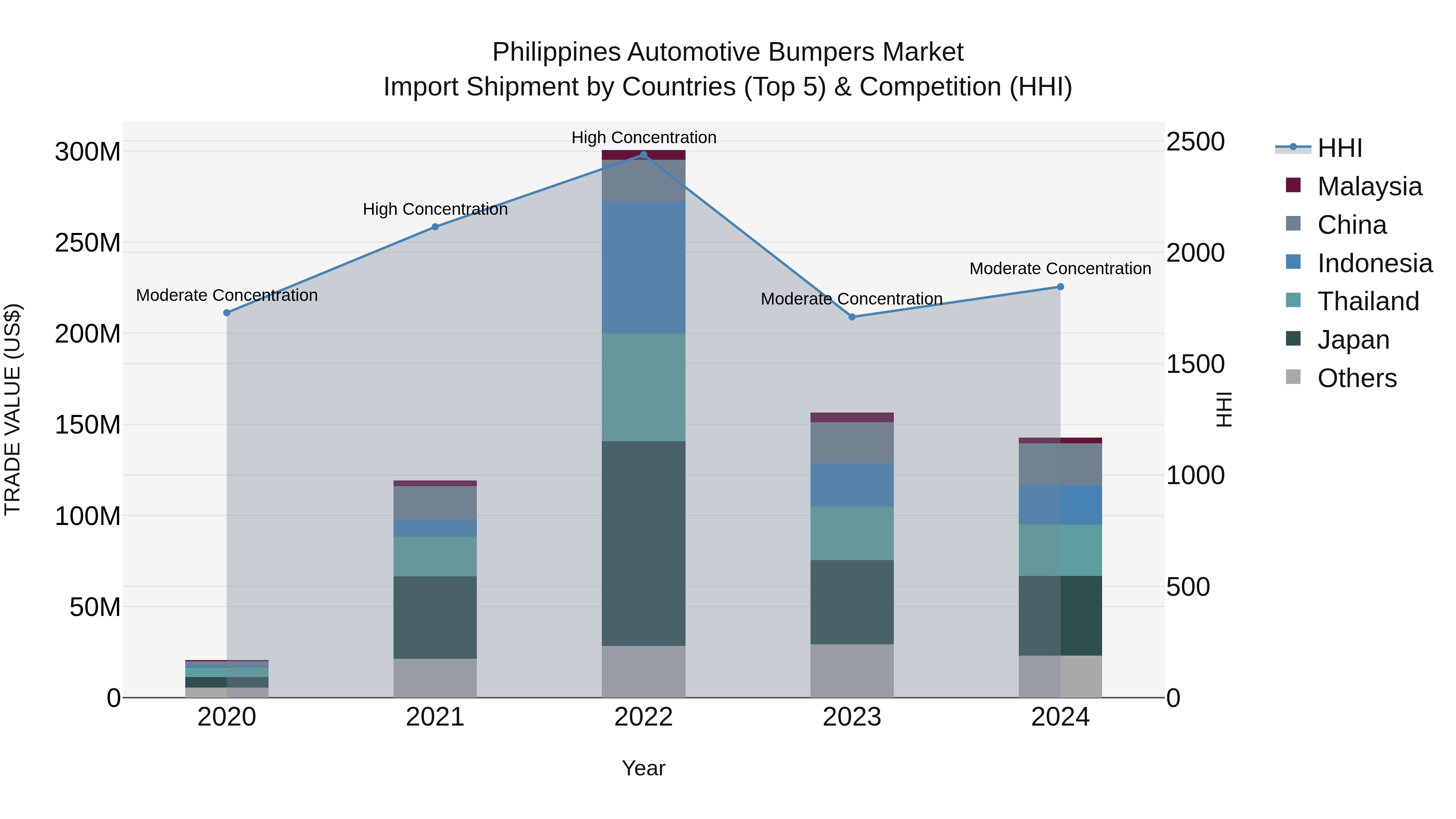
Philippines Automotive Bumpers Market Top 5 Importing Countries and Market Competition (HHI) Analysis
The Philippines automotive bumpers import market in 2024 saw a significant contribution from top exporting countries like Japan, Thailand, China, Indonesia, and Germany. Despite moderate concentration indicated by the Herfindahl-Hirschman Index (HHI), the market demonstrated strong growth with a remarkable compound annual growth rate (CAGR) of 62.32% from 2020 to 2024. However, there was a slight dip in the growth rate from 2023 to 2024, showing a decrease of -8.74%. This data suggests both opportunities and challenges for stakeholders in the automotive bumpers import sector in the Philippines.
Philippines Automotive Bumpers Market Highlights
| Report Name | Philippines Automotive Bumpers Market |
| Forecast period | 2025-2031 |
| CAGR | 5.9% |
| Growing Sector | Passenger Vehicle |
Topics Covered in the Philippines Automotive Bumpers Market
The Philippines Automotive Bumpers Market report thoroughly covers the market By Product Type, By Raw Material, By Vehicle Type and By Sales Channel. The market report provides an unbiased and detailed analysis of the ongoing market trends, opportunities/high growth areas, and market drivers which would help the stakeholders to devise and align their market strategies according to the current and future market dynamics.
Philippines Automotive Bumpers Market Synopsis
Philippines Automotive Bumpers Market growth is driven by various factors such as economic growth, rising disposable income, and government initiatives. In recent years, there has been an increasing demand for vehicles in the country, leading to a steady growth of the automotive industry.
According to 6Wresearch, the Philippines Automotive Bumpers Market is anticipated to grow at a CAGR of 5.9% during the forecast period 2025-2031. The Philippines automotive bumpers market is experiencing growth driven by several key factors. The increasing demand for vehicles, fueled by rising disposable incomes and urbanization, has led to a boosted need for high-quality automotive components, including bumpers. Additionally, advancements in materials, such as lightweight polymers and composite materials, are helping manufacturers create durable and fuel-efficient bumper designs, aligning with the evolving preferences of eco-conscious consumers. Government initiatives aimed at supporting local automotive industries and promoting vehicle production have further contributed to Philippines Automotive Bumpers Market Growth.
However, the Philippines Automotive Bumpers Industry faces significant challenges as well. High production costs and fluctuating raw material prices can impact profitability for manufacturers. Furthermore, the influx of counterfeit or substandard bumpers in the aftermarket poses a risk to consumer safety and brand reputation. Regulatory compliance and adherence to stringent safety standards also remain critical obstacles for players in the market. Despite these challenges, ongoing innovations and a growing automotive sector present opportunities for sustained growth in the Philippines automotive bumpers market.
Philippines Automotive Bumpers Market Trends
Philippines Automotive Bumpers Industry has been experiencing steady growth, driven by rising vehicle production and an increasing focus on vehicle safety and design. With evolving consumer preferences, there is a notable shift towards lightweight and durable bumper materials such as thermoplastics and composites, which enhance fuel efficiency while maintaining structural integrity. Additionally, the growing popularity of electric vehicles (EVs) in the region has spurred demand for innovative bumper designs tailored to these new platforms.
Another key trend in the market is the integration of advanced technologies, such as sensors and cameras, directly into bumper systems. These smart bumpers are becoming an essential component of modern vehicles equipped with driver-assistance systems, aligning with global trends in automotive safety innovation. Furthermore, government regulations emphasizing pedestrian safety and environmental sustainability are encouraging manufacturers to adopt recyclable materials and adhere to stringent safety standards.
The aftermarket segment also remains vibrant, as vehicle owners seek replacement or upgraded bumpers to enhance aesthetics and functionality. Overall, the Philippines automotive bumpers market continues to evolve, with a strong emphasis on innovation, sustainability, and consumer-driven demands.
Investment Opportunities in the Philippines Automotive Bumpers Market
Philippines Automotive Bumpers Market presents numerous investment opportunities driven by the country's growing automotive industry and the ongoing shift toward innovative and sustainable solutions. One key area of potential lies in the development and manufacturing of lightweight, recyclable bumper materials, which align with global trends in creating environmentally friendly automotive components. Investors can tap into this demand by supporting research and development initiatives that focus on high-performance materials like carbon fiber composites or advanced thermoplastics.
Another promising avenue is the integration of smart technologies into bumper systems. Companies investing in the production of bumpers with built-in sensors, cameras, and other components for advanced driver-assistance systems (ADAS) are well-positioned to benefit from the increasing adoption of connected vehicles. Furthermore, partnerships with local automotive manufacturers to provide tailored solutions for electric vehicles (EVs) offer growth potential, as this segment is expected to expand in the coming years.
Leading Players in the Philippines Automotive Bumpers Market
Some of the leading players in the Philippines Automotive Bumper Market include Magna International Inc., Plastic Omnium SA, Hella KGaA Hueck & Co., and Samvardhana Motherson Group. These companies are continuously expanding their presence in the market through partnerships, mergers and acquisitions, and product innovation. Other key players in the market include Hyundai Mobis Co. Ltd, JBM Auto Limited, Tong Yang Industry Co. Ltd, and FLEX-N-GATE.
Government Regulations
The government has implemented various regulations to ensure safety, quality, and environmental compliance in the automotive bumpers market. For instance, the Department of Trade and Industry (DTI) oversees the Bureau of Philippine Standards (BPS), which enforces adherence to product standards such as the Philippine National Standard (PNS) requirements for automotive parts. These standards emphasize impact resistance and durability, ensuring bumpers are capable of protecting passengers during minor collisions.
Additionally, the Clean Air Act of 1999 mandates manufacturers to reduce harmful emissions, indirectly influencing the materials used in bumper production to meet environmental standards. An example of this regulation in action is manufacturers’ shift toward recyclable and eco-friendly materials in compliance with the law. Furthermore, importation rules require automotive bumpers to undergo inspections and certifications, ensuring they align with safety and performance benchmarks before being distributed in the local market. These regulations collectively aim to protect consumers while fostering innovation and sustainability within the industry.
Future Insights of the Philippines Automotive Bumpers Market
The automotive bumpers market in the Philippines is poised for significant growth as technological advancements and environmental concerns continue to shape the industry. Innovations such as the integration of lightweight composite materials and advanced manufacturing techniques are expected to dominate future production trends. These materials not only improve vehicle fuel efficiency but also align with global sustainability goals. Additionally, the growing adoption of electric vehicles (EVs) in the Philippine market is likely to influence bumper designs, requiring them to accommodate unique structural and aerodynamic requirements.
With increasing consumer awareness about safety, demand for bumpers equipped with advanced safety features, including enhanced energy absorption designs, is predicted to rise. Local manufacturers are also expected to emphasize compliance with international quality standards, paving the way for potential export opportunities. Policies supporting green technologies and sustainable practices will further steer the market towards eco-friendly innovations. Collectively, these developments position the Philippines automotive bumpers market as a dynamic and evolving sector in the coming years.
Market Segmentation Analysis
The report offers a comprehensive study of the subsequent market segments and their leading categories.
Regular/Standard Bumpers to Dominate the Market-By Product Type
According to Sachin, Senior Research Analyst, 6Wresearch, the regular/standard segment is expected to continue experiencing growth in the near future, as it is the most commonly used type of bumper in automotive production.
Plastic Bumpers to Dominate the Market-By Raw Material
The plastic segment is expected to experience the most growth in the Philippines Automotive Bumper Market, as it is currently the most commonly used raw material for bumper production.
OEM Segment to Dominate the Market-By Sales Channel
The OEM (original equipment manufacturer) segment is expected to continue experiencing growth in the Philippines Automotive Bumper Market, as it is directly tied to vehicle production. However, there may also be opportunities for growth in the aftermarket segment as customization becomes more popular and consumers look for specialized bumper products and services. It will be important for companies to keep a pulse on consumer preferences and invest in marketing strategies to capture a share of this growing market.
Key Attractiveness of the Report
- 10 Years of Market Numbers.
- Historical Data Starting from 2021 to 2024.
- Base Year: 2024
- Forecast Data until 2031.
- Key Performance Indicators Impacting the market.
- Major Upcoming Developments and Projects.
Key Highlights of the Report:
- Philippines Automotive Bumpers Market Outlook
- Market Size of Philippines Automotive Bumpers Market, 2024
- Forecast of Philippines Automotive Bumpers Market, 2031
- Historical Data and Forecast of Philippines Automotive Bumpers Revenues & Volume for the Period 2021 - 2031
- Philippines Automotive Bumpers Market Trend Evolution
- Philippines Automotive Bumpers Market Drivers and Challenges
- Philippines Automotive Bumpers Price Trends
- Philippines Automotive Bumpers Porter's Five Forces
- Philippines Automotive Bumpers Industry Life Cycle
- Historical Data and Forecast of Philippines Automotive Bumpers Market Revenues & Volume By Product Type for the Period 2021 - 2031
- Historical Data and Forecast of Philippines Automotive Bumpers Market Revenues & Volume By Regular/Standard for the Period 2021 - 2031
- Historical Data and Forecast of Philippines Automotive Bumpers Market Revenues & Volume By Deep Drop Bumpers for the Period 2021 - 2031
- Historical Data and Forecast of Philippines Automotive Bumpers Market Revenues & Volume By Roll Pan Bumpers for the Period 2021 - 2031
- Historical Data and Forecast of Philippines Automotive Bumpers Market Revenues & Volume By Step Bumper for the Period 2021 - 2031
- Historical Data and Forecast of Philippines Automotive Bumpers Market Revenues & Volume By Tube Bumper for the Period 2021 - 2031
- Historical Data and Forecast of Philippines Automotive Bumpers Market Revenues & Volume By Raw Material for the Period 2021 - 2031
- Historical Data and Forecast of Philippines Automotive Bumpers Market Revenues & Volume By Plastic for the Period 2021 - 2031
- Historical Data and Forecast of Philippines Automotive Bumpers Market Revenues & Volume By Aluminium for the Period 2021 - 2031
- Historical Data and Forecast of Philippines Automotive Bumpers Market Revenues & Volume By Others for the Period 2021 - 2031
- Historical Data and Forecast of Philippines Automotive Bumpers Market Revenues & Volume By Vehicle Type for the Period 2021 - 2031
- Historical Data and Forecast of Philippines Automotive Bumpers Market Revenues & Volume By Compact for the Period 2021 - 2031
- Historical Data and Forecast of Philippines Automotive Bumpers Market Revenues & Volume By Mid-Sized for the Period 2021 - 2031
- Historical Data and Forecast of Philippines Automotive Bumpers Market Revenues & Volume By Premium for the Period 2021 - 2031
- Historical Data and Forecast of Philippines Automotive Bumpers Market Revenues & Volume By Luxury for the Period 2021 - 2031
- Historical Data and Forecast of Philippines Automotive Bumpers Market Revenues & Volume By Commercial for the Period 2021 - 2031
- Historical Data and Forecast of Philippines Automotive Bumpers Market Revenues & Volume By Heavy Commercial for the Period 2021 - 2031
- Historical Data and Forecast of Philippines Automotive Bumpers Market Revenues & Volume By Sales Channel for the Period 2021 - 2031
- Historical Data and Forecast of Philippines Automotive Bumpers Market Revenues & Volume By OEM for the Period 2021 - 2031
- Historical Data and Forecast of Philippines Automotive Bumpers Market Revenues & Volume By Aftermarket for the Period 2021 - 2031
- Philippines Automotive Bumpers Import Export Trade Statistics
- Market Opportunity Assessment By Product Type
- Market Opportunity Assessment By Raw Material
- Market Opportunity Assessment By Vehicle Type
- Market Opportunity Assessment By Sales Channel
- Philippines Automotive Bumpers Top Companies Market Share
- Philippines Automotive Bumpers Competitive Benchmarking By Technical and Operational Parameters
- Philippines Automotive Bumpers Company Profiles
- Philippines Automotive Bumpers Key Strategic Recommendations
Markets Covered
The report provides a detailed analysis of the following market segments:
By Product Type
- Regular/Standard
- Deep Drop Bumpers
- Roll Pan Bumpers
- Step Bumper
- Tube Bumper
By Raw Material
- Plastic
- Aluminium
- Others
By Vehicle Type
- Compact
- Mid-sized
- Premium
- Luxury
- Commercial
- Heavy Commercial
By Sales Channel
- OEM
- Aftermarket
- Competitive Landscape
Philippines Automotive Bumpers Market (2025-2031): FAQs
The increasing demand for vehicles, trend towards customization, and advancements in technology are some of the key factors driving the growth of the Philippines Automotive Bumper Market.
Some leading players in this market include Magna International Inc., Plastic Omnium SA, Hella KGaA Hueck & Co., and Samvardhana Motherson Group.
The regular/standard and deep drop bumper segments are likely to experience the most growth, as they are commonly used and offer stylish options for consumers.
Government regulations play a significant role in the Philippines Automotive Bumper Market, as they ensure safety and emissions standards and promote overall industry growth through initiatives such as the Automotive Industry Roadmap.
6Wresearch actively monitors the Philippines Automotive Bumpers Market and publishes its comprehensive annual report, highlighting emerging trends, growth drivers, revenue analysis, and forecast outlook. Our insights help businesses to make data-backed strategic decisions with ongoing market dynamics. Our analysts track relevent industries related to the Philippines Automotive Bumpers Market, allowing our clients with actionable intelligence and reliable forecasts tailored to emerging regional needs.
Yes, we provide customisation as per your requirements. To learn more, feel free to contact us on sales@6wresearch.com
| 1 Executive Summary |
| 2 Introduction |
| 2.1 Key Highlights of the Report |
| 2.2 Report Description |
| 2.3 Market Scope & Segmentation |
| 2.4 Research Methodology |
| 2.5 Assumptions |
| 3 Philippines Automotive Bumpers Market Overview |
| 3.1 Philippines Country Macro Economic Indicators |
| 3.2 Philippines Automotive Bumpers Market Revenues & Volume, 2021 & 2031F |
| 3.3 Philippines Automotive Bumpers Market - Industry Life Cycle |
| 3.4 Philippines Automotive Bumpers Market - Porter's Five Forces |
| 3.5 Philippines Automotive Bumpers Market Revenues & Volume Share, By Product Type, 2021 & 2031F |
| 3.6 Philippines Automotive Bumpers Market Revenues & Volume Share, By Raw Material, 2021 & 2031F |
| 3.7 Philippines Automotive Bumpers Market Revenues & Volume Share, By Vehicle Type, 2021 & 2031F |
| 3.8 Philippines Automotive Bumpers Market Revenues & Volume Share, By Sales Channel, 2021 & 2031F |
| 4 Philippines Automotive Bumpers Market Dynamics |
| 4.1 Impact Analysis |
| 4.2 Market Drivers |
| 4.3 Market Restraints |
| 5 Philippines Automotive Bumpers Market Trends |
| 6 Philippines Automotive Bumpers Market, By Types |
| 6.1 Philippines Automotive Bumpers Market, By Product Type |
| 6.1.1 Overview and Analysis |
| 6.1.2 Philippines Automotive Bumpers Market Revenues & Volume, By Product Type, 2021 - 2031F |
| 6.1.3 Philippines Automotive Bumpers Market Revenues & Volume, By Regular/Standard, 2021 - 2031F |
| 6.1.4 Philippines Automotive Bumpers Market Revenues & Volume, By Deep Drop Bumpers, 2021 - 2031F |
| 6.1.5 Philippines Automotive Bumpers Market Revenues & Volume, By Roll Pan Bumpers, 2021 - 2031F |
| 6.1.6 Philippines Automotive Bumpers Market Revenues & Volume, By Step Bumper, 2021 - 2031F |
| 6.1.7 Philippines Automotive Bumpers Market Revenues & Volume, By Tube Bumper, 2021 - 2031F |
| 6.2 Philippines Automotive Bumpers Market, By Raw Material |
| 6.2.1 Overview and Analysis |
| 6.2.2 Philippines Automotive Bumpers Market Revenues & Volume, By Plastic, 2021 - 2031F |
| 6.2.3 Philippines Automotive Bumpers Market Revenues & Volume, By Aluminium, 2021 - 2031F |
| 6.2.4 Philippines Automotive Bumpers Market Revenues & Volume, By Others, 2021 - 2031F |
| 6.3 Philippines Automotive Bumpers Market, By Vehicle Type |
| 6.3.1 Overview and Analysis |
| 6.3.2 Philippines Automotive Bumpers Market Revenues & Volume, By Compact, 2021 - 2031F |
| 6.3.3 Philippines Automotive Bumpers Market Revenues & Volume, By Mid-Sized, 2021 - 2031F |
| 6.3.4 Philippines Automotive Bumpers Market Revenues & Volume, By Premium, 2021 - 2031F |
| 6.3.5 Philippines Automotive Bumpers Market Revenues & Volume, By Luxury, 2021 - 2031F |
| 6.3.6 Philippines Automotive Bumpers Market Revenues & Volume, By Commercial, 2021 - 2031F |
| 6.3.7 Philippines Automotive Bumpers Market Revenues & Volume, By Heavy Commercial, 2021 - 2031F |
| 6.4 Philippines Automotive Bumpers Market, By Sales Channel |
| 6.4.1 Overview and Analysis |
| 6.4.2 Philippines Automotive Bumpers Market Revenues & Volume, By OEM, 2021 - 2031F |
| 6.4.3 Philippines Automotive Bumpers Market Revenues & Volume, By Aftermarket, 2021 - 2031F |
| 7 Philippines Automotive Bumpers Market Import-Export Trade Statistics |
| 7.1 Philippines Automotive Bumpers Market Export to Major Countries |
| 7.2 Philippines Automotive Bumpers Market Imports from Major Countries |
| 8 Philippines Automotive Bumpers Market Key Performance Indicators |
| 9 Philippines Automotive Bumpers Market - Opportunity Assessment |
| 9.1 Philippines Automotive Bumpers Market Opportunity Assessment, By Product Type, 2021 & 2031F |
| 9.2 Philippines Automotive Bumpers Market Opportunity Assessment, By Raw Material, 2021 & 2031F |
| 9.3 Philippines Automotive Bumpers Market Opportunity Assessment, By Vehicle Type, 2021 & 2031F |
| 9.4 Philippines Automotive Bumpers Market Opportunity Assessment, By Sales Channel, 2021 & 2031F |
| 10 Philippines Automotive Bumpers Market - Competitive Landscape |
| 10.1 Philippines Automotive Bumpers Market Revenue Share, By Companies, 2024 |
| 10.2 Philippines Automotive Bumpers Market Competitive Benchmarking, By Operating and Technical Parameters |
| 11 Company Profiles |
| 12 Recommendations |
| 13 Disclaimer |
Global Go To Market Strategy - 2030
Export potential enables firms to identify high-growth global markets with greater confidence by combining advanced trade intelligence with a structured quantitative methodology. The framework analyzes emerging demand trends and country-level import patterns while integrating macroeconomic and trade datasets such as GDP and population forecasts, bilateral import–export flows, tariff structures, elasticity differentials between developed and developing economies, geographic distance, and import demand projections. Using weighted trade values from 2020–2024 as the base period to project country-to-country export potential for 2030, these inputs are operationalized through calculated drivers such as gravity model parameters, tariff impact factors, and projected GDP per-capita growth. Through an analysis of hidden potentials, demand hotspots, and market conditions that are most favorable to success, this method enables firms to focus on target countries, maximize returns, and global expansion with data, backed by accuracy.
By factoring in the projected importer demand gap that is currently unmet and could be potential opportunity, it identifies the potential for the Exporter (Country) among 190 countries, against the general trade analysis, which identifies the biggest importer or exporter.
To discover high-growth global markets and optimize your business strategy:
Click Here
Pricing
- Single User License$ 1,995
- Department License$ 2,400
- Site License$ 3,120
- Global License$ 3,795

Leadership Perspectives from Industry Events
Search
Thought Leadership and Analyst Meet





Our Clients








6WResearch In News
- India Air Conditioner Market Set for Strong Rebound in 2026 After Weather-Led Correction and GST-Driven Recovery: 6Wresearch
- ADAS in India: How Automatic Emergency Braking, Blind Spot Detection & Driver Monitoring are Transforming Road Safety
- Doha a strategic location for EV manufacturing hub: IPA Qatar
- Demand for luxury TVs surging in the GCC, says Samsung
- Empowering Growth: The Thriving Journey of Bangladesh’s Cable Industry
- Demand for luxury TVs surging in the GCC, says Samsung
Latest Reports
- Nicaragua RPG Gaming Market (2026-2032)
- New Zealand RPG Gaming Market (2026-2032)
- Netherlands RPG Gaming Market (2026-2032)
- Nauru RPG Gaming Market (2026-2032)
- Namibia RPG Gaming Market (2026-2032)
- Mozambique RPG Gaming Market (2026-2032)
- Montenegro RPG Gaming Market (2026-2032)
- Mongolia RPG Gaming Market (2026-2032)
- Monaco RPG Gaming Market (2026-2032)
- Micronesia RPG Gaming Market (2026-2032)
Industry Events and Analyst Meet

EV India Expo 2026

HIMTEX 2026

India Refining Summit 2026

India EV Show 2026

EV tech India Expo 2026
Whitepaper
- Middle East & Africa Commercial Security Market Click here to view more.
- Middle East & Africa Fire Safety Systems & Equipment Market Click here to view more.
- GCC Drone Market Click here to view more.
- Middle East Lighting Fixture Market Click here to view more.
- GCC Physical & Perimeter Security Market Click here to view more.


