Philippines Automotive Chassis Market Size, Share & Growth Rate
The Philippines Automotive Chassis Market was estimated at USD 256 Million in 2025 and is projected to reach USD 354 Million by 2032, growing at a CAGR of 4.7% from 2026 to 2032. This upward trajectory is largely fueled by the burgeoning automotive manufacturing sector in the Philippines, as domestic production ramps up to meet both local and international demand. Additionally, government incentives aimed at promoting environmentally friendly vehicle options further stimulate chassis demand, especially as the shift towards electric vehicles gains momentum.
Philippines Automotive Chassis Market Growth Rate Analysis (2021-2032)
The Philippines automotive chassis market has displayed stable growth, with yearly increases of 5.8% in 2021, tapering slightly to 5.5% in 2022 and 5.2% in 2023, before rebounding to 5.3% in 2024. This fluctuation can be attributed to varying consumer demand, influenced by the recovery post-pandemic and infrastructure enhancements. As the nation invests in modern transportation systems and green technologies, demand is projected to rise sharply, reaching 5.9% in 2025. Continued advancements in digitalization and a shift toward electric vehicles drive further growth with sustained rates of 5.5% to 5.8% through the next few years. Such trends highlight an adaptive market responding to evolving automotive and regulatory landscapes.
Philippines Automotive Chassis Market Year-wise Growth Rate and Key Drivers
This graph highlights how the Philippines Automotive Chassis Market has steadily grown over the past five years, supported by major growth factors.
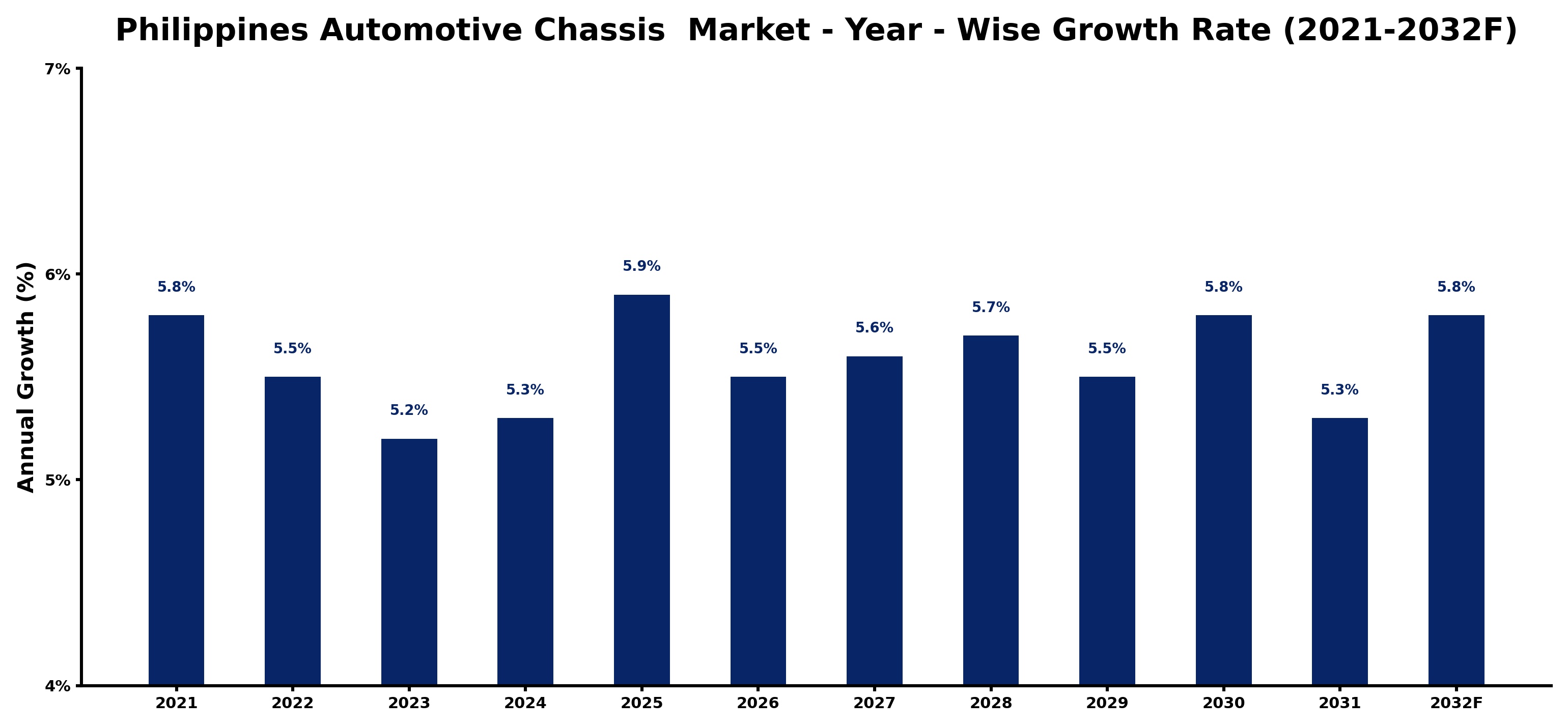
The table below presents the year‑wise growth rates along with the key drivers influencing the market
| Year | Growth Rate | Major Drivers |
| 2021 | 5.8% | Increased vehicle production capacity |
| 2022 | 5.5% | Rising demand for electric vehicles |
| 2023 | 5.2% | Expansion of automotive manufacturing hubs |
| 2024 | 5.3% | Government incentives for local production |
| 2025 | 5.9% | Technological advancements in chassis design |
| 2026 | 5.5% | Industrial activity supported growth |
| 2027 | 5.6% | Enhanced supply chain efficiencies realized |
| 2028 | 5.7% | Rising consumer disposable income levels |
| 2029 | 5.5% | Improved infrastructure supporting logistics |
| 2030 | 5.8% | Increased foreign investments in sector |
| 2031 | 5.3% | Automotive export markets expanding rapidly |
| 2032 | 5.8% | Sustainability initiatives driving innovation |
Note - Market size estimations and growth projections presented in this report are based on 6Wresearch’s advanced forecasting approach, validated with industry datasets as of June 2026.
Philippines Automotive Chassis Market Synopsis
The Philippine automotive chassis market is witnessing a significant transformation, characterized by increasing demand for both traditional and innovative vehicle structures. As the industry evolves, a growing emphasis on safety and efficiency is shaping the design and manufacturing of chassis systems.
Recent governmental initiatives and infrastructure investments have invigorated the automotive sector, creating a favorable environment for chassis manufacturers. This is complemented by rising consumer awareness regarding sustainability, pushing manufacturers to adapt their offerings to include robust and environmentally conscious chassis solutions.
Philippines Automotive Chassis Market Key Takeaways
- Market projected to reach USD 354 Million by 2032, reflecting robust growth in vehicle demand.
- Government initiatives are pivotal in promoting fuel-efficient and electric vehicles.
- Chassis manufacturers face increasing pressure to innovate amidst stringent safety standards.
- The market is poised for recovery following disruptions caused by the COVID-19 pandemic.
- Emerging trends include a shift towards lightweight materials to enhance vehicle efficiency.
Evaluation of Restraints in Philippines Automotive Chassis Market
The Philippines automotive chassis market grapples with several constraints that could impede its growth trajectory. Notably, manufacturers are challenged by the need to comply with increasingly stringent safety and emission regulations, which demand advanced engineering and technology integration. Furthermore, the fluctuating costs of raw materials can affect profit margins and production timelines, creating an environment of uncertainty. The balance between innovation, cost-effectiveness, and regulatory compliance remains a critical challenge that players in the market must navigate.
Philippines Automotive Chassis Market Trends
Several key trends are currently shaping the Philippines automotive chassis market. The demand for lightweight chassis made from advanced materials is on the rise, as manufacturers seek to improve fuel efficiency and performance. Additionally, the push for electric vehicles is prompting innovations in chassis design to accommodate new battery technologies. Smart manufacturing processes, including automation and digitization, are also gaining traction, aiming to enhance production efficiency and quality control.
Philippines Automotive Chassis Market Opportunities
Opportunities for growth within the Philippines automotive chassis market are expanding, particularly as the government continues to promote electric vehicles and infrastructure improvements. Manufacturers can leverage advancements in materials science to develop lighter, stronger chassis that meet evolving consumer expectations. Furthermore, partnerships with technology firms can foster innovation in safety features, appealing to a market increasingly concerned with vehicle safety and environmental impact.
Government Initiatives in the Philippines Automotive Chassis Market
The Philippine government plays an integral role in shaping the automotive chassis market through various initiatives and policies. Programs encouraging investments in automotive manufacturing, alongside incentives for producing fuel-efficient vehicles, create a conducive environment for market growth. Furthermore, infrastructure spending is aimed at improving transportation networks, thereby bolstering the demand for new vehicles and, consequently, chassis components.
Future Insights of the Philippines Automotive Chassis Market
Looking ahead to 2026-2032, the Philippines automotive chassis market is expected to evolve significantly, driven by technological advancements and regulatory changes. The increasing emphasis on sustainability will prompt manufacturers to invest in greener technologies and practices. Additionally, consumer preferences are likely to shift towards vehicles that blend performance with eco-friendliness, compelling manufacturers to rethink chassis designs. Overall, the market is poised for a phase of dynamic growth, fueled by innovation and adaptability to consumer demands.
Philippines Automotive Chassis Market Latest Developments (May 2025 - June 2026)
In recent months, the Philippines automotive chassis market has experienced a notable uptick in activities focused on enhancing safety and efficiency standards. Manufacturers are increasingly investing in research and development to integrate cutting-edge technologies into chassis design. Meanwhile, collaborations between automotive companies and tech firms are becoming more prevalent, aiming to address the demand for innovative features and sustainable practices. This progressive movement reflects the industry's commitment to evolving alongside consumer expectations and regulatory requirements.
Philippines Automotive Chassis Market - Key Attractiveness of the Report
- 10 Years of Market Numbers
- Historical Data Starting from 2022 to 2025
- Base Year: 2025
- Forecast Data until 2032
- Key Performance Indicators Impacting the Market
- Major Upcoming Developments and Projects
Key Highlights of the Report:
- Philippines Automotive Chassis Market Outlook
- Market Size of Philippines Automotive Chassis Market, 2025
- Forecast of Philippines Automotive Chassis Market, 2032F
- Historical Data and Forecast of Philippines Automotive Chassis Revenues & Volume for the Period 2022-2032F
- Philippines Automotive Chassis Market Trend Evolution
- Philippines Automotive Chassis Market Drivers and Challenges
- Philippines Automotive Chassis Price Trends
- Philippines Automotive Chassis Porter's Five Forces
- Philippines Automotive Chassis Industry Life Cycle
- Historical Data and Forecast of Philippines Automotive Chassis Market Revenues & Volume By Chassis Type for the Period 2022-2032F
- Historical Data and Forecast of Philippines Automotive Chassis Market Revenues & Volume By Backbone for the Period 2022-2032F
- Historical Data and Forecast of Philippines Automotive Chassis Market Revenues & Volume By Ladder for the Period 2022-2032F
- Historical Data and Forecast of Philippines Automotive Chassis Market Revenues & Volume By Monocoque for the Period 2022-2032F
- Historical Data and Forecast of Philippines Automotive Chassis Market Revenues & Volume By Modular for the Period 2022-2032F
- Historical Data and Forecast of Philippines Automotive Chassis Market Revenues & Volume By Material for the Period 2022-2032F
- Historical Data and Forecast of Philippines Automotive Chassis Market Revenues & Volume By Steel for the Period 2022-2032F
- Historical Data and Forecast of Philippines Automotive Chassis Market Revenues & Volume By Aluminum Alloy for the Period 2022-2032F
- Historical Data and Forecast of Philippines Automotive Chassis Market Revenues & Volume By Carbon Fiber Composite for the Period 2022-2032F
- Historical Data and Forecast of Philippines Automotive Chassis Market Revenues & Volume By Electric Vehicle for the Period 2022-2032F
- Historical Data and Forecast of Philippines Automotive Chassis Market Revenues & Volume By BEV for the Period 2022-2032F
- Historical Data and Forecast of Philippines Automotive Chassis Market Revenues & Volume By PHEV for the Period 2022-2032F
- Historical Data and Forecast of Philippines Automotive Chassis Market Revenues & Volume By HEV for the Period 2022-2032F
- Historical Data and Forecast of Philippines Automotive Chassis Market Revenues & Volume By Vehicle Type for the Period 2022-2032F
- Historical Data and Forecast of Philippines Automotive Chassis Market Revenues & Volume By PC for the Period 2022-2032F
- Historical Data and Forecast of Philippines Automotive Chassis Market Revenues & Volume By CV for the Period 2022-2032F
- Philippines Automotive Chassis Import Export Trade Statistics
- Market Opportunity Assessment By Chassis Type
- Market Opportunity Assessment By Material
- Market Opportunity Assessment By Electric Vehicle
- Market Opportunity Assessment By Vehicle Type
- Philippines Automotive Chassis Top Companies Market Share
- Philippines Automotive Chassis Competitive Benchmarking By Technical and Operational Parameters
- Philippines Automotive Chassis Company Profiles
- Philippines Automotive Chassis Key Strategic Recommendations






































