Philippines Automotive Reversing Radar Market Size, Share & Growth Rate
The Philippines Automotive Reversing Radar Market was estimated at USD 777 Million in 2025 and is projected to reach USD 1376 Million by 2032, growing at a CAGR of 8.5% from 2026 to 2032. This growth is primarily fueled by increasing consumer awareness regarding vehicle safety, along with rising demand for advanced driver-assistance systems (ADAS). As urban areas expand and traffic congestion intensifies, automotive reversing radar systems are becoming essential for preventing accidents and enhancing overall vehicle control.
Philippines Automotive Reversing Radar Market Year-wise Growth Rate and Key Drivers
This graph highlights how the Philippines Automotive Reversing Radar Market has steadily grown over the years, supported by major growth factors.
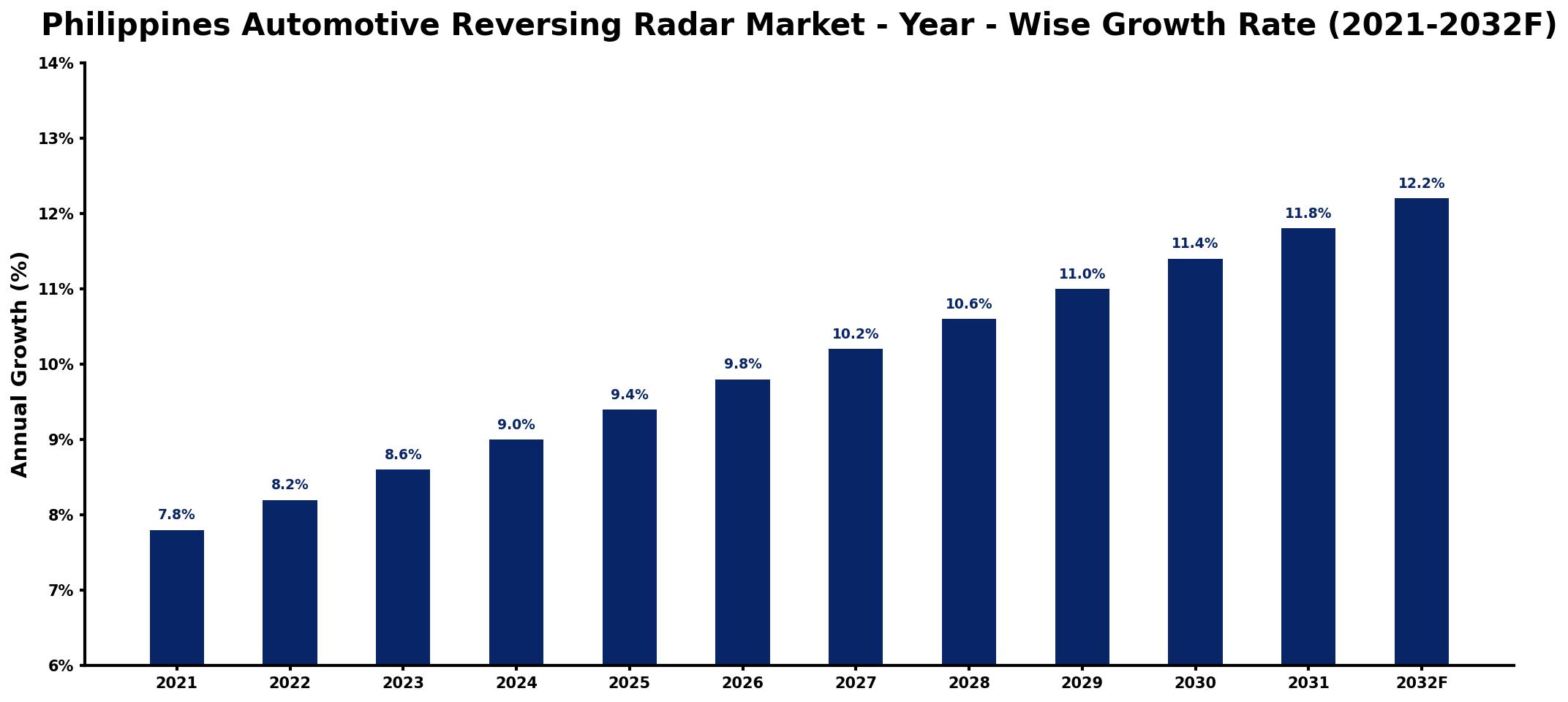
The table below presents the year‑wise growth rates along with the key drivers influencing the market
| Year | Growth Rate | Major Drivers |
| 2021 | 7.8% | Rising vehicle safety regulations |
| 2022 | 8.2% | Increased consumer safety awareness |
| 2023 | 8.6% | Growth in vehicle electronics market |
| 2024 | 9.0% | Expansion of smart vehicle technologies |
| 2025 | 9.4% | Higher demand for parking assistance |
| 2026 | 9.8% | Investments in advanced driver systems |
| 2027 | 10.2% | Surge in urban vehicle usage |
| 2028 | 10.6% | Development of autonomous vehicle features |
| 2029 | 11.0% | growing emerging market penetration |
| 2030 | 11.4% | Increase in fleet management solutions |
| 2031 | 11.8% | Advancements in sensor technologies |
| 2032 | 12.2% | Rising popularity of connected vehicles |
Note: Market size estimations and growth projections presented in this report are based on 6Wresearch's proprietary forecasting methodology, utilizing the latest available industry data, government publications, and primary research inputs.
Philippines Automotive Reversing Radar Market Synopsis
The automotive reversing radar market in the Philippines is experiencing robust growth, driven by significant investments in safety features and technological innovations. As manufacturers strive to meet evolving consumer expectations and comply with stringent safety regulations, reversing radar systems have emerged as vital components in modern vehicles.
In addition to enhancing safety during reversing maneuvers, these systems are increasingly integrated with other advanced features such as parking assistance and collision avoidance technologies. The Philippine automotive landscape is embracing these developments, reflecting a broader global trend towards smarter, safer driving experiences.
Philippines Automotive Reversing Radar Market Key Takeaways
- The market is poised for sustained growth, with a projected CAGR of 8.5% from 2026 to 2032.
- Consumer safety concerns are driving the demand for reversing radar systems in new vehicle models.
- Technological advancements are leading to the integration of reversing radar with other driver-assistance features.
- Government regulations aimed at enhancing vehicular safety are further supporting market expansion.
- Urbanization and increased traffic congestion are creating a greater need for effective parking solutions.
Evaluation of Restraints in Philippines Automotive Reversing Radar Market
Despite a favorable growth outlook, the automotive reversing radar market in the Philippines faces several challenges. Limited consumer awareness regarding the benefits of reversing radar technology may hinder adoption rates, especially in the used car segment. Furthermore, economic factors, such as fluctuations in raw material costs and the overall price sensitivity of consumers, could impact market penetration. Additionally, competition from alternative technologies, such as camera-based systems, might also pose a challenge for traditional radar solutions.
Philippines Automotive Reversing Radar Market Trends
Several trends are shaping the Philippines Automotive Reversing Radar Market. There is a notable shift towards the integration of artificial intelligence and machine learning technologies within reversing systems, enabling improved object detection and decision-making capabilities. Furthermore, the rise of smart cities and infrastructure development is encouraging automotive manufacturers to incorporate more sophisticated safety features, positioning reversing radar systems as integral components. Consumer demand for vehicle connectivity is also pushing manufacturers to create systems that interface seamlessly with smartphones and other devices, adding further value to reversing radar technology.
Philippines Automotive Reversing Radar Market Opportunities
The Philippine automotive reversing radar market presents numerous growth opportunities. As the economy continues to develop, an increase in vehicle sales, particularly in the compact car segment, will create a fertile ground for reversing radar adoption. The aftermarket sector also offers potential, as more vehicle owners seek to enhance safety features in existing vehicles. Additionally, as consumer preferences shift towards electric vehicles, integrating advanced safety systems could differentiate offerings in an increasingly competitive market. Manufacturers that capitalize on these trends stand to gain substantial market share.
Government Initiatives in the Philippines Automotive Reversing Radar Market
The Philippine government is actively supporting initiatives to enhance road safety, directly impacting the automotive reversing radar market. Regulatory frameworks aimed at improving vehicle safety standards are encouraging manufacturers to integrate advanced technologies, including reversing radar systems. Additionally, public awareness campaigns focused on road safety are likely to drive consumer demand for vehicles equipped with modern safety features, including reversing radars. These initiatives collectively foster an environment conducive to market growth.
Future Insights of the Philippines Automotive Reversing Radar Market
Looking ahead to 2026-2032, the Philippines Automotive Reversing Radar Market is expected to evolve in response to both technological advancements and consumer demands. As more consumers prioritize safety and convenience, the integration of reversing radar systems with broader vehicle technologies will likely become standard. Furthermore, as urban infrastructure continues to develop, opportunities will arise for innovations that enhance user experience during parking and low-speed maneuvers. Overall, the market is poised for significant growth as both manufacturers and consumers increasingly recognize the value of advanced safety features.
Philippines Automotive Reversing Radar Market Latest Developments (2025 - 2026)
Recent developments within the automotive reversing radar sector in the Philippines indicate a shift towards enhanced technological integration. New collaborations between automotive manufacturers and tech companies are being forged to create smarter reversing systems, featuring improved accuracy and reliability. Additionally, various manufacturers are ramping up production capabilities in response to heightened demand for safety features, demonstrating the market's readiness to adapt to evolving consumer needs. The trend towards electric vehicles is also prompting innovation in radar systems, as manufacturers seek to optimize performance and efficiency.
Philippines Automotive Reversing Radar Market - Key Attractiveness of the Report
- 10 Years of Market Numbers
- Historical Data Starting from 2022 to 2025
- Base Year: 2025
- Forecast Data until 2032
- Key Performance Indicators Impacting the Market
- Major Upcoming Developments and Projects
Key Highlights of the Report:
- Philippines Automotive Reversing Radar Market Outlook
- Market Size of Philippines Automotive Reversing Radar Market, 2025
- Forecast of Philippines Automotive Reversing Radar Market, 2032
- Historical Data and Forecast of Philippines Automotive Reversing Radar Revenues & Volume for the Period 2022-2032F
- Philippines Automotive Reversing Radar Market Trend Evolution
- Philippines Automotive Reversing Radar Market Drivers and Challenges
- Philippines Automotive Reversing Radar Price Trends
- Philippines Automotive Reversing Radar Porter's Five Forces
- Philippines Automotive Reversing Radar Industry Life Cycle
- Historical Data and Forecast of Philippines Automotive Reversing Radar Market Revenues & Volume By Type for the Period 2022-2032F
- Historical Data and Forecast of Philippines Automotive Reversing Radar Market Revenues & Volume By Ultrasonic for the Period 2022-2032F
- Historical Data and Forecast of Philippines Automotive Reversing Radar Market Revenues & Volume By Electromagnetic for the Period 2022-2032F
- Historical Data and Forecast of Philippines Automotive Reversing Radar Market Revenues & Volume By Application for the Period 2022-2032F
- Historical Data and Forecast of Philippines Automotive Reversing Radar Market Revenues & Volume By Passenger Vehicle for the Period 2022-2032F
- Historical Data and Forecast of Philippines Automotive Reversing Radar Market Revenues & Volume By Commercial Vehicle for the Period 2022-2032F
- Philippines Automotive Reversing Radar Import Export Trade Statistics
- Market Opportunity Assessment By Type
- Market Opportunity Assessment By Application
- Philippines Automotive Reversing Radar Top Companies Market Share
- Philippines Automotive Reversing Radar Competitive Benchmarking By Technical and Operational Parameters
- Philippines Automotive Reversing Radar Company Profiles
- Philippines Automotive Reversing Radar Key Strategic Recommendations






































