Philippines Biomass Briquette Market Size, Share & Growth Rate
The Philippines Biomass Briquette Market was estimated at USD 948 Million in 2025 and is projected to reach USD 1382 Million by 2032, growing at a CAGR of 5.5% from 2026 to 2032. This growth is predominantly fueled by the increasing awareness of renewable energy sources and the pressing need to reduce emissions associated with conventional energy sources. Additionally, the rise in industrialization and improving living standards are further propelling demand for alternative fuels, including biomass briquettes, as consumers seek more sustainable energy solutions.
Philippines Biomass Briquette Market Year-wise Growth Rate and Key Drivers
This graph highlights how the Philippines Biomass Briquette Market has steadily grown over the years, supported by major growth factors.
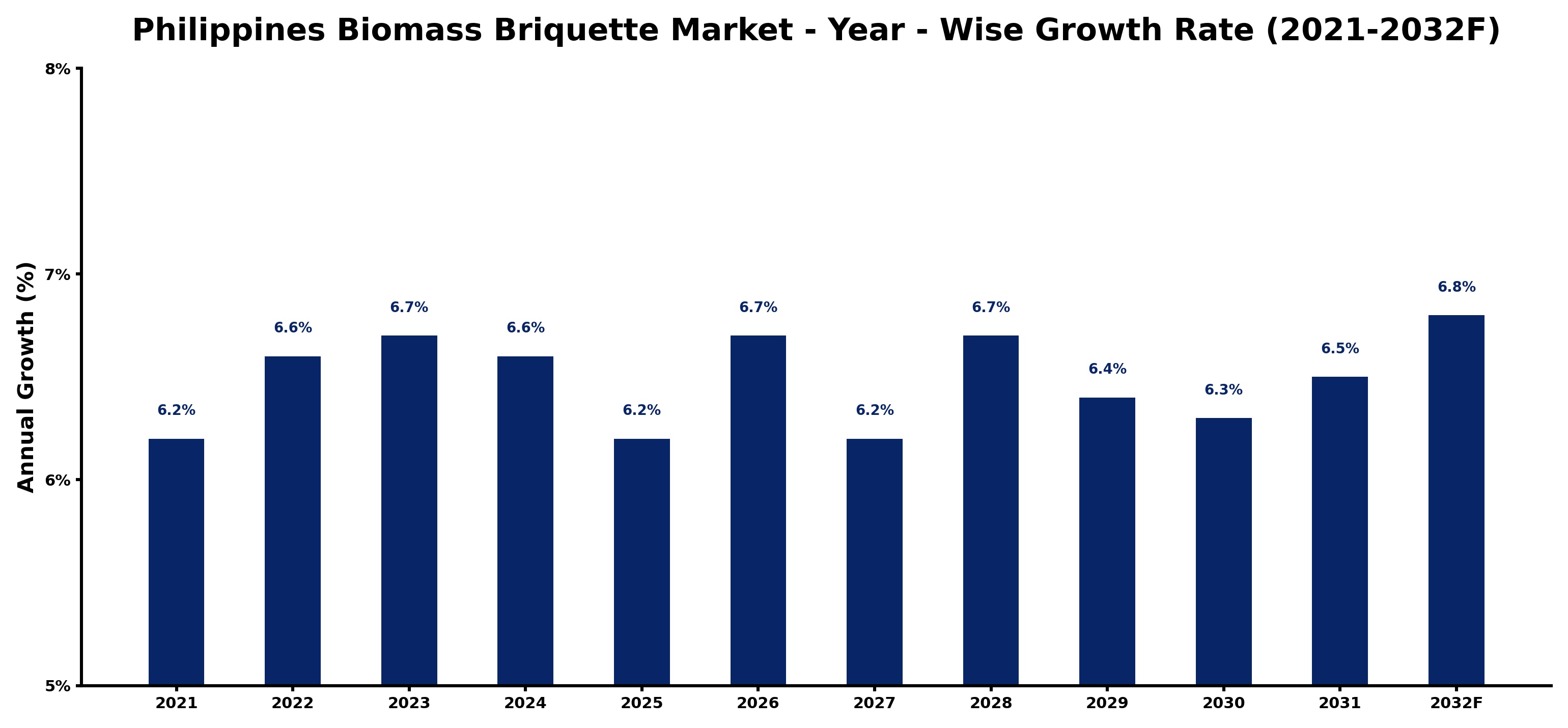
The table below presents the year‑wise growth rates along with the key drivers influencing the market
| Year | Growth Rate | Major Drivers |
| 2021 | 6.2% | Growing urbanization and commercial development |
| 2022 | 6.6% | Increasing industrial infrastructure investments |
| 2023 | 6.7% | Expansion of transportation and logistics networks |
| 2024 | 6.6% | Expansion of transportation and logistics networks |
| 2025 | 6.2% | Rising electricity demand across industries |
| 2026 | 6.7% | Increasing industrial infrastructure investments |
| 2027 | 6.2% | Expansion of transportation and logistics networks |
| 2028 | 6.7% | Rising electricity demand across industries |
| 2029 | 6.4% | Rising electricity demand across industries |
| 2030 | 6.3% | Growing urbanization and commercial development |
| 2031 | 6.5% | Government infrastructure modernization initiatives |
| 2032 | 6.8% | Rapid growth in telecom and data center sectors |
Note - Market size estimations and growth projections presented in this report are based on 6Wresearch's advanced forecasting approach, validated with industry datasets as of June 2026.
Philippines Biomass Briquette Market Synopsis
The current landscape of the Philippines biomass briquette market is marked by a heightened consumer shift towards renewable energy solutions. Growing environmental consciousness among the population is steering many away from traditional fuels, with biomass briquettes emerging as an appealing option. This trend is bolstered by various government initiatives aimed at promoting cleaner energy resources.
In recent years, there has been a surge in demand for alternative fuels, particularly within both commercial and residential sectors. This increased demand is primarily attributed to rising disposable incomes, population growth, and improved economic conditions, which collectively enhance consumer spending power. As a result, biomass briquettes are gaining traction as a viable and sustainable energy source.
Philippines Biomass Briquette Market Key Takeaways
- The market is set to expand significantly, driven by robust government backing for clean energy initiatives.
- Increasing awareness and preference for environmentally friendly fuel alternatives are reshaping consumer behaviors.
- Improvements in industrial and residential infrastructure are elevating demand for biomass briquettes.
- The market's growth is supported by the rise of bioenergy-related projects across the country.
- Economic advancements are enhancing disposable income levels, encouraging greater investment in sustainable energy solutions.
Evaluation of Restraints in Philippines Biomass Briquette Market
Despite the optimistic outlook, several constraints continue to pose challenges to the Philippines biomass briquette market. Limited access to reliable supply chains for raw materials can hinder production efficiency and scalability. Additionally, there may be reluctance among certain consumer segments to shift from long-standing traditional energy practices. Awareness of biomass briquettes' benefits, while increasing, remains uneven across different regions, potentially limiting widespread adoption. Furthermore, the initial investment costs associated with transitioning to biomass technologies could deter smaller businesses and households from making the switch.
Philippines Biomass Briquette Market Trends
Current trends within the biomass briquette market indicate a notable shift toward sustainable and eco-friendly energy sources. Innovations in production technologies are also shaping the market, allowing for more efficient and cost-effective methods of briquette manufacturing. Increased government collaboration with private entities to develop bioenergy infrastructures is becoming more prevalent, as is the introduction of consumer incentives for adopting renewable energy solutions. Moreover, there's a discernible interest in diversifying biomass feedstock, which is anticipated to enhance product quality and availability.
Philippines Biomass Briquette Market Opportunities
The Philippine biomass briquette market is ripe with opportunities for investment and growth. The ongoing urbanization trend presents avenues for establishing biomass production facilities closer to urban centers, thereby improving supply chains. Furthermore, as more businesses and households transition to renewable energy, there is potential for developing tailored marketing strategies to enhance consumer awareness and acceptance. Collaborating with educational institutions to promote research and development in biomass technology can also foster innovation, thus enriching the market landscape.
Government Initiatives in the Philippines Biomass Briquette Market
The Philippine government is actively promoting the use of biomass briquettes through various policies and initiatives aimed at enhancing renewable energy adoption. Public spending is being directed toward infrastructure projects that support green energy solutions, including biomass production facilities. Moreover, regulatory frameworks are being established to incentivize investments in clean energy technologies. Programs aimed at educating the populace on the benefits of biomass briquettes and other biofuels further underscore the government's commitment to fostering a sustainable energy future.
Future Insights of the Philippines Biomass Briquette Market
Looking ahead to the period from 2026 to 2032, the Philippines biomass briquette market is expected to thrive as consumer preferences continue to shift towards renewable energy sources. Enhanced government policies and substantial investments in green infrastructure are likely to accelerate market growth. Additionally, ongoing innovations in briquette production technologies will improve efficiency and product quality, further appealing to consumers. The anticipated rise in bioenergy consumption will solidify biomass briquettes as a cornerstone of the country's renewable energy landscape.
Philippines Biomass Briquette Market Latest Developments (May 2025 - June 2026)
Recent developments in the Philippines biomass briquette market indicate a growing engagement between the public and private sectors aimed at scaling up production capacities. Initiatives have been launched to establish more localized production plants, enhancing accessibility for consumers. Additionally, partnerships between local governments and biomass suppliers are emerging, focusing on increasing community awareness and involvement in bioenergy projects. Technological advancements in briquette manufacturing are also being pursued, aimed at reducing production costs and environmental impact.
Philippines Biomass Briquette Market - Key Attractiveness of the Report
- 10 Years of Market Numbers
- Historical Data Starting from 2022 to 2025
- Base Year: 2025
- Forecast Data until 2032
- Key Performance Indicators Impacting the Market
- Major Upcoming Developments and Projects
Key Highlights of the Report:
- Philippines Biomass Briquette Market Outlook
- Market Size of Philippines Biomass Briquette Market, 2025
- Forecast of Philippines Biomass Briquette Market, 2032
- Historical Data and Forecast of Philippines Biomass Briquette Revenues & Volume for the Period 2022-2032F
- Philippines Biomass Briquette Market Trend Evolution
- Philippines Biomass Briquette Market Drivers and Challenges
- Philippines Biomass Briquette Price Trends
- Philippines Biomass Briquette Porter's Five Forces
- Philippines Biomass Briquette Industry Life Cycle
- Historical Data and Forecast of Philippines Biomass Briquette Market Revenues & Volume By Source for the Period 2022-2032F
- Historical Data and Forecast of Philippines Biomass Briquette Market Revenues & Volume By Agro waste Briquettes for the Period 2022-2032F
- Historical Data and Forecast of Philippines Biomass Briquette Market Revenues & Volume By Sawdust Briquettes for the Period 2022-2032F
- Historical Data and Forecast of Philippines Biomass Briquette Market Revenues & Volume By Wood Briquettes for the Period 2022-2032F
- Historical Data and Forecast of Philippines Biomass Briquette Market Revenues & Volume By Application for the Period 2022-2032F
- Historical Data and Forecast of Philippines Biomass Briquette Market Revenues & Volume By Industrial for the Period 2022-2032F
- Historical Data and Forecast of Philippines Biomass Briquette Market Revenues & Volume By Household for the Period 2022-2032F
- Philippines Biomass Briquette Import Export Trade Statistics
- Market Opportunity Assessment By Source
- Market Opportunity Assessment By Application
- Philippines Biomass Briquette Top Companies Market Share
- Philippines Biomass Briquette Competitive Benchmarking By Technical and Operational Parameters
- Philippines Biomass Briquette Company Profiles
- Philippines Biomass Briquette Key Strategic Recommendations






































