Philippines Biomimetic Materials Market Size, Share & Growth Rate
The Philippines Biomimetic Materials Market was estimated at USD 150 Million in 2025 and is projected to reach USD 205 Million by 2032, growing at a CAGR of 4.6% from 2026 to 2032. This growth trajectory is largely fueled by an increasing appreciation for sustainable products across multiple sectors, from architecture to healthcare. As industries in the Philippines pivot towards eco-friendly alternatives, the innovative potential of biomimetic materials is gaining traction, opening new avenues for investment and research.
Philippines Biomimetic Materials Market Year-wise Growth Rate and Key Drivers
This graph highlights how the Philippines Biomimetic Materials Market has steadily grown over the years, supported by major growth factors.
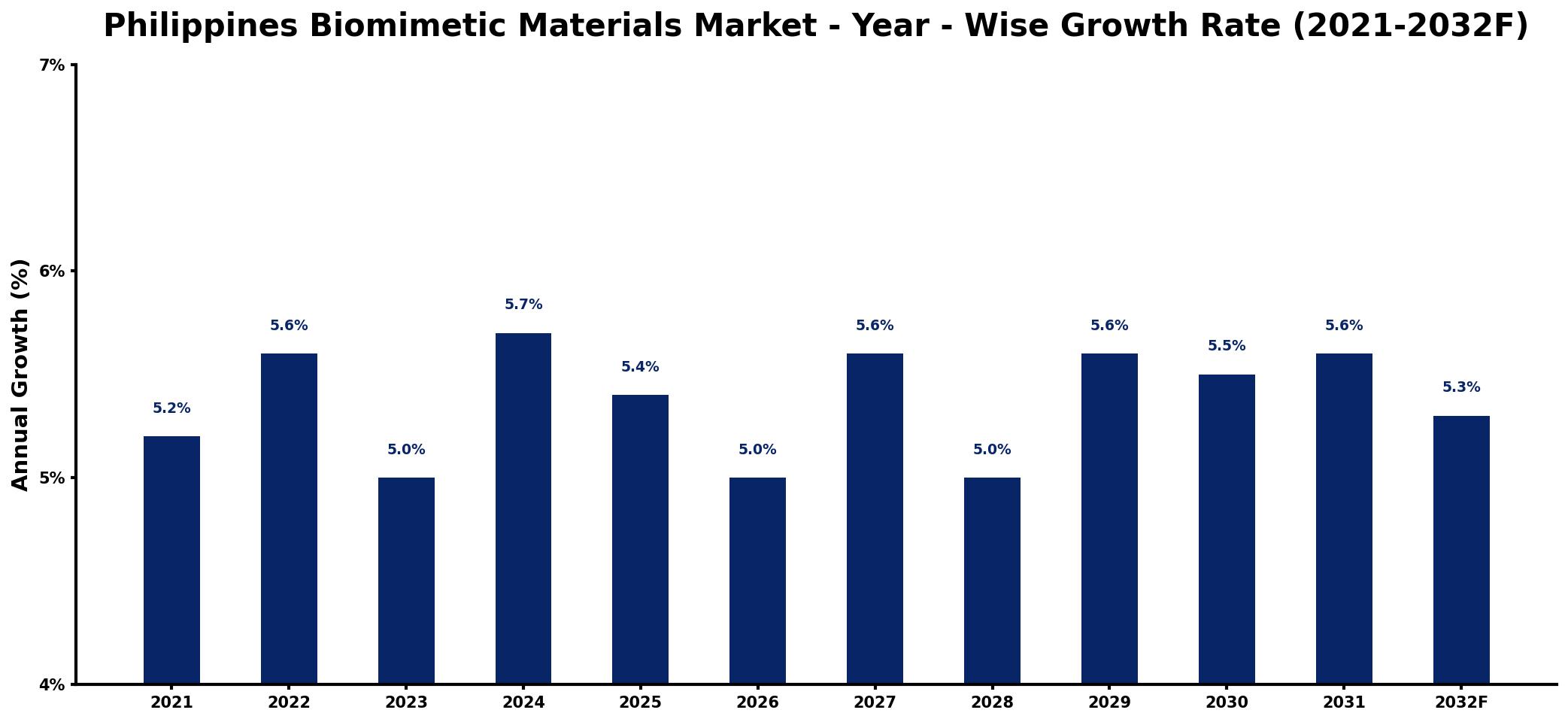
The table below presents the year‑wise growth rates along with the key drivers influencing the market
| Year | Growth Rate | Major Drivers |
| 2021 | 5.2% | Rise in sustainable design initiatives |
| 2022 | 5.6% | Growth of eco-friendly construction projects |
| 2023 | 5.0% | Increase in renewable energy investments |
| 2024 | 5.7% | Expansion of healthcare technology applications |
| 2025 | 5.4% | Demand for advanced manufacturing techniques |
| 2026 | 5.0% | Surge in consumer awareness campaigns |
| 2027 | 5.6% | increased domestic production output |
| 2028 | 5.0% | Emergence of smart city innovations |
| 2029 | 5.6% | Increased funding for research initiatives |
| 2030 | 5.5% | Development of green product certifications |
| 2031 | 5.6% | increased capital investment inflows |
| 2032 | 5.3% | Advancements in environmental regulations compliance |
Note: Market size estimations and growth projections presented in this report are based on 6Wresearch's proprietary forecasting methodology, utilizing the latest available industry data, government publications, and primary research inputs.
Philippines Biomimetic Materials Market Synopsis
The Philippines biomimetic materials market is at a critical juncture, evolving rapidly from its foundational understanding to a landscape rich in application and innovation. This momentum is expected to accelerate as companies recognize the economic and environmental advantages offered by bio-inspired materials.
Looking ahead, the market is set to transform even further, driven by advancements in biotechnology and material science. As awareness of biomimetic technologies spreads, the potential for these materials to address various industrial challenges becomes increasingly clear, positioning the Philippines as a notable player in the global biomimetic landscape.
Philippines Biomimetic Materials Market Key Takeaways
- The market is poised for significant growth, driven by environmental sustainability trends.
- Applications span multiple industries, including healthcare, robotics, and construction.
- Research and development remain central to unlocking the full potential of biomimetic technologies.
- Cost-effectiveness and scalability challenges must be addressed to enhance market penetration.
- Innovative design and functionality will define competitive advantage in the coming years.
Evaluation of Restraints in Philippines Biomimetic Materials Market
Despite the promising outlook, the Philippines biomimetic materials market faces notable restraints that may impede its full realization. One significant barrier is the requirement for advanced scientific expertise and technology to develop materials that adequately mimic natural processes. The intricate nature of ensuring biocompatibility and safety for medical applications presents additional challenges, particularly when it comes to testing and regulatory compliance. Furthermore, the path toward mass production necessitates overcoming engineering hurdles while maintaining cost-effectiveness, highlighting the need for a balanced approach between innovation and practical application.
Philippines Biomimetic Materials Market Trends
Several trends are emerging within the Philippines biomimetic materials market that are shaping demand and technological advancements. An increasing focus on renewable resources is driving interest in bio-inspired solutions, where nature's designs inform new material development. Moreover, as awareness of sustainability issues intensifies among consumers and businesses alike, companies are actively seeking biomimetic materials that not only meet performance benchmarks but also reduce ecological footprints. Collaborations between academic institutions and industry are also on the rise, facilitating a conducive environment for innovation.
Philippines Biomimetic Materials Market Opportunities
Opportunities for growth within the Philippines biomimetic materials market are vast and varied. The ongoing shift towards greener practices provides fertile ground for investment in technologies that prioritize sustainability. Additionally, sectors like construction and healthcare are increasingly incorporating biomimetic materials into their frameworks, which may lead to enhanced product offerings and market differentiation. As research continues to unveil new applications, businesses that align with this biomimetic wave stand to gain significantly in both market share and brand reputation.
Government Initiatives in the Philippines Biomimetic Materials Market
The Philippine government is actively promoting innovation in material sciences, which includes biomimetic materials, through various initiatives. Public spending on research and development is directed towards fostering collaboration between government bodies, academic institutions, and industry players. Additionally, policies aimed at sustainability are encouraging investments in green technologies, providing incentives for companies engaged in the exploration of bio-inspired materials. This supportive landscape is crucial for the growth and development of the biomimetic materials market.
Future Insights of the Philippines Biomimetic Materials Market
The outlook for the Philippines biomimetic materials market from 2026 to 2032 is characterized by robust expansion driven by technological advancements and increased adoption across various sectors. As industries continue to embrace sustainability, the demand for innovative materials that emulate nature is expected to rise significantly. The interplay of continuous research, favorable government policies, and a growing market awareness will likely position the Philippines as a key participant in the global biomimetic ecosystem, catalyzing further innovation and investment.
Philippines Biomimetic Materials Market Latest Developments (2025 - 2026)
Recent developments in the Philippines biomimetic materials market indicate a heightened focus on collaborative projects aimed at enhancing the functionality and sustainability of materials. Innovations are being reported in sectors such as healthcare and architecture, showcasing how biomimetic designs can solve real-world challenges. Industry stakeholders are increasingly seeking partnerships to leverage expertise and accelerate the introduction of groundbreaking materials into the market.
Philippines Biomimetic Materials Market - Key Attractiveness of the Report
- 10 Years of Market Numbers
- Historical Data Starting from 2022 to 2025
- Base Year: 2025
- Forecast Data until 2032
- Key Performance Indicators Impacting the Market
- Major Upcoming Developments and Projects
Key Highlights of the Report:
- Philippines Biomimetic Materials Market Outlook
- Market Size of Philippines Biomimetic Materials Market, 2025
- Forecast of Philippines Biomimetic Materials Market, 2032
- Historical Data and Forecast of Philippines Biomimetic Materials Revenues & Volume for the Period 2022-2032F
- Philippines Biomimetic Materials Market Trend Evolution
- Philippines Biomimetic Materials Market Drivers and Challenges
- Philippines Biomimetic Materials Price Trends
- Philippines Biomimetic Materials Porter's Five Forces
- Philippines Biomimetic Materials Industry Life Cycle
- Historical Data and Forecast of Philippines Biomimetic Materials Market Revenues & Volume By Material for the Period 2022-2032F
- Historical Data and Forecast of Philippines Biomimetic Materials Market Revenues & Volume By Biomimetic Polymers for the Period 2022-2032F
- Historical Data and Forecast of Philippines Biomimetic Materials Market Revenues & Volume By Biomimetic Ceramics & Glass for the Period 2022-2032F
- Historical Data and Forecast of Philippines Biomimetic Materials Market Revenues & Volume By Biomimetic Metals & Alloys for the Period 2022-2032F
- Historical Data and Forecast of Philippines Biomimetic Materials Market Revenues & Volume By Others for the Period 2022-2032F
- Historical Data and Forecast of Philippines Biomimetic Materials Market Revenues & Volume By Application for the Period 2022-2032F
- Historical Data and Forecast of Philippines Biomimetic Materials Market Revenues & Volume By Medical for the Period 2022-2032F
- Historical Data and Forecast of Philippines Biomimetic Materials Market Revenues & Volume By Automotive for the Period 2022-2032F
- Historical Data and Forecast of Philippines Biomimetic Materials Market Revenues & Volume By Defense for the Period 2022-2032F
- Historical Data and Forecast of Philippines Biomimetic Materials Market Revenues & Volume By Electronics for the Period 2022-2032F
- Historical Data and Forecast of Philippines Biomimetic Materials Market Revenues & Volume By Others for the Period 2022-2032F
- Philippines Biomimetic Materials Import Export Trade Statistics
- Market Opportunity Assessment By Material
- Market Opportunity Assessment By Application
- Philippines Biomimetic Materials Top Companies Market Share
- Philippines Biomimetic Materials Competitive Benchmarking By Technical and Operational Parameters
- Philippines Biomimetic Materials Company Profiles
- Philippines Biomimetic Materials Key Strategic Recommendations






































