Philippines Blow Moulding Machines Market Size, Share & Growth Rate
The Philippines Blow Moulding Machines Market was estimated at USD 350 Million in 2025 and is projected to reach USD 471 Million by 2032, growing at a CAGR of 4.3% from 2026 to 2032. This growth trajectory is primarily driven by the surging demand for plastic packaging solutions in various sectors, including food and beverage, pharmaceuticals, and consumer goods. The increasing focus on sustainable and recyclable materials further propels the market, as businesses strive to meet consumer expectations while adhering to environmental regulations.
Philippines Blow Moulding Machines Market Year-wise Growth Rate and Key Drivers
This graph highlights how the Philippines Blow Moulding Machines Market has steadily grown over the years, supported by major growth factors.
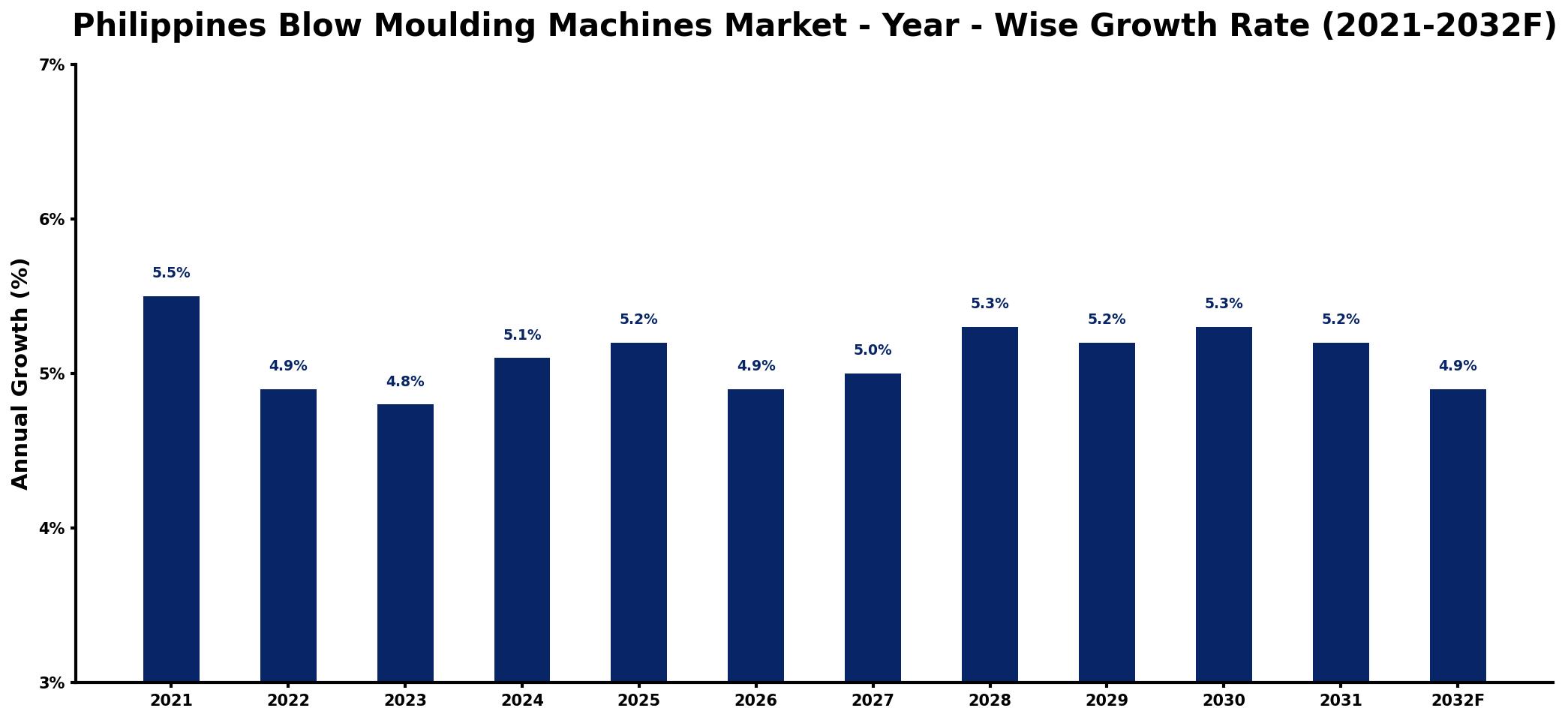
The table below presents the year‑wise growth rates along with the key drivers influencing the market
| Year | Growth Rate | Major Drivers |
| 2021 | 5.5% | Rising demand from packaging sector |
| 2022 | 4.9% | Increased investment in manufacturing |
| 2023 | 4.8% | Growth in consumer goods sector |
| 2024 | 5.1% | Expansion of construction activities |
| 2025 | 5.2% | Higher production capacities established |
| 2026 | 4.9% | Emerging markets driving demand |
| 2027 | 5.0% | Technological advancements in production |
| 2028 | 5.3% | Surge in eco-friendly initiatives |
| 2029 | 5.2% | Growing need for customized solutions |
| 2030 | 5.3% | Strengthened supply chain networks |
| 2031 | 5.2% | Increased exports to neighboring regions |
| 2032 | 4.9% | Rising popularity of sustainable products |
Note: Market size estimations and growth projections presented in this report are based on 6Wresearch's proprietary forecasting methodology, utilizing the latest available industry data, government publications, and primary research inputs.
Philippines Blow Moulding Machines Market Synopsis
In recent years, the Philippines has seen a notable uptick in the demand for blow moulding machines, largely attributed to the thriving packaging industry. Companies are seeking innovative solutions to produce lightweight, customizable, and efficient plastic containers that align with market needs. This demand is compounded by the local government's support for advancing manufacturing technologies, which provides a fertile ground for industry growth.
Moreover, the challenges posed by the COVID-19 pandemic have led to an accelerated shift towards automation and modern manufacturing practices. As businesses adapt to new consumer behaviors and preferences, the emphasis on high-quality, cost-effective blow moulding solutions has become more pronounced, ensuring sustained market activity and resilience.
Philippines Blow Moulding Machines Market Key Takeaways
- The market is characterized by a strong demand for sustainable plastic packaging solutions.
- Technological advancements and energy-efficient machines are redefining production capabilities.
- Government policies are fostering local manufacturing, promoting further market growth.
- The recovery from COVID-19 is driving innovation and investment in advanced manufacturing processes.
- Consumer trends favoring customized products significantly impact machine design and functionality.
Evaluation of Restraints in Philippines Blow Moulding Machines Market
Despite the favorable growth conditions, the Philippines Blow Moulding Machines Market faces certain constraints. One notable challenge is the pace of technological advancements, which can leave manufacturers struggling to keep their operations up-to-date. Moreover, fluctuations in raw material prices, compounded by supply chain disruptions, can impact the cost-effectiveness of blow moulding production. The necessity for skilled labor to operate and maintain advanced machinery further complicates the market landscape, as training and retention become critical factors for businesses aiming to thrive.
Philippines Blow Moulding Machines Market Trends
Current trends in the Philippines Blow Moulding Machines Market indicate a significant shift towards energy-efficient and eco-friendly manufacturing practices. Companies are increasingly adopting technologies that reduce waste and energy consumption, aligning with global sustainability goals. Additionally, there's a growing trend towards the customization of products, as businesses look to differentiate themselves in a competitive market. The rise of smart manufacturing and Industry 4.0 principles is also influencing machine design, with automation and IoT capabilities becoming essential features of new blow moulding equipment.
Philippines Blow Moulding Machines Market Opportunities
As the market matures, numerous growth and investment opportunities emerge. The continued expansion of the food and beverage sector offers robust prospects for blow moulding machines, especially with the rising demand for bottled beverages. Furthermore, the push towards sustainable packaging solutions creates avenues for manufacturers to develop specialized equipment tailored to recycling initiatives. Investing in research and development of innovative blow moulding technologies, particularly in automation and smart solutions, is crucial for firms aiming to capture new market segments.
Government Initiatives in the Philippines Blow Moulding Machines Market
The Philippine government has been active in promoting local manufacturing through various initiatives and programs designed to enhance industry competitiveness. These initiatives include financial incentives for companies investing in advanced manufacturing technologies and support for research and development. Furthermore, government policies aimed at reducing import tariffs on machinery facilitate easier access to essential equipment for local manufacturers, boosting their operational capacity and encouraging growth in the blow moulding machines market.
Future Insights of the Philippines Blow Moulding Machines Market
Looking ahead to the period from 2026 to 2032, the Philippines Blow Moulding Machines Market is poised for significant transformation. The increasing emphasis on sustainability and environmental responsibility will drive demand for lighter, more recyclable blow-moulded products. As the packaging landscape continues to evolve, manufacturers that innovate and adapt to these changes will likely dominate the market. Furthermore, as technological advancements become more integral to production processes, businesses will need to focus on upgrading their equipment to remain competitive and meet growing consumer expectations.
Philippines Blow Moulding Machines Market Latest Developments (2025 - 2026)
Recent developments in the Philippines Blow Moulding Machines Market indicate a surge in investment towards automation technologies and energy-efficient solutions. As companies strive to improve operational efficiencies, many are integrating smart technologies into their production lines. Additionally, there has been a noticeable increase in collaborations between local manufacturers and international technology providers, aimed at enhancing product offerings and broadening market reach. This trend underscores the ongoing evolution of the market as it adapts to global standards and local demands.
Philippines Blow Moulding Machines Market - Key Attractiveness of the Report
- 10 Years of Market Numbers
- Historical Data Starting from 2022 to 2025
- Base Year: 2025
- Forecast Data until 2032
- Key Performance Indicators Impacting the Market
- Major Upcoming Developments and Projects
Key Highlights of the Report:
- Philippines Blow Moulding Machines Market Outlook
- Market Size of Philippines Blow Moulding Machines Market, 2025
- Forecast of Philippines Blow Moulding Machines Market, 2032
- Historical Data and Forecast of Philippines Blow Moulding Machines Revenues & Volume for the Period 2022-2032F
- Philippines Blow Moulding Machines Market Trend Evolution
- Philippines Blow Moulding Machines Market Drivers and Challenges
- Philippines Blow Moulding Machines Price Trends
- Philippines Blow Moulding Machines Porter's Five Forces
- Philippines Blow Moulding Machines Industry Life Cycle
- Historical Data and Forecast of Philippines Blow Moulding Machines Market Revenues & Volume By Type for the Period 2022-2032F
- Historical Data and Forecast of Philippines Blow Moulding Machines Market Revenues & Volume By Extrusion for the Period 2022-2032F
- Historical Data and Forecast of Philippines Blow Moulding Machines Market Revenues & Volume By Injection for the Period 2022-2032F
- Historical Data and Forecast of Philippines Blow Moulding Machines Market Revenues & Volume By Injection Stretch for the Period 2022-2032F
- Historical Data and Forecast of Philippines Blow Moulding Machines Market Revenues & Volume By Application for the Period 2022-2032F
- Historical Data and Forecast of Philippines Blow Moulding Machines Market Revenues & Volume By Packaging for the Period 2022-2032F
- Historical Data and Forecast of Philippines Blow Moulding Machines Market Revenues & Volume By Consumable for the Period 2022-2032F
- Historical Data and Forecast of Philippines Blow Moulding Machines Market Revenues & Volume By Automotive for the Period 2022-2032F
- Historical Data and Forecast of Philippines Blow Moulding Machines Market Revenues & Volume By Electronics for the Period 2022-2032F
- Historical Data and Forecast of Philippines Blow Moulding Machines Market Revenues & Volume By Construction for the Period 2022-2032F
- Historical Data and Forecast of Philippines Blow Moulding Machines Market Revenues & Volume By Other Applications for the Period 2022-2032F
- Historical Data and Forecast of Philippines Blow Moulding Machines Market Revenues & Volume By Raw Material for the Period 2022-2032F
- Historical Data and Forecast of Philippines Blow Moulding Machines Market Revenues & Volume By Polyethylene Terephthalate (PET) for the Period 2022-2032F
- Historical Data and Forecast of Philippines Blow Moulding Machines Market Revenues & Volume By Polyethylene (PE) for the Period 2022-2032F
- Historical Data and Forecast of Philippines Blow Moulding Machines Market Revenues & Volume By Polypropylene (PP) for the Period 2022-2032F
- Historical Data and Forecast of Philippines Blow Moulding Machines Market Revenues & Volume By Polybutylene Terephthalate (PBT) for the Period 2022-2032F
- Historical Data and Forecast of Philippines Blow Moulding Machines Market Revenues & Volume By Polyvinyl chloride (PVC) for the Period 2022-2032F
- Historical Data and Forecast of Philippines Blow Moulding Machines Market Revenues & Volume By Polystyrene (PS) for the Period 2022-2032F
- Historical Data and Forecast of Philippines Blow Moulding Machines Market Revenues & Volume By Others Plastic Materials for the Period 2022-2032F
- Philippines Blow Moulding Machines Import Export Trade Statistics
- Market Opportunity Assessment By Type
- Market Opportunity Assessment By Application
- Market Opportunity Assessment By Raw Material
- Philippines Blow Moulding Machines Top Companies Market Share
- Philippines Blow Moulding Machines Competitive Benchmarking By Technical and Operational Parameters
- Philippines Blow Moulding Machines Company Profiles
- Philippines Blow Moulding Machines Key Strategic Recommendations






































