Philippines Bulk Continuous Filament Yarn Market Size, Share & Growth Rate
The Philippines Bulk Continuous Filament Yarn Market was estimated at USD 89 Million in 2025 and is projected to reach USD 97 Million by 2032, growing at a CAGR of 1.2% from 2026 to 2032. This steady growth trajectory is propelled by an increasing demand for lightweight, durable, and high-quality yarns in the textile and apparel sectors, where the versatility of bulk continuous filament yarn is increasingly favored. Additionally, the expansion of the local fashion industry and heightened consumer interest in quality fabrics play crucial roles in driving market expansion.
Philippines Bulk Continuous Filament Yarn Market Year-wise Growth Rate and Key Drivers
This graph highlights how the Philippines Bulk Continuous Filament Yarn Market has steadily grown over the years, supported by major growth factors.
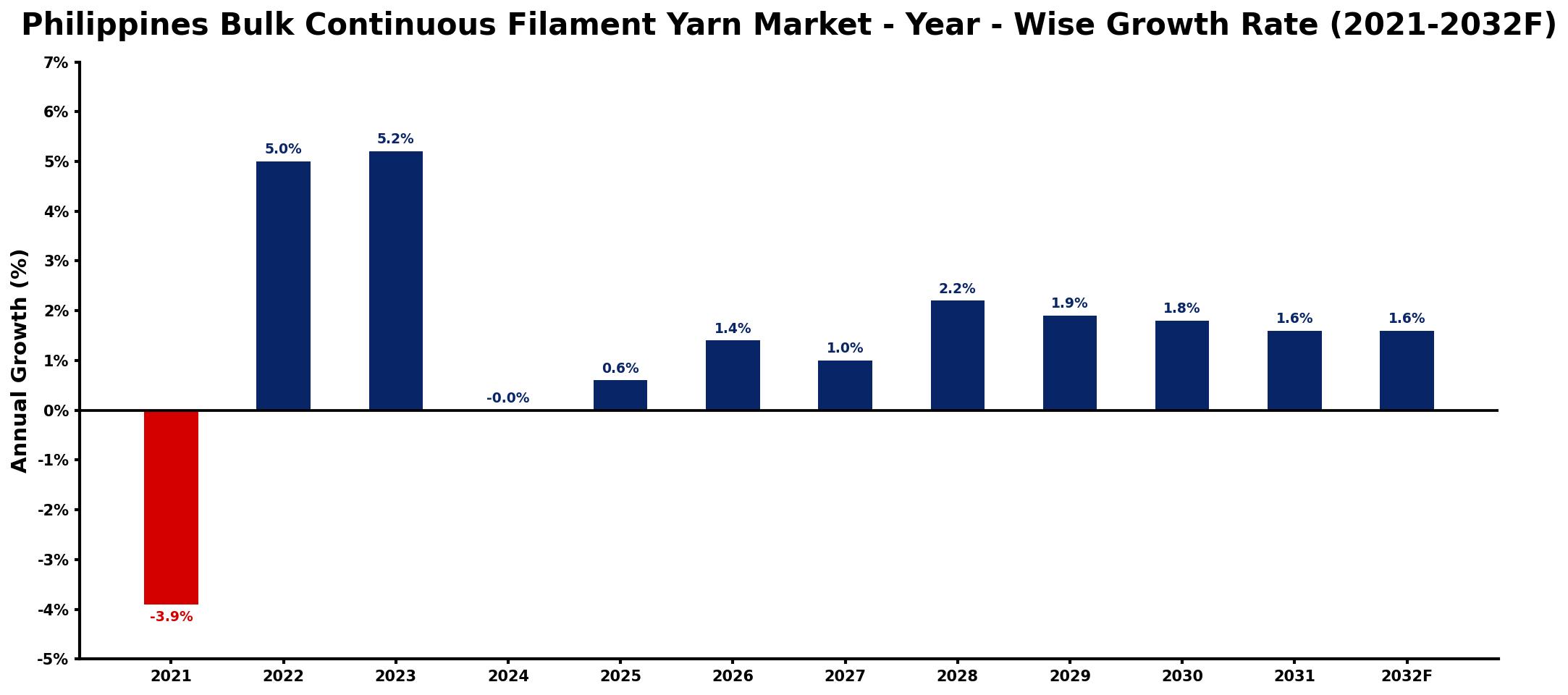
The table below presents the year‑wise growth rates along with the key drivers influencing the market
| Year | Growth Rate | Major Drivers |
| 2021 | -3.9% | decrease in textile production capacity |
| 2022 | 5.0% | rising demand from apparel sector |
| 2023 | 5.2% | increased investments in manufacturing |
| 2024 | -0.0% | growing export opportunities in ASEAN |
| 2025 | 0.6% | expansion of local textile companies |
| 2026 | 1.4% | enhanced technological advancements adoption |
| 2027 | 1.0% | higher consumer spending on fashion |
| 2028 | 2.2% | diversification into new markets |
| 2029 | 1.9% | strengthening supply chain efficiencies |
| 2030 | 1.8% | growing eco-friendly production initiatives |
| 2031 | 1.6% | increased collaborations with designers |
| 2032 | 1.6% | rising popularity of sustainable textiles |
Note: Market size estimations and growth projections presented in this report are based on 6Wresearch's proprietary forecasting methodology, utilizing the latest available industry data, government publications, and primary research inputs.
Philippines Bulk Continuous Filament Yarn Market Synopsis
A significant force shaping the Philippines Bulk Continuous Filament Yarn Market is the robust growth of the fashion and textile industries, which increasingly seek innovative materials to meet consumer preferences. This trend is further enhanced by a rising consciousness regarding sustainable fabric alternatives, as manufacturers aim to align with eco-friendly practices.
The market's dynamics are also influenced by technological advancements in fiber production, leading to improvements in filament properties such as strength, elasticity, and dyeability. These enhancements are critical in attracting apparel manufacturers looking to improve product quality while also addressing sustainability concerns.
Philippines Bulk Continuous Filament Yarn Market Key Takeaways
- Continued expansion in the textile and fashion sectors is significantly driving demand for bulk continuous filament yarn.
- Technological innovations in yarn production are enhancing the performance characteristics of filament yarns.
- Increasing consumer awareness of sustainable fabrics is leading to a preference for eco-friendly yarn options.
- Market growth is supported by both local production capabilities and the integration of advanced manufacturing processes.
- The overall market is positioned for gradual expansion, influenced by both domestic and international trends.
Evaluation of Restraints in Philippines Bulk Continuous Filament Yarn Market
Despite its positive outlook, the Philippines Bulk Continuous Filament Yarn Market faces certain limitations. Fluctuations in raw material prices, especially for petroleum-based fibers, can affect production costs and, consequently, pricing strategies. Additionally, while advancements in technology have improved filament properties, the high initial investment required for state-of-the-art production machinery may deter smaller manufacturers from entering or expanding within the market. Supply chain disruptions could also pose challenges in ensuring a consistent supply of high-quality raw materials.
Philippines Bulk Continuous Filament Yarn Market Trends
Current trends highlight a growing inclination towards sustainable manufacturing processes, with manufacturers increasingly adopting eco-friendly materials and technologies. Additionally, the rise of athleisure and activewear has spurred demand for bulk continuous filament yarns, as they provide the lightweight and stretchable characteristics desired in these applications. Social media and influencer marketing are also shaping fashion trends, resulting in rapid shifts in consumer preferences that the yarn market must adapt to.
Philippines Bulk Continuous Filament Yarn Market Opportunities
The market presents numerous opportunities, particularly in expanding applications beyond traditional textiles. Innovations in smart textiles, which integrate technology into fabric, are set to open new avenues for bulk continuous filament yarns. Moreover, the growth of local brands focusing on sustainability aligns well with the features of these yarns, positioning them as ideal candidates for inclusion in eco-conscious collections.
Government Initiatives in the Philippines Bulk Continuous Filament Yarn Market
The Philippine government has recognized the importance of the textile industry and is implementing various initiatives to support its growth. Programs aimed at enhancing the manufacturing capabilities of local companies, along with incentives for sustainable production practices, are being introduced. These initiatives not only aim to bolster local businesses but also encourage investments in technology and research, contributing to a more competitive industry landscape.
Future Insights of the Philippines Bulk Continuous Filament Yarn Market
Looking ahead to 2026-2032, the Philippines Bulk Continuous Filament Yarn Market is expected to experience steady growth, driven by evolving consumer demands for quality and sustainability. Innovations in fabric technology and continued investments in manufacturing infrastructure will likely position local producers competitively on a global scale. Furthermore, as international brands look to diversify their supply chains, the Philippines may emerge as an attractive sourcing destination for high-quality yarn.
Philippines Bulk Continuous Filament Yarn Market Latest Developments (2025 - 2026)
Recent developments in the market indicate a strong push towards modernization and sustainability within production processes. Many local manufacturers are investing in advanced machinery to enhance their capabilities, and there is a growing collaboration between textile producers and academic institutions to foster innovation. Additionally, trade fairs and exhibitions focusing on textile sustainability are being organized to showcase new products and encourage partnerships within the industry.
Philippines Bulk Continuous Filament Yarn Market - Key Attractiveness of the Report
- 10 Years of Market Numbers
- Historical Data Starting from 2022 to 2025
- Base Year: 2025
- Forecast Data until 2032
- Key Performance Indicators Impacting the Market
- Major Upcoming Developments and Projects
Key Highlights of the Report:
- Philippines Bulk Continuous Filament Yarn Market Outlook
- Market Size of Philippines Bulk Continuous Filament Yarn Market, 2025
- Forecast of Philippines Bulk Continuous Filament Yarn Market, 2032
- Historical Data and Forecast of Philippines Bulk Continuous Filament Yarn Revenues & Volume for the Period 2022-2032F
- Philippines Bulk Continuous Filament Yarn Market Trend Evolution
- Philippines Bulk Continuous Filament Yarn Market Drivers and Challenges
- Philippines Bulk Continuous Filament Yarn Price Trends
- Philippines Bulk Continuous Filament Yarn Porter's Five Forces
- Philippines Bulk Continuous Filament Yarn Industry Life Cycle
- Historical Data and Forecast of Philippines Bulk Continuous Filament Yarn Market Revenues & Volume By Material Type for the Period 2022-2032F
- Historical Data and Forecast of Philippines Bulk Continuous Filament Yarn Market Revenues & Volume By Nylon for the Period 2022-2032F
- Historical Data and Forecast of Philippines Bulk Continuous Filament Yarn Market Revenues & Volume By Polyester for the Period 2022-2032F
- Historical Data and Forecast of Philippines Bulk Continuous Filament Yarn Market Revenues & Volume By Polypropylene for the Period 2022-2032F
- Historical Data and Forecast of Philippines Bulk Continuous Filament Yarn Market Revenues & Volume By Others for the Period 2022-2032F
- Historical Data and Forecast of Philippines Bulk Continuous Filament Yarn Market Revenues & Volume By Application for the Period 2022-2032F
- Historical Data and Forecast of Philippines Bulk Continuous Filament Yarn Market Revenues & Volume By Carpets for the Period 2022-2032F
- Historical Data and Forecast of Philippines Bulk Continuous Filament Yarn Market Revenues & Volume By Rugs for the Period 2022-2032F
- Historical Data and Forecast of Philippines Bulk Continuous Filament Yarn Market Revenues & Volume By Others for the Period 2022-2032F
- Historical Data and Forecast of Philippines Bulk Continuous Filament Yarn Market Revenues & Volume By End-use for the Period 2022-2032F
- Historical Data and Forecast of Philippines Bulk Continuous Filament Yarn Market Revenues & Volume By Residential for the Period 2022-2032F
- Historical Data and Forecast of Philippines Bulk Continuous Filament Yarn Market Revenues & Volume By Commercial for the Period 2022-2032F
- Philippines Bulk Continuous Filament Yarn Import Export Trade Statistics
- Market Opportunity Assessment By Material Type
- Market Opportunity Assessment By Application
- Market Opportunity Assessment By End-use
- Philippines Bulk Continuous Filament Yarn Top Companies Market Share
- Philippines Bulk Continuous Filament Yarn Competitive Benchmarking By Technical and Operational Parameters
- Philippines Bulk Continuous Filament Yarn Company Profiles
- Philippines Bulk Continuous Filament Yarn Key Strategic Recommendations






































