Philippines Calcium Bromide Market Size, Share & Growth Rate
The Philippines Calcium Bromide Market was estimated at USD 357 Million in 2025 and is projected to reach USD 488 Million by 2032, growing at a CAGR of 4.6% from 2026 to 2032. This growth trajectory is primarily driven by the increasing demand from the oil and gas sector, where calcium bromide is essential as a mud additive and completion fluid. Additionally, its applications in various industries, including photography and organic synthesis, further bolster its market presence.
Philippines Calcium Bromide Market Year-wise Growth Rate and Key Drivers
This graph highlights how the Philippines Calcium Bromide Market has steadily grown over the years, supported by major growth factors.
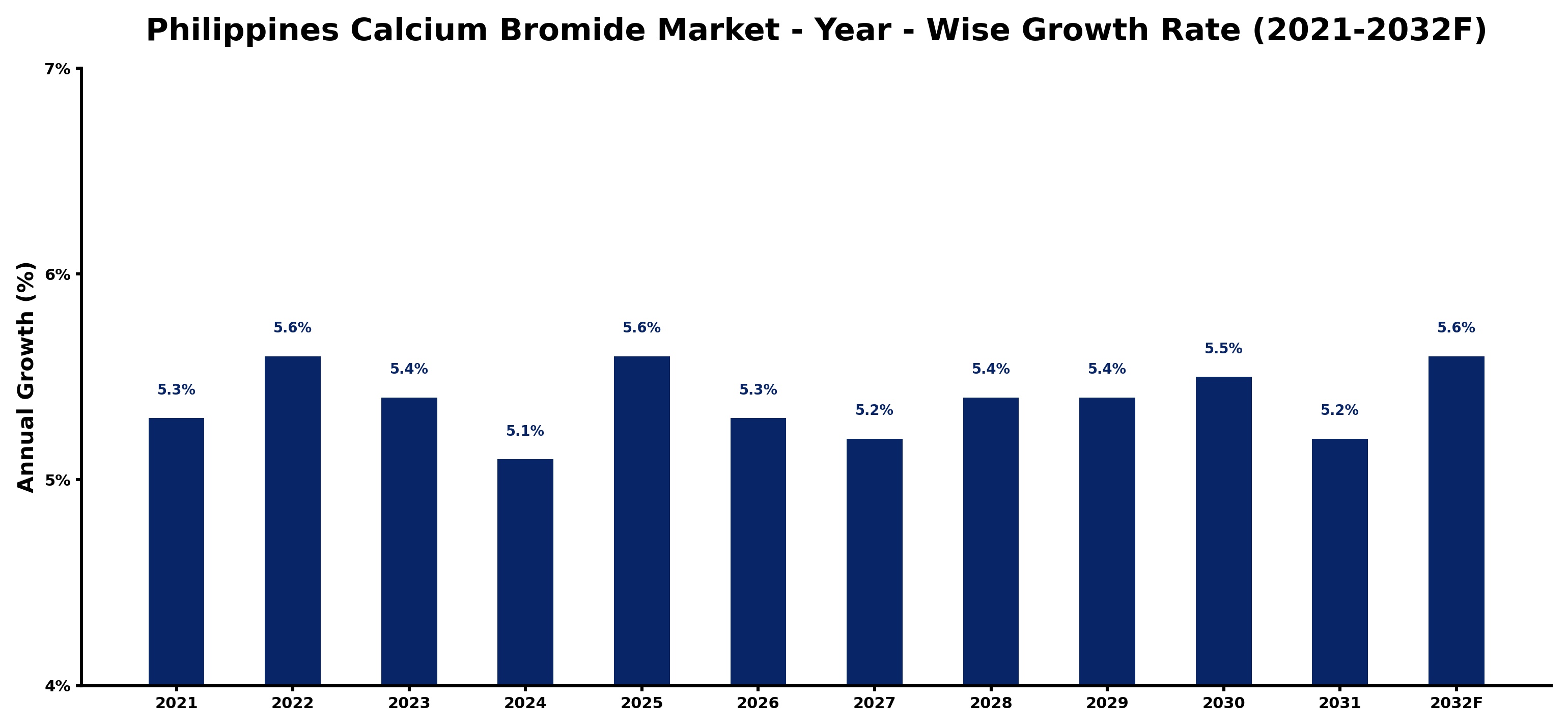
The table below presents the year‑wise growth rates along with the key drivers influencing the market
| Year | Growth Rate | Major Drivers |
| 2021 | 5.3% | Increased demand for drilling fluids |
| 2022 | 5.6% | Growth in construction activities observed |
| 2023 | 5.4% | Rising oil and gas exploration |
| 2024 | 5.1% | Enhanced water treatment applications noted |
| 2025 | 5.6% | Surge in industrial applications recorded |
| 2026 | 5.3% | Expansion of chemical manufacturing sector |
| 2027 | 5.2% | Increased adoption in agriculture sector |
| 2028 | 5.4% | Rising awareness of environmental benefits |
| 2029 | 5.4% | Industrial activity supported growth |
| 2030 | 5.5% | Technological advancements in production |
| 2031 | 5.2% | Emerging markets driving consumption growth |
| 2032 | 5.6% | Regulatory support for chemical usage |
Note - Market size estimations and growth projections presented in this report are based on 6Wresearch’s advanced forecasting approach, validated with industry datasets as of June 2026.
Philippines Calcium Bromide Market Synopsis
The Philippines calcium bromide market has displayed notable resilience, recovering from disruptions caused by the pandemic. As oil and gas exploration ramps up, the demand for calcium bromide continues to rise, positioning the market for sustained growth. In contrast, the outlook also highlights potential volatility due to its reliance on the oil and gas industry's fluctuating dynamics.
While recent trends show a rebound, the market's future hinges on the successful navigation of environmental regulations and responsible disposal methods for calcium bromide waste. As companies adapt to new norms, the market is likely to evolve, potentially diversifying its applications beyond traditional uses.
Philippines Calcium Bromide Market Key Takeaways
- The Philippines calcium bromide market is poised for significant growth, driven primarily by oil and gas sector demands.
- Market resilience is evident as it recovers from pandemic-related disruptions, with a focus on drilling safety.
- Environmental concerns pose challenges to sustainable market growth and demand dynamics.
- Emerging applications in industries like photography and organic chemistry could broaden market horizons.
- Key industry players are critical for maintaining supply chains amid fluctuating market conditions.
Evaluation of Restraints in Philippines Calcium Bromide Market
The reliance on the oil and gas industry as a primary demand driver introduces significant vulnerabilities to the calcium bromide market in the Philippines. Fluctuations in oil prices and ongoing environmental scrutiny can restrict growth opportunities and create uncertainty for manufacturers and consumers alike. Additionally, the challenges associated with the disposal of calcium bromide waste amplify the need for innovative solutions to address environmental concerns, further complicating the market landscape.
Philippines Calcium Bromide Market Trends
The market is witnessing emerging trends that emphasize sustainability and alternative applications. Innovations in drilling technologies that optimize the use of calcium bromide are gaining traction. Furthermore, as industries increasingly seek eco-friendly solutions, manufacturers are exploring ways to improve the lifecycle management of calcium bromide, including its disposal and recycling processes. This shift not only enhances operational efficiencies but also aligns with global sustainability goals.
Philippines Calcium Bromide Market Opportunities
Genuine growth opportunities in the Philippines calcium bromide market lie in diversifying applications beyond the oil and gas industry. Expanding the usage of calcium bromide in other sectors, such as pharmaceuticals and agriculture, can unlock new revenue streams. Furthermore, technological advancements in chemical processing and a growing emphasis on safety in drilling operations present avenues for investment and innovation, enabling companies to enhance their competitive edge.
Government Initiatives in the Philippines Calcium Bromide Market
The Philippine government has implemented various initiatives aimed at promoting sustainable practices within the chemical sector, including the calcium bromide market. Policies encouraging research and development of alternative chemicals, alongside regulatory frameworks targeting environmental protection, support industry growth. Additionally, incentives for companies adopting eco-friendly production methods are gradually reshaping the market landscape, fostering a more sustainable future.
Future Insights of the Philippines Calcium Bromide Market
Looking ahead to 2026-2032, the Philippines calcium bromide market is expected to evolve in response to both global and regional shifts. Anticipated growth in the oil and gas sector, spurred by increased exploration and regulatory frameworks favoring sustainability, will be crucial. As industries diversify their applications of calcium bromide and adapt to environmental challenges, the market landscape will likely transform, presenting new opportunities for innovative companies that can navigate these changes effectively.
Philippines Calcium Bromide Market Latest Developments (May 2025 - June 2026)
Recent developments in the Philippines calcium bromide market reflect a shift toward innovation and sustainability. The industry is seeing advancements in drilling technologies and applications for calcium bromide, driven by increased oil and gas exploration. Moreover, companies are exploring partnerships and collaborations to enhance their product offerings and meet the evolving regulatory requirements, ensuring a robust response to the changing market dynamics.
Philippines Calcium Bromide Market - Key Attractiveness of the Report
- 10 Years of Market Numbers
- Historical Data Starting from 2022 to 2025
- Base Year: 2025
- Forecast Data until 2032
- Key Performance Indicators Impacting the Market
- Major Upcoming Developments and Projects
Key Highlights of the Report:
- Philippines Calcium Bromide Market Outlook
- Market Size of Philippines Calcium Bromide Market, 2025
- Forecast of Philippines Calcium Bromide Market, 2032
- Historical Data and Forecast of Philippines Calcium Bromide Revenues & Volume for the Period 2022-2032F
- Philippines Calcium Bromide Market Trend Evolution
- Philippines Calcium Bromide Market Drivers and Challenges
- Philippines Calcium Bromide Price Trends
- Philippines Calcium Bromide Porter's Five Forces
- Philippines Calcium Bromide Industry Life Cycle
- Historical Data and Forecast of Philippines Calcium Bromide Market Revenues & Volume By Type for the Period 2022-2032F
- Historical Data and Forecast of Philippines Calcium Bromide Market Revenues & Volume By 7774-34-7 hexahydrate for the Period 2022-2032F
- Historical Data and Forecast of Philippines Calcium Bromide Market Revenues & Volume By 7789-41-5 anhydrous for the Period 2022-2032F
- Historical Data and Forecast of Philippines Calcium Bromide Market Revenues & Volume By 22208-73-7 dihydrate for the Period 2022-2032F
- Historical Data and Forecast of Philippines Calcium Bromide Market Revenues & Volume By Products for the Period 2022-2032F
- Historical Data and Forecast of Philippines Calcium Bromide Market Revenues & Volume By Technically specified rubber (TSR) for the Period 2022-2032F
- Historical Data and Forecast of Philippines Calcium Bromide Market Revenues & Volume By Ribbed smoked sheet (RSS) for the Period 2022-2032F
- Historical Data and Forecast of Philippines Calcium Bromide Market Revenues & Volume By Latex for the Period 2022-2032F
- Historical Data and Forecast of Philippines Calcium Bromide Market Revenues & Volume By Others for the Period 2022-2032F
- Historical Data and Forecast of Philippines Calcium Bromide Market Revenues & Volume By End Use for the Period 2022-2032F
- Historical Data and Forecast of Philippines Calcium Bromide Market Revenues & Volume By Oil & Gas for the Period 2022-2032F
- Historical Data and Forecast of Philippines Calcium Bromide Market Revenues & Volume By Automotive for the Period 2022-2032F
- Historical Data and Forecast of Philippines Calcium Bromide Market Revenues & Volume By Power Generation for the Period 2022-2032F
- Historical Data and Forecast of Philippines Calcium Bromide Market Revenues & Volume By Others for the Period 2022-2032F
- Historical Data and Forecast of Philippines Calcium Bromide Market Revenues & Volume By Application for the Period 2022-2032F
- Historical Data and Forecast of Philippines Calcium Bromide Market Revenues & Volume By Clear brine fluid for the Period 2022-2032F
- Historical Data and Forecast of Philippines Calcium Bromide Market Revenues & Volume By Oxidizer for the Period 2022-2032F
- Philippines Calcium Bromide Import Export Trade Statistics
- Market Opportunity Assessment By Type
- Market Opportunity Assessment By Products
- Market Opportunity Assessment By End Use
- Market Opportunity Assessment By Application
- Philippines Calcium Bromide Top Companies Market Share
- Philippines Calcium Bromide Competitive Benchmarking By Technical and Operational Parameters
- Philippines Calcium Bromide Company Profiles
- Philippines Calcium Bromide Key Strategic Recommendations






































