Philippines Cameras Market Summary
The philippines cameras market was estimated at USD 1296 Million in 2025 and is projected to reach USD 1877 Million by 2032, growing at a CAGR of 6.7% from 2026 to 2032.
Philippines Cameras Market Year-wise Growth Rate and Key Drivers
This graph highlights how the Philippines Cameras Market has steadily grown over the past five years, supported by major growth factors.
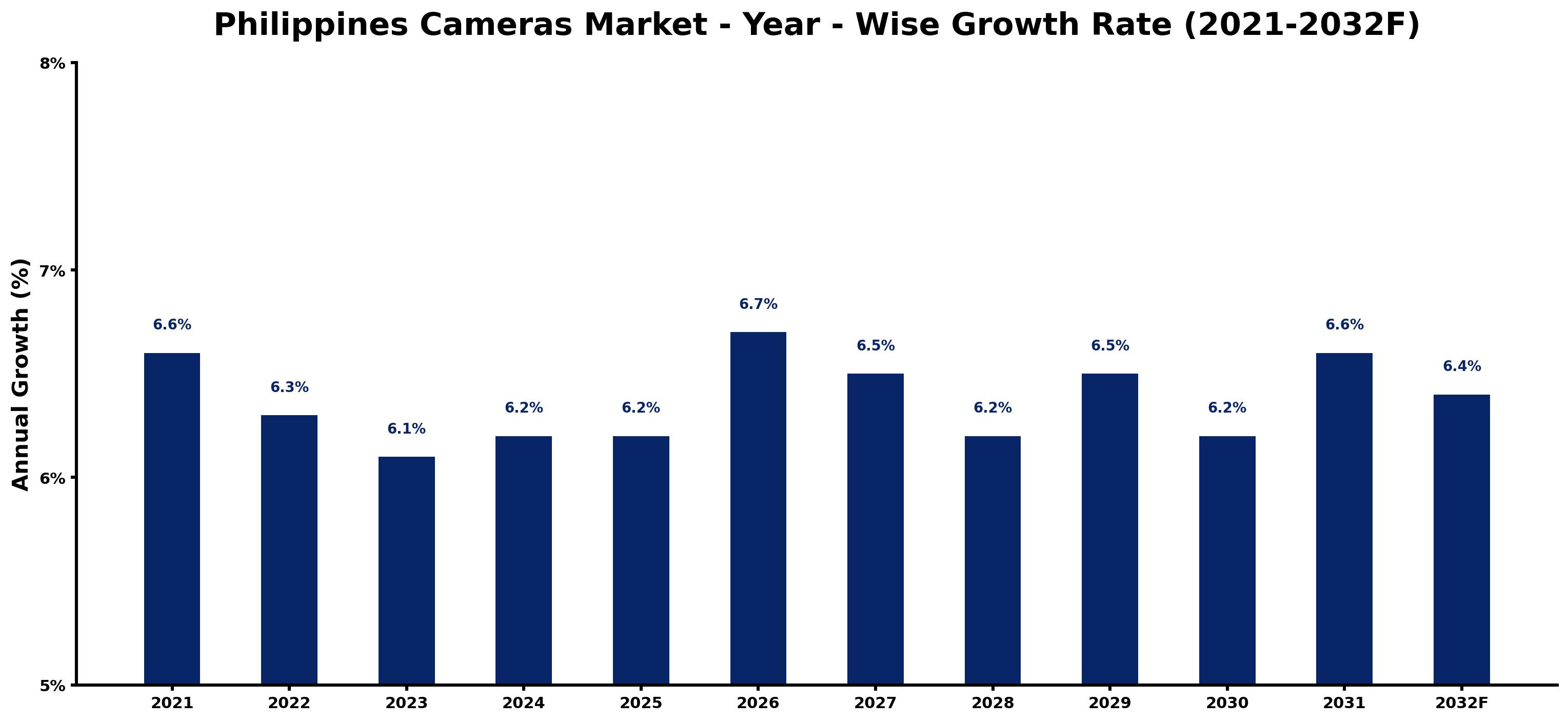
The table below presents the year wise growth rates along with the key drivers influencing the market
| Year | Growth Rate | Major Drivers |
| 2021 | 6.6% | Post-lockdown retail projects emphasized digital and traditional camera experiences. |
| 2022 | 6.3% | Local influencers showcased photography, amplifying consumer interest in advanced camera systems. |
| 2023 | 6.1% | Emerging tourism trends spurred interest in high-quality photography solutions across regions. |
| 2024 | 6.2% | Social media platforms increasingly highlighted visually appealing content, elevating camera demand. |
| 2025 | 6.2% | Innovative smartphone camera features challenged standalone cameras, prompting product differentiation strategies. |
| 2026 | 6.7% | E-commerce platforms facilitated easier access to diverse camera brands and models. |
| 2027 | 6.5% | Development of local photography communities fostered collaborative learning and equipment sharing. |
| 2028 | 6.2% | Environmental shifts encouraged interest in outdoor photography, boosting camera sales significantly. |
| 2029 | 6.5% | Filmmaking trends among youths ignited a passion for professional-grade camera equipment. |
| 2030 | 6.2% | Technological advancements in mirrorless cameras attracted enthusiasts seeking lighter gear options. |
| 2031 | 6.6% | Rental services for expensive photography gear gained traction among budget-conscious consumers. |
| 2032 | 6.4% | Sustainable materials in camera production began appealing to eco-conscious buyers, shifting preferences. |
Note - Market size estimations and growth projections presented in this report are based on 6Wresearch's advanced forecasting approach, validated with industry datasets as of June 2026.
Philippines Cameras Market Synopsis
The Philippines Cameras Market is projected to reach 6.7% and witness significant growth during the forecast period (2026-2032). The increasing prevalence of photography as a creative outlet among the populace, combined with rising disposable incomes and greater internet accessibility, is fundamentally transforming the landscape of the cameras market in the Philippines. Consumers in this market have access to a diverse range of camera types, from entry-level DSLRs designed for amateurs to high-end mirrorless systems catering to professionals. The accelerating demand for high-quality visual content is propelling growth, as consumers seek devices that deliver superior image quality and enhanced functionalities. Furthermore, technological advancements such as improved image sensors and processors continue to enhance the appeal of these products among various consumer segments.
Philippines Cameras Market Growth Drivers
Several key factors are driving the growth of the Philippines cameras market. The growing trend of social media sharing has intensified the demand for high-quality photography and videography tools. Many consumers are investing in cameras that can support their passion for creating visually compelling content. Additionally, innovations within the industry—including:
- The introduction of interchangeable lenses, which allow users to customize their shooting experiences based on specific photography needs.
- Enhanced image sensors that improve low-light performance and overall image clarity, appealing to both amateur and professional photographers.
- Artificial intelligence integrated into autofocus systems, enabling faster and more accurate focus, which is increasingly important in fast-paced shooting scenarios.
- Product diversification, including tailored offerings for different market segments such as beginner-friendly options and professional-grade solutions.
- A surge in photography workshops and courses, leading to a stronger interest in equipment purchases among participants.
Philippines Cameras Market Challenges and Restraints
Despite positive growth indicators, the Philippines cameras market faces notable challenges. One of the primary obstacles is the high cost associated with professional-grade mirrorless cameras, which often come with expensive lens configurations. This pricing barrier can deter potential buyers, particularly among the general population, thus limiting market penetration. Other challenges include:
- A saturated market with numerous product choices, which can lead to confusion among consumers regarding the best options for their needs.
- Technological advancements may result in rapid obsolescence of older models, pressuring consumers to constantly upgrade their equipment.
- The increasing preference for smartphone cameras, which are often perceived as more convenient and cost-effective, poses a competitive threat to traditional camera sales.
- Economic fluctuations that can affect consumer purchasing power, leading to a reluctance to invest in high-ticket items such as cameras.
- Limited distribution channels in rural areas, which restrict access to a wider audience interested in photography.
Philippines Cameras Market Trends and Opportunities
Examining current trends and emerging opportunities within the Philippines cameras market reveals several noteworthy insights. The inclination towards professional photography and content creation is becoming increasingly prevalent among young Filipinos, driven by social media influence. This shift has led to:
- An increase in online communities and forums focused on photography, where enthusiasts share their work and exchange tips, generating a vibrant culture around camera use.
- Growing interest in sustainability, prompting brands to explore eco-friendly materials and manufacturing processes for their products.
- The potential for e-commerce platforms to expand their offerings, making cameras more accessible to potential buyers across the nation.
- Collaboration with influencers and content creators to drive engagement and showcase camera capabilities through real-life applications.
- An increase in local photography events and exhibitions, fostering community engagement and creating awareness about various camera technologies.
Philippines Cameras Market Government Investment and Initiatives
The government of the Philippines has recognized the importance of the creative industries, including photography, in contributing to economic growth and cultural development. Initiatives aimed at promoting local artists and entrepreneurs often extend to the photography sector. These efforts include:
- Support for training programs that enhance photography skills among youth and aspiring professionals.
- Investment in infrastructure that facilitates the hosting of photography workshops, exhibitions, and competitions, thereby stimulating interest and investment in the industry.
- Potential tax incentives for businesses that contribute to the development of creative solutions and technologies within the photography domain.
- Promotion of local photography through government-sponsored campaigns that celebrate Filipino culture and heritage, driving demand for cameras to capture these narratives.
- Establishment of partnerships with educational institutions to introduce photography courses that are aligned with market needs.
Philippines Cameras Market Latest Developments (May 2025 - June 2026)
Recent developments in the Philippines cameras market reflect a dynamic shift as players adapt to evolving consumer needs and technological advancements. The trend towards mirrorless camera systems has gained momentum, with consumers increasingly seeking models that offer portability without compromising on quality. Furthermore, the emphasis on integrating smart technology into cameras has become evident, with features such as wireless connectivity and mobile app integrations becoming standard.
Sustainability also features prominently, with manufacturers exploring eco-friendly materials and practices as they recognize the growing consumer preference for environmentally responsible products. Additionally, new collaborations between technology firms and camera brands are emerging, aiming to enhance the user experience through innovative applications and firmware updates. As the market continues to evolve, stakeholders must remain attuned to these developments to effectively leverage future opportunities.
Philippines Cameras Market - Key Attractiveness of the Report
- 10 Years of Market Numbers
- Historical Data Starting from 2022 to 2025
- Base Year: 2025
- Forecast Data until 2032
- Key Performance Indicators Impacting the Market
- Major Upcoming Developments and Projects
Key Highlights of the Report:
- Philippines Cameras Market Outlook
- Market Size of Philippines Cameras Market, 2025
- Forecast of Philippines Cameras Market, 2032
- Historical Data and Forecast of Philippines Cameras Revenues & Volume for the Period 2022-2032F
- Philippines Cameras Market Trend Evolution
- Philippines Cameras Market Drivers and Challenges
- Philippines Cameras Price Trends
- Philippines Cameras Porter's Five Forces
- Philippines Cameras Industry Life Cycle
- Historical Data and Forecast of Philippines Cameras Market Revenues & Volume By Product Type for the Period 2022-2032F
- Historical Data and Forecast of Philippines Cameras Market Revenues & Volume By Built-in Lens Camera for the Period 2022-2032F
- Historical Data and Forecast of Philippines Cameras Market Revenues & Volume By Interchangeable Lens Camera for the Period 2022-2032F
- Historical Data and Forecast of Philippines Cameras Market Revenues & Volume By DSLR for the Period 2022-2032F
- Historical Data and Forecast of Philippines Cameras Market Revenues & Volume By Non-reflex for the Period 2022-2032F
- Historical Data and Forecast of Philippines Cameras Market Revenues & Volume By Application for the Period 2022-2032F
- Historical Data and Forecast of Philippines Cameras Market Revenues & Volume By Commercial for the Period 2022-2032F
- Historical Data and Forecast of Philippines Cameras Market Revenues & Volume By Residential for the Period 2022-2032F
- Historical Data and Forecast of Philippines Cameras Market Revenues & Volume By Distribution Channel for the Period 2022-2032F
- Historical Data and Forecast of Philippines Cameras Market Revenues & Volume By Online for the Period 2022-2032F
- Historical Data and Forecast of Philippines Cameras Market Revenues & Volume By Offline for the Period 2022-2032F
- Philippines Cameras Import Export Trade Statistics
- Market Opportunity Assessment By Product Type
- Market Opportunity Assessment By Application
- Market Opportunity Assessment By Distribution Channel
- Philippines Cameras Top Companies Market Share
- Philippines Cameras Competitive Benchmarking By Technical and Operational Parameters
- Philippines Cameras Company Profiles
- Philippines Cameras Key Strategic Recommendations






































