Philippines Chain Drivers Market Size, Share & Growth Rate
The Philippines Chain Drivers Market was estimated at USD 943 Million in 2025 and is projected to reach USD 1598 Million by 2032, growing at a CAGR of 7.8% from 2026 to 2032. This robust growth trajectory is primarily fueled by an uptick in industrial activities and a thriving manufacturing sector, both of which are increasingly turning to chains for efficient power transmission. The demand for reliable chain products is set to escalate, further bolstered by investments and technological advancements within the industry.
Philippines Chain Drivers Market Year-wise Growth Rate and Key Drivers
This graph highlights how the Philippines Chain Drivers Market has steadily grown over the years, supported by major growth factors.
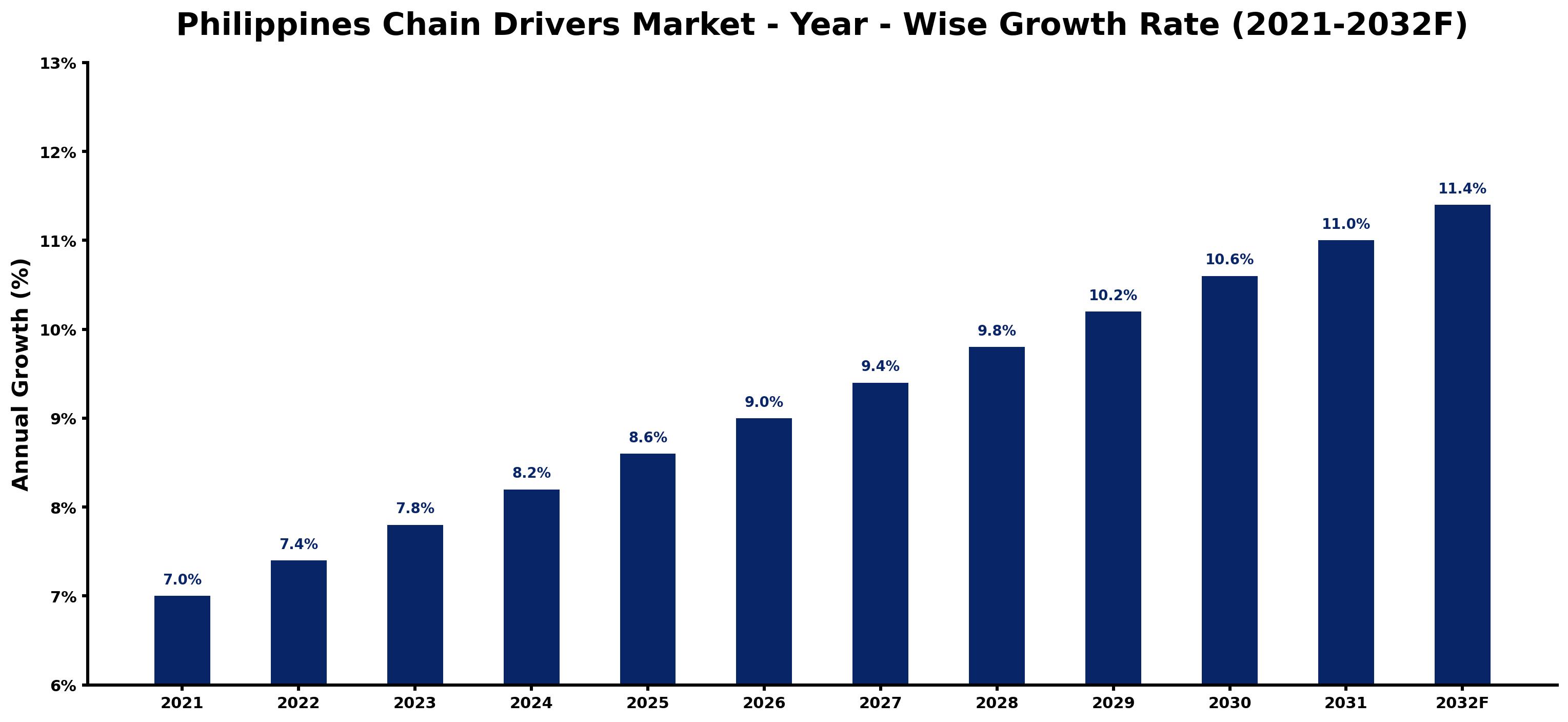
The table below presents the year‑wise growth rates along with the key drivers influencing the market
| Year | Growth Rate | Major Drivers |
| 2021 | 7.0% | Growing renewable energy integration projects |
| 2022 | 7.4% | Expansion of commercial construction activities |
| 2023 | 7.8% | Rapid growth in telecom and data center sectors |
| 2024 | 8.2% | Increasing industrial automation investments |
| 2025 | 8.6% | Increasing industrial automation investments |
| 2026 | 9.0% | Increasing industrial infrastructure investments |
| 2027 | 9.4% | Increasing smart city development projects |
| 2028 | 9.8% | Growing renewable energy integration projects |
| 2029 | 10.2% | Increasing industrial automation investments |
| 2030 | 10.6% | Rapid growth in telecom and data center sectors |
| 2031 | 11.0% | Expansion of transportation and logistics networks |
| 2032 | 11.4% | Expansion of manufacturing activities |
Note - Market size estimations and growth projections presented in this report are based on 6Wresearch’s advanced forecasting approach, validated with industry datasets as of June 2026.
Philippines Chain Drivers Market Synopsis
The Philippines chain drivers market is witnessing a significant transformation, driven by heightened industrialization and a growing demand for advanced manufacturing solutions. Currently, there is a notable shift toward the adoption of high-quality chain systems capable of delivering both energy efficiency and reliability, essential for meeting the diverse needs of various sectors.
As urbanization accelerates across major cities in the Philippines, the need for durable drive systems is becoming increasingly evident. This evolving landscape presents lucrative opportunities for manufacturers to innovate and cater to a burgeoning customer base that prioritizes efficiency and performance.
Philippines Chain Drivers Market Key Takeaways
- The market is on an upward trajectory, with significant growth forecasted through 2032.
- Rising foreign investments and technological innovations are reshaping the industry landscape.
- Government incentives play a crucial role in fostering market expansion and competitiveness.
- Urbanization trends are creating new demand for advanced chain solutions across various sectors.
- Emerging safety regulations are pushing manufacturers toward higher quality standards.
Evaluation of Restraints in Philippines Chain Drivers Market
Despite the positive outlook for the Philippines chain drivers market, certain restraints could hinder growth. Price fluctuations in raw materials, for instance, can impact production costs, leading to potential pricing challenges for manufacturers. Additionally, the need for skilled labor in the industry presents an ongoing challenge, as companies strive to maintain quality standards while navigating workforce shortages. Furthermore, competition from imported products may pressure local manufacturers to innovate continuously.
Philippines Chain Drivers Market Trends
A few notable trends are shaping the Philippines chain drivers market. Firstly, there is an increasing focus on energy efficiency and sustainability, driving innovations in product design and materials. Manufacturers are exploring lightweight and high-strength chain options that enhance performance while reducing environmental impact. Additionally, advancements in automation and smart technologies are paving the way for the integration of intelligent systems into drive solutions, further improving efficiency and reliability in operations.
Philippines Chain Drivers Market Opportunities
The Philippines chain drivers market is brimming with opportunities for growth and investment. As infrastructure development continues to accelerate, particularly in urban areas, the demand for advanced chain solutions in construction, logistics, and manufacturing is expected to soar. Furthermore, the growing emphasis on local production and reduction of import reliance presents a substantial opportunity for domestic manufacturers to enhance their offerings and cater to local needs effectively. The push for safety compliance also invites investment in high-quality products that meet new regulatory standards.
Government Initiatives in the Philippines Chain Drivers Market
The Philippine government is actively promoting initiatives aimed at bolstering the manufacturing sector, which significantly impacts the chain drivers market. Incentives such as reduced taxes for local manufacturers and export subsidies are being implemented to attract foreign investments. Furthermore, the government is working on enhancing infrastructure and improving logistical frameworks to streamline supply chains, which will ultimately benefit the chain drivers industry. Programs encouraging adherence to safety regulations are also fostering a more competitive landscape for high-quality products.
Future Insights of the Philippines Chain Drivers Market
Looking ahead to 2026-2032, the Philippines chain drivers market is poised for significant advancements. The integration of new technologies, coupled with an emphasis on sustainability, is expected to drive innovation and growth. As industries evolve and adapt to modern demands, the need for robust and efficient chain systems will become more pronounced. Businesses will likely prioritize investments in advanced products to maintain competitiveness, setting the stage for a dynamic and rapidly changing market landscape.
Philippines Chain Drivers Market Latest Developments (May 2025 - June 2026)
In the recent months, there have been several noteworthy developments in the Philippines chain drivers market. Companies are increasingly focusing on digital transformation to enhance operational efficiencies, utilizing smart technologies to monitor performance and optimize supply chains. Additionally, manufacturers are collaborating with local stakeholders to ensure compliance with emerging safety regulations, positioning themselves to meet the growing demand for high-quality chain solutions. This trend reflects an industry-wide commitment to innovation and responsiveness to market needs.
Philippines Chain Drivers Market - Key Attractiveness of the Report
- 10 Years of Market Numbers
- Historical Data Starting from 2022 to 2025
- Base Year: 2025
- Forecast Data until 2032
- Key Performance Indicators Impacting the Market
- Major Upcoming Developments and Projects
Key Highlights of the Report:
- Philippines Chain Drivers Market Outlook
- Market Size of Philippines Chain Drivers Market, 2025
- Forecast of Philippines Chain Drivers Market, 2032
- Historical Data and Forecast of Philippines Chain Drivers Revenues & Volume for the Period 2022-2032F
- Philippines Chain Drivers Market Trend Evolution
- Philippines Chain Drivers Market Drivers and Challenges
- Philippines Chain Drivers Price Trends
- Philippines Chain Drivers Porter's Five Forces
- Philippines Chain Drivers Industry Life Cycle
- Historical Data and Forecast of Philippines Chain Drivers Market Revenues & Volume By Product Type for the Period 2022-2032F
- Historical Data and Forecast of Philippines Chain Drivers Market Revenues & Volume By Roller Chains for the Period 2022-2032F
- Historical Data and Forecast of Philippines Chain Drivers Market Revenues & Volume By Silent Chains for the Period 2022-2032F
- Historical Data and Forecast of Philippines Chain Drivers Market Revenues & Volume By Leaf Chains for the Period 2022-2032F
- Historical Data and Forecast of Philippines Chain Drivers Market Revenues & Volume By Others for the Period 2022-2032F
- Historical Data and Forecast of Philippines Chain Drivers Market Revenues & Volume By Applications for the Period 2022-2032F
- Historical Data and Forecast of Philippines Chain Drivers Market Revenues & Volume By Industrial Sector for the Period 2022-2032F
- Historical Data and Forecast of Philippines Chain Drivers Market Revenues & Volume By Heavy Equipment Industry for the Period 2022-2032F
- Historical Data and Forecast of Philippines Chain Drivers Market Revenues & Volume By Agricultural Equipment Industry for the Period 2022-2032F
- Historical Data and Forecast of Philippines Chain Drivers Market Revenues & Volume By Others for the Period 2022-2032F
- Philippines Chain Drivers Import Export Trade Statistics
- Market Opportunity Assessment By Product Type
- Market Opportunity Assessment By Applications
- Philippines Chain Drivers Top Companies Market Share
- Philippines Chain Drivers Competitive Benchmarking By Technical and Operational Parameters
- Philippines Chain Drivers Company Profiles
- Philippines Chain Drivers Key Strategic Recommendations






































