Philippines Chlorothalonil Market Top 5 Importing Countries and Market Competition (HHI) Analysis
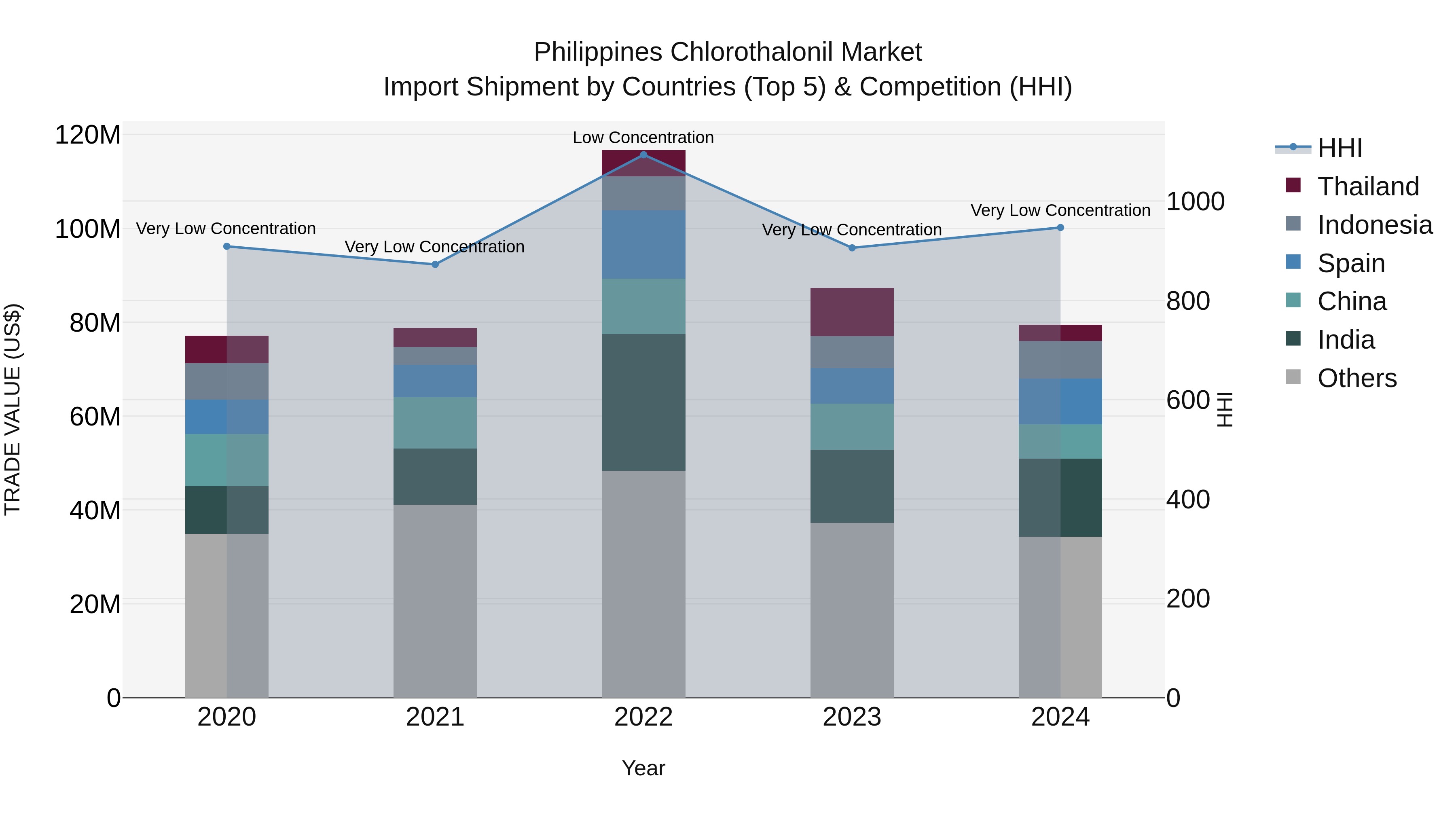
Philippines` chlorothalonil import shipments in 2024 were primarily sourced from India, Spain, Indonesia, China, and Japan. Despite the presence of multiple key exporting countries, the market remained relatively unconcentrated with a low Herfindahl-Hirschman Index (HHI) in 2024. The compound annual growth rate (CAGR) from 2020 to 2024 was modest at 0.73%, indicating stable growth over the period. However, there was a notable decline in the growth rate from 2023 to 2024, with a decrease of -9.05%, suggesting a potential shift or adjustment in the import dynamics for chlorothalonil in the Philippines.
Philippines Chlorothalonil Market Overview
Chlorothalonil is used as a broad-spectrum fungicide in agriculture. In the Philippines, demand is tied to high-value crops like fruits and vegetables, although regulatory concerns over its environmental impact may shape future trends.
Trends of the market
The chlorothalonil market in the Philippines is witnessing sustained demand, especially in the agriculture sector as an effective fungicide. Increased focus on boosting crop yields and protecting against fungal diseases is driving market expansion. However, growing concerns over environmental impact are encouraging research into safer alternatives.
Challenges of the market
Chlorothalonil, a widely used fungicide, faces regulatory scrutiny due to its potential environmental and health risks. The market is also impacted by the shift toward organic and sustainable farming practices, which often avoid synthetic chemicals. Increasing regulations, along with competition from alternative fungicides, pose challenges to the growth of the chlorothalonil market.
Investment opportunities in the Market
Chlorothalonil, a broad-spectrum fungicide used in agriculture, is in demand in the Philippines as farmers seek solutions to combat fungal diseases affecting crops. Its role in the protection of key crops like rice, corn, and vegetables highlights the potential for growth in the agricultural sector. As the government promotes agricultural sustainability, the market for chlorothalonil and similar products will expand, offering opportunities for companies to invest in more efficient and eco-friendly agricultural chemicals.
Government Policy of the market
The chlorothalonil market in the Philippines is influenced by agricultural policies and regulations that govern pesticide use. The Fertilizer and Pesticide Authority (FPA) ensures the safe application of chlorothalonil, particularly in crop protection. The governments efforts to support sustainable farming practices and the need for effective pest control solutions have led to an increase in demand for chlorothalonil. Additionally, government subsidies and training programs for farmers in pest management contribute to market growth.
Key Highlights of the Report:
- Philippines Chlorothalonil Market Outlook
- Market Size of Philippines Chlorothalonil Market, 2024
- Forecast of Philippines Chlorothalonil Market, 2031
- Historical Data and Forecast of Philippines Chlorothalonil Revenues & Volume for the Period 2021- 2031
- Philippines Chlorothalonil Market Trend Evolution
- Philippines Chlorothalonil Market Drivers and Challenges
- Philippines Chlorothalonil Price Trends
- Philippines Chlorothalonil Porter's Five Forces
- Philippines Chlorothalonil Industry Life Cycle
- Historical Data and Forecast of Philippines Chlorothalonil Market Revenues & Volume By Type for the Period 2021- 2031
- Historical Data and Forecast of Philippines Chlorothalonil Market Revenues & Volume By 98% Chlorothalonil for the Period 2021- 2031
- Historical Data and Forecast of Philippines Chlorothalonil Market Revenues & Volume By 96% Chlorothalonil for the Period 2021- 2031
- Historical Data and Forecast of Philippines Chlorothalonil Market Revenues & Volume By 90% Chlorothalonil for the Period 2021- 2031
- Historical Data and Forecast of Philippines Chlorothalonil Market Revenues & Volume By Product for the Period 2021- 2031
- Historical Data and Forecast of Philippines Chlorothalonil Market Revenues & Volume By Wettable Powder for the Period 2021- 2031
- Historical Data and Forecast of Philippines Chlorothalonil Market Revenues & Volume By Suspended Agents for the Period 2021- 2031
- Historical Data and Forecast of Philippines Chlorothalonil Market Revenues & Volume By Others (Granular & Dilute) for the Period 2021- 2031
- Historical Data and Forecast of Philippines Chlorothalonil Market Revenues & Volume By Crop Type for the Period 2021- 2031
- Historical Data and Forecast of Philippines Chlorothalonil Market Revenues & Volume By Vegetables & Fruits for the Period 2021- 2031
- Historical Data and Forecast of Philippines Chlorothalonil Market Revenues & Volume By Oilseeds & Pulses for the Period 2021- 2031
- Historical Data and Forecast of Philippines Chlorothalonil Market Revenues & Volume By Turfs & Ornamentals for the Period 2021- 2031
- Historical Data and Forecast of Philippines Chlorothalonil Market Revenues & Volume By Cereals & Grains for the Period 2021- 2031
- Philippines Chlorothalonil Import Export Trade Statistics
- Market Opportunity Assessment By Type
- Market Opportunity Assessment By Product
- Market Opportunity Assessment By Crop Type
- Philippines Chlorothalonil Top Companies Market Share
- Philippines Chlorothalonil Competitive Benchmarking By Technical and Operational Parameters
- Philippines Chlorothalonil Company Profiles
- Philippines Chlorothalonil Key Strategic Recommendations






































