Philippines Cloud Database and DBaaS Market Size & Growth Rate (2026-2032)
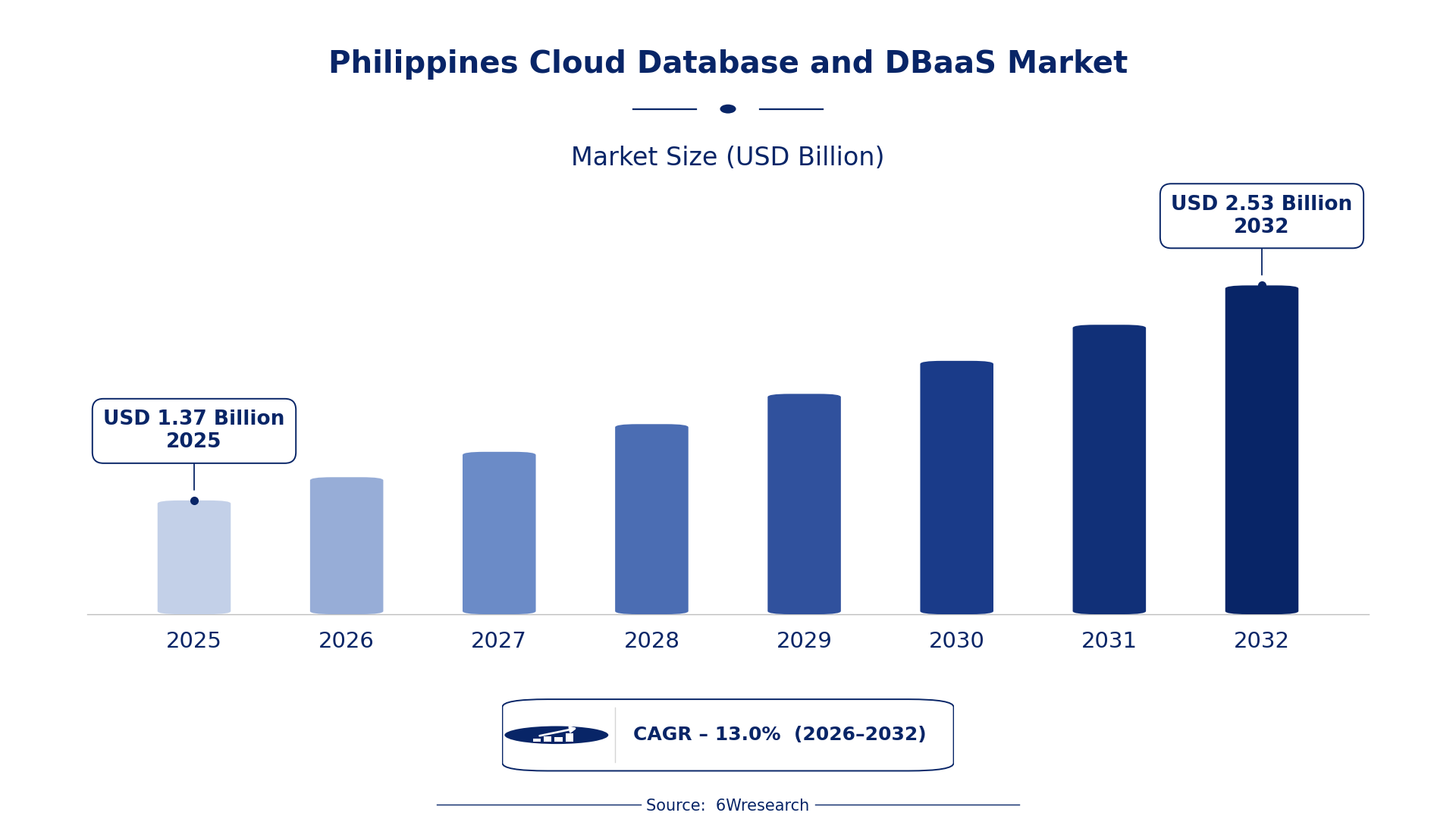
The Philippines Cloud Database and DBaaS Market was estimated at USD 1368 Million in 2025 and is projected to reach USD 2531 Million by 2032, growing at a CAGR of 13.0% from 2026 to 2032.
Philippines Cloud Database and DBaaS Market Synopsis
The surge in data generation across sectors in the Philippines has led to an increased demand for scalable cloud database solutions. Companies are increasingly looking to DBaaS offerings to alleviate the burden of database management, allowing them to focus on core business activities.
As digital transformation accelerates, organizations in the Philippines are prioritizing efficiency and agility. Cloud databases not only facilitate faster data retrieval and analysis but also enhance operational resilience, which has become crucial in the current unpredictable business environment.
Philippines Cloud Database and DBaaS Market Year-wise Growth Rate and Key Drivers
This graph illustrates the annual growth rates of the Philippines Cloud Database and DBaaS Market from 2021 to 2032, highlighting a steady upward trajectory and projected expansion over the forecast period.
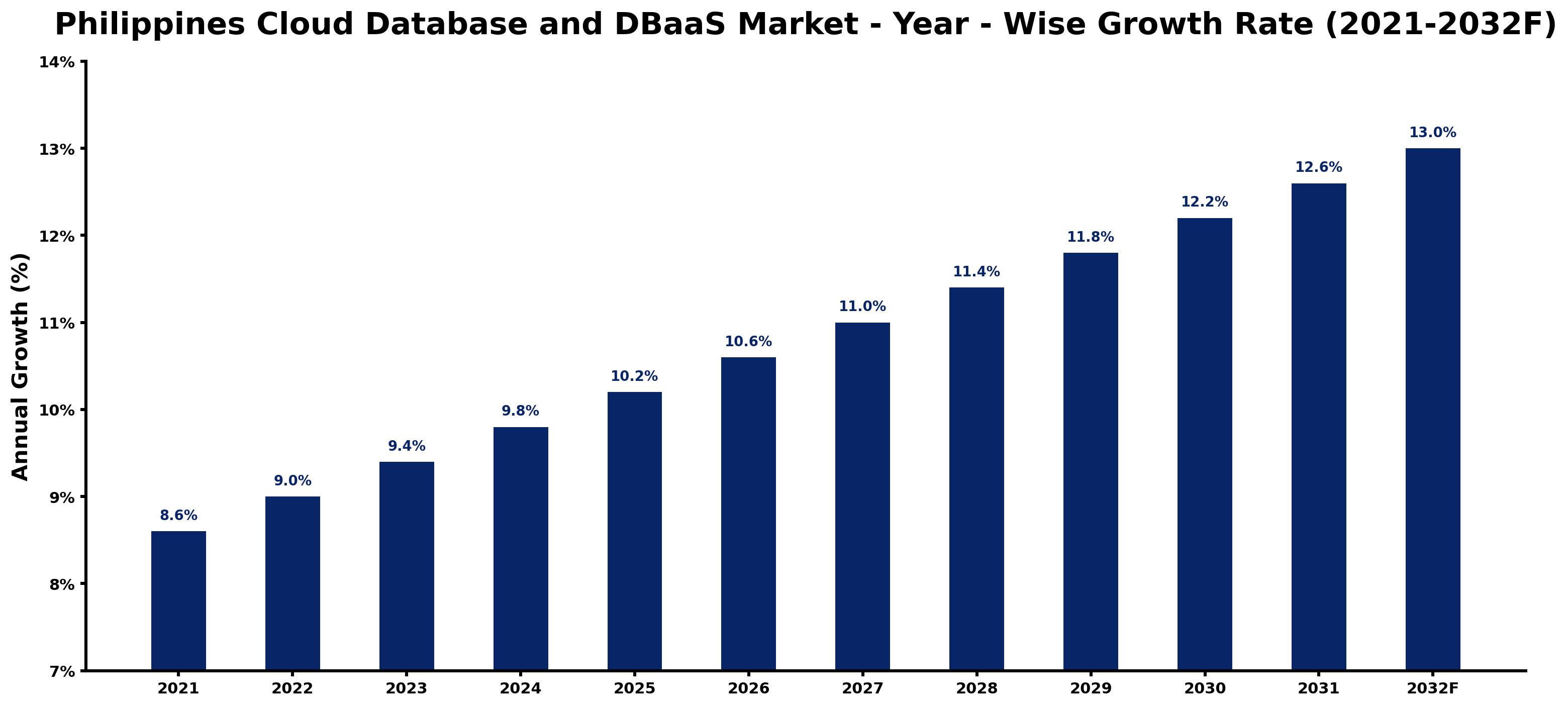
The table below presents the year‑wise growth rates along with the key drivers influencing the market
| Year | Growth Rate | Major Drivers |
| 2021 | 8.6% | PH government digitalization initiatives boost cloud adoption |
| 2022 | 9.0% | Increased demand for remote data management solutions |
| 2023 | 9.4% | Rising local startups driving DBaaS utilization |
| 2024 | 9.8% | Telecommunications expansion enhances cloud service accessibility |
| 2025 | 10.2% | E-commerce growth necessitates robust database solutions |
| 2026 | 10.6% | Regulatory focus on data privacy fuels cloud confidence |
| 2027 | 11.0% | Integration of AI technologies demands scalable database systems |
| 2028 | 11.4% | Education sector's shift to online platforms increases demand |
| 2029 | 11.8% | Public sector digitization projects boost government data storage |
| 2030 | 12.2% | Healthcare modernization drives need for secure cloud databases |
| 2031 | 12.6% | Local businesses seeking cost-effective database management solutions |
| 2032 | 13.0% | Migration to cloud for disaster recovery and resilience |
Note: Market size estimations and growth projections presented in this report are based on 6Wresearch's proprietary forecasting methodology, utilizing the latest available industry data, government publications, and primary research inputs.
Philippines Cloud Database and DBaaS Market Key Takeaways
Below are some of the specific key takeaways from the market, including:
- The increasing volume of data generated by businesses is a primary driver for adopting cloud database solutions.
- DBaaS is favored for its ability to offer managed services, freeing up internal IT resources.
- Compliance with local data protection regulations is shaping the development of cloud database strategies.
- Recent trends indicate a shift towards hybrid cloud models as companies seek to balance flexibility and control.
- Investments in digital infrastructure by the government are expected to bolster market growth.
Evaluation of Restraints in Philippines Cloud Database and DBaaS Market
Despite the promising growth trajectory, the Philippines Cloud Database and DBaaS Market faces notable restraints. One major challenge is data migration, particularly when transitioning from traditional on-premises systems to cloud environments. This process can be complex and resource-intensive, often requiring specialized expertise. Additionally, concerns regarding data governance and compliance with stringent local laws create hurdles for organizations considering cloud solutions. Downtime during transitions can also pose risks, leading to hesitance among potential adopters.
Philippines Cloud Database and DBaaS Market Trends
The market is currently witnessing a shift towards automation and artificial intelligence integrated within cloud database solutions. Companies are leveraging AI to enhance data analytics capabilities, leading to improved decision-making processes. on top of that, the rise of edge computing is influencing cloud strategies, as businesses aim to reduce latency and improve performance by processing data closer to its source. These trends indicate a market adapting to both technological advancements and changing consumer expectations.
Philippines Cloud Database and DBaaS Market Opportunities
The growth of e-commerce and digital services in the Philippines presents lucrative opportunities for cloud database providers. As companies expand their online operations, the demand for flexible and scalable database solutions will intensify. Additionally, sectors such as healthcare and finance are increasingly investing in cloud technologies to enhance their data management capabilities. Innovations around cybersecurity measures will also create new avenues for growth, as businesses seek to protect sensitive data in cloud environments.
Government Initiatives in the Philippines Cloud Database and DBaaS Market
Government policies in the Philippines are playing a crucial role in shaping the cloud database and DBaaS market. The regulatory environment is increasingly supportive of digital transformation, with initiatives aimed at fostering a secure and efficient cloud infrastructure. These policies not only enhance the market's appeal but also ensure compliance with data protection standards.
- A recently completed initiative involved the establishment of a national digital framework to improve data management across public agencies, enhancing cloud adoption.
- A currently ongoing program aims to provide incentives for businesses that adopt cloud solutions, fostering a shift towards more modern database systems.
- Upcoming legislation is set to introduce stricter data governance regulations, which will necessitate enhanced compliance measures for cloud database services.
- In 2025, a public-private partnership initiative is expected to launch, focusing on developing cloud infrastructure to support small and medium enterprises.
- A planned national cybersecurity strategy is set to be unveiled, addressing the need for secure cloud environments, thus encouraging organizations to transition to cloud databases.
Future Insights of the Philippines Cloud Database and DBaaS Market
Looking ahead to 2026-2032, the Philippines Cloud Database and DBaaS Market is set to expand as more organizations recognize the value of cloud solutions. Increased investments in digital infrastructure, coupled with a growing pool of skilled professionals in IT, will propel this market forward. on top of that, as businesses continue to prioritize data security and compliance, providers that can offer reliable and flexible solutions will thrive. The emphasis on AI-driven analytics and edge computing will also redefine how companies leverage cloud databases, ensuring that this market remains dynamic and competitive.
Philippines Cloud Database and DBaaS Market Latest Developments
In the past year, activity in the Philippines Cloud Database and DBaaS Market has been marked by a series of strategic developments. Companies are increasingly collaborating to enhance their service offerings, focusing on integrating advanced technologies that cater to the evolving needs of businesses.
- A major technology vendor announced plans for a cloud database service upgrade that started in early 2025 and is expected to enhance performance and security features.
- In mid-2025, a partnership was formed between two regional operators to provide bundled cloud database solutions targeted at small businesses, which remains ongoing.
- A leading local provider launched a new DBaaS offering in Q1 2025, aimed at improving accessibility for startups and SMEs.
- By late 2026, a rollout is expected to begin for a cloud-based analytics tool that integrates seamlessly with existing database systems.
- A new initiative aimed at educating businesses about cloud database benefits is currently underway, scheduled for completion by early 2026.
Philippines Cloud Database and DBaaS Market - Key Attractiveness of the Report
- 10 Years of Market Numbers
- Historical Data Starting from 2022 to 2025
- Base Year: 2025
- Forecast Data until 2032
- Key Performance Indicators Impacting the Market
- Major Upcoming Developments and Projects
Key Highlights of the Report:
- Philippines Cloud Database and DBaaS Market Outlook
- Market Size of Philippines Cloud Database and DBaaS Market, 2025
- Forecast of Philippines Cloud Database and DBaaS Market, 2032
- Historical Data and Forecast of Philippines Cloud Database and DBaaS Revenues & Volume for the Period 2022-2032F
- Philippines Cloud Database and DBaaS Market Trend Evolution
- Philippines Cloud Database and DBaaS Market Drivers and Challenges
- Philippines Cloud Database and DBaaS Price Trends
- Philippines Cloud Database and DBaaS Porter's Five Forces
- Philippines Cloud Database and DBaaS Industry Life Cycle
- Historical Data and Forecast of Philippines Cloud Database and DBaaS Market Revenues & Volume By Database Type for the Period 2022-2032F
- Historical Data and Forecast of Philippines Cloud Database and DBaaS Market Revenues & Volume By SQL for the Period 2022-2032F
- Historical Data and Forecast of Philippines Cloud Database and DBaaS Market Revenues & Volume By NoSQL for the Period 2022-2032F
- Historical Data and Forecast of Philippines Cloud Database and DBaaS Market Revenues & Volume By Service for the Period 2022-2032F
- Historical Data and Forecast of Philippines Cloud Database and DBaaS Market Revenues & Volume By Professional Services for the Period 2022-2032F
- Historical Data and Forecast of Philippines Cloud Database and DBaaS Market Revenues & Volume By Consulting for the Period 2022-2032F
- Historical Data and Forecast of Philippines Cloud Database and DBaaS Market Revenues & Volume By Implementation for the Period 2022-2032F
- Historical Data and Forecast of Philippines Cloud Database and DBaaS Market Revenues & Volume By Support and Maintenance for the Period 2022-2032F
- Historical Data and Forecast of Philippines Cloud Database and DBaaS Market Revenues & Volume By Managed Services for the Period 2022-2032F
- Historical Data and Forecast of Philippines Cloud Database and DBaaS Market Revenues & Volume By Vertical for the Period 2022-2032F
- Historical Data and Forecast of Philippines Cloud Database and DBaaS Market Revenues & Volume By Banking, Financial Services and Insurance (BFSI) for the Period 2022-2032F
- Historical Data and Forecast of Philippines Cloud Database and DBaaS Market Revenues & Volume By Telecom and Information Technology (IT) for the Period 2022-2032F
- Historical Data and Forecast of Philippines Cloud Database and DBaaS Market Revenues & Volume By Government for the Period 2022-2032F
- Historical Data and Forecast of Philippines Cloud Database and DBaaS Market Revenues & Volume By Consumer Goods and Retail for the Period 2022-2032F
- Historical Data and Forecast of Philippines Cloud Database and DBaaS Market Revenues & Volume By Manufacturing for the Period 2022-2032F
- Historical Data and Forecast of Philippines Cloud Database and DBaaS Market Revenues & Volume By Energy and Utilities for the Period 2022-2032F
- Historical Data and Forecast of Philippines Cloud Database and DBaaS Market Revenues & Volume By Media and Entertainment for the Period 2022-2032F
- Historical Data and Forecast of Philippines Cloud Database and DBaaS Market Revenues & Volume By Healthcare and Life Sciences for the Period 2022-2032F
- Historical Data and Forecast of Philippines Cloud Database and DBaaS Market Revenues & Volume By Component for the Period 2022-2032F
- Historical Data and Forecast of Philippines Cloud Database and DBaaS Market Revenues & Volume By Solution for the Period 2022-2032F
- Historical Data and Forecast of Philippines Cloud Database and DBaaS Market Revenues & Volume By Services for the Period 2022-2032F
- Historical Data and Forecast of Philippines Cloud Database and DBaaS Market Revenues & Volume By Deployment Model for the Period 2022-2032F
- Historical Data and Forecast of Philippines Cloud Database and DBaaS Market Revenues & Volume By Public Cloud for the Period 2022-2032F
- Historical Data and Forecast of Philippines Cloud Database and DBaaS Market Revenues & Volume By Private Cloud for the Period 2022-2032F
- Historical Data and Forecast of Philippines Cloud Database and DBaaS Market Revenues & Volume By Hybrid Cloud for the Period 2022-2032F
- Historical Data and Forecast of Philippines Cloud Database and DBaaS Market Revenues & Volume By Organization Size for the Period 2022-2032F
- Historical Data and Forecast of Philippines Cloud Database and DBaaS Market Revenues & Volume By Large Enterprises for the Period 2022-2032F
- Historical Data and Forecast of Philippines Cloud Database and DBaaS Market Revenues & Volume By Small and Medium-sized Enterprises (SMEs) for the Period 2022-2032F
- Philippines Cloud Database and DBaaS Import Export Trade Statistics
- Market Opportunity Assessment By Database Type
- Market Opportunity Assessment By Service
- Market Opportunity Assessment By Vertical
- Market Opportunity Assessment By Component
- Market Opportunity Assessment By Deployment Model
- Market Opportunity Assessment By Organization Size
- Philippines Cloud Database and DBaaS Top Companies Market Share
- Philippines Cloud Database and DBaaS Competitive Benchmarking By Technical and Operational Parameters
- Philippines Cloud Database and DBaaS Company Profiles
- Philippines Cloud Database and DBaaS Key Strategic Recommendations






































