Philippines Cloud Infrastructure Services Market Size & Growth Rate (2026-2032)
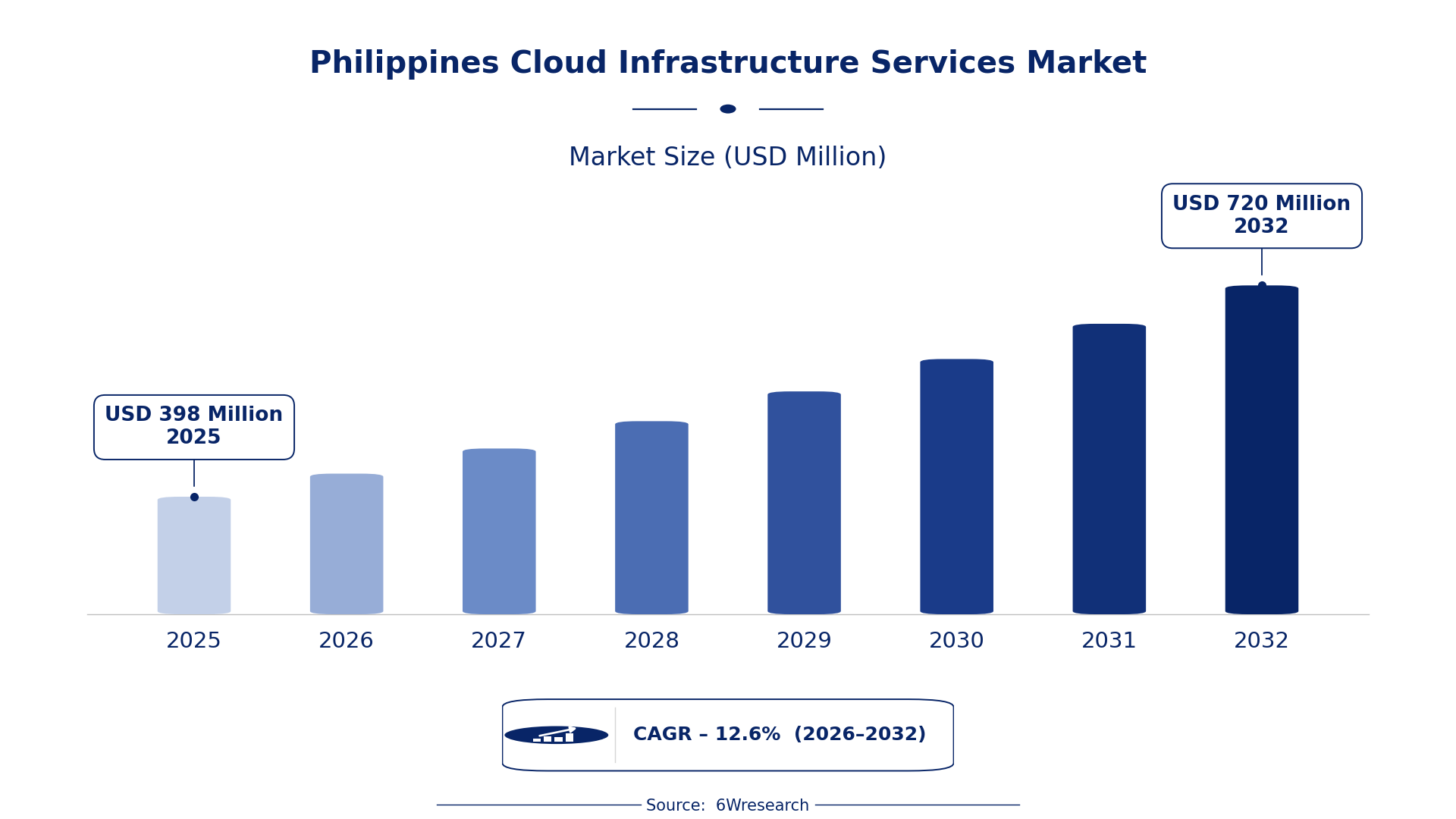
The Philippines Cloud Infrastructure Services Market was estimated at USD 398 Million in 2025 and is projected to reach USD 720 Million by 2032, growing at a CAGR of 12.6% from 2026 to 2032.
Philippines Cloud Infrastructure Services Market Synopsis
The primary force driving the Philippines Cloud Infrastructure Services Market is the rapid digital transformation across various sectors. Organizations are increasingly shifting their IT infrastructure to the cloud, necessitating advanced cloud services to enhance operational efficiency and scalability.
This shift is not merely a trend; it’s a necessity driven by the demands of remote work and the need for business continuity. Companies are seeking reliable cloud infrastructure solutions that provide the compute, storage, and networking resources essential for modern operations.
Philippines Cloud Infrastructure Services Market Year-wise Growth Rate and Key Drivers
This graph illustrates the annual growth rates of the Philippines Cloud Infrastructure Services Market from 2021 to 2032, highlighting a steady upward trajectory and projected expansion over the forecast period.
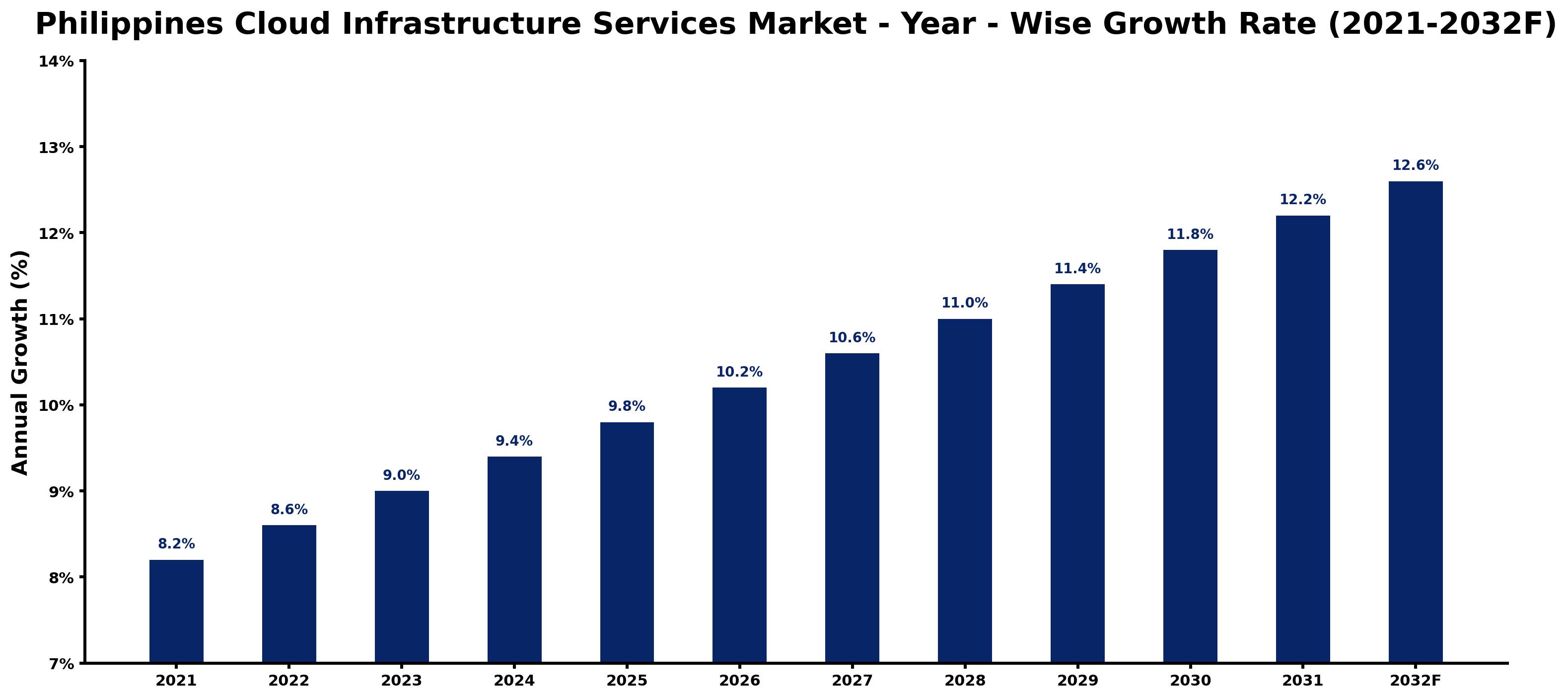
The table below presents the year‑wise growth rates along with the key drivers influencing the market
| Year | Growth Rate | Major Drivers |
| 2021 | 8.2% | Emerging fintech sector increasing cloud computing requirements. |
| 2022 | 8.6% | Local startups adopt cloud for agile business models. |
| 2023 | 9.0% | Government's DICT enhances cloud ecosystem in Philippines. |
| 2024 | 9.4% | Rising remote work trends drive cloud service adoption. |
| 2025 | 9.8% | Increased investment in online education platforms requires cloud. |
| 2026 | 10.2% | Philippines implementing 5G technology boosts cloud service usage. |
| 2027 | 10.6% | Healthcare digitalization pushes demand for cloud storage solutions. |
| 2028 | 11.0% | Local enterprises shifting to cloud for disaster recovery. |
| 2029 | 11.4% | Telecommunication companies expanding services using cloud capabilities. |
| 2030 | 11.8% | Government regulations support public sector cloud migrations. |
| 2031 | 12.2% | Local gaming industry fueling demand for scalable cloud resources. |
| 2032 | 12.6% | Exporting IT services drives demand for robust cloud infrastructure. |
Note: Market size estimations and growth projections presented in this report are based on 6Wresearch's proprietary forecasting methodology, utilizing the latest available industry data, government publications, and primary research inputs.
Philippines Cloud Infrastructure Services Market Key Takeaways
Below are some of the specific key takeaways from the market, including:
- The market is experiencing a consistent upward trajectory, fueled by increased cloud adoption across industries.
- Infrastructure as a Service (IaaS) and Platform as a Service (PaaS) are the leading segments within the cloud services framework.
- Concerns over security and network performance are pivotal challenges that companies must address.
- Government initiatives aimed at enhancing digital infrastructure are expected to bolster market growth significantly.
- The COVID-19 pandemic has acted as a catalyst, accelerating the transition to cloud-based solutions.
Evaluation of Restraints in Philippines Cloud Infrastructure Services Market
Despite the promising growth, the Philippines Cloud Infrastructure Services Market faces substantial restraints. Chief among these are the issues related to network performance and reliability. In remote and underserved areas, ensuring low latency and high availability becomes a formidable challenge. Additionally, security remains a persistent concern for organizations that are increasingly relying on cloud solutions. The need for robust security measures is paramount as the frequency of cyber threats escalates.
Philippines Cloud Infrastructure Services Market Trends
Several trends are currently shaping the demand for cloud infrastructure services in the Philippines. The rise of hybrid cloud solutions is one such trend, where businesses combine on-premises infrastructure with public cloud services to optimize performance. on top of that, there is a growing focus on sustainability, with companies seeking energy-efficient cloud solutions. The integration of AI and machine learning into cloud services is also becoming commonplace, enabling organizations to leverage data analytics for better decision-making.
Philippines Cloud Infrastructure Services Market Opportunities
The Philippines presents a multitude of opportunities for growth in cloud infrastructure services. Emerging sectors such as e-commerce and fintech are particularly poised for expansion, driving demand for reliable cloud solutions. As businesses continue to adopt digital tools, there is a clear need for localized data centers that can provide faster services and comply with regulations. Additionally, partnerships between local enterprises and global cloud service providers can facilitate further investment and innovation in the sector.
Government Initiatives in the Philippines Cloud Infrastructure Services Market
The government of the Philippines is increasingly recognizing the importance of cloud infrastructure in fostering economic growth and enhancing digital capabilities. Public policies are becoming more supportive of cloud adoption, which is crucial for the country’s digital transformation goals. Regulatory frameworks are being developed to ensure that cloud services are secure, accessible, and beneficial to all sectors of the economy.
- A national digital infrastructure upgrade programme now in its rollout phase aims to enhance connectivity across the archipelago.
- Current initiatives include establishing cloud computing standards to ensure interoperability and security within cloud services.
- A planned public-private initiative expected to expand telecom infrastructure access by 2028 will enhance the reach of cloud services.
- Recently completed regulatory frameworks focus on data protection, which is critical for fostering trust in cloud services.
- Ongoing discussions about tax incentives for companies investing in cloud technologies are expected to promote further growth in this sector.
Future Insights of the Philippines Cloud Infrastructure Services Market
Looking ahead, the Philippines Cloud Infrastructure Services Market is set for substantial growth. By 2026, we anticipate a marked increase in cloud adoption as businesses continue to prioritize digital transformation. The demand for advanced services like edge computing and AI-driven analytics will likely rise, pushing providers to innovate continuously. As infrastructure improvements take shape, connectivity will improve, allowing even remote areas to tap into cloud solutions.
Philippines Cloud Infrastructure Services Market Latest Developments
Recent months have seen a surge of activity within the Philippines Cloud Infrastructure Services Market. Companies are ramping up efforts to enhance their service offerings to meet the growing demand from various sectors. This dynamic environment is fostering innovation and partnerships, ensuring that businesses are better equipped to leverage cloud technologies.
- A major technology vendor announced a new cloud service rollout aimed at small and medium-sized enterprises, which began in early 2025 and is expected to be completed by late 2025.
- An initiative that began in mid-2025 and remains underway focuses on enhancing cybersecurity measures for cloud services, addressing growing concerns in this area.
- A leading regional operator is planning to expand its data center footprint, with a rollout expected to begin in the second half of 2026.
- In early 2025, a collaborative project between several local firms was launched to develop a cloud-based platform for agricultural management.
- A new partnership between a domestic provider and an international cloud giant was announced in Q2 2025, aimed at improving service availability across the country.
Philippines Cloud Infrastructure Services Market - Key Attractiveness of the Report
- 10 Years of Market Numbers
- Historical Data Starting from 2022 to 2025
- Base Year: 2025
- Forecast Data until 2032
- Key Performance Indicators Impacting the Market
- Major Upcoming Developments and Projects
Key Highlights of the Report:
- Philippines Cloud Infrastructure Services Market Outlook
- Market Size of Philippines Cloud Infrastructure Services Market, 2025
- Forecast of Philippines Cloud Infrastructure Services Market, 2032
- Historical Data and Forecast of Philippines Cloud Infrastructure Services Revenues & Volume for the Period 2022-2032F
- Philippines Cloud Infrastructure Services Market Trend Evolution
- Philippines Cloud Infrastructure Services Market Drivers and Challenges
- Philippines Cloud Infrastructure Services Price Trends
- Philippines Cloud Infrastructure Services Porter's Five Forces
- Philippines Cloud Infrastructure Services Industry Life Cycle
- Historical Data and Forecast of Philippines Cloud Infrastructure Services Market Revenues & Volume By Service Type for the Period 2022-2032F
- Historical Data and Forecast of Philippines Cloud Infrastructure Services Market Revenues & Volume By Compute as a Service for the Period 2022-2032F
- Historical Data and Forecast of Philippines Cloud Infrastructure Services Market Revenues & Volume By Storage as a Service for the Period 2022-2032F
- Historical Data and Forecast of Philippines Cloud Infrastructure Services Market Revenues & Volume By Disaster Recovery and Backup as a Service for the Period 2022-2032F
- Historical Data and Forecast of Philippines Cloud Infrastructure Services Market Revenues & Volume By Networking as a Service for the Period 2022-2032F
- Historical Data and Forecast of Philippines Cloud Infrastructure Services Market Revenues & Volume By Desktop as a Service for the Period 2022-2032F
- Historical Data and Forecast of Philippines Cloud Infrastructure Services Market Revenues & Volume By Managed Hosting for the Period 2022-2032F
- Historical Data and Forecast of Philippines Cloud Infrastructure Services Market Revenues & Volume By Deployment Type for the Period 2022-2032F
- Historical Data and Forecast of Philippines Cloud Infrastructure Services Market Revenues & Volume By On-premises for the Period 2022-2032F
- Historical Data and Forecast of Philippines Cloud Infrastructure Services Market Revenues & Volume By Cloud for the Period 2022-2032F
- Historical Data and Forecast of Philippines Cloud Infrastructure Services Market Revenues & Volume By Organization Size for the Period 2022-2032F
- Historical Data and Forecast of Philippines Cloud Infrastructure Services Market Revenues & Volume By Small and Medium-sized Enterprises (SMEs) for the Period 2022-2032F
- Historical Data and Forecast of Philippines Cloud Infrastructure Services Market Revenues & Volume By Large Enterprises for the Period 2022-2032F
- Historical Data and Forecast of Philippines Cloud Infrastructure Services Market Revenues & Volume By Vertical for the Period 2022-2032F
- Historical Data and Forecast of Philippines Cloud Infrastructure Services Market Revenues & Volume By Banking, Financial Services, and Insurance (BFSI) for the Period 2022-2032F
- Historical Data and Forecast of Philippines Cloud Infrastructure Services Market Revenues & Volume By IT and Telecommunications for the Period 2022-2032F
- Historical Data and Forecast of Philippines Cloud Infrastructure Services Market Revenues & Volume By Government and Public Sector for the Period 2022-2032F
- Historical Data and Forecast of Philippines Cloud Infrastructure Services Market Revenues & Volume By Retail and Consumer Goods for the Period 2022-2032F
- Historical Data and Forecast of Philippines Cloud Infrastructure Services Market Revenues & Volume By Manufacturing for the Period 2022-2032F
- Historical Data and Forecast of Philippines Cloud Infrastructure Services Market Revenues & Volume By Energy and Utilities for the Period 2022-2032F
- Historical Data and Forecast of Philippines Cloud Infrastructure Services Market Revenues & Volume By Media and Entertainment for the Period 2022-2032F
- Historical Data and Forecast of Philippines Cloud Infrastructure Services Market Revenues & Volume By Healthcare and Life Sciences for the Period 2022-2032F
- Philippines Cloud Infrastructure Services Import Export Trade Statistics
- Market Opportunity Assessment By Service Type
- Market Opportunity Assessment By Deployment Type
- Market Opportunity Assessment By Organization Size
- Market Opportunity Assessment By Vertical
- Philippines Cloud Infrastructure Services Top Companies Market Share
- Philippines Cloud Infrastructure Services Competitive Benchmarking By Technical and Operational Parameters
- Philippines Cloud Infrastructure Services Company Profiles
- Philippines Cloud Infrastructure Services Key Strategic Recommendations






































