Philippines Cloud Professional Services Market Size & Growth Rate (2026-2032)
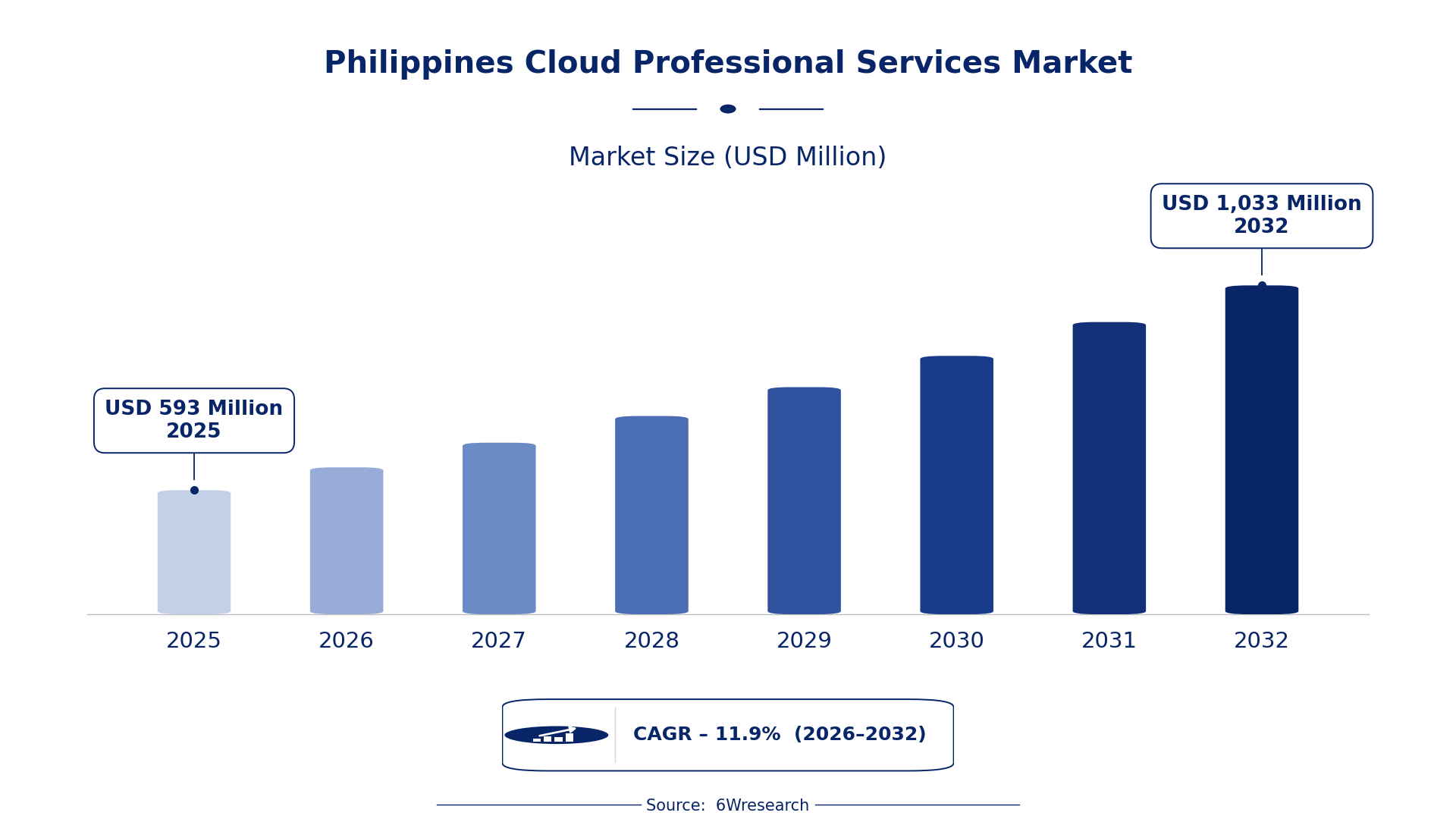
The Philippines Cloud Professional Services Market was estimated at USD 593 Million in 2025 and is projected to reach USD 1033 Million by 2032, growing at a CAGR of 11.9% from 2026 to 2032.
Philippines Cloud Professional Services Market Synopsis
The Philippines is rapidly embracing cloud technologies, and this shift is driving an increasing demand for professional services. Organizations are recognizing that without expert guidance, the transition to cloud solutions can be fraught with challenges, from planning to implementation and ongoing management.
As companies seek to modernize their operations and enhance agility, cloud professional services are becoming indispensable. The market is not just about technology; it’s about strategic partnerships that enable businesses to thrive in a digital-first world.
Philippines Cloud Professional Services Market Year-wise Growth Rate and Key Drivers
This graph illustrates the annual growth rates of the Philippines Cloud Professional Services Market from 2021 to 2032, highlighting a steady upward trajectory and projected expansion over the forecast period.
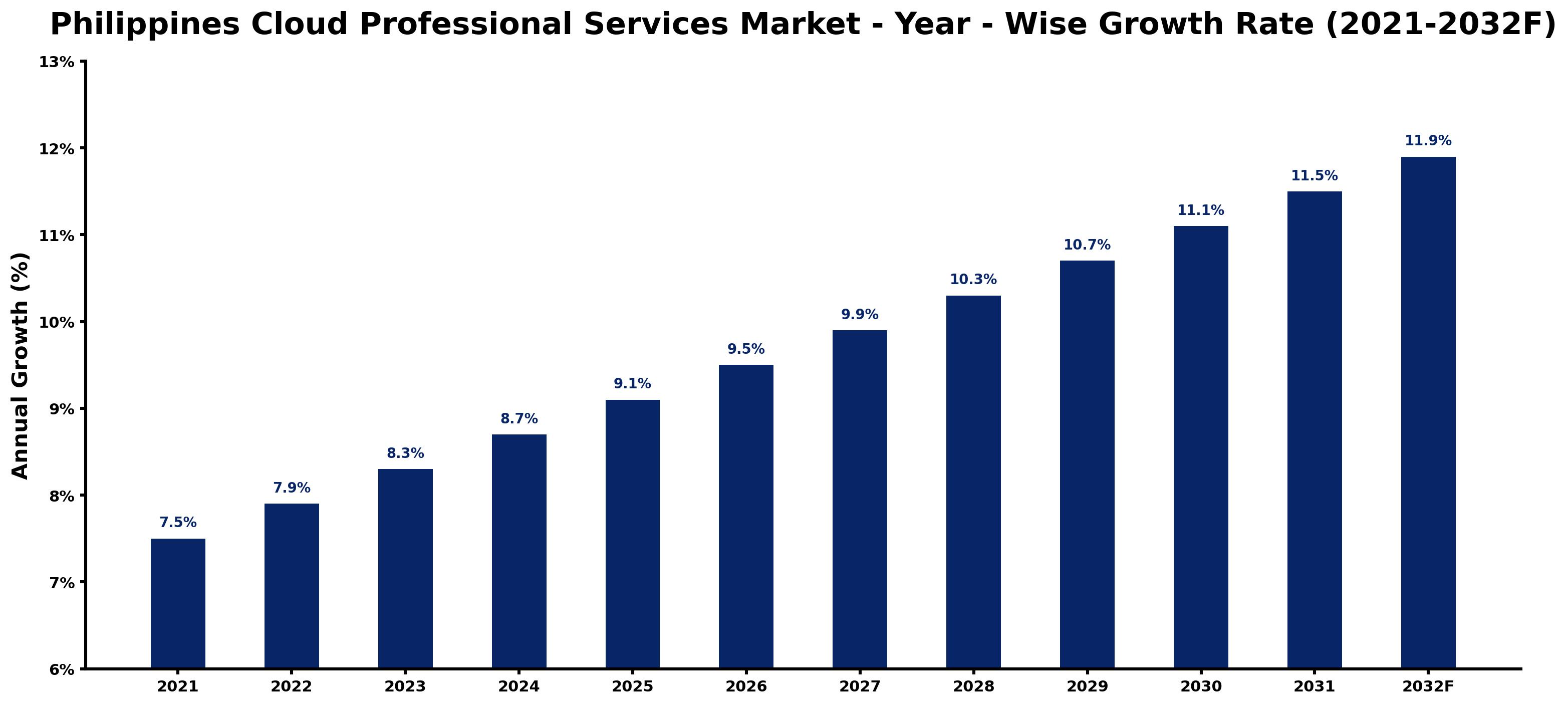
The table below presents the year‑wise growth rates along with the key drivers influencing the market
| Year | Growth Rate | Major Drivers |
| 2021 | 7.5% | Philippine Digital Transformation Roadmap promotes cloud adoption. |
| 2022 | 7.9% | Government's cloud-first policy drives enterprise migration. |
| 2023 | 8.3% | Increasing remote work boosts demand for cloud services. |
| 2024 | 8.7% | Rise in cybersecurity regulations enhances cloud security needs. |
| 2025 | 9.1% | Local startups leverage cloud for digital innovation. |
| 2026 | 9.5% | BPO sector invests in cloud solutions for scalability. |
| 2027 | 9.9% | Educational institutions adopt cloud for online learning platforms. |
| 2028 | 10.3% | Growing e-commerce sector relies on cloud infrastructure. |
| 2029 | 10.7% | Philippine data privacy law encourages secure cloud solutions. |
| 2030 | 11.1% | Increased internet penetration fuels cloud service demand. |
| 2031 | 11.5% | Telecommunication upgrades enhance cloud service capabilities. |
| 2032 | 11.9% | Rising telehealth services drive cloud computing utilization. |
Note: Market size estimations and growth projections presented in this report are based on 6Wresearch's proprietary forecasting methodology, utilizing the latest available industry data, government publications, and primary research inputs.
Philippines Cloud Professional Services Market Key Takeaways
Below are some of the specific key takeaways from the market, including:
- The market is experiencing a significant upsurge, fueled by the complexities of cloud adoption.
- Businesses are increasingly turning to external experts for cloud migration and management.
- The competitive environment is intensifying, with both local and international players vying for market share.
- Ongoing digital transformation initiatives are propelling demand for cloud consulting and implementation services.
- Government policies are increasingly supportive of cloud adoption, further driving market growth.
Evaluation of Restraints in Philippines Cloud Professional Services Market
Despite the promising growth, several factors are constraining the Philippines Cloud Professional Services Market. Competition from global service providers is strong, leading to aggressive pricing strategies that can erode profit margins. Additionally, the skill gap in local talent poses challenges for organizations seeking to build in-house expertise. Many companies still grapple with the complexities of integrating cloud solutions with existing IT infrastructures, which can delay adoption and reduce overall effectiveness. Addressing these barriers is crucial for long-term growth in this sector.
Philippines Cloud Professional Services Market Trends
Several trends are shaping the Philippines Cloud Professional Services Market. The rise of hybrid cloud environments is notable, as organizations seek flexibility while managing costs. on top of that, the increasing emphasis on data security and compliance is prompting companies to invest more in professional services that offer specialized knowledge in these areas. The push for automation within cloud operations is also gaining traction, with businesses looking to streamline processes and reduce human error.
Philippines Cloud Professional Services Market Opportunities
There are numerous growth opportunities on the horizon for the Philippines Cloud Professional Services Market. With the ongoing digital transformation across various sectors, including finance, healthcare, and retail, the demand for tailored cloud solutions is surging. on top of that, the expansion of 5G technology is set to enhance cloud service delivery, opening new avenues for innovative applications. Investment in upskilling local talent can also create a competitive advantage, positioning organizations to better meet the needs of the market.
Government Initiatives in the Philippines Cloud Professional Services Market
The Philippine government has recognized the importance of cloud technology in driving economic growth and enhancing public services. Various initiatives are being implemented to foster an environment conducive to cloud adoption, emphasizing regulatory support and infrastructure development. These efforts are critical in shaping the future of the cloud professional services market.
- A national digital infrastructure upgrade programme is currently in its rollout phase, aimed at enhancing connectivity across the archipelago.
- The Department of Information and Communications Technology is implementing a regulatory framework to ensure data privacy and security in cloud services.
- A planned public-private partnership initiative aims to expand cloud service accessibility for small and medium enterprises by 2026.
- Recently completed initiatives include training programs for government employees to improve their cloud literacy and skills.
- Ongoing consultations are taking place to formulate policies that will encourage investment in cloud technology and services.
Future Insights of the Philippines Cloud Professional Services Market
Looking ahead to 2026-2032, the Philippines Cloud Professional Services Market is set for transformative growth. With digital transformation firmly on the agenda, businesses will increasingly prioritize cloud solutions to remain competitive. Enhanced government support and the emergence of new technologies will drive further adoption. As organizations become more sophisticated in their cloud strategies, the demand for specialized consulting and managed services will continue to rise, making this market a critical area for investment and innovation.
Philippines Cloud Professional Services Market Latest Developments
Recent activity in the Philippines Cloud Professional Services Market reflects a dynamic and rapidly evolving sector. Over the past year, organizations have been investing heavily in cloud solutions to adapt to shifting market demands. This has resulted in an uptick in partnerships and service offerings aimed at enhancing cloud capabilities.
- A major technology vendor launched a comprehensive cloud migration service in early 2025 to assist businesses transitioning to the cloud.
- In mid-2025, a leading regional operator announced an expansion of its cloud service offerings to include advanced analytics solutions.
- Several companies are currently piloting automated cloud management tools, with initial results showing improved efficiency and reduced costs.
- An initiative that began in early 2025 and remains underway aims to establish a national cloud competency center to foster innovation.
- By late 2025, a new service dedicated to compliance and security in cloud solutions is expected to launch, catering to increasing regulatory demands.
Philippines Cloud Professional Services Market - Key Attractiveness of the Report
- 10 Years of Market Numbers
- Historical Data Starting from 2022 to 2025
- Base Year: 2025
- Forecast Data until 2032
- Key Performance Indicators Impacting the Market
- Major Upcoming Developments and Projects
Key Highlights of the Report:
- Philippines Cloud Professional Services Market Outlook
- Market Size of Philippines Cloud Professional Services Market, 2025
- Forecast of Philippines Cloud Professional Services Market, 2032
- Historical Data and Forecast of Philippines Cloud Professional Services Revenues & Volume for the Period 2022-2032F
- Philippines Cloud Professional Services Market Trend Evolution
- Philippines Cloud Professional Services Market Drivers and Challenges
- Philippines Cloud Professional Services Price Trends
- Philippines Cloud Professional Services Porter's Five Forces
- Philippines Cloud Professional Services Industry Life Cycle
- Historical Data and Forecast of Philippines Cloud Professional Services Market Revenues & Volume By Service Type for the Period 2022-2032F
- Historical Data and Forecast of Philippines Cloud Professional Services Market Revenues & Volume By Consulting for the Period 2022-2032F
- Historical Data and Forecast of Philippines Cloud Professional Services Market Revenues & Volume By Integration & Optimization for the Period 2022-2032F
- Historical Data and Forecast of Philippines Cloud Professional Services Market Revenues & Volume By Implementation & Migration for the Period 2022-2032F
- Historical Data and Forecast of Philippines Cloud Professional Services Market Revenues & Volume By Application Development & Modernization for the Period 2022-2032F
- Historical Data and Forecast of Philippines Cloud Professional Services Market Revenues & Volume By Service Model for the Period 2022-2032F
- Historical Data and Forecast of Philippines Cloud Professional Services Market Revenues & Volume By Platform as a Service (PaaS) for the Period 2022-2032F
- Historical Data and Forecast of Philippines Cloud Professional Services Market Revenues & Volume By Software as a Service (SaaS) for the Period 2022-2032F
- Historical Data and Forecast of Philippines Cloud Professional Services Market Revenues & Volume By Infrastructure as a Service (IaaS) for the Period 2022-2032F
- Historical Data and Forecast of Philippines Cloud Professional Services Market Revenues & Volume By Deployment Model for the Period 2022-2032F
- Historical Data and Forecast of Philippines Cloud Professional Services Market Revenues & Volume By Public Cloud for the Period 2022-2032F
- Historical Data and Forecast of Philippines Cloud Professional Services Market Revenues & Volume By Private Cloud for the Period 2022-2032F
- Historical Data and Forecast of Philippines Cloud Professional Services Market Revenues & Volume By Organization Size for the Period 2022-2032F
- Historical Data and Forecast of Philippines Cloud Professional Services Market Revenues & Volume By Small and Medium-Sized Enterprises (SMEs) for the Period 2022-2032F
- Historical Data and Forecast of Philippines Cloud Professional Services Market Revenues & Volume By Large Enterprises for the Period 2022-2032F
- Historical Data and Forecast of Philippines Cloud Professional Services Market Revenues & Volume By Vertical for the Period 2022-2032F
- Historical Data and Forecast of Philippines Cloud Professional Services Market Revenues & Volume By Baanking, Financial Services, and insurance (BFSI) for the Period 2022-2032F
- Historical Data and Forecast of Philippines Cloud Professional Services Market Revenues & Volume By Retail & Consumer Goods for the Period 2022-2032F
- Historical Data and Forecast of Philippines Cloud Professional Services Market Revenues & Volume By IT & ITeS for the Period 2022-2032F
- Historical Data and Forecast of Philippines Cloud Professional Services Market Revenues & Volume By Telecommunications for the Period 2022-2032F
- Historical Data and Forecast of Philippines Cloud Professional Services Market Revenues & Volume By Healthcare & Life Sciences for the Period 2022-2032F
- Historical Data and Forecast of Philippines Cloud Professional Services Market Revenues & Volume By Manufacturing for the Period 2022-2032F
- Historical Data and Forecast of Philippines Cloud Professional Services Market Revenues & Volume By Energy & Utilities for the Period 2022-2032F
- Historical Data and Forecast of Philippines Cloud Professional Services Market Revenues & Volume By Government & Defense for the Period 2022-2032F
- Philippines Cloud Professional Services Import Export Trade Statistics
- Market Opportunity Assessment By Service Type
- Market Opportunity Assessment By Service Model
- Market Opportunity Assessment By Deployment Model
- Market Opportunity Assessment By Organization Size
- Market Opportunity Assessment By Vertical
- Philippines Cloud Professional Services Top Companies Market Share
- Philippines Cloud Professional Services Competitive Benchmarking By Technical and Operational Parameters
- Philippines Cloud Professional Services Company Profiles
- Philippines Cloud Professional Services Key Strategic Recommendations






































