Philippines Coaxial Cables Market Summary
The philippines coaxial cables market was estimated at USD 1140 Million in 2025 and is projected to reach USD 1635 Million by 2032, growing at a CAGR of 6.4% from 2026 to 2032.
Philippines Coaxial Cables Market Year-wise Growth Rate and Key Drivers
This graph highlights how the Philippines Coaxial Cables Market has steadily grown over the past five years, supported by major growth factors.
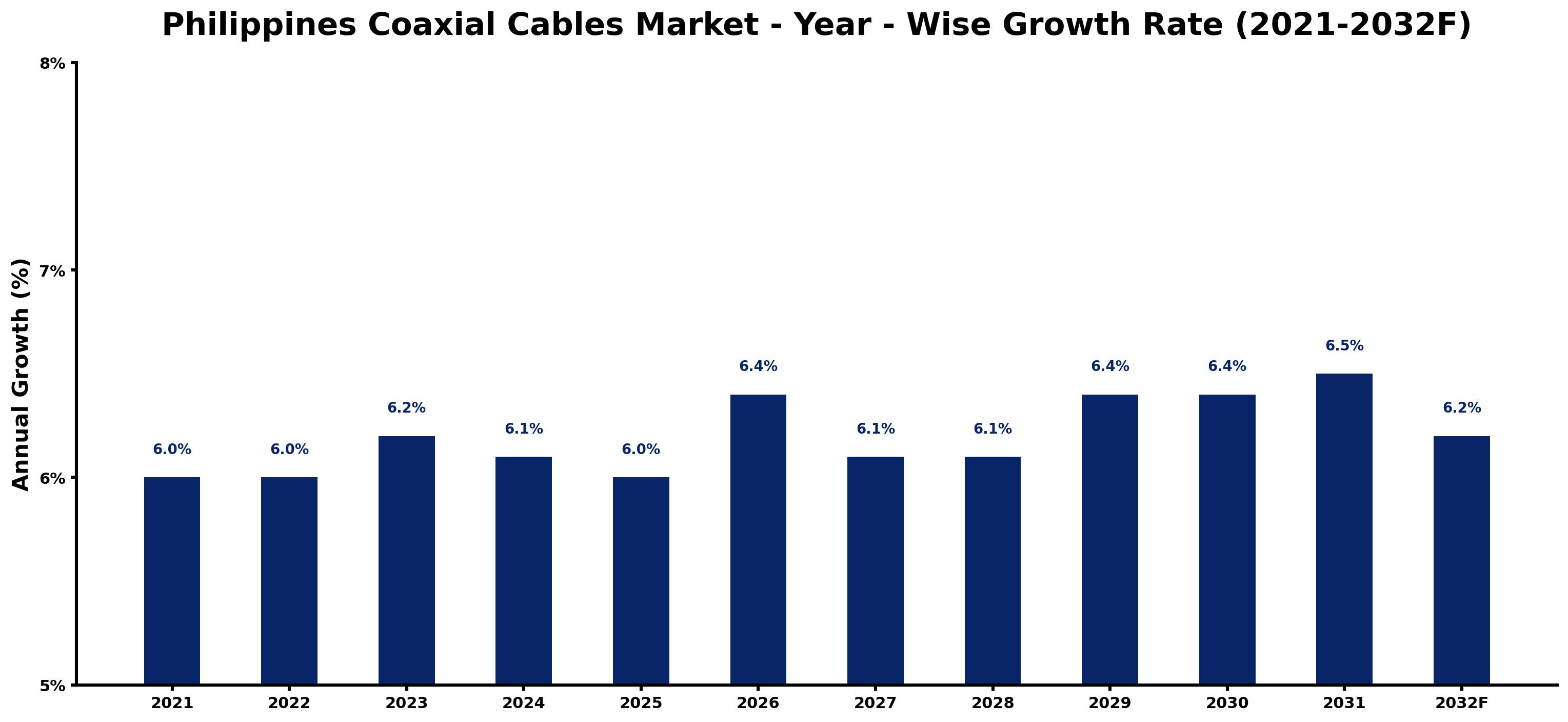
The table below presents the year wise growth rates along with the key drivers influencing the market
| Year | Growth Rate | Major Drivers |
| 2021 | 6.0% | Post-lockdown retail projects emphasized connectivity, spurring coaxial cable demand. |
| 2022 | 6.0% | Legacy copper grid failures prompted utilities to upgrade to modern coaxial solutions. |
| 2023 | 6.2% | Telecom companies expanded infrastructure, enhancing broadband access across urban areas. |
| 2024 | 6.1% | Rising interest in smart homes increased the need for robust cable installations. |
| 2025 | 6.0% | Local manufacturers began producing coaxial cables, reducing import dependency and costs. |
| 2026 | 6.4% | Construction booms in urban centers drove higher sales of electrical wiring and cables. |
| 2027 | 6.1% | Demand from emerging gaming and entertainment sectors called for advanced cable solutions. |
| 2028 | 6.1% | Technological innovations in cable design improved performance and user experience significantly. |
| 2029 | 6.4% | Environmental concerns led to a shift towards eco-friendly coaxial cable materials. |
| 2030 | 6.4% | Increased foreign investments in telecommunications strengthened the sector's overall growth. |
| 2031 | 6.5% | Collaborations between firms and government entities fostered new infrastructure projects nationwide. |
| 2032 | 6.2% | Evolving consumer preferences for high-bandwidth services drove ongoing market expansion. |
Note - Market size estimations and growth projections presented in this report are based on 6Wresearch's advanced forecasting approach, validated with industry datasets as of June 2026.
Philippines Coaxial Cables Market Synopsis
The Philippines Coaxial Cables Market is projected to reach 6.4% and witness significant growth during the forecast period (2026-2032). The surge in demand for cable and networking solutions across various industrial sectors is a key dynamic driving this expansion. The international reliance on coaxial cables, particularly in communication systems, has bolstered market growth. Government and private sector investments in infrastructure development, combined with rising consumer disposable income and advancements in technologies like 4G/LTE, are pivotal factors anticipated to enhance demand for coaxial solutions across a multitude of sectors. Furthermore, increasing internet penetration and the rapid expansion of digital services will likely play a crucial role in the market's growth trajectory over the coming years.
Philippines Coaxial Cables Market Growth Drivers
The growth of the Philippines Coaxial Cables Market can be attributed to several key drivers:
- The COVID-19 pandemic has accelerated the demand for reliable network solutions, as businesses have shifted towards online communication platforms like Skype and Zoom, increasing the need for high-quality audio and video transmission.
- Technological advancements in telecommunications, particularly the rollout of 4G and upcoming 5G networks, have created a pressing need for upgraded coaxial infrastructure to support faster and more efficient data transmission.
- Rising disposable incomes among consumers have led to increased spending on infrastructure, driving demand for high-performance coaxial cables in residential and commercial installations.
- The continuous evolution of digital services and high-speed internet access contributes to an ongoing requirement for coaxial cable solutions, especially as online entertainment and remote work become more common.
- Manufacturers are focusing on innovation to introduce technologically advanced products that offer superior performance compared to traditional coaxial options, further enhancing their market appeal.
Philippines Coaxial Cables Market Challenges and Restraints
Despite the positive growth trajectory, several challenges could impede the expansion of the Philippines Coaxial Cables Market:
- The high initial investment costs associated with upgrading infrastructure to utilize coaxial cables effectively may deter adoption, especially for small-scale enterprises with limited budgets.
- The rapid pace of technological advancements demands continuous investments in infrastructure, which can be a financial burden for companies, particularly during economic uncertainties.
- Regulatory challenges and compliance with industry standards may hinder the speed at which new technologies and products can be implemented in the market.
- Competition from alternative transmission mediums, such as fiber optics, can pose a threat to the coaxial cable market, limiting its growth potential in some applications.
- Market fluctuations driven by global economic conditions may impact investment levels in infrastructure projects, creating uncertainty in demand for coaxial products.
Philippines Coaxial Cables Market Government Investment and Initiatives
The Philippine government has recognized the importance of advanced telecommunications infrastructure in driving national development. Several initiatives aimed at enhancing the country's digital ecosystem will likely influence the Philippines Coaxial Cables Market positively:
- The government is channeling investments into improving nationwide broadband access, with initiatives that focus on expanding telecommunications infrastructure, including coaxial cable networks in underserved areas.
- Public-private partnerships are being encouraged to facilitate infrastructure development projects, with incentives offered for companies that contribute to enhancing the country's communication networks.
- There is a strategic focus on supporting the rollout of next-generation mobile networks, which will require significant upgrades to existing coaxial cable systems for optimal performance.
- Government policies are increasingly aimed at fostering innovation and technology transfer, which will support the growth of advanced coaxial cable solutions in the local market.
- The push towards digitalization in public services is creating a robust environment for telecom companies, further increasing the demand for efficient coaxial cables to support various applications.
Philippines Coaxial Cables Market Latest Developments (May 2025 - June 2026)
The Philippines Coaxial Cables Market has witnessed notable developments between May 2025 and June 2026, reflective of the evolving industry landscape:
- There has been a noticeable uptick in infrastructure projects across the country, focusing on enhancing communication capabilities and improving internet service quality, thus increasing the demand for coaxial cables.
- The industry has seen a trend towards integration of high-performance coaxial solutions with emerging technologies, preparing for the anticipated launch and integration of 5G networks.
- As part of ongoing governmental commitments, several public initiatives aimed at digital transformation were launched, which incorporated plans that directly benefit the coaxial cable market.
- The push for remote connectivity and the surge in telecommuting have led to increased investments in cable infrastructure to accommodate the corresponding rise in data traffic.
- Industry stakeholders continued to innovate, focusing on developing coaxial cables with enhanced bandwidth capabilities to meet the demands of modern digital applications and services.
Philippines Coaxial Cables Market - Key Attractiveness of the Report
- 10 Years of Market Numbers
- Historical Data Starting from 2022 to 2025
- Base Year: 2025
- Forecast Data until 2032
- Key Performance Indicators Impacting the Market
- Major Upcoming Developments and Projects
Key Highlights of the Report:
- Philippines Coaxial Cables Market Outlook
- Market Size of Philippines Coaxial Cables Market, 2025
- Forecast of Philippines Coaxial Cables Market, 2032
- Historical Data and Forecast of Philippines Coaxial Cables Revenues & Volume for the Period 2022-2032F
- Philippines Coaxial Cables Market Trend Evolution
- Philippines Coaxial Cables Market Drivers and Challenges
- Philippines Coaxial Cables Price Trends
- Philippines Coaxial Cables Porter's Five Forces
- Philippines Coaxial Cables Industry Life Cycle
- Historical Data and Forecast of Philippines Coaxial Cables Market Revenues & Volume By Types for the Period 2022-2032F
- Historical Data and Forecast of Philippines Coaxial Cables Market Revenues & Volume By Hard-line Cable for the Period 2022-2032F
- Historical Data and Forecast of Philippines Coaxial Cables Market Revenues & Volume By Triaxial Cable for the Period 2022-2032F
- Historical Data and Forecast of Philippines Coaxial Cables Market Revenues & Volume By Twin Axial Cable for the Period 2022-2032F
- Historical Data and Forecast of Philippines Coaxial Cables Market Revenues & Volume By Applications for the Period 2022-2032F
- Historical Data and Forecast of Philippines Coaxial Cables Market Revenues & Volume By Internet Data Transfer for the Period 2022-2032F
- Historical Data and Forecast of Philippines Coaxial Cables Market Revenues & Volume By Video Distribution for the Period 2022-2032F
- Historical Data and Forecast of Philippines Coaxial Cables Market Revenues & Volume By Radio Distribution Frequency Transfer for the Period 2022-2032F
- Historical Data and Forecast of Philippines Coaxial Cables Market Revenues & Volume By Others for the Period 2022-2032F
- Historical Data and Forecast of Philippines Coaxial Cables Market Revenues & Volume By End-users for the Period 2022-2032F
- Historical Data and Forecast of Philippines Coaxial Cables Market Revenues & Volume By Cable Television Industry for the Period 2022-2032F
- Historical Data and Forecast of Philippines Coaxial Cables Market Revenues & Volume By Military and Aerospace for the Period 2022-2032F
- Historical Data and Forecast of Philippines Coaxial Cables Market Revenues & Volume By Internet Service Providers for the Period 2022-2032F
- Historical Data and Forecast of Philippines Coaxial Cables Market Revenues & Volume By Telephone Network Operators for the Period 2022-2032F
- Historical Data and Forecast of Philippines Coaxial Cables Market Revenues & Volume By Communication Equipment Manufactures for the Period 2022-2032F
- Philippines Coaxial Cables Import Export Trade Statistics
- Market Opportunity Assessment By Types
- Market Opportunity Assessment By Applications
- Market Opportunity Assessment By End-users
- Philippines Coaxial Cables Top Companies Market Share
- Philippines Coaxial Cables Competitive Benchmarking By Technical and Operational Parameters
- Philippines Coaxial Cables Company Profiles
- Philippines Coaxial Cables Key Strategic Recommendations






































