Philippines Coconut Products Market Top 5 Importing Countries and Market Competition (HHI) Analysis
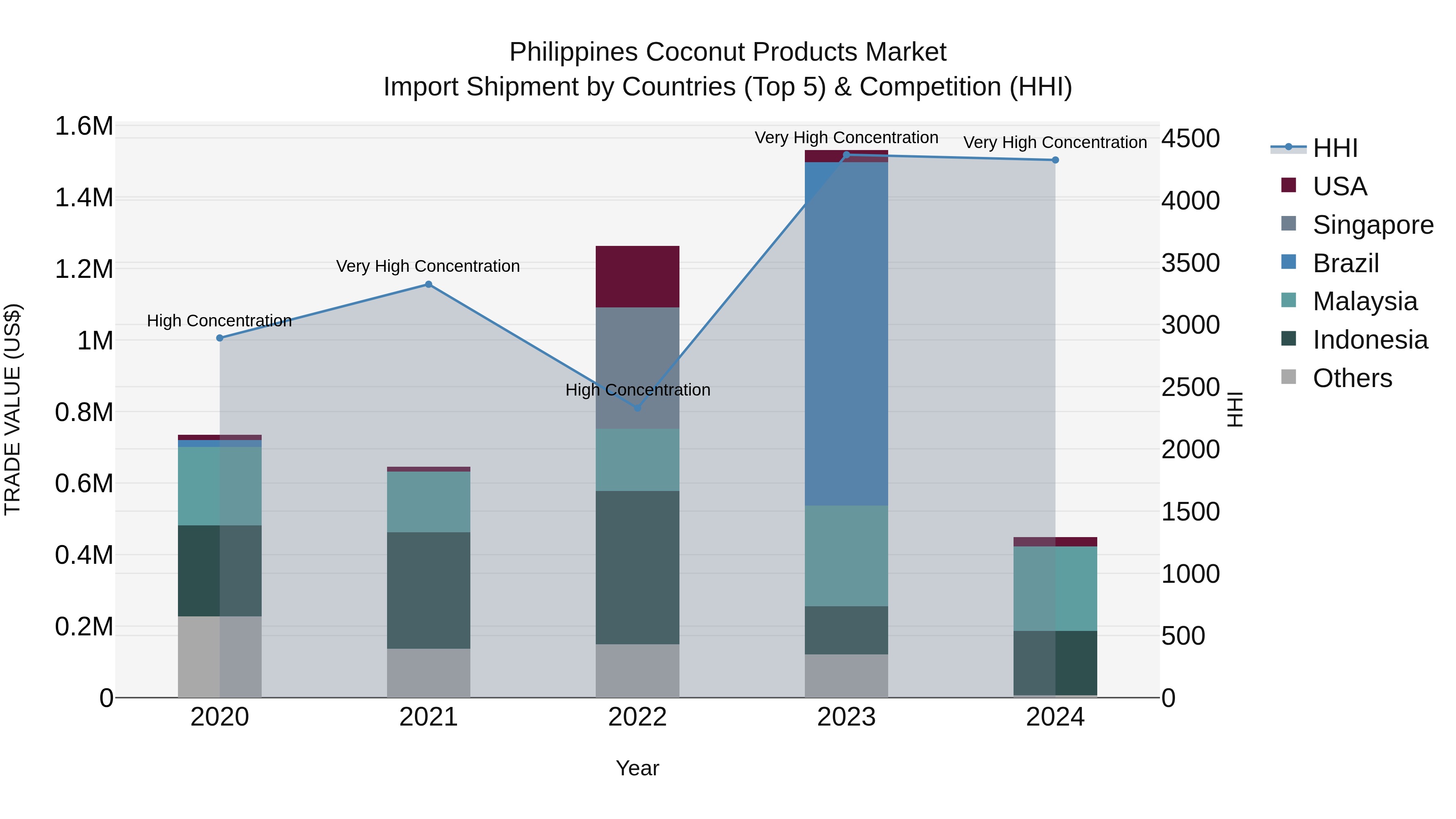
The Philippines coconut products import market in 2024 continued to see a high level of concentration with top exporters being Malaysia, Indonesia, USA, Germany, and Poland. Despite the challenging market conditions, the industry experienced a significant decline in both the compound annual growth rate (CAGR) at -11.59% from 2020 to 2024 and the growth rate from 2023 to 2024 at -70.66%. This indicates a tough year for coconut product imports in the Philippines, highlighting the need for strategic planning and adaptation to changing market dynamics.
Coconut Products Market: Philippines vs Top 5 Major Economies in 2027 (Asia)
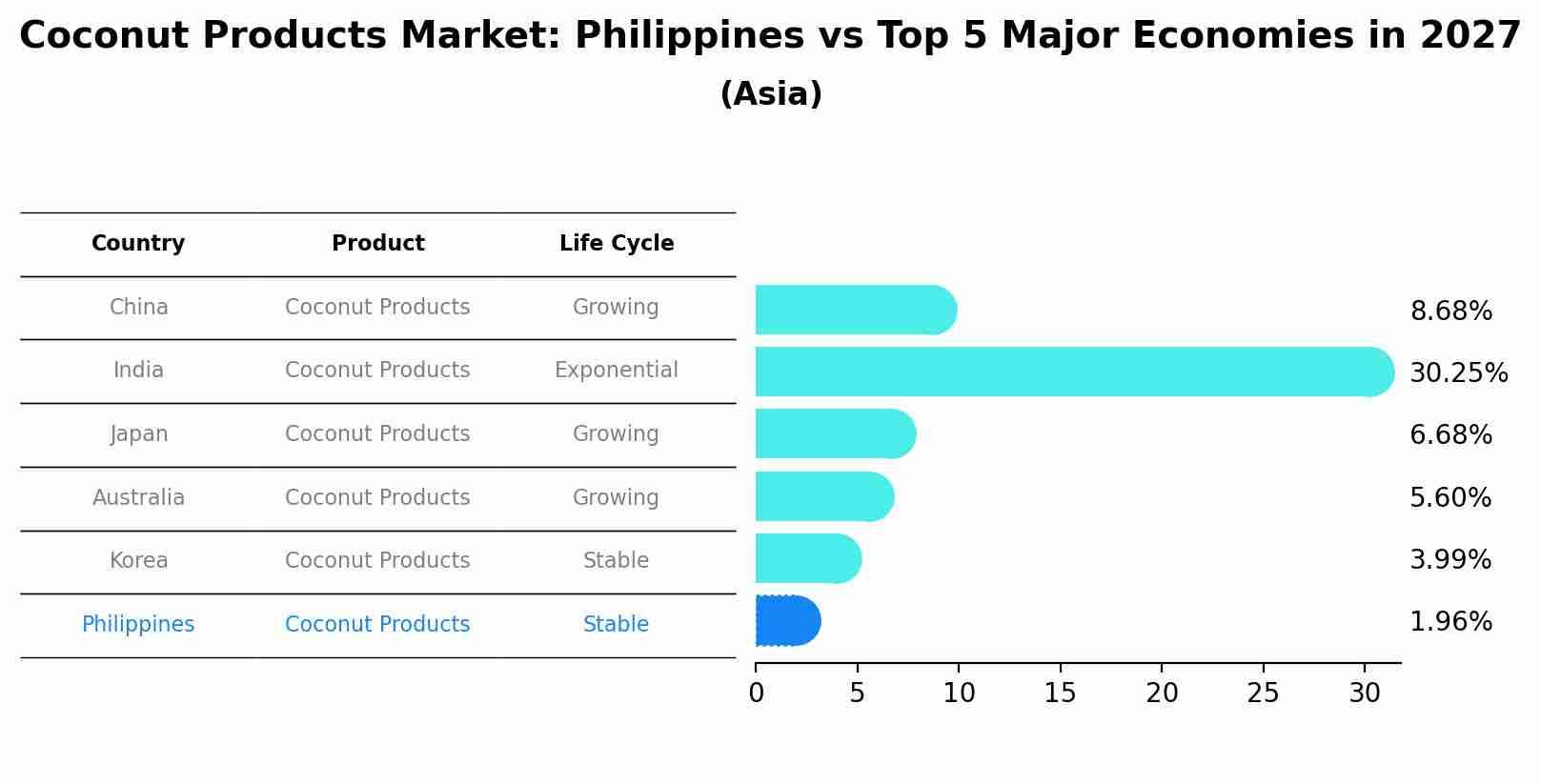
The Coconut Products market in Philippines is projected to grow at a stable growth rate of 1.96% by 2027, within the Asia region led by China, along with other countries like India, Japan, Australia and South Korea, collectively shaping a dynamic and evolving market environment driven by innovation and increasing adoption of emerging technologies.
Philippines Coconut Products Market Growth Rate
According to 6Wresearch internal database and industry insights, the Philippines Coconut Products Market is projected to grow at a compound annual growth rate (CAGR) of 8.5% during the forecast period from 2026 to 2032.
Topics Covered in the Philippines Coconut Products Market Report
The Philippines Coconut Products Market report thoroughly covers the market by type, form, and application. It provides a detailed and unbiased analysis of ongoing market trends, opportunities, challenges, and market drivers, helping stakeholders align strategies with current and future market dynamics.
Philippines Coconut Products Market Highlights
| Report Name | Philippines Coconut Products Market |
| Forecast Period | 2026–2032 |
| CAGR | 8.5% |
| Growing Sector | Agriculture and Food Processing |
Philippines Coconut Products Market Synopsis
The Philippines coconut products market growth has been steady across the country due to the country’s rich coconut resources. The widespread usage of coconut across various sectors, such as beauty, food, and health products, supports the market growth. Additionally, ongoing cumulative global demand for organic and natural products due to the rising awareness regarding health and environmental concerns also propels the market demand. Overall, the actively growing popularity of Coconut oil, milk, and other derivatives in both local and international markets drives the steady market expansion.
Evaluation of Growth Drivers in the Philippines Coconut Products Market
Below mentioned are some prominent drivers and their impact on the Philippines Coconut Products Market dynamics:
| Drivers | Primary Segment Affected | Why it Matters (Evidence) |
| Growing Health Consciousness | All Segments | Increasing awareness of the health benefits of coconut products, including their nutritional and functional properties, is driving demand. |
| A Rise in the Expansion of Applications in Cosmetics | Coconut Oil, Coconut Milk | The use of coconut oil and milk in skincare and cosmetic products is on the rise, backed by consumer's preference for natural and organic products. |
| Increasing Demand for Plant-Based Products | Coconut Water, Coconut Oil | Consumers increasingly see coconut products as natural and gluten-free alternatives. |
| Increased Global Exports | All Segments | As the Philippines remains one of the largest coconut producers, its export market for coconut products is rapidly growing, driving market growth. |
| Sustainability Trends | Coconut Oil, Coconut Water | The increasing focus on sustainability and eco-friendly products has result in higher demand for organic and responsibly sourced coconut-based products. |
The Philippines Coconut Products Market is projected to grow at a CAGR of 8.5% from 2026 to 2032. Several key drivers are driving the steady growth of the Philippines coconut products market. Key drivers such as consumers shifting preference for natural products and the increasing health awareness further support the robust growth of the market. Also, consumers seek healthier alternatives to synthetic ingredients, propelling demand for coconut products. The active growth of the personal care and food industry is also fueling the Philippines Coconut Products Market growth.
Evaluation of Restraints in the Philippines Coconut Products Market
Below mentioned are some major restraints and their influence on the Philippines Coconut Products Market dynamics:
| Restraints | Primary Segment Affected | What This Means (Evidence) |
| Fluctuations in Coconut Supply | All Segments | Variability in coconut production due to climate change, pests, or natural disasters can impact the supply chain and prices. |
| Price Sensitivity | All Segments | Premium coconut product prices can be prohibitively expensive for consumers, particularly those with lower incomes. |
| High Dependency on Global Markets | Coconut Water, Coconut Oil | Coconut Oil The coconut products market is heavily dependent on export markets, which makes it susceptible to global trade changes. |
| Limited Consumer Education in Rural Areas | Coconut Milk, Coconut Oil | There is a limited knowledge about the benefits of coconut-based products in rural areas, which can affect industry growth. |
| Regulatory Obstacles | All Segments | Strict rules in international markets regarding product quality can pose limitation to export growth. |
Philippines Coconut Products Market Challenges
The Philippines coconut products market faces several challenges even with the robust growth. The variation in coconut supply owing to weather and farming issues poses a major challenge to market growth. Additionally, Limited infrastructure and technology also remain the major concern impacting production efficiency. The rising competition from synthetic and cheaper alternatives poses hurdles. Issues such as logistics costs and price volatility also affect the profitability, creating difficulties for producers.
Philippines Coconut Products Market Trends
Several key trends are evolving the Philippines coconut products market. The rise in the demand for natural and organic products among health-conscious consumers is one major trends increasing the coconut product's demand. Also, ongoing innovations are boosting new product types such as coconut-based beauty items and snacks for consumers. Another key trend supporting the market growth is the rising adoption of eco-friendly and sustainable production methods. Moreover, Collaboration between processors, farmers, and brands is focusing on improving product quality and availability, supporting the market expansion.
Investment Opportunities in the Philippines Coconut Products Market
The Philippines Coconut Products Market offers significant investment opportunities for new investors, especially in the development and marketing of innovative, health oriented products such as organic and functional coconut water, coconut oil, and coconut milk that meet the growing consumer’s demand for natural and plant-based alternatives. There is an opportunity to expand distribution through e commerce platforms and modern retail networks to further reach both domestic and international consumers more effectively. Investments in value added and sustainable product lines, including flavored and fortified coconut beverages and eco friendly packaging solutions, are being made to attract environmentally conscious buyers.
Top 5 Leading Players in the Philippines Coconut Products Market
Below is the list of prominent companies leading the Philippines Coconut Products Market:
1. Peter Paul Philippine Corporation
| Company Name | Peter Paul Philippine Corporation |
|---|---|
| Established Year | 1984 |
| Headquarters | Quezon City, Philippines |
| Official Website | - |
Peter Paul Philippine Corporation is a leading producer and exporter of coconut products such as coconut milk, coconut cream, and coconut water. The company has built a strong reputation for its high-quality coconut-based products for both domestic and international markets.
2. Axelum Resources Corp
| Company Name | Axelum Resources Corp |
|---|---|
| Established Year | 1991 |
| Headquarters | Mandaluyong City, Philippines |
| Official Website | - |
Axelum Resources Corp is one of the Philippines' largest manufacturers of coconut products, including coconut water, coconut milk, and desiccated coconut.
3. Franklin Baker Company
| Company Name | Franklin Baker Company |
|---|---|
| Established Year | 1937 |
| Headquarters | General Santos City, Philippines |
| Official Website | Click Here |
Franklin Baker is a leading producer of coconut products such as coconut milk, coconut cream, and desiccated coconut. The company has been serving the local and international markets for over 80 years.
4. Primex Coco Products
| Company Name | Primex Coco Products |
|---|---|
| Established Year | 1999 |
| Headquarters | Quezon City, Philippines |
| Official Website | Click Here |
Primex Coco Products is a well-established supplier of high-quality coconut products, including coconut milk, coconut oil, and desiccated coconut.
5. Celebes Coconut Corporation
| Company Name | Celebes Coconut Corporation |
|---|---|
| Established Year | 1973 |
| Headquarters | Makati City, Philippines |
| Official Website | Click Here |
Celebes Coconut Corporation is a leading coconut exporter specializing in coconut milk, desiccated coconut, coconut water, and coconut oil. The company has a strong presence in the global market, offering premium quality coconut products that are recognized for their purity.
Government Regulations Introduced in the Philippines Coconut Products Market
According to Philippines government data, they have established various regulations to make sure the quality and safety of coconut products. The Coconut Industry Development Board (CIDB) is responsible for regulating the production and distribution of coconut products, which include making sure that products must meet specific health and safety standards. The Food and Drug Administration (FDA) enforces regulations regarding the labeling, packaging, and marketing of coconut-based products, requiring transparency about nutritional content and ingredient sourcing. Lastly, the government has introduced some specific guidelines for organic certification for coconut-based products, which allows businesses to capitalize on the growing consumer demand for organic products.
Future Insights of the Philippines Coconut Products Market
The Philippines coconut products market share is estimated to increase in the coming years on account of the rising global demand for natural and healthy products. Technology improvements in processing, improving product quality and variety are likely to fuel the market development. Along with this, increasing disposable incomes of middle class population and greater awareness of the nutritional benefits associated with coconut products will continue to fuel demand both domestically and in export markets.
Market Segmentation Analysis
The report offers a comprehensive study of the following market segments and their leading categories:
By Type – Coconut Water to Lead the Market
According to Harshita, Senior Research Analyst, 6Wresearch, Coconut Water is expected to lead the Philippines Coconut Products Market on account of its growing popularity as a healthy and hydrating beverage. Its natural and refreshing properties, along with increasing consumer demand for functional and plant-based drinks, contribute to its market dominance.
By Application – Food to Dominate the Market
The Food segment is anticipated to dominate the market on account of the wide usage of coconut products, such as coconut milk and oil, in a variety of traditional Filipino dishes and growing global demand for coconut-based ingredients in food products.
Key Attractiveness of the Report
- 10 Years of Market Numbers
- Historical Data Starting from 2022 to 2025
- Base Year: 2025
- Forecast Data until 2032
- Key Performance Indicators Impacting the Market
- Major Upcoming Developments and Projects
Key Highlights of the Report:
- Philippines Coconut Products Market Outlook
- Market Size of Philippines Coconut Products Market, 2025
- Forecast of Philippines Coconut Products Market, 2032
- Historical Data and Forecast of Philippines Coconut Products Revenues & Volume for the Period 2022-2032
- Philippines Coconut Products Market Trend Evolution
- Philippines Coconut Products Market Drivers and Challenges
- Philippines Coconut Products Price Trends
- Philippines Coconut Products Porter's Five Forces
- Philippines Coconut Products Industry Life Cycle
- Historical Data and Forecast of Philippines Coconut Products Market Revenues & Volume By Type for the Period 2022-2032
- Historical Data and Forecast of Philippines Coconut Products Market Revenues & Volume By Coconut Water for the Period 2022-2032
- Historical Data and Forecast of Philippines Coconut Products Market Revenues & Volume By Coconut Oil for the Period 2022-2032
- Historical Data and Forecast of Philippines Coconut Products Market Revenues & Volume By Coconut Milk for the Period 2022-2032
- Historical Data and Forecast of Philippines Coconut Products Market Revenues & Volume By Dried Coconut Products for the Period 2022-2032
- Historical Data and Forecast of Philippines Coconut Products Market Revenues & Volume By Others for the Period 2022-2032
- Historical Data and Forecast of Philippines Coconut Products Market Revenues & Volume By Application for the Period 2022-2032
- Historical Data and Forecast of Philippines Coconut Products Market Revenues & Volume By Food for the Period 2022-2032
- Historical Data and Forecast of Philippines Coconut Products Market Revenues & Volume By Beverage for the Period 2022-2032
- Historical Data and Forecast of Philippines Coconut Products Market Revenues & Volume By Cosmetics for the Period 2022-2032
- Historical Data and Forecast of Philippines Coconut Products Market Revenues & Volume By Others for the Period 2022-2032
- Historical Data and Forecast of Philippines Coconut Products Market Revenues & Volume By Form for the Period 2022-2032
- Historical Data and Forecast of Philippines Coconut Products Market Revenues & Volume By Solid for the Period 2022-2032
- Historical Data and Forecast of Philippines Coconut Products Market Revenues & Volume By Liquid for the Period 2022-2032
- Philippines Coconut Products Import Export Trade Statistics
- Market Opportunity Assessment By Type
- Market Opportunity Assessment By Application
- Market Opportunity Assessment By Form
- Philippines Coconut Products Top Companies Market Share
- Philippines Coconut Products Competitive Benchmarking By Technical and Operational Parameters
- Philippines Coconut Products Company Profiles
- Philippines Coconut Products Key Strategic Recommendations
Market Segmentation
The Market report covers a detailed analysis of the following market segments:
By Type
- Coconut Water
- Coconut Oil
- Coconut Milk
- Dried Coconut Products
By Application
- Food
- Beverage
- Cosmetics
By Form
- Solid
- Liquid






































