Philippines Computer Software Market Size, Share & Growth Rate
The Philippines Computer Software Market was estimated at USD 235 Million in 2025 and is projected to reach USD 327 Million by 2032, growing at a CAGR of 4.8% from 2026 to 2032. This promising trajectory is largely fueled by an accelerated digital transformation across sectors, alongside an increasing emphasis on cloud-based solutions. As businesses and governmental bodies continue to prioritize technology integration, demand for innovative software solutions will remain robust.
Philippines Computer Software Market Year-wise Growth Rate and Key Drivers
This graph highlights how the Philippines Computer Software Market has steadily grown over the years, supported by major growth factors.
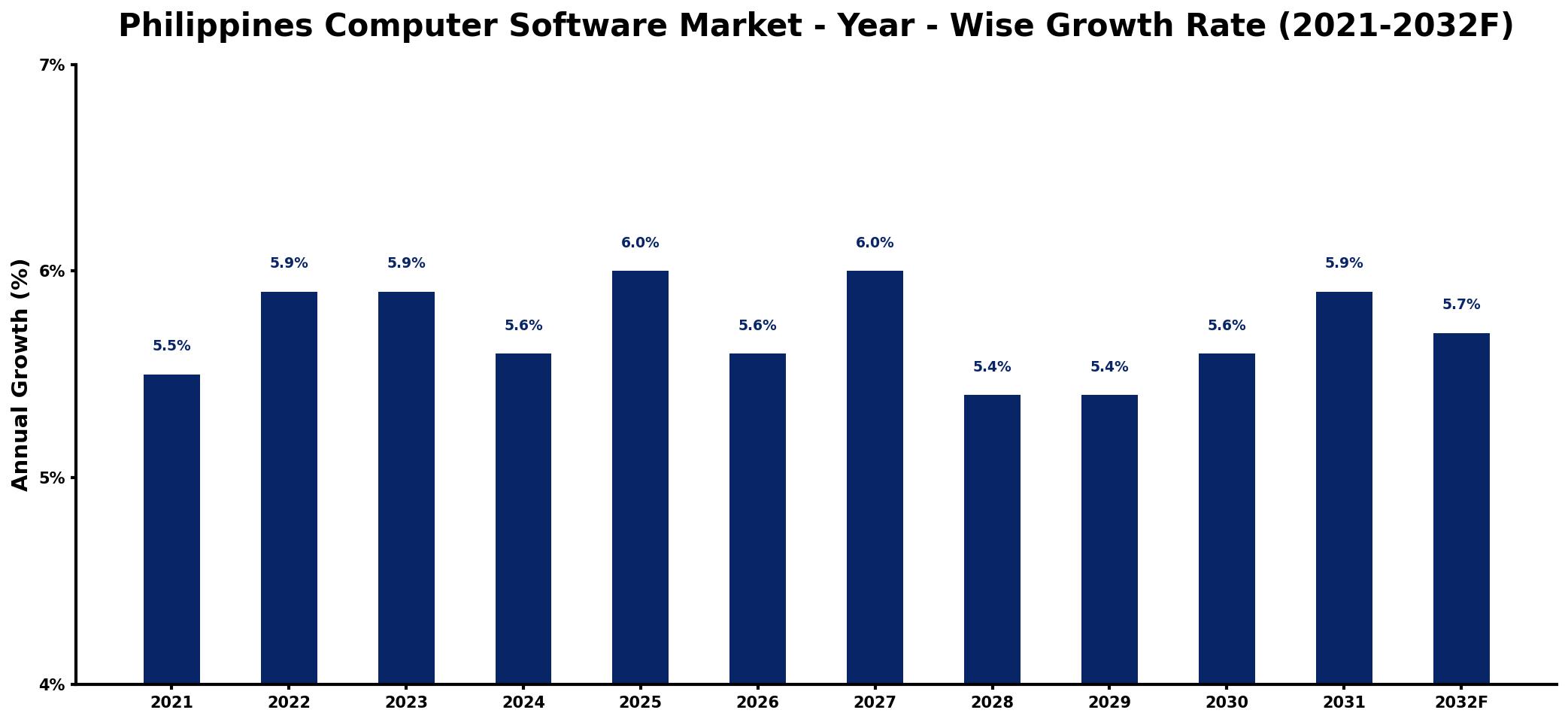
The table below presents the year‑wise growth rates along with the key drivers influencing the market
| Year | Growth Rate | Major Drivers |
| 2021 | 5.5% | Rise in digital transformation initiatives |
| 2022 | 5.9% | Increased adoption of cloud services |
| 2023 | 5.9% | Growing demand for remote solutions |
| 2024 | 5.6% | Expansion of e-commerce platforms |
| 2025 | 6.0% | Investment in cybersecurity technologies |
| 2026 | 5.6% | Surge in mobile application development |
| 2027 | 6.0% | Adoption of artificial intelligence tools |
| 2028 | 5.4% | Growth in data analytics services |
| 2029 | 5.4% | Increased focus on automation solutions |
| 2030 | 5.6% | expanding industrial usage applications |
| 2031 | 5.9% | Demand for collaborative work environments |
| 2032 | 5.7% | expanding manufacturing base activity |
Note: Market size estimations and growth projections presented in this report are based on 6Wresearch's proprietary forecasting methodology, utilizing the latest available industry data, government publications, and primary research inputs.
Philippines Computer Software Market Synopsis
The growing reliance on cloud services is reshaping the Philippines Computer Software Market. Businesses are increasingly adopting Software-as-a-Service (SaaS) models, enabling them to streamline operations and enhance customer engagement while minimizing upfront costs. Moreover, educational institutions are harnessing software tools to facilitate online learning, reflecting a broader trend towards digital education.
As digitalization penetrates various sectors, from healthcare to government services, there is a marked increase in the demand for custom software solutions that cater to local needs. Government initiatives aimed at promoting open-source technologies further bolster this demand, positioning the Philippines as a pivotal player in Southeast Asia's software landscape.
Philippines Computer Software Market Key Takeaways
- The market is anticipated to see significant growth, reaching USD 327 Million by 2032.
- A robust shift towards cloud-based services and SaaS models is evident among businesses and institutions.
- Government investments in open-source technology are driving software innovation.
- Increased digitalization in sectors like education and healthcare is creating new demand for tailored software solutions.
- Challenges such as software piracy and localization requirements remain ongoing concerns for market players.
Evaluation of Restraints in Philippines Computer Software Market
While the Philippines Computer Software Market demonstrates significant potential, several restraints hinder its progress. Software piracy remains a critical issue, affecting revenues and undermining the efforts of legitimate software developers. Furthermore, the challenge of ensuring software localization—making products user-friendly for the diverse linguistic landscape—poses logistical hurdles. Companies often find it demanding to align their offerings with local regulatory standards, thus complicating market entry and sustainability.
Philippines Computer Software Market Trends
Current trends indicate a profound shift towards artificial intelligence (AI) integration within software solutions, aiming to enhance operational efficiency and customer satisfaction. The expansion of fintech solutions also signifies a growing need for software that supports secure financial transactions. Moreover, the surge in remote work due to the pandemic has entrenched the use of collaborative software tools, creating a lasting impact on how organizations approach productivity.
Philippines Computer Software Market Opportunities
Significant growth opportunities lie in the development of niche software solutions tailored for specific industries, such as healthcare and education. With increasing government support for digital initiatives, companies that can innovate with open-source platforms are well-positioned to thrive. Additionally, as cloud adoption becomes more widespread, opportunities for robust cybersecurity software to protect sensitive data present a further avenue for investment and expansion.
Government Initiatives in the Philippines Computer Software Market
The Philippine government has launched several initiatives aimed at boosting the technology sector, including support for software startups and investments in ICT infrastructure. Programs that encourage the use of open-source technology are designed to enhance the competitiveness of local developers. Furthermore, public spending on technology and digital services has seen a noticeable increase, aiming to drive innovation and improve public service delivery.
Future Insights of the Philippines Computer Software Market
Looking ahead to 2026-2032, the Philippines Computer Software Market is set for transformative growth. The emphasis on sustainable digital solutions will steer demand towards environmentally friendly software practices. Additionally, emerging technologies like machine learning and blockchain are poised to reshape existing paradigms, opening new avenues for innovation and attracting foreign investment. Continuous evolution in consumer behavior will compel companies to stay agile and responsive to market dynamics.
Philippines Computer Software Market Latest Developments (2025 - 2026)
Recent industry developments indicate a surge in software partnerships among local and international companies, emphasizing collaborative innovation. The shift to remote work has led to an increase in the integration of virtual collaboration tools, enhancing productivity across various sectors. Moreover, educational institutions are increasingly adopting e-learning platforms to facilitate remote education, reflecting a sustained demand for tailored software solutions.
Philippines Computer Software Market - Key Attractiveness of the Report
- 10 Years of Market Numbers
- Historical Data Starting from 2022 to 2025
- Base Year: 2025
- Forecast Data until 2032
- Key Performance Indicators Impacting the Market
- Major Upcoming Developments and Projects
Key Highlights of the Report:
- Philippines Computer Software Market Outlook
- Market Size of Philippines Computer Software Market, 2025
- Forecast of Philippines Computer Software Market, 2032
- Historical Data and Forecast of Philippines Computer Software Revenues & Volume for the Period 2022-2032F
- Philippines Computer Software Market Trend Evolution
- Philippines Computer Software Market Drivers and Challenges
- Philippines Computer Software Price Trends
- Philippines Computer Software Porter's Five Forces
- Philippines Computer Software Industry Life Cycle
- Historical Data and Forecast of Philippines Computer Software Market Revenues & Volume By Type for the Period 2022-2032F
- Historical Data and Forecast of Philippines Computer Software Market Revenues & Volume By Operating Systems & Productivity Software Publishing for the Period 2022-2032F
- Historical Data and Forecast of Philippines Computer Software Market Revenues & Volume By Database, Storage & Backup Software Publishing for the Period 2022-2032F
- Historical Data and Forecast of Philippines Computer Software Market Revenues & Volume By Business Analytics & Enterprise Software for the Period 2022-2032F
- Historical Data and Forecast of Philippines Computer Software Market Revenues & Volume By Video Game Software for the Period 2022-2032F
- Historical Data and Forecast of Philippines Computer Software Market Revenues & Volume By Design for the Period 2022-2032F
- Historical Data and Forecast of Philippines Computer Software Market Revenues & Volume By Editing & Rendering Software for the Period 2022-2032F
- Historical Data and Forecast of Philippines Computer Software Market Revenues & Volume By Application for the Period 2022-2032F
- Historical Data and Forecast of Philippines Computer Software Market Revenues & Volume By Personal for the Period 2022-2032F
- Historical Data and Forecast of Philippines Computer Software Market Revenues & Volume By Business/Commercial for the Period 2022-2032F
- Historical Data and Forecast of Philippines Computer Software Market Revenues & Volume By Industrial for the Period 2022-2032F
- Historical Data and Forecast of Philippines Computer Software Market Revenues & Volume By Industry Verticals for the Period 2022-2032F
- Historical Data and Forecast of Philippines Computer Software Market Revenues & Volume By BFSI for the Period 2022-2032F
- Historical Data and Forecast of Philippines Computer Software Market Revenues & Volume By Media & Entertainment for the Period 2022-2032F
- Historical Data and Forecast of Philippines Computer Software Market Revenues & Volume By IT & Telecommunications for the Period 2022-2032F
- Historical Data and Forecast of Philippines Computer Software Market Revenues & Volume By Energy & Utilities for the Period 2022-2032F
- Historical Data and Forecast of Philippines Computer Software Market Revenues & Volume By Government & Public Sector for the Period 2022-2032F
- Historical Data and Forecast of Philippines Computer Software Market Revenues & Volume By Retail & Consumer Goods for the Period 2022-2032F
- Historical Data and Forecast of Philippines Computer Software Market Revenues & Volume By Manufacturing for the Period 2022-2032F
- Historical Data and Forecast of Philippines Computer Software Market Revenues & Volume By Others for the Period 2022-2032F
- Philippines Computer Software Import Export Trade Statistics
- Market Opportunity Assessment By Type
- Market Opportunity Assessment By Application
- Market Opportunity Assessment By Industry Verticals
- Philippines Computer Software Top Companies Market Share
- Philippines Computer Software Competitive Benchmarking By Technical and Operational Parameters
- Philippines Computer Software Company Profiles
- Philippines Computer Software Key Strategic Recommendations






































