Philippines Construction Sand And Gravel Market (2026-2032) | Outlook , Size, Analysis, Share, Industry, Growth, Revenue, Trends, Companies, Value & Forecast
Market Forecast By Product Type (Natural Sand, Synthetic Sand), By End Users (Foundry, Construction, Ceramics and Refractories, Glass Manufacturing) And Competitive Landscape
| Product Code: ETC320249 | Publication Date: Aug 2022 | Updated Date: Mar 2026 | Product Type: Market Research Report | |
| Publisher: 6Wresearch | Author: Ravi Bhandari | No. of Pages: 75 | No. of Figures: 35 | No. of Tables: 20 |
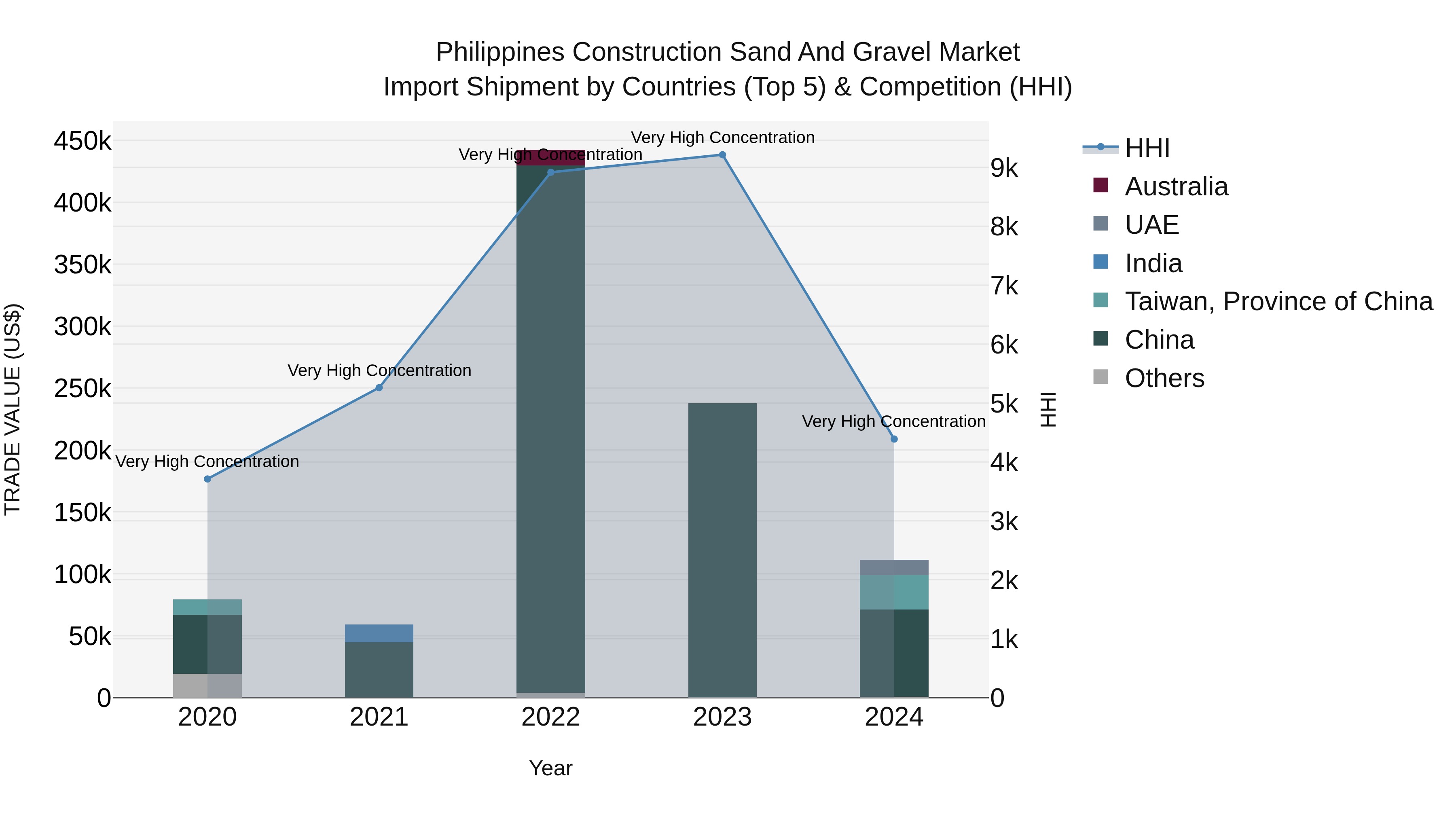
Philippines Construction Sand And Gravel Market Top 5 Importing Countries and Market Competition (HHI) Analysis
Despite a high concentration of import shipments in the Philippines construction sand and gravel market in 2024, the top exporting countries such as China, Taiwan, UAE, Spain, and the USA continue to play a significant role. The impressive 8.92% CAGR from 2020 to 2024 indicates a steady growth trajectory, although the sudden -53.12% growth rate in 2024 may require further analysis. The market dynamics and trade relationships between these key exporting countries and the Philippines are crucial factors to monitor for potential shifts in the industry landscape.
Philippines Construction Sand and Gravel Market Growth Rate
According to 6Wresearch internal database and industry insights, the Philippines Construction Sand and Gravel Market is projected to grow at a compound annual growth rate (CAGR) of 6.9% during the forecast period from 2026 to 2032.
Topics Covered in the Philippines Construction Sand and Gravel Market Report
The Philippines Construction Sand and Gravel Market report thoroughly covers the market by product type and end users. It provides a detailed and unbiased analysis of ongoing market trends, opportunities, challenges, and market drivers, helping stakeholders align strategies with current and future market dynamics.
Philippines Construction Sand and Gravel Market Highlights
| Report Name | Philippines Construction Sand and Gravel Market |
| Forecast Period | 2026–2032 |
| CAGR | 6.9% |
| Growing Sector | Construction & Infrastructure |
Philippines Construction Sand and Gravel Market Synopsis
The Philippines Construction Sand and Gravel Market has experienced steady growth, supported by increasing urbanization, government infrastructure projects, and the booming construction sector. The market is experiencing a surge due to a rising demand for both natural sand for general construction activities and synthetic sand for specialized applications in high-end projects. Also, demand from various industries such as foundry, ceramics, refractories, and glass manufacturing is also contributing to market expansion.
Evaluation of Growth Drivers in the Philippines Construction Sand and Gravel Market
Below mentioned are some prominent drivers and their impact on the Philippines Construction Sand and Gravel Market dynamics:
| Drivers | Primary Segment Affected | Why It Matters (Evidence) |
| Urbanization and Infrastructure Growth | By End Users (Construction) | Increased demand for residential, commercial, and industrial buildings is driving the consumption of sand and gravel. |
| Government Investment in Infrastructure | By End Users (Foundry, Construction) | National infrastructure projects like roads, bridges, and public facilities fuel demand for construction materials. |
| Demand for Specialized Sand in High-End Applications | By Product Type (Synthetic Sand) | Growing demand for synthetic sand in specialized construction and glass manufacturing sectors is boosting its market share. |
| Growth in Industrial Production | By End Users (Glass Manufacturing, Ceramics and Refractories) | The demand for sand and gravel in the production of ceramics, refractories, and glass is increasing due to industrial growth. |
| Real Estate Development | By End Users (Construction) | Rapid growth in residential and commercial real estate developments is contributing to market growth. |
The Philippines Construction Sand and Gravel Market is projected to grow at a CAGR of 6.9% from 2026 to 2032. As it is driven by rapid urbanization, the expansion of infrastructure projects, and the rising demand for high-quality sand products for both traditional construction and specialized industrial uses. The growing construction demand in both urban and rural areas, along with investments from the government, will continue to support this Philippines Construction Sand and Gravel Market growth.
Restraints in the Philippines Construction Sand and Gravel Market
Below mentioned are some major restraints and their influence on the Philippines Construction Sand and Gravel Market dynamics:
| Restraints | Primary Segment Affected | What This Means (Evidence) |
| Environmental and Regulatory Challenges | By Product Type (Natural Sand, Synthetic Sand) | Restrictions on sand mining to prevent environmental degradation may limit supply of natural sand. |
| High Raw Material Costs | By Product Type (Synthetic Sand, Natural Sand) | The increasing cost of extracting and processing raw materials can increase product pricing, impacting affordability. |
| Limited Local Supply in Remote Areas | By End Users (Construction) | There are supply chain inefficiencies and lack of local availability in certain areas, which can hinder market access, especially in rural regions. |
| Competition from Imported Products | By Product Type (Synthetic Sand) | Imported synthetic sand can be cheaper, presenting competition to locally produced sand and gravel. |
Challenges in the Philippines Construction Sand and Gravel Market
In spite of the positive growth, the market faces numbers of obstacles. Resource depletion of natural sand and gravel is a critical issue, as unregulated extraction from rivers and seabeds has result in environmental degradation. Besides that, instable changes in raw material costs and transportation expenses affect market stability. Another challenge comes from increasing competition among local and imported substitutes, particularly in coastal areas where marine sand is available. Addressing these challenges requires sustainable practices and regulatory accountability.
Philippines Construction Sand And Gravel Market Trends
Several ongoing trends shape the growth of the market. The rising use of eco-friendly and sustainable approaches to reclamation, such as making use of recycled aggregates, and the gradually emergence of recorded alternatives to natural aggregates, like synthetic sand is growing in popularity. The rise of smart manufacturing processes and integrating new technology to monitor production and environmental impact is also gaining access. Additionally, interest in producing ultra-fine sand for purposes such as glass manufacturing and electronics, creates a new playing field for market participants. Moreover, the use of Artificial Intelligence (AI) to aid in extraction and processing will likely help to further optimize the industry.
Investment Opportunities in the Philippines Construction Sand And Gravel Market
There are several opportunities to invest into the Philippines Construction Sand And Gravel industry, especially in the alternatives in sustainable extraction processes, synthetic sand manufacture and recycling plants. Any investment into new technology aimed at being more cost-effective and productive exhibiting respect for environmental regulations is worth developing. Investors could also examine avenues such as supply chain integration with existing local suppliers to improve networks for distribution in local rural markets that are perhaps less depleted by infrastructure investments. Government support for foreign investors, particularly for infrastructure development means it is encouraging players both domestic and international.
Top 5 Leading Players in the Philippines Construction Sand and Gravel Market
Below is the list of prominent companies leading the Philippines Construction Sand and Gravel Market:
1. Holcim Philippines, Inc.
| Company Name | Holcim Philippines, Inc. |
|---|---|
| Established Year | 1974 |
| Headquarters | Makati, Philippines |
| Official Website | Click Here |
Holcim Philippines is one of the largest producers of construction materials, including sand and gravel for residential, commercial, and infrastructure projects.
2. Cemex Holdings Philippines, Inc.
| Company Name | Cemex Holdings Philippines, Inc. |
|---|---|
| Established Year | 1999 |
| Headquarters | Manila, Philippines |
| Official Website | - |
Cemex is a key player in the Philippines construction sector, providing aggregates like sand and gravel for use in various building applications.
3. Republic Cement & Building Materials, Inc.
| Company Name | Republic Cement & Building Materials, Inc. |
|---|---|
| Established Year | 1955 |
| Headquarters | Pasig City, Philippines |
| Official Website | Click Here |
Republic Cement is a major supplier of building materials, including sand and gravel, used in large-scale infrastructure and construction projects.
4. Vulcan Materials Company
| Company Name | Vulcan Materials Company |
|---|---|
| Established Year | 1981 |
| Headquarters | Quezon City, Philippines |
| Official Website | Click Here |
Vulcan Materials is a leading construction materials supplier with a strong presence in sand and gravel production for construction projects across the Philippines.
5. Metro Builders Supply, Inc.
| Company Name | Metro Builders Supply, Inc. |
|---|---|
| Established Year | 1990 |
| Headquarters | Manila, Philippines |
| Official Website | - |
Metro Builders Supply offers a range of construction materials, including sand and gravel, catering to residential, commercial, and industrial sectors.
Government Regulations Introduced in the Philippines Construction Sand and Gravel Market
As per the Philippine government data, the Philippine government has been active in implementing regulations aimed at curbing the environmental consequences of sand and gravel extraction. To that end, the Department of Environment and Natural Resources (DENR) requires the issuance of mining permits and an Environmental Impact Assessment (EIA) prior to extraction. Moreover, the Government is creating best practices in sustainable mining with initiatives like "Minahang Bayan," which regulates both small- and large-scale operations. The first plan for the nation's National Greening Program, which requires reforestation of degraded extraction areas, is another prime example of government initiatives balancing the drive for growth with the importance of protecting the environment.
Future Insights of the Philippines Construction Sand and Gravel Market
In terms of future growth, the market is expected to see a greater acceptance of synthetic sand, owing to its consistency, reliability and lower environmental impact. With future infrastructure projects such as New Clark City, and the integration of technology into construction methodologies, demand for high-grade sand and gravel will increase. Additionally, recycling of construction materials, and collaboration between public- and private-sectors, will affect future market developments.
Market Segmentation Analysis
The report offers a comprehensive study of the following market segments and their leading categories:
By Product Type – Natural Sand to Lead the Market
According to Harshita, Senior Research Analyst, 6Wresearch, Natural sand leads the Philippines Construction Sand and Gravel Market due to its wide availability and lower processing costs compared to synthetic sand. It is extensively used in the construction industry for applications such as concrete production, road base materials, and land reclamation projects.
By End Users – Construction to Lead the Market
In terms of end users, Construction is likely to increase the market size on account of ongoing demand for sand and gravel in both residential and large-scale infrastructure projects.
Key Attractiveness of the Report
- 10 Years of Market Numbers
- Historical Data Starting from 2022 to 2025
- Base Year: 2025
- Forecast Data until 2032
- Key Performance Indicators Impacting the Market
- Major Upcoming Developments and Projects
Key Highlights of the Report:
- Philippines Construction Sand And Gravel Market Outlook
- Market Size of Philippines Construction Sand And Gravel Market, 2025
- Forecast of Philippines Construction Sand And Gravel Market, 2032
- Historical Data and Forecast of Philippines Construction Sand And Gravel Revenues & Volume for the Period 2022-2032
- Philippines Construction Sand And Gravel Market Trend Evolution
- Philippines Construction Sand And Gravel Market Drivers and Challenges
- Philippines Construction Sand And Gravel Price Trends
- Philippines Construction Sand And Gravel Porter's Five Forces
- Philippines Construction Sand And Gravel Industry Life Cycle
- Historical Data and Forecast of Philippines Construction Sand And Gravel Market Revenues & Volume By Product Type for the Period 2022-2032
- Historical Data and Forecast of Philippines Construction Sand And Gravel Market Revenues & Volume By Natural Sand for the Period 2022-2032
- Historical Data and Forecast of Philippines Construction Sand And Gravel Market Revenues & Volume By Synthetic Sand for the Period 2022-2032
- Historical Data and Forecast of Philippines Construction Sand And Gravel Market Revenues & Volume By End Users for the Period 2022-2032
- Historical Data and Forecast of Philippines Construction Sand And Gravel Market Revenues & Volume By Foundry for the Period 2022-2032
- Historical Data and Forecast of Philippines Construction Sand And Gravel Market Revenues & Volume By Construction for the Period 2022-2032
- Historical Data and Forecast of Philippines Construction Sand And Gravel Market Revenues & Volume By Ceramics and Refractories for the Period 2022-2032
- Historical Data and Forecast of Philippines Construction Sand And Gravel Market Revenues & Volume By Glass Manufacturing for the Period 2022-2032
- Philippines Construction Sand And Gravel Import Export Trade Statistics
- Market Opportunity Assessment By Product Type
- Market Opportunity Assessment By End Users
- Philippines Construction Sand And Gravel Top Companies Market Share
- Philippines Construction Sand And Gravel Competitive Benchmarking By Technical and Operational Parameters
- Philippines Construction Sand And Gravel Company Profiles
- Philippines Construction Sand And Gravel Key Strategic Recommendations
Market Covered
The Market report covers a detailed analysis of the following market segments:
By Product Type
- Natural Sand
- Synthetic Sand
By End Users
- Foundry
- Construction
- Ceramics and Refractories
- Glass Manufacturing
Philippines Construction Sand And Gravel Market (2026-2032): FAQs
The Philippines Construction Sand and Gravel Market is expected to grow at a compound annual growth rate of 6.9% during the forecast period.
Regulatory guidelines by DENR ensure that sand and gravel extraction follows sustainable and environmentally safe practices.
Urbanization, infrastructure projects, and rising demand for synthetic sand are key drivers of the market.
Challenges include environmental regulations, high raw material costs, and competition from imported sand products.
6Wresearch actively monitors the Philippines Construction Sand And Gravel Market and publishes its comprehensive annual report, highlighting emerging trends, growth drivers, revenue analysis, and forecast outlook. Our insights help businesses to make data-backed strategic decisions with ongoing market dynamics. Our analysts track relevent industries related to the Philippines Construction Sand And Gravel Market, allowing our clients with actionable intelligence and reliable forecasts tailored to emerging regional needs.
Yes, we provide customisation as per your requirements. To learn more, feel free to contact us on sales@6wresearch.com
| 1 Executive Summary |
| 2 Introduction |
| 2.1 Key Highlights of the Report |
| 2.2 Report Description |
| 2.3 Market Scope & Segmentation |
| 2.4 Research Methodology |
| 2.5 Assumptions |
| 3 Philippines Construction Sand And Gravel Market Overview |
| 3.1 Philippines Country Macro Economic Indicators |
| 3.2 Philippines Construction Sand And Gravel Market Revenues & Volume, 2022 & 2032F |
| 3.3 Philippines Construction Sand And Gravel Market - Industry Life Cycle |
| 3.4 Philippines Construction Sand And Gravel Market - Porter's Five Forces |
| 3.5 Philippines Construction Sand And Gravel Market Revenues & Volume Share, By Product Type, 2022 & 2032F |
| 3.6 Philippines Construction Sand And Gravel Market Revenues & Volume Share, By End Users, 2022 & 2032F |
| 4 Philippines Construction Sand And Gravel Market Dynamics |
| 4.1 Impact Analysis |
| 4.2 Market Drivers |
| 4.2.1 Increasing demand for infrastructure development projects in the Philippines |
| 4.2.2 Growing construction industry in the country |
| 4.2.3 Government initiatives and investments in infrastructure projects |
| 4.2.4 Urbanization and population growth leading to higher demand for residential and commercial construction |
| 4.2.5 Technological advancements in the extraction and processing of sand and gravel |
| 4.3 Market Restraints |
| 4.3.1 Environmental regulations impacting the extraction of sand and gravel |
| 4.3.2 Fluctuating prices of raw materials and transportation costs |
| 4.3.3 Competition from alternative construction materials |
| 4.3.4 Challenges in obtaining permits for extraction sites |
| 4.3.5 Seasonal variations affecting the supply of sand and gravel |
| 5 Philippines Construction Sand And Gravel Market Trends |
| 6 Philippines Construction Sand And Gravel Market, By Types |
| 6.1 Philippines Construction Sand And Gravel Market, By Product Type |
| 6.1.1 Overview and Analysis |
| 6.1.2 Philippines Construction Sand And Gravel Market Revenues & Volume, By Product Type, 2022-2032F |
| 6.1.3 Philippines Construction Sand And Gravel Market Revenues & Volume, By Natural Sand, 2022-2032F |
| 6.1.4 Philippines Construction Sand And Gravel Market Revenues & Volume, By Synthetic Sand, 2022-2032F |
| 6.2 Philippines Construction Sand And Gravel Market, By End Users |
| 6.2.1 Overview and Analysis |
| 6.2.2 Philippines Construction Sand And Gravel Market Revenues & Volume, By Foundry, 2022-2032F |
| 6.2.3 Philippines Construction Sand And Gravel Market Revenues & Volume, By Construction, 2022-2032F |
| 6.2.4 Philippines Construction Sand And Gravel Market Revenues & Volume, By Ceramics and Refractories, 2022-2032F |
| 6.2.5 Philippines Construction Sand And Gravel Market Revenues & Volume, By Glass Manufacturing, 2022-2032F |
| 7 Philippines Construction Sand And Gravel Market Import-Export Trade Statistics |
| 7.1 Philippines Construction Sand And Gravel Market Export to Major Countries |
| 7.2 Philippines Construction Sand And Gravel Market Imports from Major Countries |
| 8 Philippines Construction Sand And Gravel Market Key Performance Indicators |
| 8.1 Environmental sustainability metrics related to extraction and processing practices |
| 8.2 Efficiency of supply chain management |
| 8.3 Percentage of recycled materials used in construction projects |
| 8.4 Adoption rate of innovative technologies in extraction and processing |
| 8.5 Customer satisfaction and project completion timelines |
| 9 Philippines Construction Sand And Gravel Market - Opportunity Assessment |
| 9.1 Philippines Construction Sand And Gravel Market Opportunity Assessment, By Product Type, 2022 & 2032F |
| 9.2 Philippines Construction Sand And Gravel Market Opportunity Assessment, By End Users, 2022 & 2032F |
| 10 Philippines Construction Sand And Gravel Market - Competitive Landscape |
| 10.1 Philippines Construction Sand And Gravel Market Revenue Share, By Companies, 2025 |
| 10.2 Philippines Construction Sand And Gravel Market Competitive Benchmarking, By Operating and Technical Parameters |
| 11 Company Profiles |
| 12 Recommendations |
| 13 Disclaimer |
Global Go To Market Strategy - 2030
Export potential enables firms to identify high-growth global markets with greater confidence by combining advanced trade intelligence with a structured quantitative methodology. The framework analyzes emerging demand trends and country-level import patterns while integrating macroeconomic and trade datasets such as GDP and population forecasts, bilateral import–export flows, tariff structures, elasticity differentials between developed and developing economies, geographic distance, and import demand projections. Using weighted trade values from 2020–2024 as the base period to project country-to-country export potential for 2030, these inputs are operationalized through calculated drivers such as gravity model parameters, tariff impact factors, and projected GDP per-capita growth. Through an analysis of hidden potentials, demand hotspots, and market conditions that are most favorable to success, this method enables firms to focus on target countries, maximize returns, and global expansion with data, backed by accuracy.
By factoring in the projected importer demand gap that is currently unmet and could be potential opportunity, it identifies the potential for the Exporter (Country) among 190 countries, against the general trade analysis, which identifies the biggest importer or exporter.
To discover high-growth global markets and optimize your business strategy:
Click Here
Pricing
- Single User License$ 1,995
- Department License$ 2,400
- Site License$ 3,120
- Global License$ 3,795

Leadership Perspectives from Industry Events
Search
Thought Leadership and Analyst Meet





Our Clients








6WResearch In News
- India Air Conditioner Market Set for Strong Rebound in 2026 After Weather-Led Correction and GST-Driven Recovery: 6Wresearch
- ADAS in India: How Automatic Emergency Braking, Blind Spot Detection & Driver Monitoring are Transforming Road Safety
- Doha a strategic location for EV manufacturing hub: IPA Qatar
- Demand for luxury TVs surging in the GCC, says Samsung
- Empowering Growth: The Thriving Journey of Bangladesh’s Cable Industry
- Demand for luxury TVs surging in the GCC, says Samsung
Latest Reports
- Nicaragua RPG Gaming Market (2026-2032)
- New Zealand RPG Gaming Market (2026-2032)
- Netherlands RPG Gaming Market (2026-2032)
- Nauru RPG Gaming Market (2026-2032)
- Namibia RPG Gaming Market (2026-2032)
- Mozambique RPG Gaming Market (2026-2032)
- Montenegro RPG Gaming Market (2026-2032)
- Mongolia RPG Gaming Market (2026-2032)
- Monaco RPG Gaming Market (2026-2032)
- Micronesia RPG Gaming Market (2026-2032)
Industry Events and Analyst Meet

EV India Expo 2026

HIMTEX 2026

India Refining Summit 2026

India EV Show 2026

EV tech India Expo 2026
Whitepaper
- Middle East & Africa Commercial Security Market Click here to view more.
- Middle East & Africa Fire Safety Systems & Equipment Market Click here to view more.
- GCC Drone Market Click here to view more.
- Middle East Lighting Fixture Market Click here to view more.
- GCC Physical & Perimeter Security Market Click here to view more.


