Philippines Conveyors Systems Market Size, Share & Growth Rate
The Philippines Conveyors Systems Market was estimated at USD 438 Million in 2025 and is projected to reach USD 575 Million by 2032, growing at a CAGR of 4.0% from 2026 to 2032. This upward trajectory is largely fueled by the growing manufacturing and logistics sectors, alongside the increasing demand for automation within these industries. As companies seek to streamline operations and enhance productivity, conveyor systems are becoming indispensable for efficient material handling.
Philippines Conveyors Systems Market Year-wise Growth Rate and Key Drivers
This graph highlights how the Philippines Conveyors Systems Market has steadily grown over the years, supported by major growth factors.
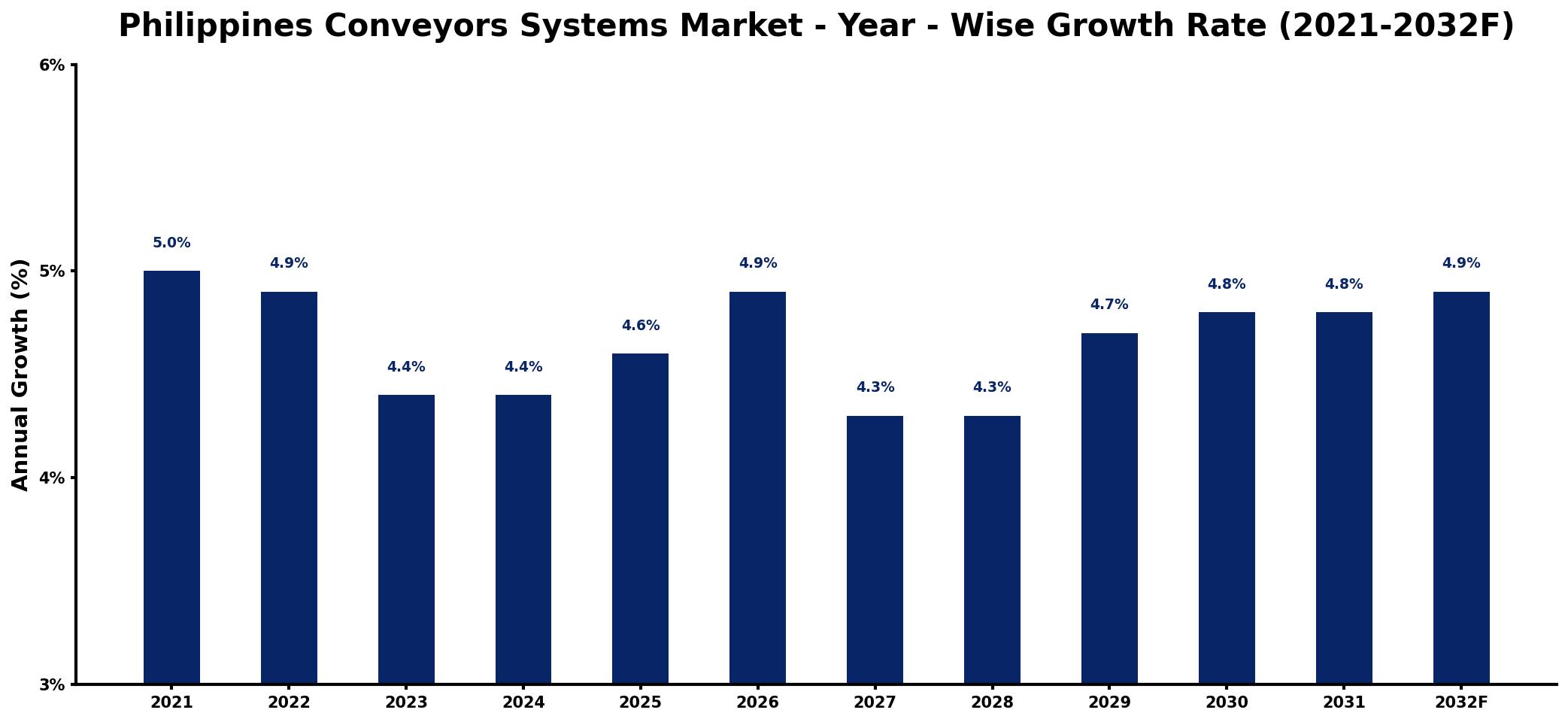
The table below presents the year‑wise growth rates along with the key drivers influencing the market
| Year | Growth Rate | Major Drivers |
| 2021 | 5.0% | Rising demand in manufacturing sector |
| 2022 | 4.9% | Expansion in logistics infrastructure projects |
| 2023 | 4.4% | Increased automation in warehouses |
| 2024 | 4.4% | Growth in retail distribution networks |
| 2025 | 4.6% | Surge in e-commerce activities |
| 2026 | 4.9% | Investment in food processing industry |
| 2027 | 4.3% | Development of smart factories |
| 2028 | 4.3% | Enhancement of supply chain efficiency |
| 2029 | 4.7% | Focus on sustainable practices adoption |
| 2030 | 4.8% | growing regional consumption patterns |
| 2031 | 4.8% | Emergence of new market players |
| 2032 | 4.9% | Technological advancements in operations |
Note: Market size estimations and growth projections presented in this report are based on 6Wresearch's proprietary forecasting methodology, utilizing the latest available industry data, government publications, and primary research inputs.
Philippines Conveyors Systems Market Synopsis
The Philippines conveyors systems market is currently experiencing robust momentum driven by escalating industrial activities. However, as the market evolves, future growth will increasingly hinge on innovative technologies and energy-efficient solutions tailored to meet the specific needs of local industries.
While traditional belt conveyors dominate the landscape, there is a noticeable shift towards more flexible and efficient options, such as screw conveyors and pneumatic systems. This transition is indicative of a broader trend towards enhanced operational efficiency and responsiveness to market demands.
Philippines Conveyors Systems Market Key Takeaways
- The market is witnessing significant growth driven by expanding manufacturing, logistics, and e-commerce sectors.
- Belt type conveyors remain the most widely used, but demand for innovative systems like pneumatic and screw conveyors is rising.
- Industrial manufacturing accounts for over 60% of the market's total revenues, highlighting its dominance.
- Automation and efficient supply chain management are key factors fueling market expansion.
- Energy efficiency and sustainability are becoming crucial considerations for future developments in conveyor technologies.
Evaluation of Restraints in Philippines Conveyors Systems Market
Despite the promising growth, the Philippines conveyors systems market faces challenges that could hinder its progress. One significant restraint is the high energy consumption associated with conveyor systems, particularly in large-scale operations. This not only escalates operational costs but also raises environmental concerns regarding carbon emissions. The need for energy-efficient designs and sustainable practices is becoming increasingly urgent. Additionally, limited investment in advanced technology and infrastructure may slow down the adoption of innovative conveyor solutions, posing a challenge for the market's overall expansion.
Philippines Conveyors Systems Market Trends
Several current and emerging trends are shaping the dynamics of the Philippines conveyors systems market. Increased adoption of automation technologies is one such trend, driven by the rise of e-commerce and the demand for rapid order fulfillment. Furthermore, flexibility and adaptability in conveyor systems are becoming essential features as companies seek to optimize their operations. Sustainability is also a growing focus, with many manufacturers exploring eco-friendly materials and energy-efficient designs, responding to both regulatory pressures and consumer expectations.
Philippines Conveyors Systems Market Opportunities
There is a wealth of opportunities for growth and investment within the Philippines conveyors systems market. As the manufacturing sector expands, the demand for more sophisticated and tailored conveyor solutions is on the rise. Companies specializing in automation technology have significant room for growth as they cater to industries looking to enhance efficiency and reduce operational costs. Moreover, the increasing focus on sustainability presents avenues for businesses to develop innovative solutions that not only meet current demands but also align with environmental goals.
Government Initiatives in the Philippines Conveyors Systems Market
The Philippine government has been actively supporting initiatives aimed at bolstering the manufacturing and logistics sectors. This includes investments in infrastructure development, policies that encourage automation in industries, and programs focused on enhancing supply chain efficiency. These governmental efforts not only aim to modernize the manufacturing landscape but also to promote sustainable practices within the conveyor systems market.
Future Insights of the Philippines Conveyors Systems Market
Looking ahead to 2026-2032, the Philippines conveyors systems market is poised for transformative growth. As industries increasingly embrace automation and smart technologies, the demand for advanced conveyor systems will escalate. The emphasis on energy efficiency and sustainability will further drive innovation, resulting in solutions that not only meet operational needs but also adhere to environmental standards. This period will likely see the integration of IoT and AI technologies, making conveyor systems smarter and more efficient.
Philippines Conveyors Systems Market Latest Developments (2025 - 2026)
Recent developments within the Philippines conveyors systems market indicate a strong push towards automation and sustainability. Many companies are exploring partnerships to develop cutting-edge conveyor technologies that enhance operational efficiency and reduce environmental footprints. Additionally, the COVID-19 pandemic's aftermath has accelerated the shift towards e-commerce, leading to increased investments in automated conveyor systems for improved logistics and supply chain operations.
Philippines Conveyors Systems Market - Key Attractiveness of the Report
- 10 Years of Market Numbers
- Historical Data Starting from 2022 to 2025
- Base Year: 2025
- Forecast Data until 2032
- Key Performance Indicators Impacting the Market
- Major Upcoming Developments and Projects
Key Highlights of the Report:
- Philippines Conveyors Systems Market Outlook
- Market Size of Philippines Conveyors Systems Market, 2025
- Forecast of Philippines Conveyors Systems Market, 2032
- Historical Data and Forecast of Philippines Conveyors Systems Revenues & Volume for the Period 2022-2032F
- Philippines Conveyors Systems Market Trend Evolution
- Philippines Conveyors Systems Market Drivers and Challenges
- Philippines Conveyors Systems Price Trends
- Philippines Conveyors Systems Porter's Five Forces
- Philippines Conveyors Systems Industry Life Cycle
- Historical Data and Forecast of Philippines Conveyors Systems Market Revenues & Volume By Type for the Period 2022-2032F
- Historical Data and Forecast of Philippines Conveyors Systems Market Revenues & Volume By Roller for the Period 2022-2032F
- Historical Data and Forecast of Philippines Conveyors Systems Market Revenues & Volume By Flat Belt for the Period 2022-2032F
- Historical Data and Forecast of Philippines Conveyors Systems Market Revenues & Volume By Wheel for the Period 2022-2032F
- Historical Data and Forecast of Philippines Conveyors Systems Market Revenues & Volume By Vertical for the Period 2022-2032F
- Historical Data and Forecast of Philippines Conveyors Systems Market Revenues & Volume By Others for the Period 2022-2032F
- Historical Data and Forecast of Philippines Conveyors Systems Market Revenues & Volume By Location for the Period 2022-2032F
- Historical Data and Forecast of Philippines Conveyors Systems Market Revenues & Volume By In-floor for the Period 2022-2032F
- Historical Data and Forecast of Philippines Conveyors Systems Market Revenues & Volume By On-floor for the Period 2022-2032F
- Historical Data and Forecast of Philippines Conveyors Systems Market Revenues & Volume By Overhead for the Period 2022-2032F
- Historical Data and Forecast of Philippines Conveyors Systems Market Revenues & Volume By Load for the Period 2022-2032F
- Historical Data and Forecast of Philippines Conveyors Systems Market Revenues & Volume By Unit Load for the Period 2022-2032F
- Historical Data and Forecast of Philippines Conveyors Systems Market Revenues & Volume By Bulk Load for the Period 2022-2032F
- Historical Data and Forecast of Philippines Conveyors Systems Market Revenues & Volume By Application for the Period 2022-2032F
- Historical Data and Forecast of Philippines Conveyors Systems Market Revenues & Volume By Food & Beverages for the Period 2022-2032F
- Historical Data and Forecast of Philippines Conveyors Systems Market Revenues & Volume By Pharmaceuticals for the Period 2022-2032F
- Historical Data and Forecast of Philippines Conveyors Systems Market Revenues & Volume By Supply chain & Logistics for the Period 2022-2032F
- Historical Data and Forecast of Philippines Conveyors Systems Market Revenues & Volume By Manufacturing for the Period 2022-2032F
- Historical Data and Forecast of Philippines Conveyors Systems Market Revenues & Volume By Mining for the Period 2022-2032F
- Historical Data and Forecast of Philippines Conveyors Systems Market Revenues & Volume By Others for the Period 2022-2032F
- Philippines Conveyors Systems Import Export Trade Statistics
- Market Opportunity Assessment By Type
- Market Opportunity Assessment By Location
- Market Opportunity Assessment By Load
- Market Opportunity Assessment By Application
- Philippines Conveyors Systems Top Companies Market Share
- Philippines Conveyors Systems Competitive Benchmarking By Technical and Operational Parameters
- Philippines Conveyors Systems Company Profiles
- Philippines Conveyors Systems Key Strategic Recommendations






































