Philippines Cooking Appliances Market Summary
The philippines cooking appliances market was estimated at USD 472 Million in 2025 and is projected to reach USD 651 Million by 2032, growing at a CAGR of 5.5% from 2026 to 2032.
Philippines Cooking Appliances Market Year-wise Growth Rate and Key Drivers
This graph highlights how the Philippines Cooking Appliances Market has steadily grown over the past five years, supported by major growth factors.
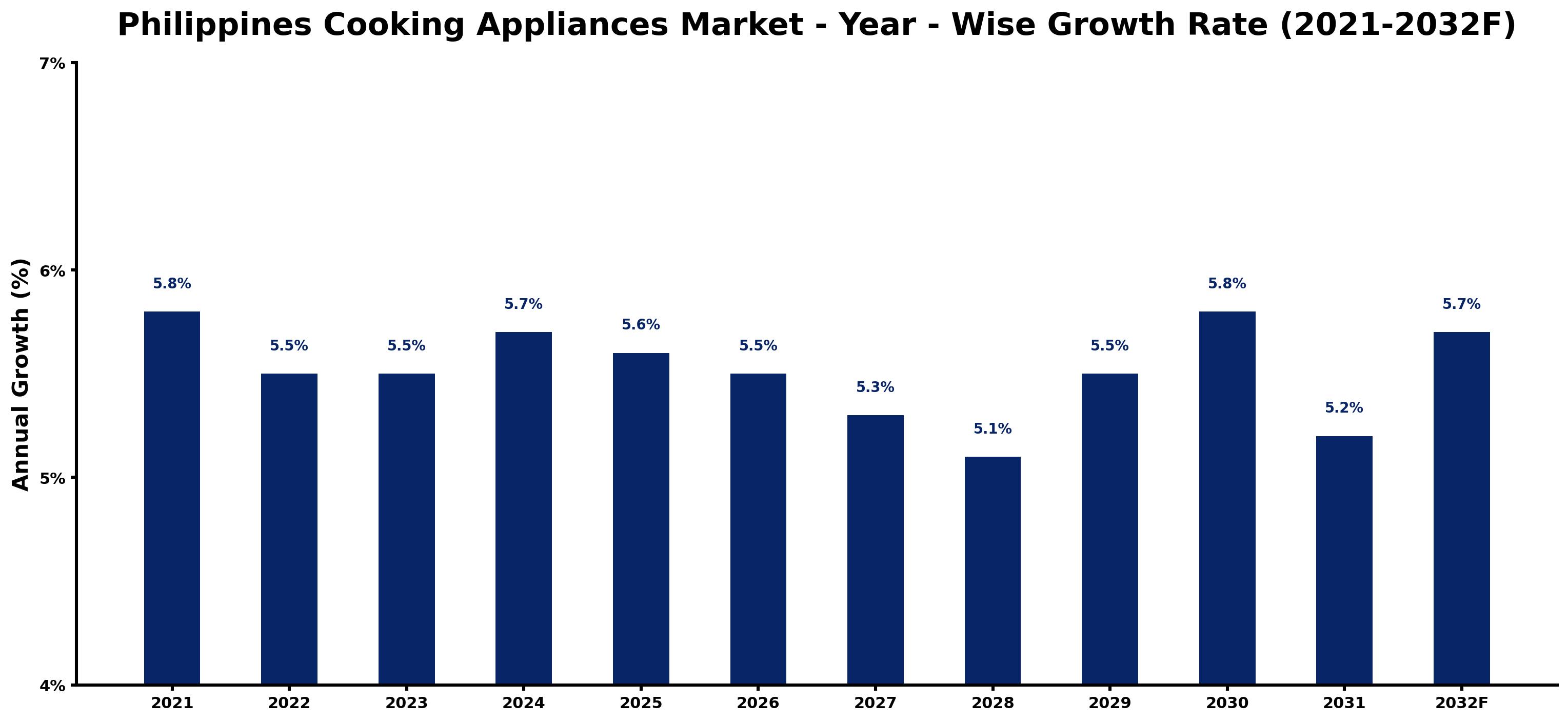
The table below presents the year wise growth rates along with the key drivers influencing the market
| Year | Growth Rate | Major Drivers |
| 2021 | 5.8% | Home cooking saw renewed interest as people embraced culinary hobbies during lockdowns. |
| 2022 | 5.5% | Consumer preferences shifted towards energy-efficient appliances due to rising electricity costs. |
| 2023 | 5.5% | Technological innovations enhanced kitchen automation, increasing demand for smart cooking devices. |
| 2024 | 5.7% | Urbanization trends led to smaller living spaces, boosting compact appliance popularity. |
| 2025 | 5.6% | Sustainability concerns prompted manufacturers to introduce eco-friendly cooking solutions. |
| 2026 | 5.5% | Youth-driven culinary trends on social media encouraged appliance purchases among younger demographics. |
| 2027 | 5.3% | Rising disposable incomes enabled households to invest in premium kitchen equipment. |
| 2028 | 5.1% | Increased female workforce participation positively influenced home appliance purchasing decisions. |
| 2029 | 5.5% | Culinary tourism expanded, promoting local cooking appliances that cater to diverse cuisines. |
| 2030 | 5.8% | Digital marketing campaigns targeted millennials, creating awareness around modern cooking products. |
| 2031 | 5.2% | Collaboration with local chefs increased product visibility and consumer trust in appliances. |
| 2032 | 5.7% | The trend of home-based entertainment drove demand for multi-functional cooking appliances. |
Note - Market size estimations and growth projections presented in this report are based on 6Wresearch's advanced forecasting approach, validated with industry datasets as of June 2026.
Philippines Cooking Appliances Market Synopsis
The Philippines Cooking Appliances Market is projected to reach 5.5% and witness significant growth during the forecast period (2026-2032). This market encompasses the manufacturing, distribution, and sales of a variety of cooking equipment and appliances utilized in both household and commercial settings. Key products in this sector include gas stoves, electric cookers, microwave ovens, induction cooktops, rice cookers, and other related devices that cater to the evolving needs of Filipino consumers.
Philippines Cooking Appliances Market Growth Drivers
Several factors contribute to the robust growth of the Philippines Cooking Appliances Market. One of the primary drivers is the rise in disposable income among the middle-class population. As financial stability increases, consumers are more inclined to invest in modern cooking equipment that enhances their culinary experiences.
- The increasing purchasing power of Filipino households has resulted in expanded expenditure on home appliances, including cooking appliances essential for daily meal preparations.
- Rapid urbanization in major cities is transforming lifestyles, with urban dwellers seeking time-efficient appliances that can simplify their cooking processes.
- The growing trend of modular kitchens, which integrate advanced and efficient cooking appliances, is significantly influencing consumer preferences and driving demand.
- Health consciousness among consumers is pushing the adoption of cooking appliances that offer healthier cooking methods, such as steamers and air fryers.
- The influx of international brands into the market introduces a wider variety of choices for consumers, further stimulating market growth through competition and innovation.
Philippines Cooking Appliances Market Trends and Opportunities
The Philippines Cooking Appliances Market is characterized by several emerging trends that offer opportunities for both manufacturers and consumers. As Filipino consumers increasingly prioritize convenience and efficiency, the demand for smart appliances that integrate technology into everyday cooking processes is on the rise.
- Smart cooking appliances equipped with IoT capabilities are gaining traction, enabling consumers to control their devices remotely and enhancing their cooking experiences.
- Environmental sustainability is becoming a focal point for consumers, leading to an increased preference for energy-efficient cooking appliances that reduce carbon footprints.
- Innovations in cooking technology, such as induction cooking and multi-functional devices, are reshaping consumer expectations and contributing to overall market growth.
- Online shopping trends are influencing how consumers purchase cooking appliances, with e-commerce platforms becoming critical channels for distribution.
- Health and wellness trends are driving demand for appliances that facilitate wholesome cooking methods, prompting manufacturers to invest in product development that aligns with consumers' health goals.
Philippines Cooking Appliances Market Challenges and Restraints
Despite the positive growth trajectory, the Philippines Cooking Appliances Market faces several challenges that could impede its development. Infrastructure limitations remain a significant concern, impacting the adoption of certain cooking appliances.
- Unstable electricity supply in various regions poses a challenge for consumers reliant on electric cooking appliances, limiting their regular usage and reliability.
- Inadequate gas connections in specific areas further restrict the use of gas-powered cooking appliances, creating barriers to market penetration.
- The competitive landscape is characterized by numerous local and international brands, which may lead to price wars and reduce profit margins for companies.
- Consumer education regarding the benefits and features of advanced cooking appliances is necessary to drive adoption but remains a barrier in some segments.
- Economic fluctuations may affect consumer spending patterns, leading to caution in appliance purchases and impacting overall market growth.
Philippines Cooking Appliances Market Government Investment and Initiatives
The Philippine government has recognized the importance of enhancing the manufacturing capabilities within the home appliances sector. Various initiatives and public spending plans aim to foster growth in the cooking appliances market.
- Government policies focusing on boosting local manufacturing are expected to encourage domestic production of cooking appliances, thereby reducing dependence on imports.
- Investment in infrastructure development, particularly in rural areas, is being prioritized to improve access to essential utilities needed for operating cooking appliances.
- Incentives for energy-efficient appliances are being discussed, aimed at promoting sustainable practices and reducing energy consumption across households.
- The government is also considering programs to educate consumers about the benefits of modern cooking appliances, which could positively influence market demand.
- Strategic partnerships between the public and private sectors are being explored to enhance technological advancements in the cooking appliances market.
Philippines Cooking Appliances Market Latest Developments (May 2025 - June 2026)
Recent developments in the Philippines Cooking Appliances Market indicate a strong push toward technological advancement and sustainability. Manufacturers are focusing on integrating smart technologies into cooking appliances to cater to the evolving lifestyles of consumers.
- There has been a noticeable increase in the launch of smart cooking devices that support connectivity and remote operation, aiming to enhance user convenience.
- Companies are increasingly emphasizing energy efficiency in their product lines, aligning with global sustainability trends and consumer preferences for eco-friendly options.
- Market players are exploring collaborations with tech firms to innovate appliance functionalities, thereby setting new standards in cooking technology.
- Consumer interest in online shopping platforms has prompted brands to enhance their digital presence, leading to new e-commerce strategies and direct-to-consumer models.
- Overall, the market is adapting to changing consumer demands, emphasizing convenience, health, and technology integration in cooking appliances.
Philippines Cooking Appliances Market - Key Attractiveness of the Report
- 10 Years of Market Numbers
- Historical Data Starting from 2022 to 2025
- Base Year: 2025
- Forecast Data until 2032
- Key Performance Indicators Impacting the Market
- Major Upcoming Developments and Projects
Key Highlights of the Report:
- Philippines Cooking Appliances Market Outlook
- Market Size of Philippines Cooking Appliances Market, 2025
- Forecast of Philippines Cooking Appliances Market, 2032
- Historical Data and Forecast of Philippines Cooking Appliances Revenues & Volume for the Period 2022-2032F
- Philippines Cooking Appliances Market Trend Evolution
- Philippines Cooking Appliances Market Drivers and Challenges
- Philippines Cooking Appliances Price Trends
- Philippines Cooking Appliances Porter's Five Forces
- Philippines Cooking Appliances Industry Life Cycle
- Historical Data and Forecast of Philippines Cooking Appliances Market Revenues & Volume By Types for the Period 2022-2032F
- Historical Data and Forecast of Philippines Cooking Appliances Market Revenues & Volume By Microwaves for the Period 2022-2032F
- Historical Data and Forecast of Philippines Cooking Appliances Market Revenues & Volume By Ovens for the Period 2022-2032F
- Historical Data and Forecast of Philippines Cooking Appliances Market Revenues & Volume By Cooktops for the Period 2022-2032F
- Historical Data and Forecast of Philippines Cooking Appliances Market Revenues & Volume By Range Hoods for the Period 2022-2032F
- Historical Data and Forecast of Philippines Cooking Appliances Market Revenues & Volume By Small Appliances for the Period 2022-2032F
- Historical Data and Forecast of Philippines Cooking Appliances Market Revenues & Volume By Parts & Accessories for the Period 2022-2032F
- Historical Data and Forecast of Philippines Cooking Appliances Market Revenues & Volume By Applications for the Period 2022-2032F
- Historical Data and Forecast of Philippines Cooking Appliances Market Revenues & Volume By Household for the Period 2022-2032F
- Historical Data and Forecast of Philippines Cooking Appliances Market Revenues & Volume By Commercial for the Period 2022-2032F
- Historical Data and Forecast of Philippines Cooking Appliances Market Revenues & Volume By Fuel Type for the Period 2022-2032F
- Historical Data and Forecast of Philippines Cooking Appliances Market Revenues & Volume By Cooking gas for the Period 2022-2032F
- Historical Data and Forecast of Philippines Cooking Appliances Market Revenues & Volume By Electricity for the Period 2022-2032F
- Historical Data and Forecast of Philippines Cooking Appliances Market Revenues & Volume By Distribution Channel for the Period 2022-2032F
- Historical Data and Forecast of Philippines Cooking Appliances Market Revenues & Volume By Online for the Period 2022-2032F
- Historical Data and Forecast of Philippines Cooking Appliances Market Revenues & Volume By Offline for the Period 2022-2032F
- Philippines Cooking Appliances Import Export Trade Statistics
- Market Opportunity Assessment By Types
- Market Opportunity Assessment By Applications
- Market Opportunity Assessment By Fuel Type
- Market Opportunity Assessment By Distribution Channel
- Philippines Cooking Appliances Top Companies Market Share
- Philippines Cooking Appliances Competitive Benchmarking By Technical and Operational Parameters
- Philippines Cooking Appliances Company Profiles
- Philippines Cooking Appliances Key Strategic Recommendations






































