Philippines Critical Infrastructure Protection Market Size & Growth Rate (2026-2032)
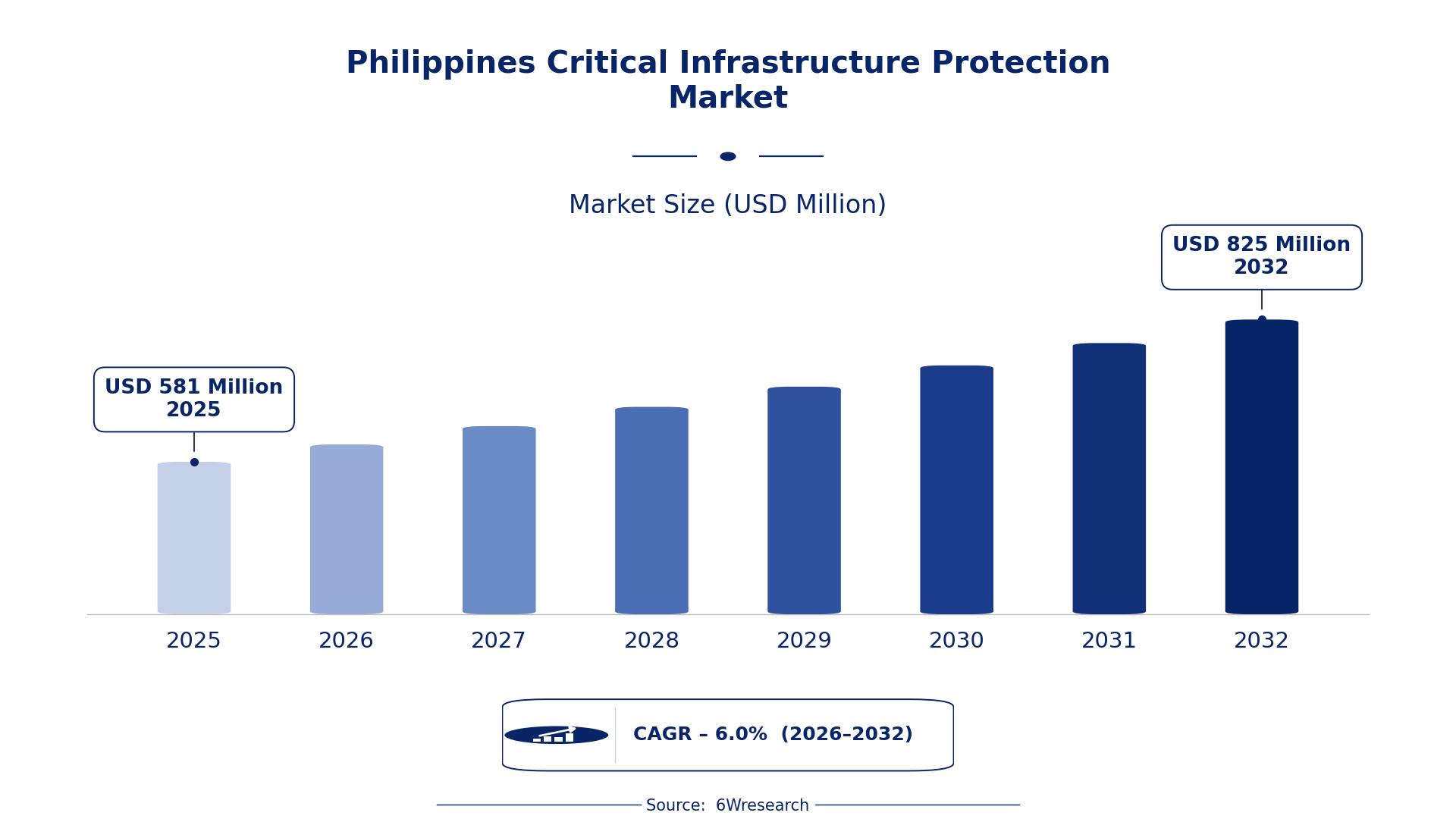
The Philippines Critical Infrastructure Protection Market was estimated at USD 581 Million in 2025 and is projected to reach USD 825 Million by 2032, growing at a CAGR of 6.0% from 2026 to 2032.
Philippines Critical Infrastructure Protection Market Synopsis
The necessity for critical infrastructure protection in the Philippines is underscored by the country’s reliance on essential services like energy, transportation, and telecommunications. As these sectors increasingly integrate advanced technologies, the demand for effective protection measures against both physical and cyber threats is skyrocketing.
Local authorities are compelled to fortify these infrastructure systems amidst challenges such as aging assets and increasing cyber vulnerabilities. Enhanced investment in security technologies is critical to ensure operational continuity and safeguard citizens’ welfare.
Philippines Critical Infrastructure Protection Market Year-wise Growth Rate and Key Drivers
This graph illustrates the annual growth rates of the Philippines Critical Infrastructure Protection Market from 2021 to 2032, highlighting a steady upward trajectory and projected expansion over the forecast period.
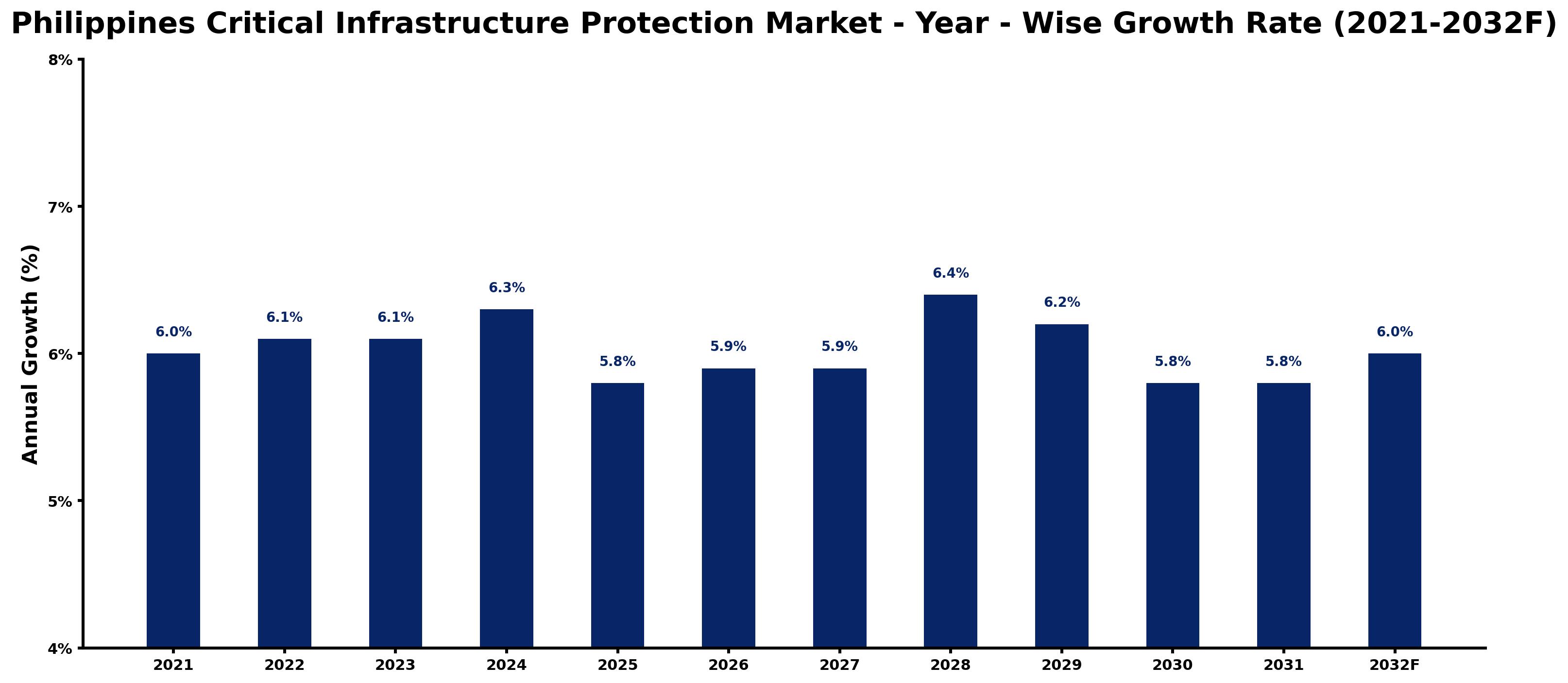
The table below presents the year‑wise growth rates along with the key drivers influencing the market
| Year | Growth Rate | Major Drivers |
| 2021 | 6.0% | Implementation of Philippine Cybersecurity Plan enhancing resilience. |
| 2022 | 6.1% | Rising threats leading to increased security funding. |
| 2023 | 6.1% | Growing urbanization driving demand for protective solutions. |
| 2024 | 6.3% | Philippine government prioritizing disaster response capabilities. |
| 2025 | 5.8% | Increased investments in public safety technologies nationwide. |
| 2026 | 5.9% | Heightened awareness of cybersecurity risks among enterprises. |
| 2027 | 5.9% | Emergence of local private sector cybersecurity initiatives. |
| 2028 | 6.4% | Supportive regulations from DICT on cyber defense frameworks. |
| 2029 | 6.2% | Public-private partnerships enhancing critical infrastructure security. |
| 2030 | 5.8% | Rising geopolitical tensions prompting security assessments. |
| 2031 | 5.8% | Growth of smart city projects necessitating protective measures. |
| 2032 | 6.0% | Advancements in surveillance technologies increasing market potential. |
Note: Market size estimations and growth projections presented in this report are based on 6Wresearch's proprietary forecasting methodology, utilizing the latest available industry data, government publications, and primary research inputs.
Philippines Critical Infrastructure Protection Market Key Takeaways
Below are some of the specific key takeaways from the market, including:
- The market is expanding significantly as awareness of security needs grows.
- Investment in cybersecurity and advanced technologies is becoming essential.
- Public policy and regulatory frameworks are evolving to address infrastructure security.
- Aging infrastructure poses considerable risks that need immediate attention.
- Increased digitalization is reshaping the methods of protection required.
Evaluation of Restraints in Philippines Critical Infrastructure Protection Market
A major restraint impacting the Philippines Critical Infrastructure Protection Market is the deteriorating state of existing infrastructure. Many facilities were built years ago and lack the resilience needed to counteract today's sophisticated threats. Financial constraints also limit the pace at which upgrades can occur, causing a lag in adopting the latest security technologies. on top of that, a shortage of skilled workforce exacerbates these challenges, making it difficult for organizations to implement and maintain comprehensive protection strategies.
Philippines Critical Infrastructure Protection Market Trends
A notable trend is the increasing integration of Internet of Things (IoT) devices into critical infrastructure. These devices offer real-time monitoring and alerts, enhancing response times to potential threats. Additionally, the shift towards more collaborative public-private partnerships is gaining traction, allowing for shared resources and expertise to address security challenges more effectively. There's also a rising focus on training and capacity-building initiatives, designed to equip personnel with the skills necessary to counteract emerging threats.
Philippines Critical Infrastructure Protection Market Opportunities
As the market evolves, opportunities abound in various sectors. The implementation of more stringent regulatory frameworks will drive demand for compliant solutions, particularly in cybersecurity and surveillance. Investing in smart infrastructure upgrades could yield significant returns as cities move towards more resilient and technologically advanced systems. Public-private partnerships will likely open additional funding avenues, enabling wider-reaching projects that enhance the protective capabilities of critical infrastructures.
Government Initiatives in the Philippines Critical Infrastructure Protection Market
Government initiatives are pivotal in shaping the Philippines Critical Infrastructure Protection Market. The regulatory posture emphasizes building a comprehensive safety net for critical systems, prioritizing investments that enhance national resilience. Policymakers are increasingly focused on collaborative efforts between the government and private sector to develop and implement effective strategies.
- A recently completed initiative involved the rollout of a national cybersecurity framework aimed at enhancing protection across key sectors.
- Ongoing programs include a multi-phase upgrade of transportation infrastructure, incorporating advanced security measures into existing frameworks.
- A planned public-private partnership seeks to enhance telecommunications security, expected to kick off in early 2026.
- Legislation introduced in 2025 mandates periodic reviews of critical infrastructure vulnerability assessments.
- Current discussions are underway regarding funding allocations for a nationwide energy facility resilience program.
Future Insights of the Philippines Critical Infrastructure Protection Market
Looking ahead to 2026-2032, the Philippines Critical Infrastructure Protection Market is set for substantial growth. As technology continues to evolve, the demand for innovative solutions will likely surge. The government's commitment to enhancing infrastructure security will further fuel investment, especially in cybersecurity and smart technologies. The convergence of physical and cyber security protocols will become more pronounced, as organizations recognize the interconnected nature of today's threats.
Philippines Critical Infrastructure Protection Market Latest Developments
Over the past 12-14 months, the Philippines Critical Infrastructure Protection Market has witnessed dynamic advancements focused on enhancing security measures across various sectors. There's been a push towards integrating advanced technologies and frameworks to respond to the rising security threats faced by critical infrastructure.
- An ongoing initiative involves partnerships with technology vendors to implement AI-driven security systems across major transport hubs, expected to be complete by late 2026.
- A major technology vendor launched an upgraded monitoring platform for energy facilities, enhancing threat detection capabilities in early 2025.
- Plans for an upcoming legislative review of existing security policies are set to commence in mid-2026.
- Recent efforts have been made to standardize security protocols across telecommunications operators, initiated in Q1 2025.
- Long-term investment in training programs for personnel managing critical infrastructure is now underway, having started in early 2025.
Philippines Critical Infrastructure Protection Market - Key Attractiveness of the Report
- 10 Years of Market Numbers
- Historical Data Starting from 2022 to 2025
- Base Year: 2025
- Forecast Data until 2032
- Key Performance Indicators Impacting the Market
- Major Upcoming Developments and Projects
Key Highlights of the Report:
- Philippines Critical Infrastructure Protection Market Outlook
- Market Size of Philippines Critical Infrastructure Protection Market, 2025
- Forecast of Philippines Critical Infrastructure Protection Market, 2032
- Historical Data and Forecast of Philippines Critical Infrastructure Protection Revenues & Volume for the Period 2022-2032F
- Philippines Critical Infrastructure Protection Market Trend Evolution
- Philippines Critical Infrastructure Protection Market Drivers and Challenges
- Philippines Critical Infrastructure Protection Price Trends
- Philippines Critical Infrastructure Protection Porter's Five Forces
- Philippines Critical Infrastructure Protection Industry Life Cycle
- Historical Data and Forecast of Philippines Critical Infrastructure Protection Market Revenues & Volume By Solution for the Period 2022-2032F
- Historical Data and Forecast of Philippines Critical Infrastructure Protection Market Revenues & Volume By Physical Safety for the Period 2022-2032F
- Historical Data and Forecast of Philippines Critical Infrastructure Protection Market Revenues & Volume By Security Video Surveillance Systems for the Period 2022-2032F
- Historical Data and Forecast of Philippines Critical Infrastructure Protection Market Revenues & Volume By Screening for the Period 2022-2032F
- Historical Data and Forecast of Philippines Critical Infrastructure Protection Market Revenues & Volume By Scanning for the Period 2022-2032F
- Historical Data and Forecast of Philippines Critical Infrastructure Protection Market Revenues & Volume By Cybersecurity for the Period 2022-2032F
- Historical Data and Forecast of Philippines Critical Infrastructure Protection Market Revenues & Volume By Encryption for the Period 2022-2032F
- Historical Data and Forecast of Philippines Critical Infrastructure Protection Market Revenues & Volume By Threat Intelligence for the Period 2022-2032F
- Historical Data and Forecast of Philippines Critical Infrastructure Protection Market Revenues & Volume By Component for the Period 2022-2032F
- Historical Data and Forecast of Philippines Critical Infrastructure Protection Market Revenues & Volume By Solution for the Period 2022-2032F
- Historical Data and Forecast of Philippines Critical Infrastructure Protection Market Revenues & Volume By Services for the Period 2022-2032F
- Historical Data and Forecast of Philippines Critical Infrastructure Protection Market Revenues & Volume By Vertical for the Period 2022-2032F
- Historical Data and Forecast of Philippines Critical Infrastructure Protection Market Revenues & Volume By Financial Institutions for the Period 2022-2032F
- Historical Data and Forecast of Philippines Critical Infrastructure Protection Market Revenues & Volume By Government for the Period 2022-2032F
- Historical Data and Forecast of Philippines Critical Infrastructure Protection Market Revenues & Volume By Defense for the Period 2022-2032F
- Historical Data and Forecast of Philippines Critical Infrastructure Protection Market Revenues & Volume By Transport and Logistics for the Period 2022-2032F
- Historical Data and Forecast of Philippines Critical Infrastructure Protection Market Revenues & Volume By Energy and Power for the Period 2022-2032F
- Historical Data and Forecast of Philippines Critical Infrastructure Protection Market Revenues & Volume By Commercial Sector for the Period 2022-2032F
- Historical Data and Forecast of Philippines Critical Infrastructure Protection Market Revenues & Volume By Telecom for the Period 2022-2032F
- Historical Data and Forecast of Philippines Critical Infrastructure Protection Market Revenues & Volume By Chemicals and Manufacturing for the Period 2022-2032F
- Philippines Critical Infrastructure Protection Import Export Trade Statistics
- Market Opportunity Assessment By Solution
- Market Opportunity Assessment By Cybersecurity
- Market Opportunity Assessment By Component
- Market Opportunity Assessment By Vertical
- Philippines Critical Infrastructure Protection Top Companies Market Share
- Philippines Critical Infrastructure Protection Competitive Benchmarking By Technical and Operational Parameters
- Philippines Critical Infrastructure Protection Company Profiles
- Philippines Critical Infrastructure Protection Key Strategic Recommendations






































