Philippines Cutting Equipment Market Size, Share & Growth Rate
The Philippines Cutting Equipment Market was estimated at USD 314 Million in 2025 and is projected to reach USD 433 Million by 2032, growing at a CAGR of 4.7% from 2026 to 2032. This growth trajectory is primarily driven by an upsurge in industrial activities, particularly in manufacturing and construction sectors, which are increasingly adopting advanced cutting technologies to improve productivity. Additionally, the focus on infrastructure development further fuels demand for cutting equipment, as businesses seek efficient solutions for precision cutting and fabrication.
Philippines Cutting Equipment Market Year-wise Growth Rate and Key Drivers
This graph highlights how the Philippines Cutting Equipment Market has steadily grown over the years, supported by major growth factors.
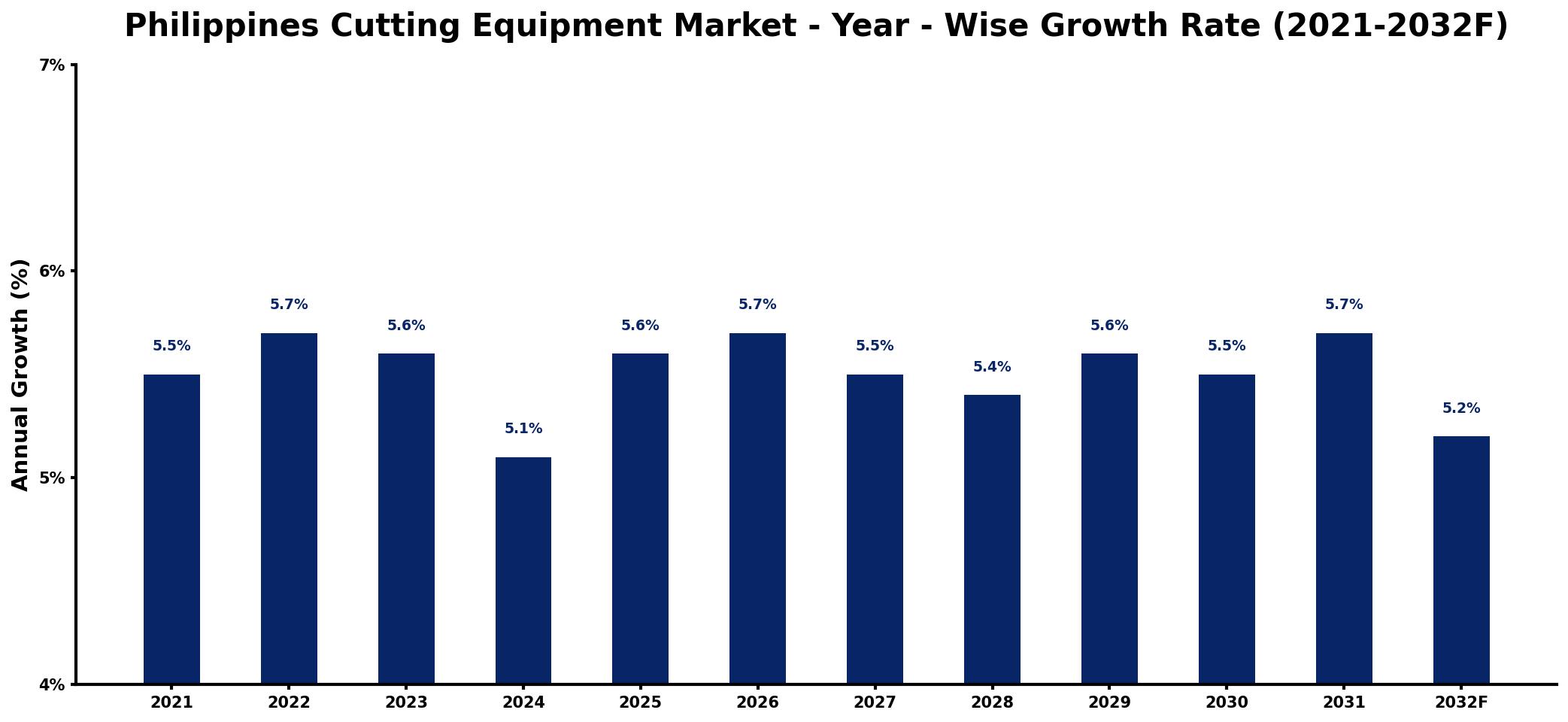
The table below presents the year‑wise growth rates along with the key drivers influencing the market
| Year | Growth Rate | Major Drivers |
| 2021 | 5.5% | Rising construction sector investments |
| 2022 | 5.7% | Increased manufacturing output demands |
| 2023 | 5.6% | Growing automotive industry requirements |
| 2024 | 5.1% | Expansion in renewable energy projects |
| 2025 | 5.6% | Surge in local export activities |
| 2026 | 5.7% | Technological advancements in fabrication |
| 2027 | 5.5% | Higher demand for precision tools |
| 2028 | 5.4% | Growth in DIY home improvement |
| 2029 | 5.6% | Emergence of new market players |
| 2030 | 5.5% | Increased focus on automation solutions |
| 2031 | 5.7% | Rising demand for custom designs |
| 2032 | 5.2% | Expansion of infrastructure development |
Note: Market size estimations and growth projections presented in this report are based on 6Wresearch's proprietary forecasting methodology, utilizing the latest available industry data, government publications, and primary research inputs.
Philippines Cutting Equipment Market Synopsis
The most significant force currently shaping the Philippines Cutting Equipment Market is the surge in infrastructure projects. The government's commitment to enhancing public infrastructure, coupled with private sector investments, has increased the demand for robust cutting solutions across various applications. This growing trend underscores the shift towards high-performance equipment that meets industry standards while prioritizing safety and efficiency.
In addition, technological advancements continue to redefine the market landscape. The evolution of cutting tools, from traditional methods to CNC and laser cutting systems, showcases the industry's pivot towards automated and precision-based technologies. As industries embrace these innovations, they are driving the demand for cutting equipment that offers accuracy and reliability.
Philippines Cutting Equipment Market Key Takeaways
- The market is experiencing sustained growth driven by industrial expansion and infrastructure development.
- Advancements in technology, including CNC and automated cutting solutions, are reshaping operational efficiencies.
- Safety and precision remain critical considerations for manufacturers, influencing product innovation.
- The market is gradually recovering from disruptions caused by the COVID-19 pandemic, with improvements anticipated in industrial activities.
- Investment opportunities are ripe within emerging sectors like automotive and construction, driving future demand.
Evaluation of Restraints in Philippines Cutting Equipment Market
Despite the promising growth outlook, the Philippines Cutting Equipment Market faces certain restraints that could hinder its progress. Safety concerns regarding the operation of cutting equipment often necessitate comprehensive training programs, which can strain resources for both manufacturers and operators. Additionally, the need for continuous research and development to keep pace with technological advancements requires significant investment, which may not be feasible for all companies. Moreover, market players must contend with competitive pressures that could lead to pricing wars, impacting profitability and product development. Ensuring consistent quality while meeting increasing demand remains a balancing act for industry stakeholders.
Philippines Cutting Equipment Market Trends
Key trends shaping the Philippines Cutting Equipment Market include a noticeable shift towards automation and smart technologies. Manufacturers are increasingly integrating IoT capabilities into cutting equipment, which enhances operational efficiency and data analytics. Furthermore, the rise of environmentally friendly and energy-efficient cutting solutions is gaining traction as companies become more aware of their carbon footprint. The demand for portable and lightweight cutting tools is also on the rise, catering to the evolving needs of the construction and manufacturing sectors.
Philippines Cutting Equipment Market Opportunities
The Philippines Cutting Equipment Market presents significant growth opportunities, particularly within the automotive and aerospace sectors. As these industries expand, the need for high-precision cutting solutions becomes critical. Moreover, as local and foreign investments continue to pour into the country's infrastructure projects, manufacturers of cutting equipment stand to benefit from increased demand for their products. Strategic partnerships and collaborations could also provide avenues for innovation and market penetration, allowing companies to enhance their product offerings and expand their reach.
Government Initiatives in the Philippines Cutting Equipment Market
The Philippine government has initiated several programs to bolster the manufacturing sector, which in turn supports the cutting equipment market. Investments in infrastructure development, along with various incentives for local manufacturers, aim to stimulate economic growth. Policies promoting research and development in manufacturing technologies encourage innovation, enabling companies to stay competitive in a rapidly evolving market. Furthermore, regulatory frameworks that ensure safety and quality standards for cutting equipment contribute to consumer confidence and market stability.
Future Insights of the Philippines Cutting Equipment Market
Looking ahead to 2026-2032, the Philippines Cutting Equipment Market is poised for further expansion. As industries continue to prioritize automation and efficiency, the demand for advanced cutting solutions will likely intensify. The integration of artificial intelligence and machine learning into cutting technologies is expected to elevate operational capabilities, driving innovation. Furthermore, the market is anticipated to benefit from an increasing focus on sustainability, with more companies seeking eco-friendly cutting solutions. As infrastructure projects ramp up and industrial activities recover, the Philippines is set to emerge as a key player in the cutting equipment landscape.
Philippines Cutting Equipment Market Latest Developments (2025 - 2026)
In recent months, the Philippines Cutting Equipment Market has seen several developments geared towards technological enhancement and efficiency improvements. Manufacturers are unveiling new products that incorporate advanced materials and energy-efficient technologies, responding to growing market demands. Additionally, collaborations between local firms and international partners are fostering knowledge transfer and innovation, strengthening the industry as a whole. The sector is also witnessing an increase in training programs focused on safety and operational excellence, reflecting a commitment to improving workforce capabilities and equipment handling standards.
Philippines Cutting Equipment Market - Key Attractiveness of the Report
- 10 Years of Market Numbers
- Historical Data Starting from 2022 to 2025
- Base Year: 2025
- Forecast Data until 2032
- Key Performance Indicators Impacting the Market
- Major Upcoming Developments and Projects
Key Highlights of the Report:
- Philippines Cutting Equipment Market Outlook
- Market Size of Philippines Cutting Equipment Market, 2025
- Forecast of Philippines Cutting Equipment Market, 2032
- Historical Data and Forecast of Philippines Cutting Equipment Revenues & Volume for the Period 2022-2032F
- Philippines Cutting Equipment Market Trend Evolution
- Philippines Cutting Equipment Market Drivers and Challenges
- Philippines Cutting Equipment Price Trends
- Philippines Cutting Equipment Porter's Five Forces
- Philippines Cutting Equipment Industry Life Cycle
- Historical Data and Forecast of Philippines Cutting Equipment Market Revenues & Volume By Equipment Type for the Period 2022-2032F
- Historical Data and Forecast of Philippines Cutting Equipment Market Revenues & Volume By Manual for the Period 2022-2032F
- Historical Data and Forecast of Philippines Cutting Equipment Market Revenues & Volume By Mechanized for the Period 2022-2032F
- Historical Data and Forecast of Philippines Cutting Equipment Market Revenues & Volume By Cutting Technology for the Period 2022-2032F
- Historical Data and Forecast of Philippines Cutting Equipment Market Revenues & Volume By Plasma cutting for the Period 2022-2032F
- Historical Data and Forecast of Philippines Cutting Equipment Market Revenues & Volume By Oxy-fuel cutting for the Period 2022-2032F
- Historical Data and Forecast of Philippines Cutting Equipment Market Revenues & Volume By Laser cutting for the Period 2022-2032F
- Historical Data and Forecast of Philippines Cutting Equipment Market Revenues & Volume By Waterjet cutting for the Period 2022-2032F
- Historical Data and Forecast of Philippines Cutting Equipment Market Revenues & Volume By Carbon arc cutting for the Period 2022-2032F
- Historical Data and Forecast of Philippines Cutting Equipment Market Revenues & Volume By End Use Industry for the Period 2022-2032F
- Historical Data and Forecast of Philippines Cutting Equipment Market Revenues & Volume By Construction for the Period 2022-2032F
- Historical Data and Forecast of Philippines Cutting Equipment Market Revenues & Volume By Heavy metal fabrication for the Period 2022-2032F
- Historical Data and Forecast of Philippines Cutting Equipment Market Revenues & Volume By Shipbuilding & offshore for the Period 2022-2032F
- Historical Data and Forecast of Philippines Cutting Equipment Market Revenues & Volume By Automotive for the Period 2022-2032F
- Historical Data and Forecast of Philippines Cutting Equipment Market Revenues & Volume By Others for the Period 2022-2032F
- Historical Data and Forecast of Philippines Cutting Equipment Market Revenues & Volume By Type for the Period 2022-2032F
- Historical Data and Forecast of Philippines Cutting Equipment Market Revenues & Volume By Equipment for the Period 2022-2032F
- Historical Data and Forecast of Philippines Cutting Equipment Market Revenues & Volume By Consumables/Accessories for the Period 2022-2032F
- Philippines Cutting Equipment Import Export Trade Statistics
- Market Opportunity Assessment By Equipment Type
- Market Opportunity Assessment By Cutting Technology
- Market Opportunity Assessment By End Use Industry
- Market Opportunity Assessment By Type
- Philippines Cutting Equipment Top Companies Market Share
- Philippines Cutting Equipment Competitive Benchmarking By Technical and Operational Parameters
- Philippines Cutting Equipment Company Profiles
- Philippines Cutting Equipment Key Strategic Recommendations






































