Philippines Data Center Networking Market Size & Growth Rate (2026-2032)
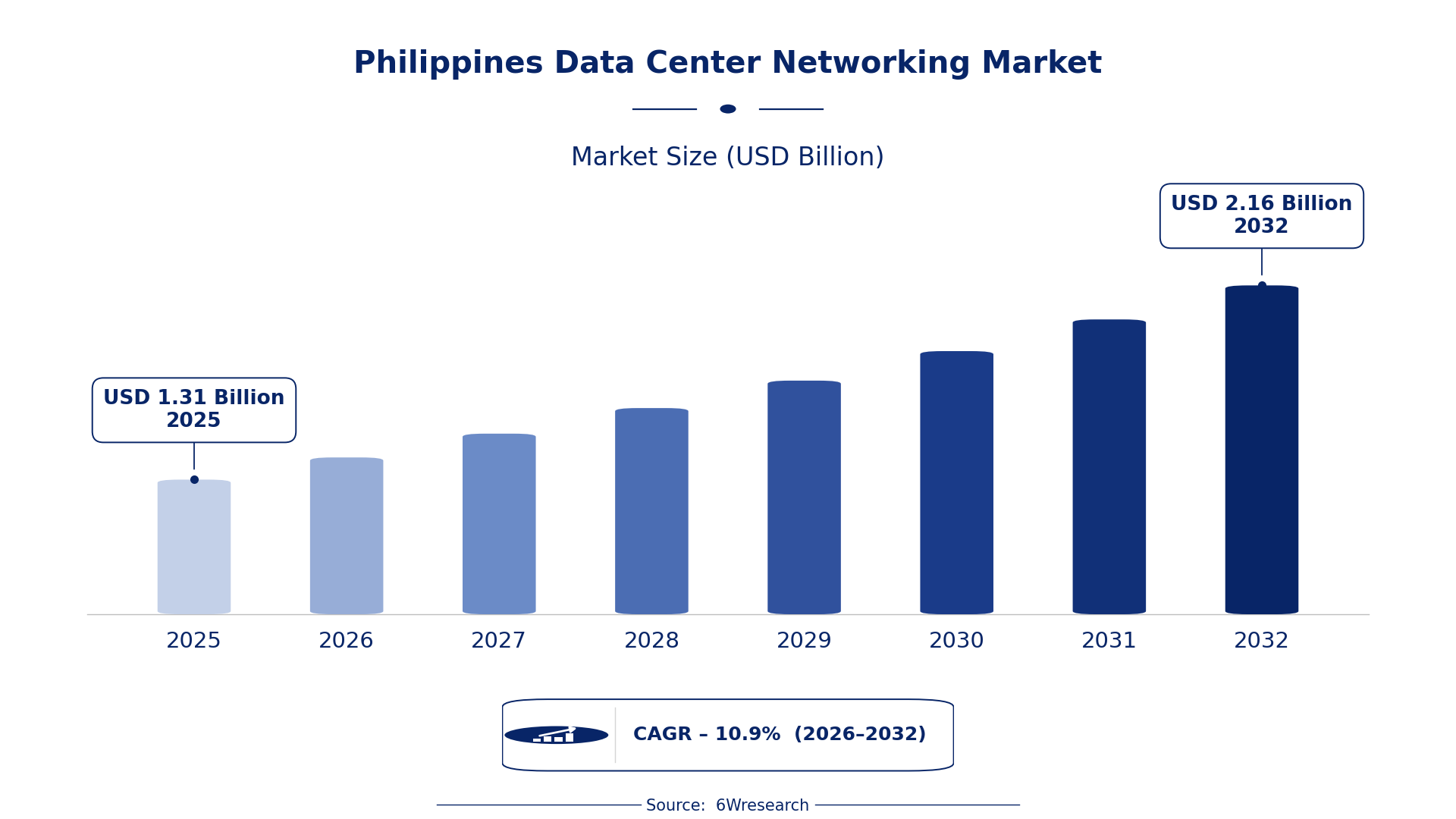
The Philippines Data Center Networking Market was estimated at USD 1308 Million in 2025 and is projected to reach USD 2157 Million by 2032, growing at a CAGR of 10.9% from 2026 to 2032.
Philippines Data Center Networking Market Synopsis
The escalating adoption of cloud computing technologies is the most influential factor driving the Philippines Data Center Networking Market. Organizations are increasingly seeking high-speed connectivity solutions to support their digital transformation initiatives, ultimately shaping the demand for advanced networking products and services.
As businesses continue to harness big data analytics and virtualization, the need for reliable and efficient data center networking has never been more pronounced. This evolving demand is propelling investment into infrastructure upgrades, ensuring organizations can meet their growing data processing and storage needs.
Philippines Data Center Networking Market Year-wise Growth Rate and Key Drivers
This graph illustrates the annual growth rates of the Philippines Data Center Networking Market from 2021 to 2032, highlighting a steady upward trajectory and projected expansion over the forecast period.
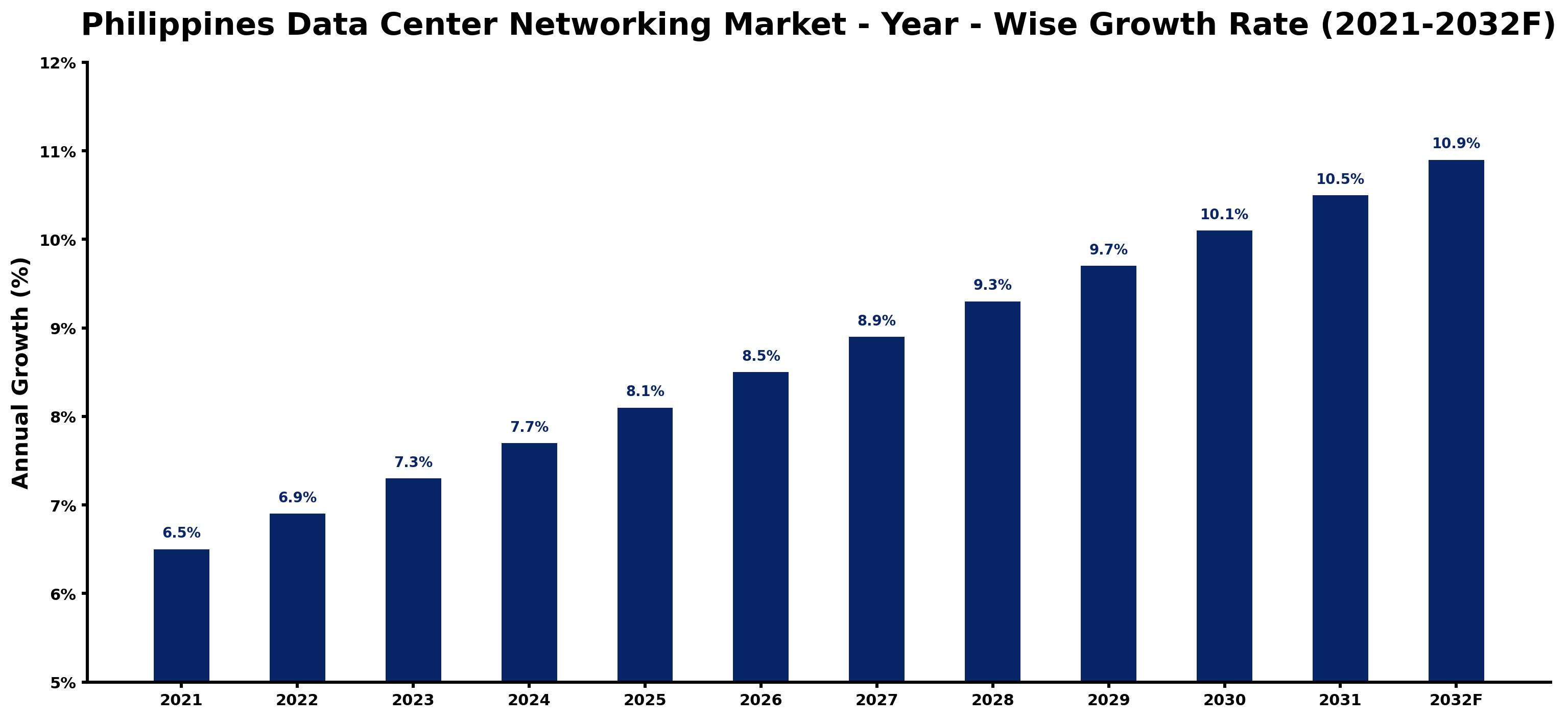
The table below presents the year‑wise growth rates along with the key drivers influencing the market
| Year | Growth Rate | Major Drivers |
| 2021 | 6.5% | Philippine banking apps driving data transmission needs |
| 2022 | 6.9% | BIR regulations pushing digital transformations in enterprises |
| 2023 | 7.3% | National broadband plan enhancing network infrastructure investments |
| 2024 | 7.7% | Rapid adoption of e-learning platforms requiring robust connectivity |
| 2025 | 8.1% | Government initiatives fostering tech startup ecosystem growth |
| 2026 | 8.5% | Local fintech firms expanding demand for data center services |
| 2027 | 8.9% | Increased cybersecurity threats motivating data protection investments |
| 2028 | 9.3% | Telecommunication reforms enhancing data access across provinces |
| 2029 | 9.7% | Rising online gaming industry demanding high-performance networks |
| 2030 | 10.1% | Smart city projects leading to infrastructure upgrade demands |
| 2031 | 10.5% | Increased remote work policies stimulating data network needs |
| 2032 | 10.9% | Philippine Competitiveness Council promoting digital infrastructure enhancements |
Note: Market size estimations and growth projections presented in this report are based on 6Wresearch's proprietary forecasting methodology, utilizing the latest available industry data, government publications, and primary research inputs.
Philippines Data Center Networking Market Key Takeaways
Below are some of the specific key takeaways from the market, including:
- The shift towards cloud-based solutions is reshaping networking demands.
- Investment in infrastructure is critical to maintaining competitive advantages.
- Organizations are increasingly focusing on minimizing latency issues.
- Technological advancements are essential for meeting future networking requirements.
- Market growth is supported by a robust demand for data processing capabilities.
Evaluation of Restraints in Philippines Data Center Networking Market
Despite the promising growth, the Philippines Data Center Networking Market faces notable challenges, particularly concerning latency and reliability. With the archipelagic geography of the country, ensuring consistent low-latency connections across more than 7,000 islands is no small feat. This geographical barrier complicates the establishment of effective data center networking solutions, necessitating innovative approaches to connectivity.
Philippines Data Center Networking Market Trends
Several trends are emerging in the Philippines Data Center Networking Market. A notable trend is the increasing integration of artificial intelligence and machine learning technologies, which are enhancing network management and operational efficiencies. As organizations strive for real-time data processing, the demand for adaptive and intelligent networking solutions is set to rise.
on top of that, the growing focus on sustainability is prompting data centers to adopt energy-efficient networking technologies. This shift not only aligns with global environmental objectives but also offers cost savings for businesses investing in greener infrastructure.
Philippines Data Center Networking Market Opportunities
The Philippines presents substantial opportunities for growth in the Data Center Networking Market. As businesses expand their digital footprints, demand for advanced networking solutions that can facilitate seamless connectivity will surge. on top of that, emerging sectors such as e-commerce and fintech are driving the need for enhanced data processing capabilities, creating lucrative prospects for investors and technology providers.
Public-private partnerships aimed at upgrading digital infrastructure also represent a significant opportunity. These collaborations can accelerate the deployment of next-generation networking technologies, ultimately enhancing the overall competitiveness of the market.
Government Initiatives in the Philippines Data Center Networking Market
Government policy is a crucial factor shaping the Philippines Data Center Networking Market. The government's commitment to improving digital infrastructure is evident through various initiatives designed to bolster connectivity and support the growth of the digital economy. These efforts focus on addressing regulatory hurdles and facilitating investments in advanced networking technologies.
- A national digital infrastructure upgrade program recently launched aims to improve connectivity across the islands.
- Currently, the government is working on regulatory reforms to streamline data center operations and attract foreign investments.
- A planned public-private initiative is expected to enhance telecom infrastructure access by 2028.
- In early 2025, a framework mandating improved transparency in billing practices for data services was introduced.
Future Insights of the Philippines Data Center Networking Market
Looking ahead to 2026-2032, the Philippines Data Center Networking Market is set to experience significant evolution. The ongoing digital transformation across industries will require a sustained investment in networking infrastructure. As companies increasingly adopt hybrid cloud solutions, networking capabilities will need to adapt to support diverse operational models, making flexibility a critical feature of future offerings.
The integration of advanced technologies such as 5G and edge computing will also reshape networking strategies, providing opportunities for innovation and improved service delivery. As businesses respond to these advancements, the competitive landscape will likely intensify, driving further investment and growth.
Philippines Data Center Networking Market Latest Developments
Recent months have seen a flurry of activity in the Philippines Data Center Networking Market, with several initiatives aimed at bolstering infrastructure and enhancing connectivity. Organizations are prioritizing investments in modernizing their networking capabilities to align with evolving business demands and technological advancements.
- A major technology vendor launched a new high-speed networking solution in Q1 2025, aimed at improving data processing capabilities for local enterprises.
- In mid-2025, a consortium of regional telecom operators announced a collaboration to expand fiber-optic networks across underserved areas.
- An initiative to upgrade existing data center facilities began in late 2024 and remains underway, focusing on enhancing energy efficiency.
- A rollout of next-generation networking protocols is expected to begin in Q2 2026, promising to reduce latency and improve overall performance.
Philippines Data Center Networking Market - Key Attractiveness of the Report
- 10 Years of Market Numbers
- Historical Data Starting from 2022 to 2025
- Base Year: 2025
- Forecast Data until 2032
- Key Performance Indicators Impacting the Market
- Major Upcoming Developments and Projects
Key Highlights of the Report:
- Philippines Data Center Networking Market Outlook
- Market Size of Philippines Data Center Networking Market, 2025
- Forecast of Philippines Data Center Networking Market, 2032
- Historical Data and Forecast of Philippines Data Center Networking Revenues & Volume for the Period 2022-2032F
- Philippines Data Center Networking Market Trend Evolution
- Philippines Data Center Networking Market Drivers and Challenges
- Philippines Data Center Networking Price Trends
- Philippines Data Center Networking Porter's Five Forces
- Philippines Data Center Networking Industry Life Cycle
- Historical Data and Forecast of Philippines Data Center Networking Market Revenues & Volume By Component for the Period 2022-2032F
- Historical Data and Forecast of Philippines Data Center Networking Market Revenues & Volume By Solution for the Period 2022-2032F
- Historical Data and Forecast of Philippines Data Center Networking Market Revenues & Volume By Services for the Period 2022-2032F
- Historical Data and Forecast of Philippines Data Center Networking Market Revenues & Volume By End User for the Period 2022-2032F
- Historical Data and Forecast of Philippines Data Center Networking Market Revenues & Volume By IT and telecom for the Period 2022-2032F
- Historical Data and Forecast of Philippines Data Center Networking Market Revenues & Volume By Retail for the Period 2022-2032F
- Historical Data and Forecast of Philippines Data Center Networking Market Revenues & Volume By BFSI for the Period 2022-2032F
- Historical Data and Forecast of Philippines Data Center Networking Market Revenues & Volume By Public sector and utilities for the Period 2022-2032F
- Historical Data and Forecast of Philippines Data Center Networking Market Revenues & Volume By Energy for the Period 2022-2032F
- Historical Data and Forecast of Philippines Data Center Networking Market Revenues & Volume By Manufacturing for the Period 2022-2032F
- Historical Data and Forecast of Philippines Data Center Networking Market Revenues & Volume By Healthcare for the Period 2022-2032F
- Historical Data and Forecast of Philippines Data Center Networking Market Revenues & Volume By Others for the Period 2022-2032F
- Philippines Data Center Networking Import Export Trade Statistics
- Market Opportunity Assessment By Component
- Market Opportunity Assessment By End User
- Philippines Data Center Networking Top Companies Market Share
- Philippines Data Center Networking Competitive Benchmarking By Technical and Operational Parameters
- Philippines Data Center Networking Company Profiles
- Philippines Data Center Networking Key Strategic Recommendations






































