Philippines Data Integration Market Size & Growth Rate (2026-2032)
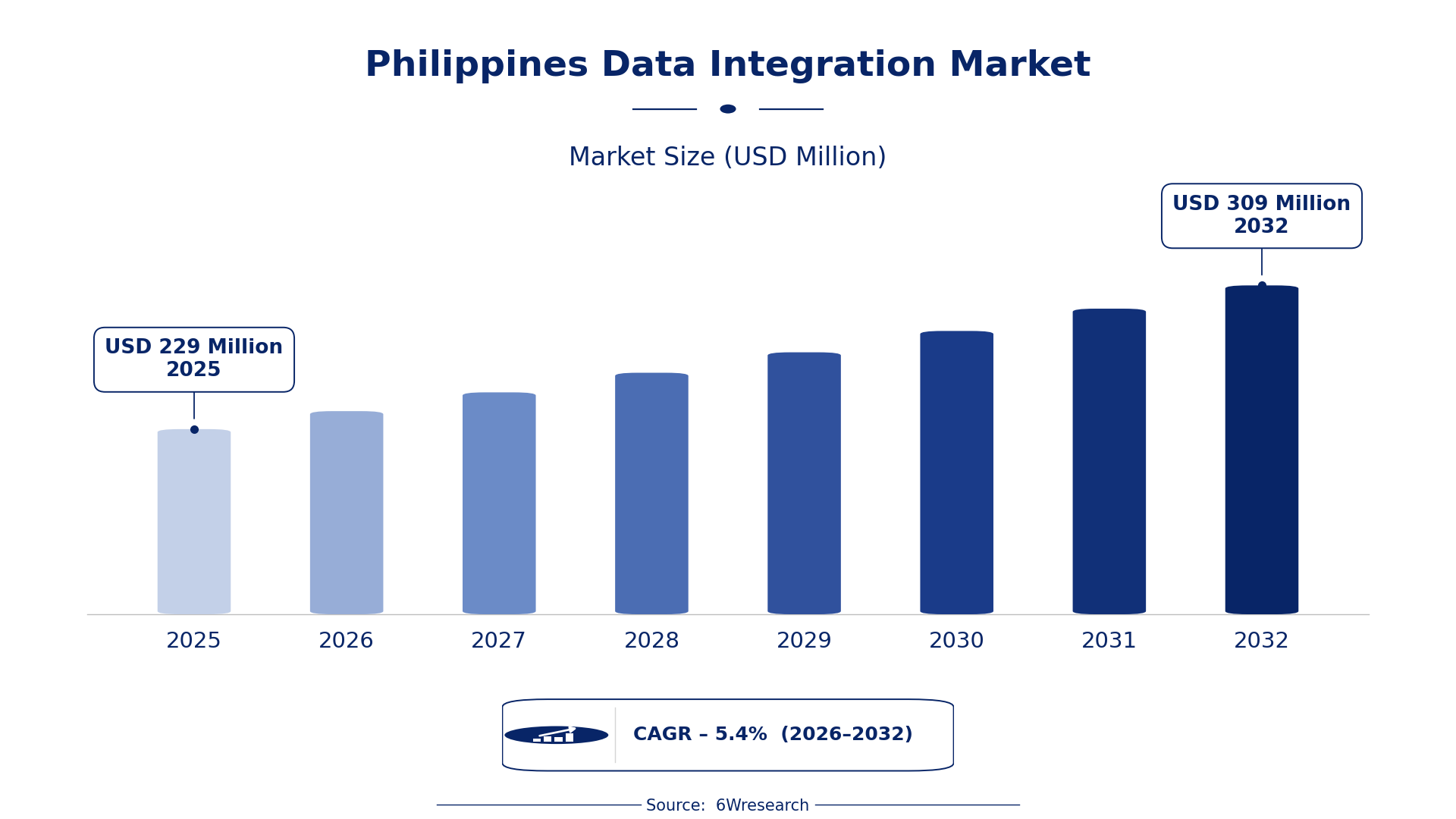
The Philippines Data Integration Market was estimated at USD 229 Million in 2025 and is projected to reach USD 309 Million by 2032, growing at a CAGR of 5.4% from 2026 to 2032.
Philippines Data Integration Market Synopsis
The demand for data integration solutions is the primary force driving growth in the Philippines Data Integration Market. Organizations are under increasing pressure to consolidate data from a variety of sources to derive actionable insights that inform decision-making.
The surge in data volume and diversity is pushing businesses to invest in integration technologies. As companies strive for improved data management, the need for solutions that offer seamless connectivity and interoperability has never been more critical.
Philippines Data Integration Market Year-wise Growth Rate and Key Drivers
This graph illustrates the annual growth rates of the Philippines Data Integration Market from 2021 to 2032, highlighting a steady upward trajectory and projected expansion over the forecast period.
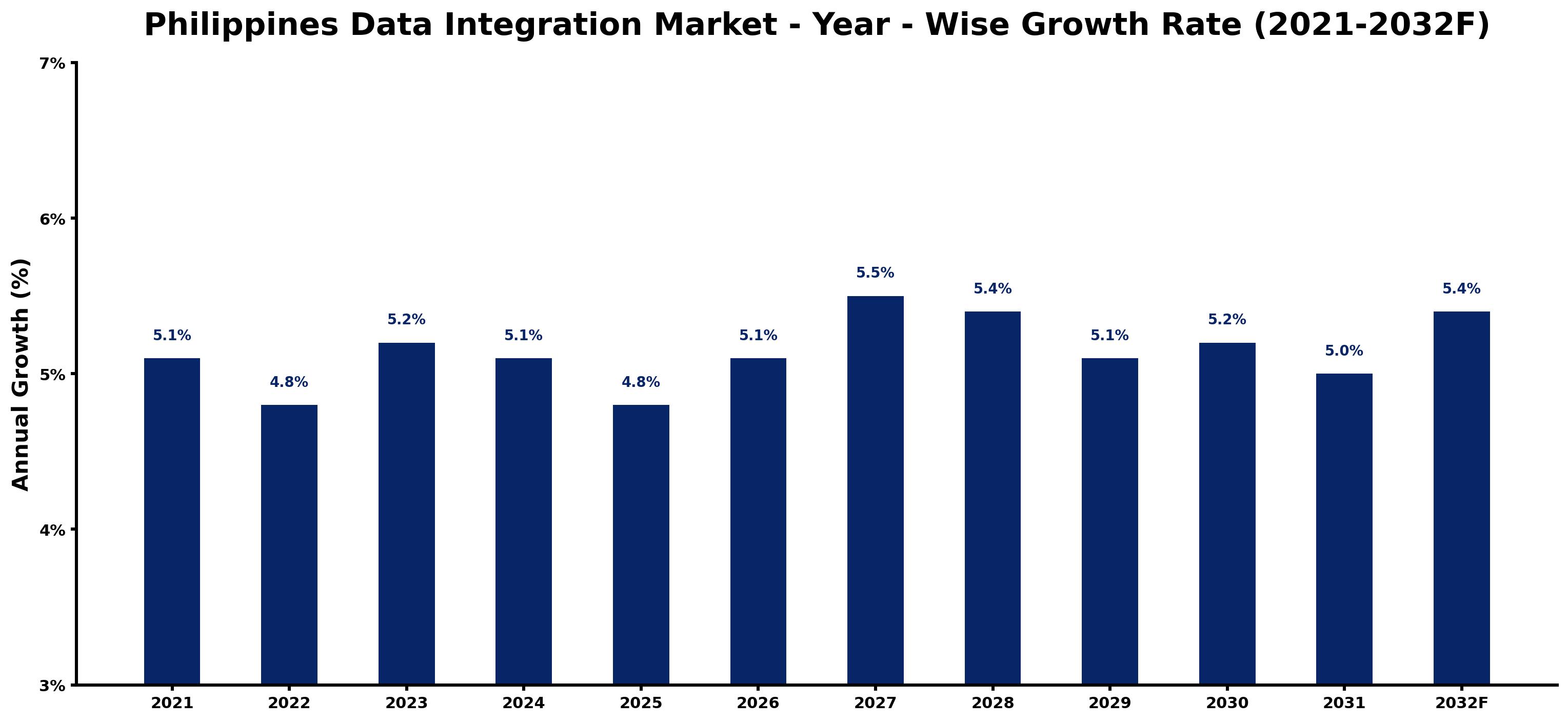
The table below presents the year‑wise growth rates along with the key drivers influencing the market
| Year | Growth Rate | Major Drivers |
| 2021 | 5.1% | Philippine government digitization initiative boosts data integration needs. |
| 2022 | 4.8% | Increased mobile internet penetration enhances data management capabilities. |
| 2023 | 5.2% | E-commerce expansion drives demand for integrated data solutions. |
| 2024 | 5.1% | Regulatory compliance necessitates improved data handling processes. |
| 2025 | 4.8% | Emerging fintech companies require sophisticated data integration services. |
| 2026 | 5.1% | Data privacy laws prompt upgrades to integration frameworks. |
| 2027 | 5.5% | Growing remote workforce increases reliance on integrated platforms. |
| 2028 | 5.4% | Healthcare sector digitization boosts demand for data integration. |
| 2029 | 5.1% | Adoption of AI technologies accelerates need for seamless data access. |
| 2030 | 5.2% | Local firms investing in data analytics spur integration growth. |
| 2031 | 5.0% | Increased focus on cybersecurity drives integration solution demand. |
| 2032 | 5.4% | Smart city projects foster collaboration and data sharing initiatives. |
Note: Market size estimations and growth projections presented in this report are based on 6Wresearch's proprietary forecasting methodology, utilizing the latest available industry data, government publications, and primary research inputs.
Philippines Data Integration Market Key Takeaways
Below are some of the specific key takeaways from the market, including:
- The Philippines Data Integration Market is experiencing steady growth, driven by the need for effective data consolidation.
- Data silos within organizations present a significant challenge, complicating the integration process.
- COVID-19 has accelerated the importance of data integration as organizations pivoted to remote operations.
- Key players are focusing on developing innovative solutions to enhance data connectivity.
- Government initiatives are shaping the regulatory environment, encouraging investment in digital infrastructure.
Evaluation of Restraints in Philippines Data Integration Market
Despite its growth potential, the Philippines Data Integration Market faces notable restraints. A primary concern is the prevalence of data silos within organizations. These silos hinder the ability to achieve a comprehensive view of data, complicating integration efforts. on top of that, disparities in data formats and compatibility issues with legacy systems can stall integration projects, limiting their effectiveness. Addressing these challenges is essential for the market to reach its full potential.
Philippines Data Integration Market Trends
The demand for cloud-based data integration solutions is on the rise, as businesses recognize the flexibility and scalability these platforms offer. Companies are increasingly adopting Artificial Intelligence (AI) and Machine Learning (ML) technologies to enhance data processing capabilities, enabling faster and more accurate insights. There’s also a growing emphasis on data governance and security, driven by regulatory requirements and the need to protect sensitive information.
Philippines Data Integration Market Opportunities
A wealth of opportunities exists for investment in the Philippines Data Integration Market. As digital transformation initiatives expand, businesses are looking for solutions that can effectively manage their data ecosystems. The increasing integration of IoT devices in various sectors is creating a demand for real-time data processing and integration. Additionally, firms that specialize in offering tailored integration solutions to address specific industry needs stand to benefit significantly.
Government Initiatives in the Philippines Data Integration Market
Government policy plays a crucial role in shaping the Philippines Data Integration Market. By prioritizing digital transformation, the government is creating a conducive environment for data integration initiatives. Policies aimed at enhancing digital infrastructure and regulatory frameworks promote investment in data management technologies. These initiatives are essential for ensuring that businesses can effectively harness their data for decision-making.
- A national digital infrastructure upgrade programme recently completed aims to enhance connectivity across various regions.
- Current efforts are focused on implementing a regulatory framework that mandates data sharing among government agencies.
- A planned public-private initiative is expected to facilitate integration technologies in the healthcare sector by 2026.
- Ongoing workshops and training programs are being held to educate businesses on best practices in data integration.
Future Insights of the Philippines Data Integration Market
Looking ahead, the Philippines Data Integration Market is set to experience continued growth through 2032. With businesses increasingly recognizing the value of integrated data, demand for advanced solutions will expand. The integration of new technologies, including AI and real-time analytics, will redefine how organizations manage their data. As the government continues to support digital initiatives, the market will attract further investments, positioning itself as a vital component of the country's economic landscape.
Philippines Data Integration Market Latest Developments
In the past year, the Philippines Data Integration Market has seen a flurry of activity as organizations seek to enhance their data management capabilities. The focus has been on adopting innovative integration solutions that can handle the complexities of modern data environments. Companies are increasingly collaborating to develop technologies that meet the growing demands of various sectors.
- A leading technology vendor launched a new data integration platform in early 2025, designed to streamline data workflows for businesses.
- A major regional operator is currently upgrading its existing data integration solutions to include AI capabilities, with the rollout expected by late 2025.
- In mid-2025, a partnership was announced between two firms to develop a cloud-based integration service aimed at small to medium-sized enterprises.
- Plans are underway for a nationwide seminar series to educate businesses on data integration best practices, set to commence in Q4 2026.
Philippines Data Integration Market - Key Attractiveness of the Report
- 10 Years of Market Numbers
- Historical Data Starting from 2022 to 2025
- Base Year: 2025
- Forecast Data until 2032
- Key Performance Indicators Impacting the Market
- Major Upcoming Developments and Projects
Key Highlights of the Report:
- Philippines Data Integration Market Outlook
- Market Size of Philippines Data Integration Market, 2025
- Forecast of Philippines Data Integration Market, 2032
- Historical Data and Forecast of Philippines Data Integration Revenues & Volume for the Period 2022-2032F
- Philippines Data Integration Market Trend Evolution
- Philippines Data Integration Market Drivers and Challenges
- Philippines Data Integration Price Trends
- Philippines Data Integration Porter's Five Forces
- Philippines Data Integration Industry Life Cycle
- Historical Data and Forecast of Philippines Data Integration Market Revenues & Volume By Deployment Mode for the Period 2022-2032F
- Historical Data and Forecast of Philippines Data Integration Market Revenues & Volume By Cloud for the Period 2022-2032F
- Historical Data and Forecast of Philippines Data Integration Market Revenues & Volume By On-premises for the Period 2022-2032F
- Historical Data and Forecast of Philippines Data Integration Market Revenues & Volume By Organization Size for the Period 2022-2032F
- Historical Data and Forecast of Philippines Data Integration Market Revenues & Volume By Large enterprises for the Period 2022-2032F
- Historical Data and Forecast of Philippines Data Integration Market Revenues & Volume By SMEs for the Period 2022-2032F
- Historical Data and Forecast of Philippines Data Integration Market Revenues & Volume By Business Application for the Period 2022-2032F
- Historical Data and Forecast of Philippines Data Integration Market Revenues & Volume By Marketing for the Period 2022-2032F
- Historical Data and Forecast of Philippines Data Integration Market Revenues & Volume By Sales for the Period 2022-2032F
- Historical Data and Forecast of Philippines Data Integration Market Revenues & Volume By Operations for the Period 2022-2032F
- Historical Data and Forecast of Philippines Data Integration Market Revenues & Volume By Finance for the Period 2022-2032F
- Historical Data and Forecast of Philippines Data Integration Market Revenues & Volume By HR for the Period 2022-2032F
- Historical Data and Forecast of Philippines Data Integration Market Revenues & Volume By Component for the Period 2022-2032F
- Historical Data and Forecast of Philippines Data Integration Market Revenues & Volume By Tools for the Period 2022-2032F
- Historical Data and Forecast of Philippines Data Integration Market Revenues & Volume By Services for the Period 2022-2032F
- Historical Data and Forecast of Philippines Data Integration Market Revenues & Volume By Professional Services for the Period 2022-2032F
- Historical Data and Forecast of Philippines Data Integration Market Revenues & Volume By Managed Services for the Period 2022-2032F
- Historical Data and Forecast of Philippines Data Integration Market Revenues & Volume By Industry Vertical for the Period 2022-2032F
- Historical Data and Forecast of Philippines Data Integration Market Revenues & Volume By BFSI for the Period 2022-2032F
- Historical Data and Forecast of Philippines Data Integration Market Revenues & Volume By Retail and Consumer Goods for the Period 2022-2032F
- Historical Data and Forecast of Philippines Data Integration Market Revenues & Volume By Media and Entertainment for the Period 2022-2032F
- Historical Data and Forecast of Philippines Data Integration Market Revenues & Volume By Manufacturing for the Period 2022-2032F
- Historical Data and Forecast of Philippines Data Integration Market Revenues & Volume By Energy and Utilities for the Period 2022-2032F
- Historical Data and Forecast of Philippines Data Integration Market Revenues & Volume By Telecom and IT for the Period 2022-2032F
- Historical Data and Forecast of Philippines Data Integration Market Revenues & Volume By Healthcare and Life Sciences for the Period 2022-2032F
- Historical Data and Forecast of Philippines Data Integration Market Revenues & Volume By Government and Defense for the Period 2022-2032F
- Philippines Data Integration Import Export Trade Statistics
- Market Opportunity Assessment By Deployment Mode
- Market Opportunity Assessment By Organization Size
- Market Opportunity Assessment By Business Application
- Market Opportunity Assessment By Component
- Market Opportunity Assessment By Industry Vertical
- Philippines Data Integration Top Companies Market Share
- Philippines Data Integration Competitive Benchmarking By Technical and Operational Parameters
- Philippines Data Integration Company Profiles
- Philippines Data Integration Key Strategic Recommendations






































