Philippines Data Protection Market Size & Growth Rate (2026-2032)
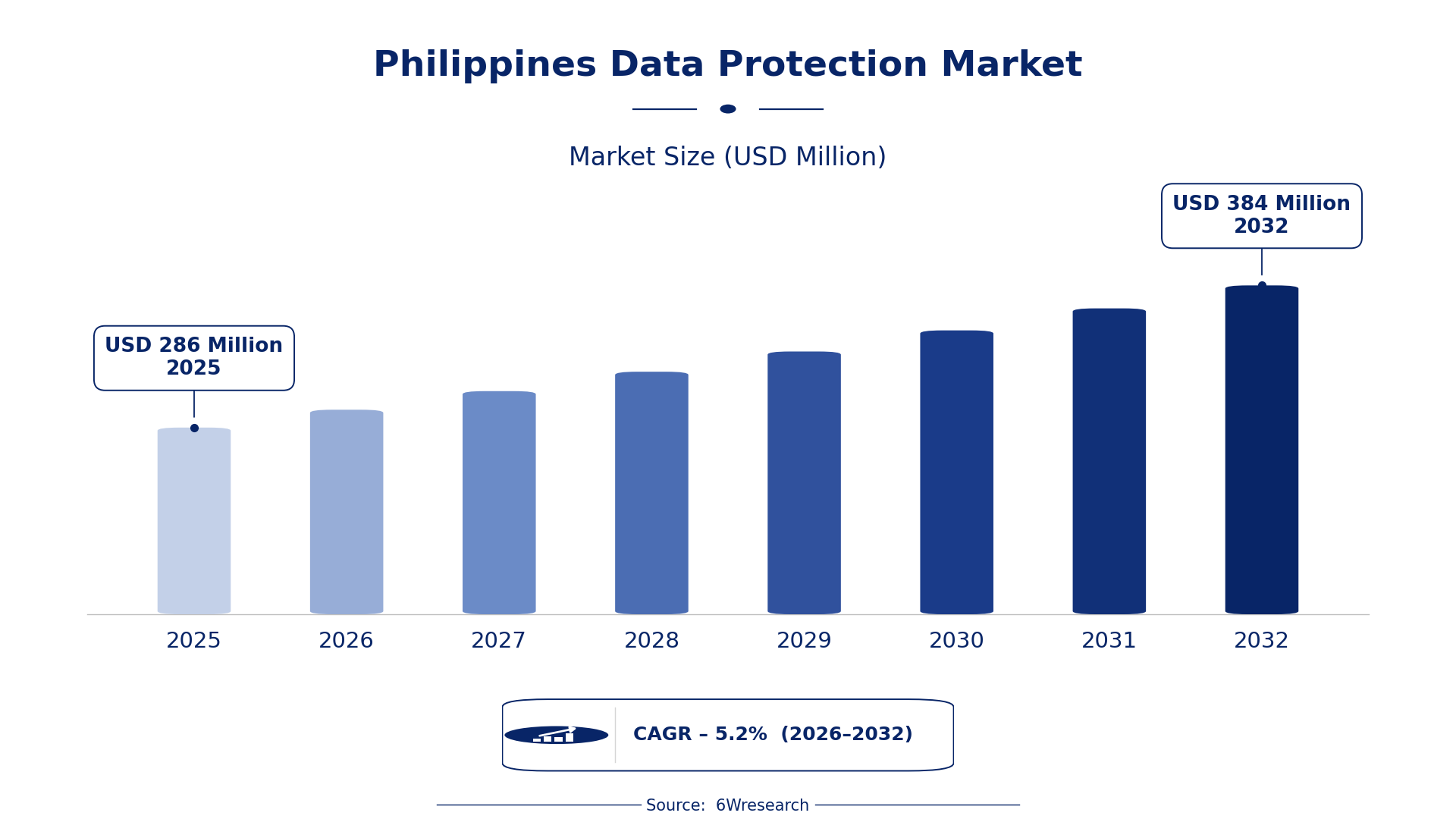
The Philippines Data Protection Market was estimated at USD 286 Million in 2025 and is projected to reach USD 384 Million by 2032, growing at a CAGR of 5.2% from 2026 to 2032.
Philippines Data Protection Market Synopsis
The Philippines Data Protection Market has gained momentum, driven by a surge in data breaches and a cultural shift towards prioritizing data privacy. The increase in regulatory scrutiny has catalyzed a proactive stance from organizations, pushing them to invest in comprehensive data protection solutions.
Looking forward, this market is set to evolve further as awareness around cyber threats grows. The need for businesses to not only comply with regulations but also safeguard consumer trust will push demand for more sophisticated data protection strategies and technologies.
Philippines Data Protection Market Year-wise Growth Rate and Key Drivers
This graph illustrates the annual growth rates of the Philippines Data Protection Market from 2021 to 2032, highlighting a steady upward trajectory and projected expansion over the forecast period.
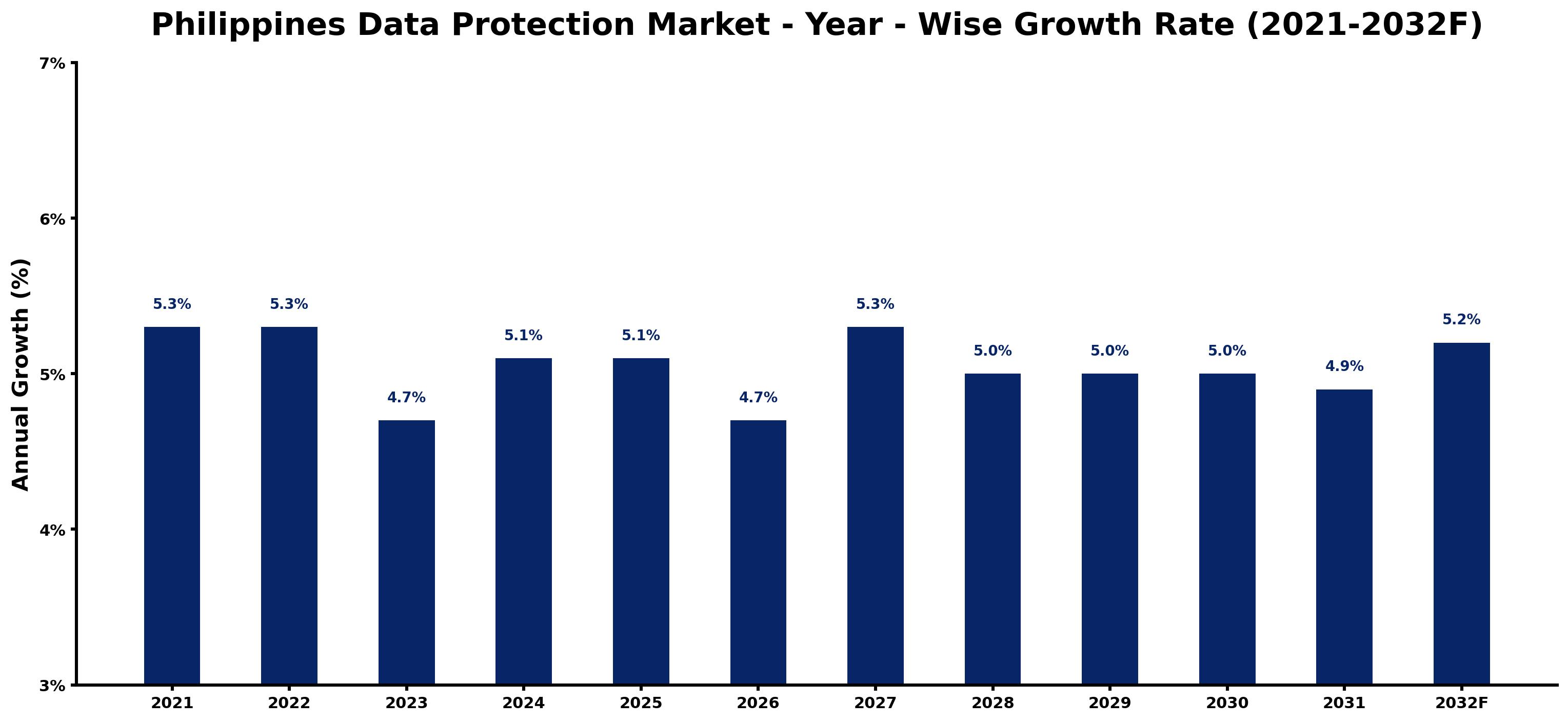
The table below presents the year‑wise growth rates along with the key drivers influencing the market
| Year | Growth Rate | Major Drivers |
| 2021 | 5.3% | Implementation of Data Privacy Act by NPC |
| 2022 | 5.3% | Rising awareness of data breach implications among businesses |
| 2023 | 4.7% | Increased demand for cybersecurity solutions post-pandemic |
| 2024 | 5.1% | Deployment of local cloud services enhancing data control |
| 2025 | 5.1% | Growth in e-commerce driving data protection needs |
| 2026 | 4.7% | Regulatory compliance pressures from global partners |
| 2027 | 5.3% | Expanding digital economy requiring enhanced data governance |
| 2028 | 5.0% | Investment in data protection training programs for firms |
| 2029 | 5.0% | Surge in mobile transactions prompting stricter data handling |
| 2030 | 5.0% | Growing number of startups necessitating robust data policies |
| 2031 | 4.9% | Heightened focus on consumer privacy rights legislation |
| 2032 | 5.2% | Emergence of localized privacy technology solutions |
Note: Market size estimations and growth projections presented in this report are based on 6Wresearch's proprietary forecasting methodology, utilizing the latest available industry data, government publications, and primary research inputs.
Philippines Data Protection Market Key Takeaways
Below are some of the specific key takeaways from the market, including:
- Stringent data privacy regulations are driving organizational investment in data protection solutions.
- The growing volume of digital data is amplifying the need for effective data management practices.
- Small and medium-sized enterprises (SMEs) are increasingly adopting data protection measures despite budget constraints.
- The shift to remote work during the pandemic has heightened awareness of data vulnerabilities.
- Partnerships among technology vendors are enhancing innovation in the market.
Evaluation of Restraints in Philippines Data Protection Market
Despite growth prospects, the Philippines Data Protection Market faces real constraints. Evolving regulations can create confusion, particularly for organizations struggling to keep up with compliance demands. Additionally, the resource allocation for SMEs remains limited, hindering their ability to implement comprehensive data protection strategies. This combination of regulatory challenges and financial limitations presents a significant barrier to achieving a uniform standard of data security across all sectors.
Philippines Data Protection Market Trends
Key trends are currently shaping the Philippines Data Protection Market. The shift towards cloud-based data storage solutions is notable as companies seek scalable options for managing their information. Advanced technologies, including artificial intelligence and machine learning, are being integrated into data protection tools, offering predictive analytics to preempt potential breaches. Additionally, an increasing emphasis on employee training for data security best practices is beginning to resonate as organizations recognize the human element in data protection.
Philippines Data Protection Market Opportunities
Opportunities abound in the Philippines Data Protection Market, especially as regulatory frameworks become more defined. Organizations that can offer tailored solutions for specific industries, such as healthcare or finance, will find lucrative niches. on top of that, as the market matures, there’s potential for the development of local cybersecurity talent, which would not only enhance services but also strengthen the overall industry ecosystem.
Government Initiatives in the Philippines Data Protection Market
Government policies are significantly shaping the Philippines Data Protection Market. Recent regulations have focused on enhancing data privacy standards to align with international benchmarks, reflecting a commitment to safeguarding consumer rights. Ongoing initiatives aimed at raising awareness about data protection demonstrate the government’s proactive approach to public policy in this area.
- A regulatory framework established in early 2023 mandates stricter compliance measures for data controllers and processors.
- Current outreach programs are underway to educate SMEs about data protection best practices, fostering a culture of compliance.
- A national data protection summit scheduled for late 2025 aims to gather industry leaders and policymakers to discuss future regulatory directions.
- Plans for a public-private partnership to enhance cybersecurity infrastructure are expected to begin implementation by mid-2026.
Future Insights of the Philippines Data Protection Market
Between 2026 and 2032, the Philippines Data Protection Market will continue its upward trajectory as compliance becomes non-negotiable. The increasing prevalence of cyber threats will necessitate ongoing investment in advanced data protection technologies. on top of that, as consumers demand greater transparency and security in how their data is managed, companies that can demonstrate robust data protection strategies will gain a competitive edge.
Philippines Data Protection Market Latest Developments
The last year has seen a flurry of activity within the Philippines Data Protection Market, as organizations respond to growing regulatory pressures and heightened cyber threats. Significant investments in new technologies and partnerships are setting the stage for a more secure data environment.
- A major technology vendor launched a new data encryption solution aimed at SMEs in early 2025, significantly enhancing data security capabilities.
- An initiative focusing on integrating AI-driven analytics into existing data protection protocols is currently underway and aims to reduce breach response times.
- A public awareness campaign highlighting data protection rights kicked off in Q1 2025, aiming to educate citizens on their data privacy rights.
- Plans for a comprehensive cybersecurity training program for local businesses are expected to roll out in late 2026, targeting skills development in data protection.
Philippines Data Protection Market - Key Attractiveness of the Report
- 10 Years of Market Numbers
- Historical Data Starting from 2022 to 2025
- Base Year: 2025
- Forecast Data until 2032
- Key Performance Indicators Impacting the Market
- Major Upcoming Developments and Projects
Key Highlights of the Report:
- Philippines Data Protection Market Outlook
- Market Size of Philippines Data Protection Market, 2025
- Forecast of Philippines Data Protection Market, 2032
- Historical Data and Forecast of Philippines Data Protection Revenues & Volume for the Period 2022-2032F
- Philippines Data Protection Market Trend Evolution
- Philippines Data Protection Market Drivers and Challenges
- Philippines Data Protection Price Trends
- Philippines Data Protection Porter's Five Forces
- Philippines Data Protection Industry Life Cycle
- Historical Data and Forecast of Philippines Data Protection Market Revenues & Volume By Component for the Period 2022-2032F
- Historical Data and Forecast of Philippines Data Protection Market Revenues & Volume By Solutions for the Period 2022-2032F
- Historical Data and Forecast of Philippines Data Protection Market Revenues & Volume By Services (Professional Services and Managed Services) for the Period 2022-2032F
- Historical Data and Forecast of Philippines Data Protection Market Revenues & Volume By Deployment Mode for the Period 2022-2032F
- Historical Data and Forecast of Philippines Data Protection Market Revenues & Volume By On-premises for the Period 2022-2032F
- Historical Data and Forecast of Philippines Data Protection Market Revenues & Volume By Cloud for the Period 2022-2032F
- Historical Data and Forecast of Philippines Data Protection Market Revenues & Volume By Industry Vertical for the Period 2022-2032F
- Historical Data and Forecast of Philippines Data Protection Market Revenues & Volume By Government and defense for the Period 2022-2032F
- Historical Data and Forecast of Philippines Data Protection Market Revenues & Volume By Banking, Financial Services, and Insurance (BFSI) for the Period 2022-2032F
- Historical Data and Forecast of Philippines Data Protection Market Revenues & Volume By Healthcare for the Period 2022-2032F
- Historical Data and Forecast of Philippines Data Protection Market Revenues & Volume By IT and telecom for the Period 2022-2032F
- Historical Data and Forecast of Philippines Data Protection Market Revenues & Volume By Consumer goods and retail for the Period 2022-2032F
- Historical Data and Forecast of Philippines Data Protection Market Revenues & Volume By Education for the Period 2022-2032F
- Historical Data and Forecast of Philippines Data Protection Market Revenues & Volume By Media and entertainment for the Period 2022-2032F
- Historical Data and Forecast of Philippines Data Protection Market Revenues & Volume By Organization Size Large Enterprises for the Period 2022-2032F
- Historical Data and Forecast of Philippines Data Protection Market Revenues & Volume By SMEs for the Period 2022-2032F
- Historical Data and Forecast of Philippines Data Protection Market Revenues & Volume By Large Enterprises for the Period 2022-2032F
- Philippines Data Protection Import Export Trade Statistics
- Market Opportunity Assessment By Component
- Market Opportunity Assessment By Deployment Mode
- Market Opportunity Assessment By Industry Vertical
- Market Opportunity Assessment By Organization Size Large Enterprises
- Philippines Data Protection Top Companies Market Share
- Philippines Data Protection Competitive Benchmarking By Technical and Operational Parameters
- Philippines Data Protection Company Profiles
- Philippines Data Protection Key Strategic Recommendations






































